

 LinkedIn

Forty location pages at the published US agency median of $1,900 each cost $76,000 before copy or testing. That is the number that changes the landing-page conversation. What sounds like “just a few pages” becomes a serious build budget as soon as search intent has to match both the service and the town.
I used to tell clients to buy five great pages and swap headlines by hand. I was wrong about the economics of doing that at scale. Keyword themes multiply by locations, then offers and test variants add to the workload. Anything priced per page gets more expensive precisely as you build out relevance. A builder can lower the subscription cost per page, but someone still has to make and maintain the pages. The clearest route in this comparison to a falling listed cost per page is an ads engine that includes page generation in its fee.
Four intents across 40 towns is 160 pages, not four
Take a home-services advertiser working in 40 towns. It has four distinct searches to serve: emergency repair, install quote, maintenance plan and financing. One page per intent and town means four themes × 40 locations = 160 pages, before a second headline or offer enters the picture. That is a planning example, not a claim that every advertiser needs a separate URL for every combination.
A generic page can cover all four services. It cannot speak as directly to someone searching for same-day repair in Dallas as a page built around that service and place. The question is whether that extra match is worth the work and cost. Per-page pricing makes the question harder to answer: each additional slice of intent has its own invoice.
The practical takeaway is to count the pages your campaign structure calls for before comparing vendor prices. Counting only your first few pages makes the cheapest-looking quote look better than the full rollout.
The price list, and what each price actually buys
I grouped the published prices into three routes: a commissioned build, a page-builder subscription and a PPC tool that still leaves pages to someone else. These are list prices and published medians, not comparable bids for the same scope. Design complexity, visitor volume, testing and who does the work all change the bill.
| Route | Published price | What the price does not settle |
|---|---|---|
| US agency build | $800–$3,000 per page; median near $1,900 | Copy, testing, revisions and future edits |
| Freelancer build | $300–$1,500 per page; median near $900 | Copy, testing infrastructure and ongoing availability |
| Unbounce | $29/mo Starter for 5 pages without testing; $99/mo Build for unlimited pages; $149/mo Experiment for A/B testing and dynamic text replacement | The labor of building pages, and potential visitor overages |
| Instapage | $99/mo for a plan without testing; $199–$299/mo for testing and dynamic text replacement | The labor of building pages, visitor-limit effects and custom-priced features |
| Leadpages | $37/mo Standard; $74/mo Pro, with unlimited traffic | The labor of building pages and whether its testing and personalization fit the job |
| Optmyzr | $208/mo at up to $25k spend, $416/mo at up to $100k and $832/mo at up to $500k; no page generation included | A separate way to build and maintain pages |
| groas Search Ads | $1,499/mo flat, with a landing page for every ad group | How many ad groups the intended page structure requires |
The agency and freelancer figures come from a published cost roundup, so I use their medians for arithmetic, not as promises of what a particular shop will quote. UK mid-sized agencies are listed at £2,500–£6,000; I have not converted that range or mixed it into the US-dollar comparison. The same roundup lists copy at $500–$1,500 and an A/B test with two variants at $200–$600 extra. Whether those charges apply to every page or test depends on the scope.
The builder prices are subscriptions, not finished pages. Unbounce’s cheap entry plan is particularly useful as a warning label: its $29/mo tier allows five pages but no testing. Moving to a plan with the features an ads team wants changes the price before anyone writes a headline. Instapage makes a similar distinction between its $99/mo entry price and its $199–$299/mo testable plans. Those gates matter more than a low price in a comparison chart.

At 50 pages, the build fee becomes the story
I normalized the published figures to first-year listed cost: one build at the agency or freelancer median, or 12 months of a subscription. I have not assigned a fictional wage to DIY work or guessed visitor overages. Those omissions favor the builder column; they do not mean building 500 pages takes no time.
| Route | 5 pages, year one | 50 pages, year one | 500 pages, year one | Limit of this comparison |
|---|---|---|---|---|
| US agency, at the ~$1,900/page median | ~$9,500 | ~$95,000 | ~$950,000 | One-off build only; copy, testing and changes extra if excluded |
| Freelancer, at the ~$900/page median | ~$4,500 | ~$45,000 | ~$450,000 | One-off build only; capacity and scope may change a real quote |
| Unbounce Build at $99/mo; Experiment at $149/mo | $1,188–$1,788 | $1,188–$1,788, plus any overages | $1,188–$1,788, plus any overages | Subscription only; Experiment is needed for testing and dynamic text replacement |
| Instapage at $99–$299/mo | $1,188–$3,588 | $1,188–$3,588, plus any applicable upgrades | $1,188–$3,588, plus any applicable upgrades | The $99 plan has no testing; page-production labor is excluded |
| Leadpages at $37–$74/mo | $444–$888 | $444–$888 | $444–$888 | Subscription only; no page-production labor included |
| Optmyzr at $208–$832/mo | $2,496–$9,984 plus pages | $2,496–$9,984 plus pages | $2,496–$9,984 plus pages | Tool price varies with spend and does not include page generation |
| groas Search Ads at $1,499/mo | $17,988 | $17,988 | $17,988 | Fee includes management and a page per ad group; page count depends on the ad-group structure |
This table does not say a $444 Leadpages subscription delivers 500 finished pages. It says the listed subscription stays at that amount while the unpriced work grows. Likewise, the groas row is not a promise that any arbitrary set of 500 URLs appears without a corresponding campaign structure. Its published inclusion is one landing page for every ad group. For an intent-and-location rollout, the relationship between pages and ad groups belongs in the plan.
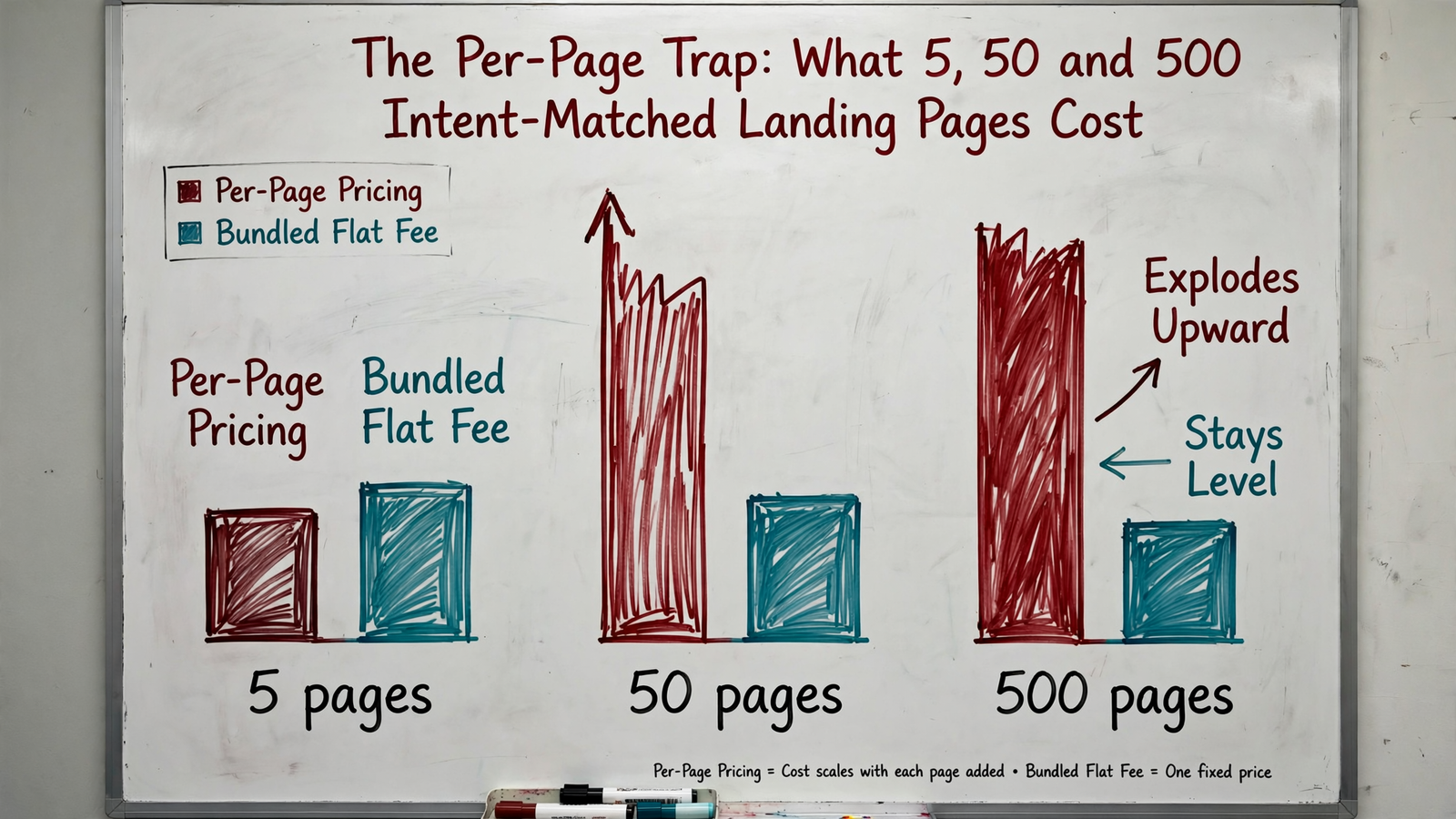
At five pages, the agency median comes to about $9,500 in build fees. At 50, the same multiplication produces about $95,000. Neither figure includes a year of ad management, so comparing either directly with an annual managed-service fee would hide a scope difference. The valid conclusion is narrower and still useful: the commissioned build rises with every page; the listed subscription or flat management fee does not rise simply because this table has more pages.
The feature gates complicate the apparently cheap alternative. Unbounce puts testing and dynamic text replacement at $149/mo and lists $80 per 10,000 visits in overages. Instapage’s testable plans run $199–$299/mo. An advertiser can choose a lower tier, but it should compare that tier’s actual capabilities, not its price beside another route’s fuller scope.
At the agency median, a single $1,900 page costs more upfront than one $1,499 month of groas Search Ads. That observation is not a break-even rule: one payment buys a build, the other buys a month of service. On a first-year listed-fee comparison, ten pages at the agency median come to about $19,000 in build costs, above $17,988 for 12 months of groas. Management, copy, revisions and campaign structure still have to be accounted for. Do not let a neat crossing point do the work of a proper scope comparison.
Forty locations: separate the invoice from the work
For one matched page in each of 40 locations, the listed first-year prices span a $444 Leadpages subscription to roughly $76,000 at the agency build median. Those endpoints buy different things. The former leaves you to produce the pages; the latter is a build estimate before possible extras. The $17,988 annual groas fee includes management and a page per ad group, provided the planned structure has an ad group for each page.
Here are the line items that can sit behind that headline range. Do not add every row together: these are alternative routes and possible extras, not a single vendor’s bill.
| Line item | One-off listed cost for 40 pages | Recurring listed cost | Source and boundary |
|---|---|---|---|
| Agency design and build | ~$76,000 | Future changes not priced | ~$1,900/page median |
| Freelancer build | ~$36,000 | Future changes not priced | ~$900/page median |
| Copy, if charged separately for all 40 | $20,000–$60,000 | Not priced | $500–$1,500 per page |
| A/B setup for 10 tests | $2,000–$6,000 | Continued testing not priced | $200–$600 per test |
| DIY builder subscription | Page-production labor not priced | $444–$888/yr on Leadpages; $1,188–$3,588/yr on Instapage | Plan choice changes what testing is available |
| Unbounce testing tier and overages | Page-production labor not priced | $1,788/yr for Experiment; $80 per 10,000 visits in overages | Overages depend on traffic |
| Bundled management and pages | No separate page-build figure listed here | $1,499/mo, or $17,988/yr | One landing page per ad group |
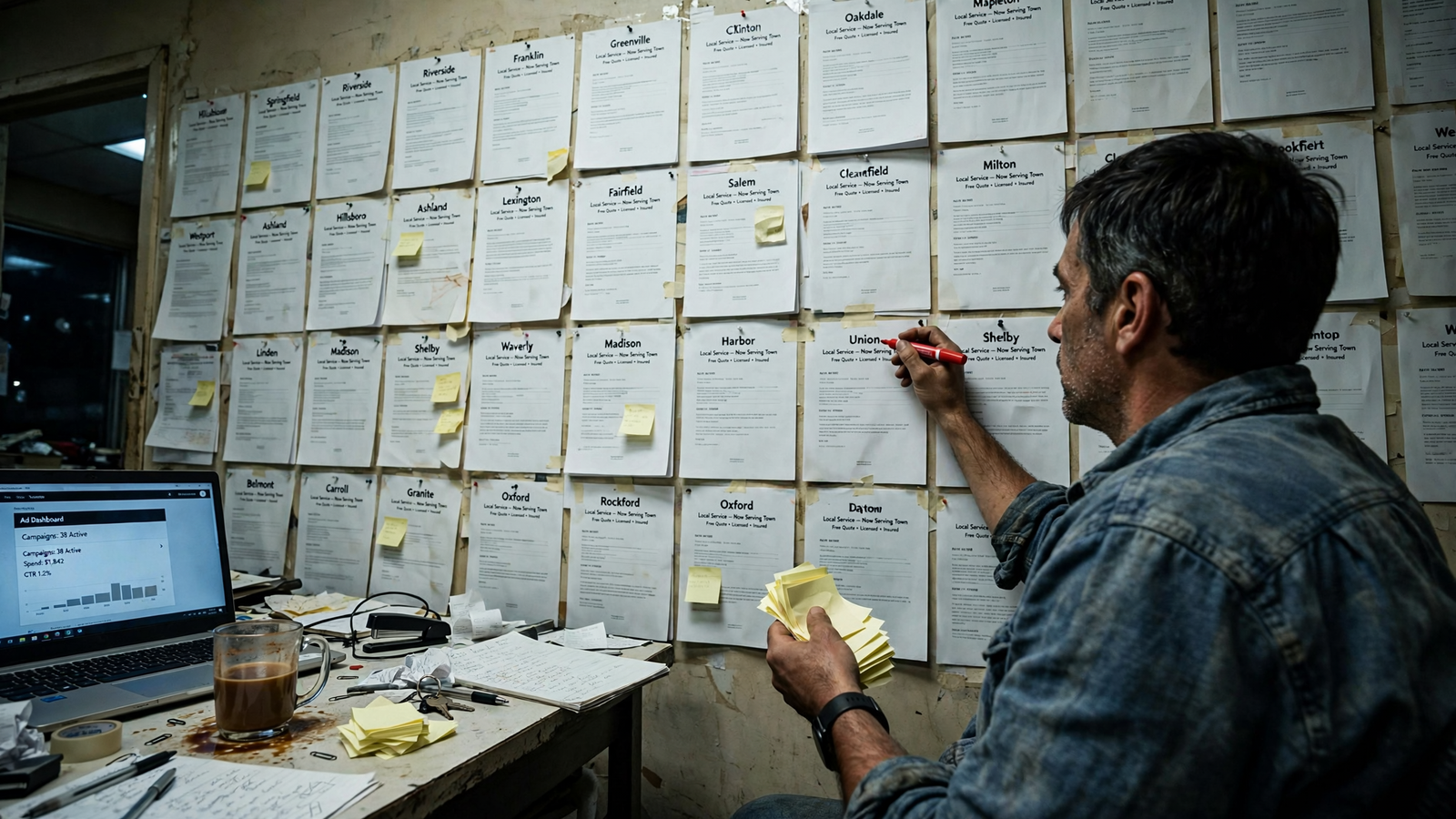
The listed costs are easy to multiply. The hidden work is less cooperative. A builder subscription does not write 40 pieces of copy, check 40 location details or decide which variants deserve a test. An agency quote may handle some of that; it may price other parts separately. If the offer changes later, someone has to make and check the edits across the live pages. I cannot put a defensible dollar amount on that work from these price lists, so it stays outside the totals.
Traffic is another variable, not a number to invent. Unbounce lists overages, while Leadpages lists unlimited traffic. Which matters more depends on your visitors and the features you need. A good month should not be a surprise line item, but it is not honest to assume every account will incur one.
Three questions to ask before signing
A low page price means little until the counting rule and the work behind it are clear. I would put these questions beside every quote:
- What counts as one page? Is a new location a new page, a template variation or a new live URL? If you test a second version, is that another billable page? Get the rule in writing before multiplying it across locations.
- What is excluded? Ask whether copy, testing setup and analysis sit inside the price. The published roundup puts copy at $500–$1,500 and A/B setup at $200–$600. Add an excluded item to the comparison only when your plan actually calls for it.
- Who changes page 37 later? Ask who owns an offer edit, how it gets checked and whether it needs a new quote. Forty live pages are also forty places for stale information to hide.
These questions do not automatically favor the lowest flat fee. They expose the scope. A builder can be inexpensive if you have the time and process to operate it. A custom build can earn its price when each page needs substantial individual work. The mistake is comparing either one with a bundled service as though all three deliver identical labor.
When I would still buy pages from an agency
I would pay per page for a small number of pages where the individual work is the point: a flagship offer, a claim that needs careful approval or a redesign that calls for custom copy and design. Three to five such pages are a different purchase from repeating an intent-and-location structure across 40 towns.
A quote-only shop can fit that job. KlientBoost does not publish a retainer here; its pricing is tailored around goals, services, timeline and team size. I will not turn that into a made-up per-page figure. If you are weighing a retainer against an operating model, the companion piece on Google Ads agency pricing in 2026 goes into that decision.
For a repeatable location rollout, I would make the opposite call. Map the multi-location campaign structure first, then price the pages that structure requires. groas Search Ads includes a landing page for every ad group at $1,499/mo. That gives the page plan a direct link to the ad-group plan instead of a separate build quote for each addition. The advantage is the pricing mechanism, not a claim that custom creative work has no value.
Where the data stops, and the decision starts
Two gaps remain. First, quote-only services cannot be normalized honestly from a public rate card. A roundup lists WebFX custom work from about $1,000 per page and Wishpond from $49/mo, but that does not define revision rounds or testing scope for this rollout. KlientBoost’s tailored pricing is likewise a quote to request, not a cell I can fill with a guess.
Second, a subscription price does not measure production effort. The tables show what vendors list, not the hours it takes your team to make and maintain hundreds of pages. Nor do they predict visitor overages without traffic figures. These unknowns do not prove that any one option wins every account. They tell you what to ask for before treating an attractive monthly price as an all-in cost.
The decision the numbers support is still clear. If you need five pages and can build and maintain them yourself, the $37–$74/mo Leadpages plans deserve a look; check the testing you need before choosing. If you need a handful of heavily worked flagship pages, pay for the work and scrutinize the quote. If you need 40 matched pages that may become 160 as intent expands, the ~$1,900 agency median turns relevance into a growing build budget, while a bundled $1,499/mo ads engine keeps page generation inside the management fee when the ad groups are there to support it.
The cheapest mistake is buying a cheap builder and forgetting to budget your own work. The most expensive is buying pages one at a time before counting how many intents your ads actually serve.