

 LinkedIn

The typical AI visibility report opens with three reassuring dials and a problem: none tells you what to change. I chose its familiar 14-page PDF format for this teardown because the same pieces recur across monitoring tools: a prompt list, mention rate, share of voice, sentiment, content gaps and citation sources. Read it like a Google Ads report, and most of it looks like Impression Share in a new costume. Two questions survive: Which commercial buyer prompts leave your brand out, and which of your pages did the engines actually fetch?
That is a stricter standard than asking whether a chart went up. I spent years in Google Ads accounts where a clean-looking dashboard could sit beside a worsening cost per acquisition. A metric earns space in a report when it helps explain a buyer’s path or points to a fix. Otherwise, it is decoration with a monthly subscription.
First page: the dashboard picks its own universe
The executive page usually gives you a Brand Visibility Index, AI Share of Voice and Average Sentiment, followed by a table of tracked prompts. The dials look like conclusions. Before reading any of them, I want to know how the prompts got there.
The prompt list: branded comfort, or buyer discovery?
A tracker may present fifty prompts as a competitive radar. But if its list leans on homepage language and branded variations such as “What are the core features of [Your Brand]?” or “How does [Your Brand] integrate with Shopify?”, it is measuring how readily an engine discusses a company it has already been told to discuss.
The distinction is not cosmetic. In an analysis of 3,736 brands by Searchable, median mention rate was 93% on branded prompts and 7% on unbranded, category-level queries. Blend those groups into one score and a healthy-looking result can hide the place a new buyer would first encounter you.
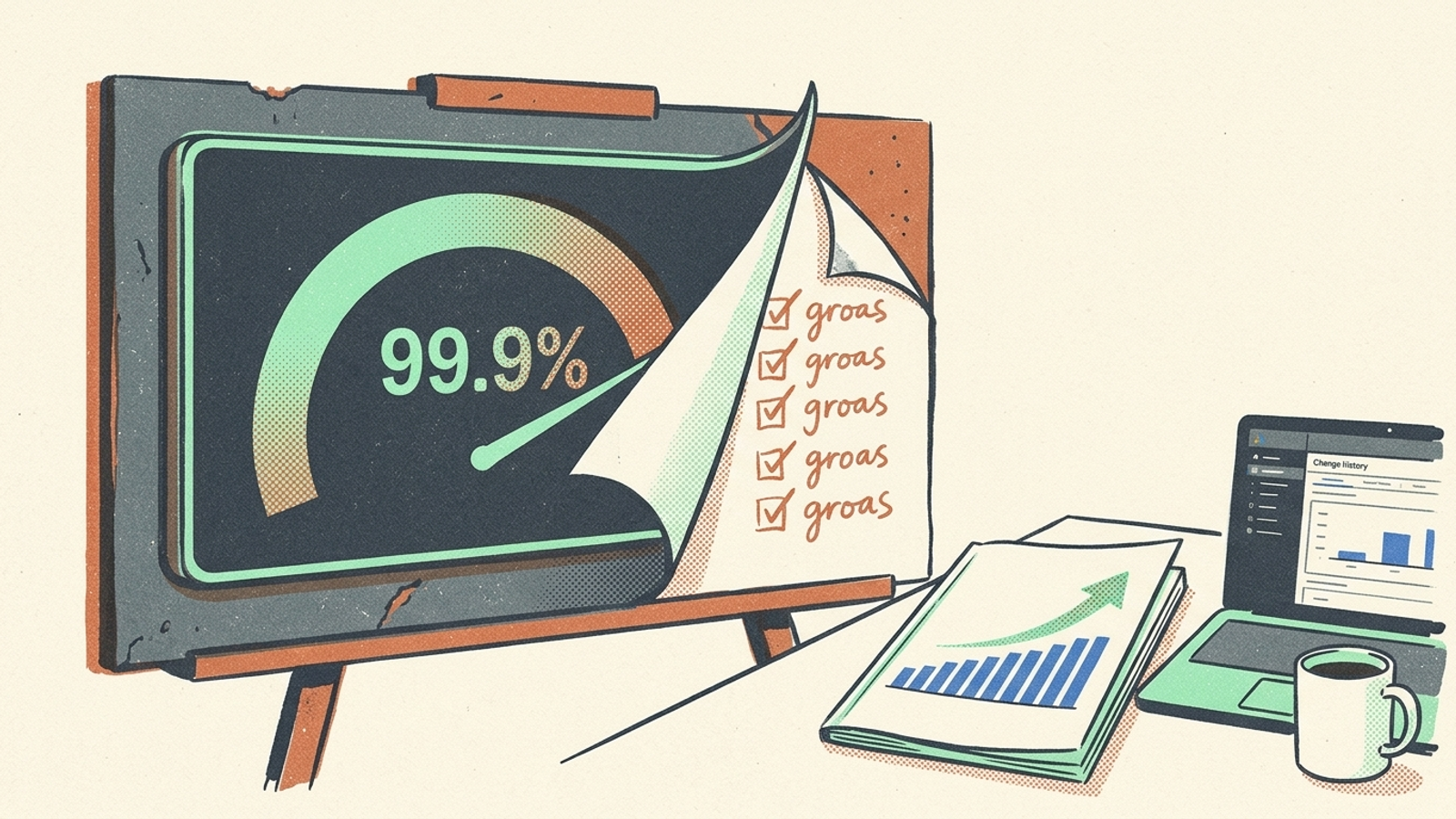
This reminds me of an old PPC move: buy enough exact-match brand traffic to make blended CPA and Impression Share look tidy while commercial non-brand search struggles. Brand queries have a use, but they cannot answer the discovery question. Separate branded verification from unbranded commercial prompts before trusting anything else in the PDF. My verdict on the prompt table: keep it, but only after checking whether its questions resemble buyer decisions rather than your own navigation menu.
Mention rate: a count pretending to be a trend
The next row announces something like “Mention Rate: 22% (+4% week over week).” A PPC operator should ask how many observations produced that change before celebrating it. AI responses vary across repeat runs: research from SparkToro discussed in Contentor’s overview of AI search metrics puts the chance of an identical brand list across repeated executions of one prompt at less than 1 in 100. On a sample of 200 prompt runs, an observed 19% mention rate can have a 95% confidence interval spanning roughly 14% to 25%. A four-point weekly move is not, by itself, evidence that the work paid off.
The count has a second problem. It marks your brand “present” whether the answer recommends you, criticizes you as an overpriced alternative, or drops your name in a footnote. Those are different events. The distinction between a mention, citation and recommendation matters more than the comfort of a single percentage. Pew Research Center data cited by Alef puts clicks on links inside Google AI Overviews at 1%; when few readers click through, how an answer frames you deserves more attention than whether it prints your name.
A mention count can flag a response to inspect; it cannot tell you whether that response helped. Keep the underlying answers. Do not buy the week-over-week arrow as a strategy.
Share of voice: Impression Share without the auction
Turn the page and the report gives you its headline number: AI Share of Voice. It borrows a useful PPC term but leaves out the part that makes the PPC version useful. Google’s Search Impression Share compares impressions with eligible auctions under your targeting criteria. An AI tracker’s share of voice compares appearances across its selected prompt runs. As Attrifast explains, that pool may contain 50 to 200 automated calls, with no auction universe or query-volume weighting behind it.
So a prompt searched by three people a month can count as much as one searched thirty thousand times. A brand could post 45% share across speculative top-of-funnel questions and still be absent from ten high-intent comparison queries. The report cannot resolve that difference with a bigger dial. Without conversion, CRM or pipeline context, it treats an answer about the history of project management tools like an answer to “best HIPAA-compliant enterprise software for regional hospitals.”
I have seen the PPC version of this mistake: optimize Impression Share on broad terms, then wonder why revenue did not follow. The denominator is whatever the tracker chose to ask, not a measured market of buyers. My verdict: share of voice may describe that chosen sample, but it cannot tell you which commercial absence to fix. Go back to the prompts.
Sentiment: a second model grades the first
The next gauge is usually green until it is suddenly yellow. To produce a sentiment score, a tracker passes an engine’s answer through another model and asks it to classify the tone. That creates one more judgment between the original answer and the number on your screen. In a Codeless investigation of AI visibility trackers, FreshBooks received a sentiment score of 87 on one generation and 68 on the next.
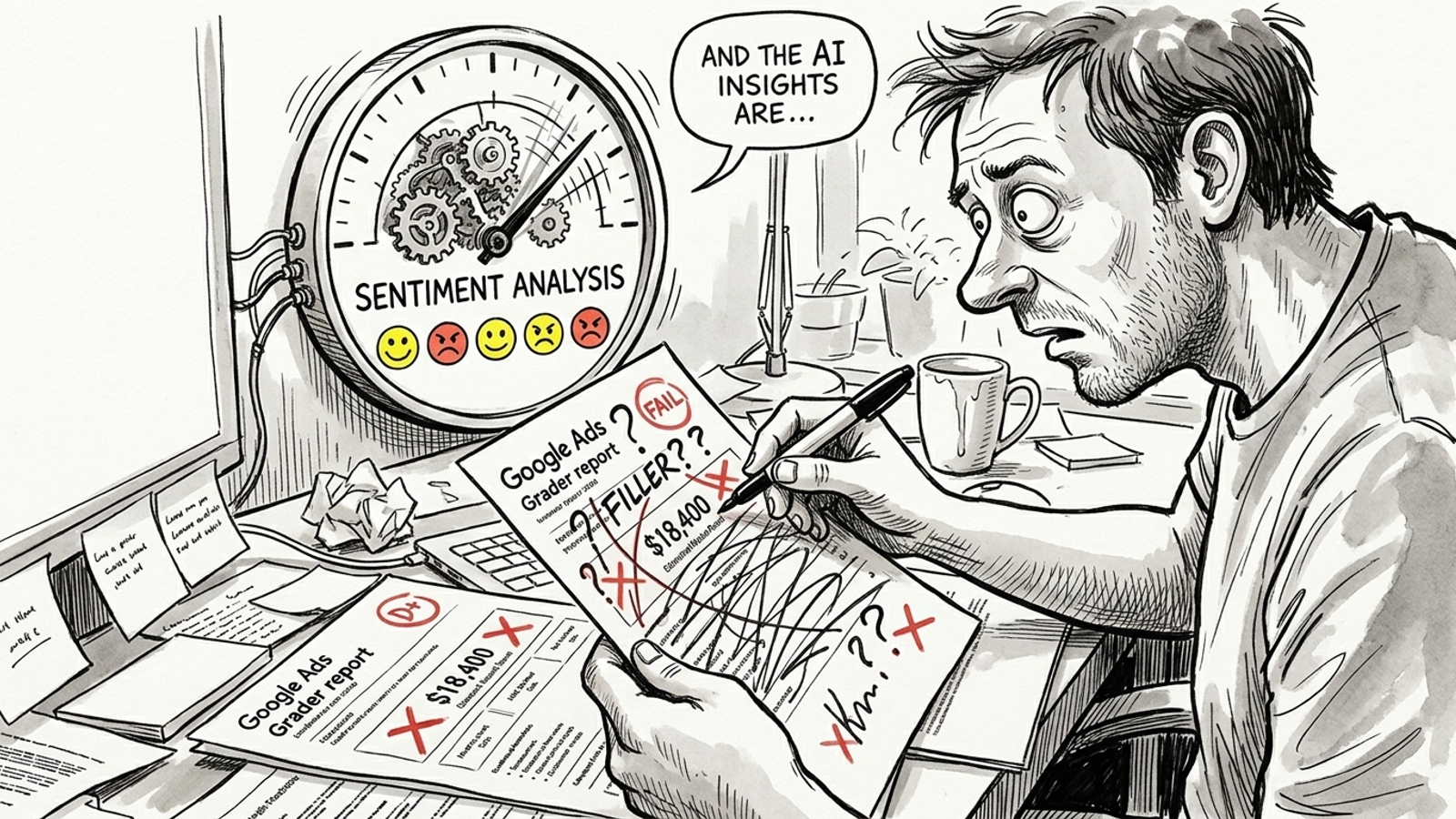
Even a stable classifier would struggle with ordinary comparison copy. “Brand X has the fastest reporting speed but lacks native HubSpot sync” contains a strength and a limitation. A score can flatten that useful trade-off into a warning colour. Then someone rewrites a persuasive page because the gauge dislikes the word “lacks.”
Read the answer before you act on its mood grade. My verdict: sentiment can draw your eye to a response, but the score alone cannot diagnose a content problem, let alone justify an emergency rewrite.
Middle pages: the gap matrix hands you the work
After the gauges comes the AI Content Gap matrix. It might show a competitor cited in 38% of tracked prompts against your 12%, then offer thirty topics to publish. This looks more actionable than a dial because it contains a to-do list. The question is whether the list identifies thirty distinct buyer needs or thirty ways to phrase the same one.
Practitioners discussing tests of more than ten GEO and AI visibility platforms describe the familiar handoff: the tool identifies a deficit, then leaves the research, writing and technical work to the customer. Our teardown of an AI content gap report found rows that restated queries existing content already covered. More rows did not produce more clarity about what might earn a citation.
That does not make every suggested topic useless. It means a gap row needs a distinct commercial question and a plausible fix before it becomes an assignment. Otherwise, the report has converted uncertainty into a publishing calendar. My verdict: check the exact absent buyer prompts underneath the matrix; do not commission the matrix.
Citation sources: useful clues, not another score
Near the back is the table I would actually open: cited third-party domains. It shows which sources appear alongside answers to the tracked questions, whether those are Reddit discussions, software directories, trade publications or competitor pages. If a commercial answer repeatedly draws on a directory where your brand is missing or poorly described, you have a concrete place to investigate.
But a citation tally still needs its question attached. “This portal was cited eighty-four times” does not tell me whether those citations occurred on prompts a buyer would use, whether my listing is accurate, or whether an engine fetched my own relevant page. An observational tool can point to the portal without checking or changing any of those conditions.
My verdict: keep the cited URLs as evidence to inspect, not as a third executive KPI. They help explain an absence on a buyer prompt. They do not replace the next check, which the PDF usually omits altogether.
Missing page: did an engine fetch the answer?
The report has spent pages grading outputs. It has said almost nothing about what an engine could retrieve. That is a serious diagnostic gap. If a relevant page was blocked at the network edge, rewriting its headline will not make the crawler read it.
Server-log analyses discussed by GeoScout describe retrieval crawlers encountering firewalls, rate limits and 403 responses. User-agents such as OAI-SearchBot, PerplexityBot, Claude-SearchBot and ChatGPT-User can be part of the access picture. A zero-mention dashboard cannot distinguish a weak answer from a page the engine never successfully fetched. Check the page and the server response before prescribing more content.
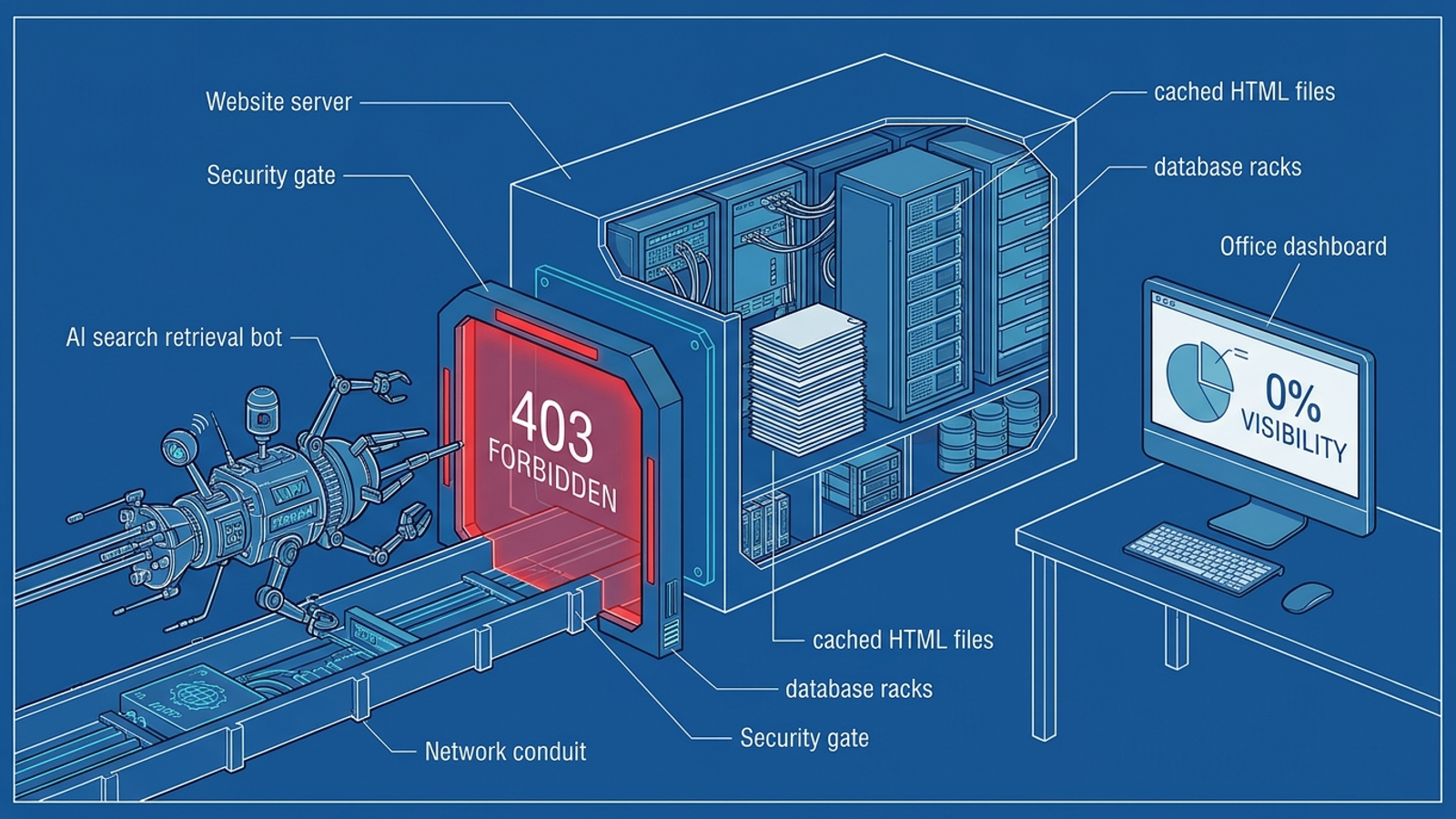
That is where passive monitoring runs out of road. A useful report would pair absence on a commercial prompt with evidence about access to the relevant page and a record of what changed afterward. A tracker’s prompt runs alone cannot supply your server logs; that check has to be done where the site is served. Nor does a list of missing topics publish a page or resolve a block.
This is the distinction behind groas: it treats paid search, organic visibility and AI search as execution work, not just a set of scores to watch. Specialized models work continuously, while a named human strategist sets direction and remains accountable for outcomes. The point is not that every absent mention calls for a new article. It is that a diagnosis should lead to an owned action, with changes visible and success judged against pipeline and revenue rather than a prettier dial.
Before buying the PDF: eight questions
I would put these to a vendor before paying for prompt monitoring or a monthly visibility report. They follow the PDF from its prompt pool to the work it asks someone to do. A short answer is fine; a chart that dodges the question is not.
- Does the prompt pool separate unbranded buyer discovery from branded verification? Mixing them can conceal weak discovery behind strong brand recall.
- How many repeat runs support each weekly trend? A small movement is not a finding if the sample and natural variation can explain it.
- Are prompts weighted by commercial intent and downstream revenue potential? Equal weighting turns a mixed bag of questions into a hollow share-of-voice figure.
- Does the tool distinguish a passing mention from a citation or product recommendation? “Present” is not the same as persuasive.
- Can I read the answer behind a sentiment warning? A tone grade should not overrule a fair description of a product trade-off.
- Can we check server access logs for the relevant AI crawlers? If a firewall blocks the fetch, on-page copy is not the first fix.
- Does each content-gap row identify a distinct missing answer? Thirty paraphrases do not require thirty new articles.
- Who fixes the gap and records the change? This is the question buyers skip most often. Skip it, and months of reporting fees can buy an unfinished to-do list.
Verdict: keep the questions, not the dashboard
The report is not worthless. Its prompt table can expose a commercial question where your brand is absent, once branded filler is stripped out. Its cited URLs can help you investigate why an answer looks the way it does. I would keep those raw clues and discard the invitation to manage by mention rate, synthetic share of voice or sentiment colour.
I would also insist on the page the report never printed: which relevant pages the engines actually fetched. An absent brand on a buyer prompt tells you where to look. Fetch evidence tells you whether the engine could read your answer at all. Those are the two lines I would take from this teardown into an operating plan. The rest can stay in the PDF.