

 LinkedIn

You have 30 days, one internal owner running the exit, and Meta spend that cannot stop. Most businesses stay with a percentage-of-spend agency longer than they should because they think switching managers wipes the account’s learning. It does not.
The pixel, Conversions API history, audiences, and ad-level social proof sit in assets your business should own. Keep the winning ads running, and the goal is no more than one learning reset on anything you change, not a fresh start for the account. I used to tell clients to rebuild for a clean slate. I was wrong. A rebuild throws away the useful part of the old arrangement: the data and ads that already work.
This is a constrained exit, not a campaign makeover. One person runs the handover. Spend stays on. New tests wait. The reward is a flat-fee manager who inherits an operating account instead of charging you to reconstruct one. Full-service Meta management can run 10–20% of spend, with $1,000–$5,000 minimums. At $20k a month, a 15% fee is $3,000 on top of the ad bill. That is a good reason to inspect the exit before you approve another month of periodic check-ins.
1. Before day 1: establish what you own
Cost: Two hours and one uncomfortable read of your contract. Buys: The right to leave with a working account, rather than a folder of screenshots.
Start in Business Settings, not the agency’s latest report. An ad account created inside an agency portfolio stays there and cannot be moved. A pixel or dataset cannot be transferred between portfolios; it can only be shared. If the agency owns those assets, continued access depends on its cooperation. Check the owner of the ad account, dataset, Page, and audiences before giving notice.
Confirm that your business portfolio holds full control and that you have admin access to the ad account, pixel, Page, and catalog. One internal owner can run this project; that does not mean one person should be the only person with control. Put a second in-house person on the portfolio as a backup. If the agency owns an asset you need and will not share it, stop the 30-day clock. A confident resignation email will not transfer a pixel.
Now read the signed agreement. Notice periods can turn a 30-day operational exit into a longer billing obligation; the termination clause, not the proposal deck, sets your dates. Mark three of them:
- The last day you can give notice and still exit on your intended date.
- The last day the old agency is paid to answer handover questions.
- The day it stops charging its management fee.
The ownership checks, exports, and manager overlap must happen while the old agency still has a reason to cooperate. What gets cut: A broad performance audit. You are not deciding whether every old decision was good. You are deciding whether the next manager can inherit the assets and keep spending.
2. Week 1: secure access before you give notice
Cost: One project owner and about three hours in Business Settings. Buys: A handover that does not depend on someone promising to send a file after their access ends.
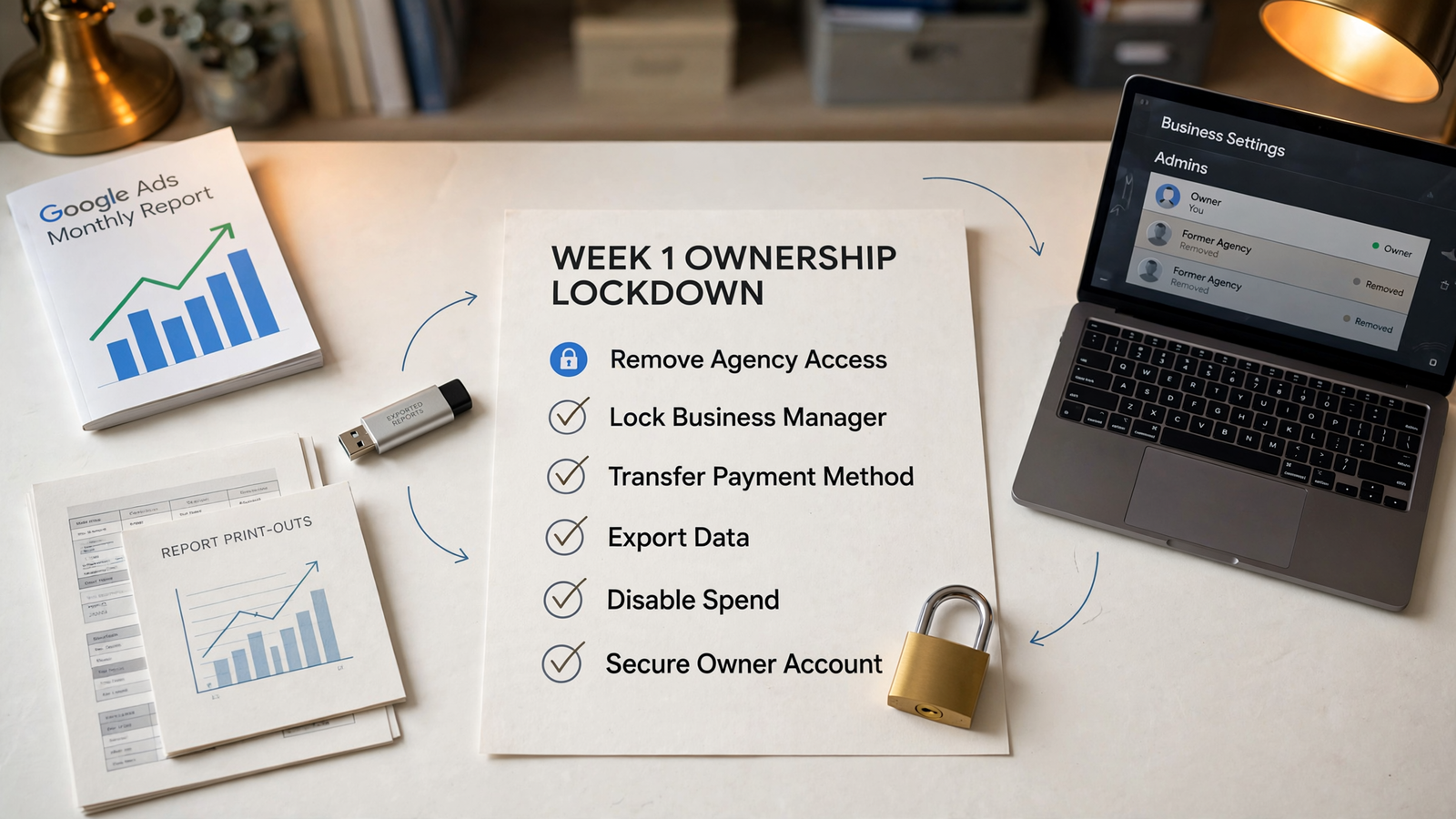
While relations are friendly, confirm that two in-house people have full control of your business portfolio and that your business has admin access to everything it owns. Check that the payment card on the ad account is yours. Then tell the agency, in writing, that you are consolidating ownership as routine account hygiene. Do not begin by removing its access and asking for help afterward. The sequence is new manager in first, old partner out later.
Export as though access might disappear tomorrow. Ads Manager reporting reaches back 37 months from the export date, and a custom export can include deleted campaigns. Pull campaign, ad set, and ad breakdowns month by month for the last 13 months. Save the creative files and test notes. Thirteen months gives the incoming manager this year, last Q4, and a basis for comparing attribution periods without guessing what ran.
Then make a short evidence packet:
- Screenshot attribution settings, domain verification, and active prospecting and retargeting audiences with their sizes.
- Save creative files, test notes, and the reporting exports somewhere the incoming manager can reach.
- Download every instant-form lead. Those leads vanish after 90 days, so test that a Page admin outside the agency login can download them.
- Move the CRM connection off the agency’s integration before its access goes.
This is the backup brain if sharing breaks. What gets cut: Campaign changes. Week 1 is for securing the account, not proving the new manager has ideas.
3. Week 2: overlap managers, not campaign strategies
Cost: Ten days of paid overlap with both managers able to see the account. Buys: A handover based on what ran and why, rather than somebody’s recollection of the good ads.
Give the incoming manager three things, in this order:
- Winning ads by post ID. Include ad name, post ID, spend, cost per qualified lead or ROAS, and one line on why each ad won. Duplicating an ad normally creates a new post without its likes and comments. Use Existing Post with the post ID points a new ad set at the underlying post, preserving that social proof where reuse makes sense.
- Exclusion logic. Say what you suppress, why, and what breaks if an exclusion disappears. A list of audience names without the reason behind them is not a handover.
- Offer history with dates. Note what ran, when, and at what discount. Otherwise, a promotional spike can look like a targeting breakthrough.
That packet is the working plan for a 30-day switch without breaking reporting. The new manager can see the live account, but the old one still runs it until handover day. One operator, one set of live decisions.

Your first instruction is: do not rebuild everything. Changes to targeting, creative, or the optimization event, adding an ad, or leaving an ad set paused for seven or more days can send it back into learning. An ad set usually exits learning after about 50 results in the week following its last significant edit. So leave the one or two producers on, identify the clear losers, and plan any necessary changes one at a time.
Post ID reuse is not sacred. Skip it when the comments have turned toxic, the audience has changed, or the message no longer fits. What gets cut: New creative tests, angles, and landing pages. You are buying continuity this week. Brilliance can wait until the account has changed hands.
4. Week 3: change the manager, not the account
Cost: Thirty minutes and one firm email on handover day. Buys: A flat-fee manager with working access and no pause in spend.
Order matters. Add the new manager as a partner, confirm they can reach the assets they need, then remove the old partner and any individual users the agency added. Confirm the payment card is still yours. Remove the old partner only after the new one is in place. I prefer midday on a Tuesday to Friday afternoon: if sharing breaks, there is still time to fix it while people are working.
Campaigns stay on throughout. Do not pause to switch. Do not duplicate winners to start clean. The ad account does not know your invoice changed. That afternoon, run the 22-point handover lock: pixel sharing active, catalog shared, Page roles correct, lead forms downloadable, domain verified.
For the first seven days, allow only one change: a batch of clear-loser pauses. Use the rule in the draft account plan: ad sets that spent twice your target CPA with zero qualified results in the last 14 days are candidates to pause. Leave the producers running. Do not change structure, creative, audiences, and offers in the same week just to make the new management look busy.
One pause batch is not a full-account reset. The point is to confine disruption to what you touch, rather than put every winner back through learning. This is where owners tend to approve a rebuild because it looks like action. Motion was what the percentage fee sold you. Stillness, for one week, protects what is working. What gets cut: Every nonessential change. If tracking works and the winners are running, leave them alone.
5. Week 4: score the switch on the evidence you have
Cost: One spreadsheet and the discipline not to declare victory or disaster on day eight. Buys: An honest day-30 checkpoint, followed by a fairer performance read once enough post-handover days exist.
Separate the questions. First: did spend continue, did tracking hold, and did the winning ads survive the change? Second: what happened to cost per qualified result? Use the same qualified-lead or purchase definition, offer, attribution window, and spend basis on both sides. Calculate CPA as ad spend divided by qualified results. Blended ROAS alone can hide whether the next dollar bought a useful result.
Do not manufacture a 21-day new-manager sample by day 30 if the manager took over in Week 3. Use the post-handover days available at day 30 as a directional check against the agency’s final period. Note the seven-day pause window and do not mistake a short wobble for a settled result. Once you have 21 days under the new manager, compare that period with the agency’s final 30 days on the same definitions. If CPA is within 10% while spend held steady, that is a useful sign the handover held; it is not evidence that every new test has worked. Same spend, same offer, same attribution window. Otherwise, the comparison is fiction.
The fee calculation does not need to wait for a full performance sample. At $20k monthly spend, a 15% management fee is $3,000. A flat-fee manager like groas charges $1,499 a month for Meta Ads, regardless of spend, with no cut of ad spend and no setup fee. That is $1,501 a month back before CPA moves. At $50k in spend, 15% is $7,500 against the same $1,499 flat fee: a $6,001 gap. At a $150 CPA, that gap is equivalent to 40 qualified leads. It is a measure of the fee, not a promise that buying more ads produces exactly 40 leads.
What gets cut: A day-30 claim that the new manager has already improved performance. At day 30, score continuity and the fee difference. Let the fuller CPA comparison follow the actual handover date.
6. Before you proceed: three reasons to stop the clock
Cost: A delayed switch. Buys: Avoiding an exit that breaks the account you meant to protect. I want you off a percentage fee when the fee no longer makes sense, but not by pretending every business can leave this month.
- The agency owns the assets and will not share them. If the ad account lives in its portfolio and it will not share the pixel, dataset, and audiences, do not give notice yet. Build a new ad account, pixel, and Conversions API feed inside your own business portfolio first. Run it in parallel for two full weeks, aiming to collect 50-plus results, then start the 30-day exit clock. That preparation sits before this plan; it is not a secret extra task for the same 30 days.
- Your peak week is 14 days away. If Black Friday, enrollment, or storm season pays for the year, hold the handover until that week passes. Keeping an account flat through peak beats introducing a learning wobble during it.
- Tracking is already broken. Fix an unverified domain, offline Conversions API, or lead forms tied to the agency’s login before you move. A new manager cannot optimize against missing signals.
No ownership, no switch. No tracking, no switch. No peak-season heroics. What gets cut here is the deadline itself. A 30-day exit is useful only if you can keep its constraints.
7. Day 31: test beside the winners
When the constraint lifts, change things deliberately. Keep the rule that got you out: one variable at a time, with inherited winners still spending. Ask the flat-fee manager to open one test track beside the producers. Keep the offer and attribution window the same; use new creative with existing post IDs where the message fits and social proof helps. Judge the test on marginal CPA after 50 results, not on day-three CTR.
I have watched owners pay 15% for years because leaving felt riskier than another invoice. The exit does not require a clean slate. It requires owned assets, paid overlap, one person accountable for the handover, and enough restraint to let the winners keep doing their job. Percentage pricing charges you more for spending more. Once the handover is complete, use the fee difference and a properly timed CPA comparison to decide what the new arrangement bought you.