

 LinkedIn

By December 31, 2027, no Meta ads manager will be able to justify their fee by saying they make a lot of creative. Meta has already described the end state it wants: you hand over a product image, a budget and an objective; its AI builds the ad, picks the audience and sets the budget. Zuckerberg has framed it as stating your objective and supplying your bank account while Meta handles the rest.
I used to tell clients that creative testing was the job. I was wrong about which part of the job survives. Testing still matters. Producing piles of variations matters less when Meta can produce them for you. The fee will belong to the manager who can tell Meta which leads close, which sales keep margin and which offer deserves to be shown in the first place. Creative volume gets cheap. Better signals become the work.
This is not a prediction built on a product demo alone. Advantage+ is now the default for Sales, App and Leads campaigns, with manual and AI flows merged into one by early 2026. Defaults shape how accounts get run: fewer advertisers will build a manual structure when the standard path steers them toward automation. Meta has also stated its aim of full automation by the end of 2026, with the advertiser supplying the objective and budget.
The delivery system is moving in the same direction. Meta’s Andromeda retrieval engine, announced in December 2024 and rolled out globally by October 2025, shifted delivery from audience-led to creative-led. Creative signals help determine who sees an ad, and Meta recommends broad targeting and Advantage+ placements. When the system reads the ad to find a buyer, interest stacking and narrow audience surgery stop carrying the weight they did in 2021. I have watched a better hook beat an audience tweak by a factor of three to one. That does not make the hook irrelevant. It changes who does the repetitive work around it.

Prediction 1: By December 31, 2027, creative volume stops being a billable moat
Meta can already generate backgrounds, text variations and video from a static image. Andromeda then decides who sees what based on the creative. When the machine makes the variants and helps pick the audience, 30 lookalike headlines are one idea wearing 30 hats. The production count looks impressive in a proposal. It tells you little about whether anybody found a new reason to buy.
That distinction matters because Meta’s system clusters same-message headlines, reordered benefits and background swaps as one concept. Five structurally different ads, each built around a different persona, problem framing or mechanism, do more strategic work than 30 cosmetic tweaks. I learned that the expensive way in ecommerce tests: the 27th variant flopped, while one ugly UGC clip with a different opening line cut CPA by a third. I would still test the opening line. I would not invoice as though producing the other 26 variations were the scarce skill.
What survives is the thinking behind distinct concepts: customer language, offer angles and a reason one message should reach someone another message misses. Generation and resizing are moving toward zero marginal cost inside Meta. That makes a per-creative fee harder to defend, even when the manager’s ideas are worth paying for.
What would prove me wrong: In December 2027, agencies still charge $200 per static, clients gladly pay, and those statics move cost per lead on their own. Until then, stop asking how many creatives a manager delivers. Ask where the five different ideas come from.
Prediction 2: By June 30, 2027, the best lead managers will be CRM plumbers
If you buy leads on form-fill count, Meta learns to find people who fill forms. Some will show up, qualify and pay. Others will leave you with a tidy dashboard and an irritated sales team. The difference is invisible to an optimization system that never hears what happened after the click.
The work is sending that outcome back through Conversions API for CRM, so Meta can optimize toward qualified pipeline rather than cheap contact details. The evidence is already visible: Meta’s 2026 figures say advertisers using Conversions API for CRM see 19% lower cost per quality lead on average, 21% on instant forms using the Conversion Leads goal, alongside a 44% higher lead-to-quality-lead rate. Those figures do not mean every account gets the same result. They do show why the event you feed the system matters more than a prettier report on raw CPL.
Run the arithmetic. Buy 100 leads at $5 each with a 5% close rate, and you spend $500 for five customers: $100 per customer. Now buy 70 leads at $7 each with a 15% close rate. That is $490 for an expected 10.5 customers, or roughly $47 per customer. CPL rises; customer acquisition cost falls by about half. I have seen that inversion strain agency relationships because the dashboard got worse while the sales team quietly stopped complaining.
The same move from leads to pipeline signals has already shaped Google Ads accounts, including this B2B SaaS team’s switch from leads to pipeline signals. Meta managers who report only raw CPL will be selling the wrong fraction. They need to know which CRM stages matter and whether those outcomes make it back to Meta while the system can still use them.
What would prove me wrong: On June 30, 2027, accounts optimizing on raw leads beat accounts sending back qualified and closed-won events at the same budget. I would not bet on it. Ask a provider how they wire your CRM stages into Meta before asking how low they can push form CPL. If the answer is vague, keep looking.
Prediction 3: By December 31, 2027, revenue ROAS will stop proving profit
Break-even ROAS is 1 divided by gross margin. A 2.5x revenue ROAS clears that bar at 60% margin and misses it at 25% margin. Yet a revenue-only purchase value gives Meta an incentive to find more revenue, regardless of how much of it the business keeps. Low-margin bundles and discounted SKUs can look excellent in the ad account. So can repeat buyers who would have purchased anyway.
Average ecommerce ROAS on Meta sits around 2.5 to 3.5x, with the top quartile above 4.5x. That range tells you little about profit without margin attached. Suppose two campaigns cost the same to run. One produces a $100 sale that keeps $10; the other produces a $60 sale that keeps $30. Revenue ROAS crowns the first. The bank account prefers the second.
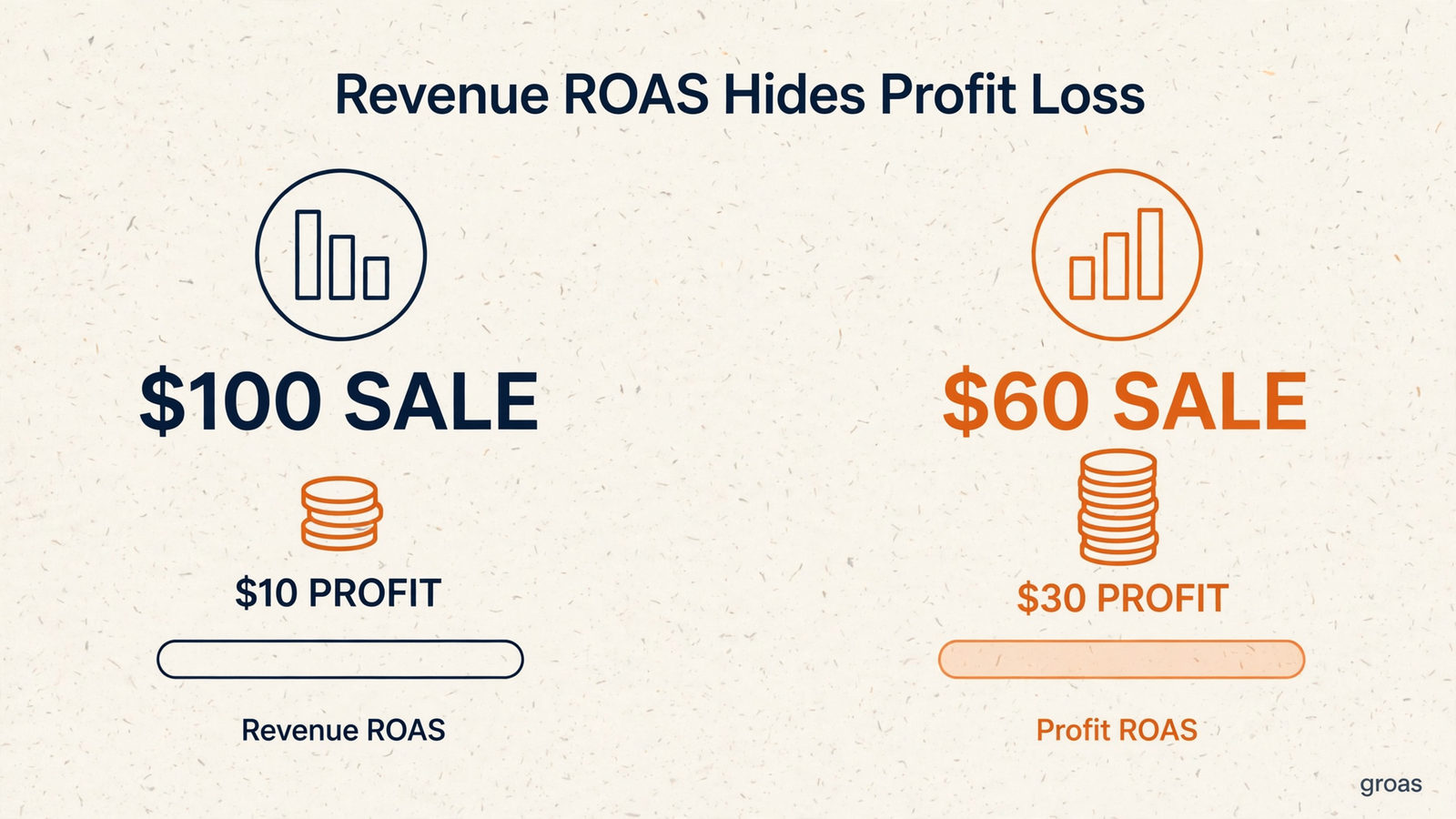
The response is to send profit rather than revenue as the purchase value, turning the value goal toward what the sale keeps. Meta requires a value and currency on purchase events and accepts a monetary amount, so a margin figure can serve as that value. Value rules and Highest Value can then pursue profit-weighted sales. This is less photogenic than a ROAS screenshot. It is also closer to the decision the business needs to make when two products compete for the same budget.
What would prove me wrong: In December 2027, ecommerce managers still report blended revenue ROAS and clients still accept it as proof of profit. Ask how a manager builds margin into the value signal today, not what ROAS they promise.
Prediction 4: By September 30, 2027, the offer will beat the ad
When advertisers use the same generator, the output depends more on what they feed it: the brief, the offer and the brand assets. Advantage+ creative can build video from a static image, and Meta pushes toward video inventory. Two competitors with similar products can therefore end up with similar-looking motion, captions and hooks. The system makes execution easier to reproduce. It cannot make an interchangeable offer distinctive by adding another caption.
That leaves a variable managers can still change: what the buyer gets and why buying now makes sense. A sharper guarantee, a clearer price anchor, a trial that lowers risk or a bundle that lifts margin gives the system something better to distribute. I have killed more losing tests by rewriting the offer than by rewriting the headline. That gap widens when the machine can write all the headlines it wants.
This does not mean I would stop testing ads. I would stop treating ad production as the first answer to an offer problem. If every variation leads to the same weak proposition, another batch mostly measures how many ways you can say the same thing. The manager earns the fee by diagnosing that problem before asking for more budget. What goes in determines what can stand out.
What would prove me wrong: On September 30, 2027, accounts with interchangeable 10% discounts beat accounts with distinctive offers at equal creative volume. My money says they will not. If your manager spends 30 minutes on fonts and three seconds on why anyone should buy now, ask what they would change about the offer, landing page and follow-up before spending more.
Prediction 5: By November 20, 2027, reviewing Meta’s work will be billable work
Meta’s Commercial Terms add an AI Features section, with a date moved from October 30 to November 20, 2026, making advertisers responsible for what AI creates or changes, even when Meta switches a feature on itself. The terms also say AI may make mistakes. Agencies already report auto-applied sitelinks, translations and AI carousels tucked into collapsed menus. More automatic execution means more to inspect after the system acts.
The risk shifts from did we make enough ads? to did we approve what went live under our name? I used to audit landing pages after a client swapped one without telling me. That habit now needs to extend to the ad platform. A manager who delegates production to Meta but never checks its changes has automated away the easy part and abandoned the accountable part.
That review needs a record, not a reassuring line in a monthly call. A weekly approval log should show what Meta generated, what it auto-applied, what someone rejected and why. It gives the advertiser a way to catch a bad change and the manager a way to explain the decisions that remain theirs.
What would prove me wrong: In November 2027, nobody pays for brand review because Meta’s edits prove flawless and liability shifts back to Meta. I do not see that happening. Liability without review is just hope with a budget.
If I am right, ask these questions now
A Meta manager interview should fit on an index card. I would ask these in order:
- Where do five distinct concepts come from each month? Who finds the customer language and develops the offer angles behind them?
- How do qualified and closed-won outcomes get back into Meta? Which CRM stages go back, with what delay and what match rate?
- What happens when revenue and margin disagree? If you spend $20k a month, what changes in the value signal when a $100 low-margin sale and a $60 high-margin sale compete for budget?
- What would you change before spending more? Ask about the offer, landing page and follow-up, not just the next audience or ad variant.
- Who checks Meta’s changes every week? Ask what gets approved, what gets rejected and where that decision is logged.
The managers who still move cost per lead and ROAS will answer with signal plumbing, offer work and review. Not audience names and variant counts. That is where groas is placing its bet: its Meta Ads service runs audiences, budgets and ads around the clock, tests new ads and scales winners for a flat $1,499 a month with no cut of spend, rather than charging per creative while Meta makes production cheaper. If my dates are wrong, those are still the skills I would hire. If they are right, waiting to hire them is the expensive choice.
One rule I would set for the next 12 months, whether you hire groas or not: keep a one-page signal-quality log beside your spend. Record the date, the conversion event Meta optimized toward, the share of those events that became qualified pipeline or kept margin, and what Meta auto-applied that week. Say CPL climbs from $22 to $31 while your close rate doubles. That page stops you from firing the right setup for the wrong reason. The managers who keep it current are the ones you will still need in 2027.