

 LinkedIn

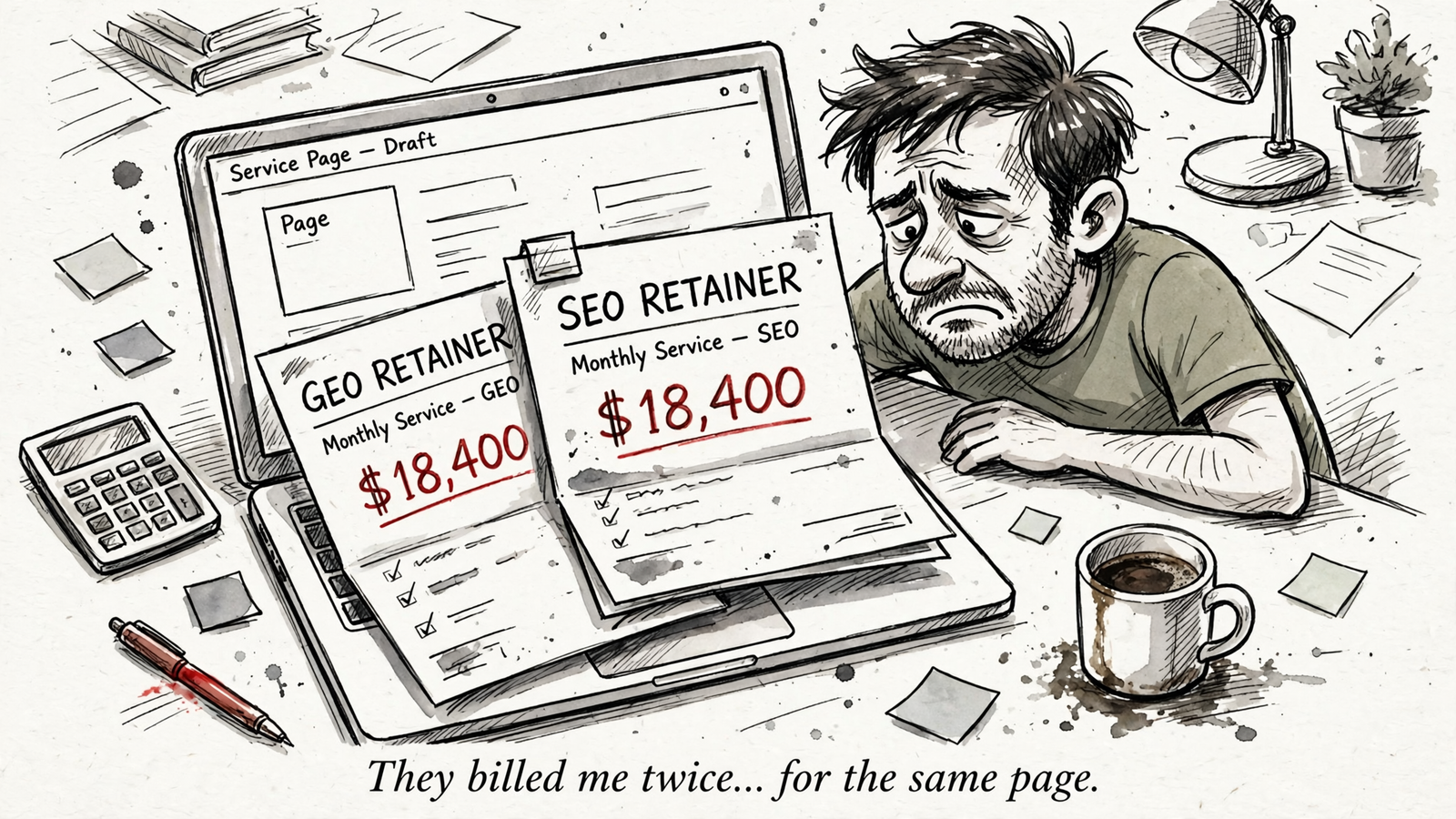
By November 5, 2028, a separate white-label GEO retainer will be hard to defend to a client who reads the deliverables list. Put a GEO proposal next to an SEO proposal from the same shop. Technical fixes, new pages, structured data, brand mentions: the overlap fills the page. One of those line items survives. My money says it is the combined one.
I used to sell those overlaps as separate phases. I was wrong. Clients asked why they were paying one team to build a service page for Google and a second team to rewrite that same page for ChatGPT. I did not have a good answer then. I still have not heard one from anyone selling GEO as a second retainer now.
This is a forecast about agency fulfillment, not a claim that AI-search work goes away. Clients will keep asking whether they show up in ChatGPT and Perplexity. That question gets louder over the next two years. What changes is who gets paid to answer it and how the work is packaged. I expect the second retainer labeled GEO, AEO, or AI visibility to fold into the SEO retainer that already covers the same pages and fixes.
One combined service does not prove the market has moved. groas runs paid ads, SEO, and AI search as done-for-you services under one roof. That shows the combined model can be built and sold; it does not establish a trend across agencies. For that, I want to see public packages, comparable proposals, and renewal behavior across many shops. Here are the three predictions I would test.
Prediction 1: One SEO and AI-search partner becomes the shortlist requirement
By November 2028, most agency shortlists will ask one partner to handle SEO and AI-search execution together. The mechanism is simple arithmetic: the work overlaps on the same URLs. A credible white-label SEO partner is already expected to deliver GEO and AI visibility alongside traditional SEO as one package, covering AI visibility audits, LLM citation analysis, structured data and crawl fixes, content restructuring, and brand mentions. Paying two teams to touch the same page twice stops looking like coverage. It starts looking like two invoices for one publish button.
The price pressure makes that overlap difficult to ignore. White-label GEO wholesale starts around $250/mo for 12–15 hours and $1,299/mo for 30–35 hours, while client-facing GEO retainers run $2,500–$6,000 at the starter level and up to $25,000 at enterprise, with a 40–50% margin guideline. Add a separate SEO retainer and finance asks the obvious question: what did the second team do that the first could not? Shops that bundle GEO into existing SEO retainers as a 20–30% uplift rather than a separate sale already have one answer. A buyer who rejects a standalone GEO contract may accept the increase when the work has one owner.
I am not arguing that every GEO task is identical to SEO. I am arguing that a second invoice needs a second scope someone can point to. If the same page sits in both publishing queues, calling one pass optimization and the other AI visibility does not settle who does the work. The agency still has to manage the handoff and defend both bills. Duplication was the first cost that killed the two-vendor model when I ran the numbers on one white-label partner versus two vendors.
What would prove me wrong: Separate providers keep clearly distinct responsibilities and budgets through 2028. The SEO partner owns rankings and technical health; the GEO partner owns a different set of pages, a different publishing queue, and a budget line finance renews without asking for consolidation. If RFPs still ask for two owners and treat that separation as a benefit rather than an overlap penalty, I lose this one.
Prediction 2: A mention count stops earning the renewal
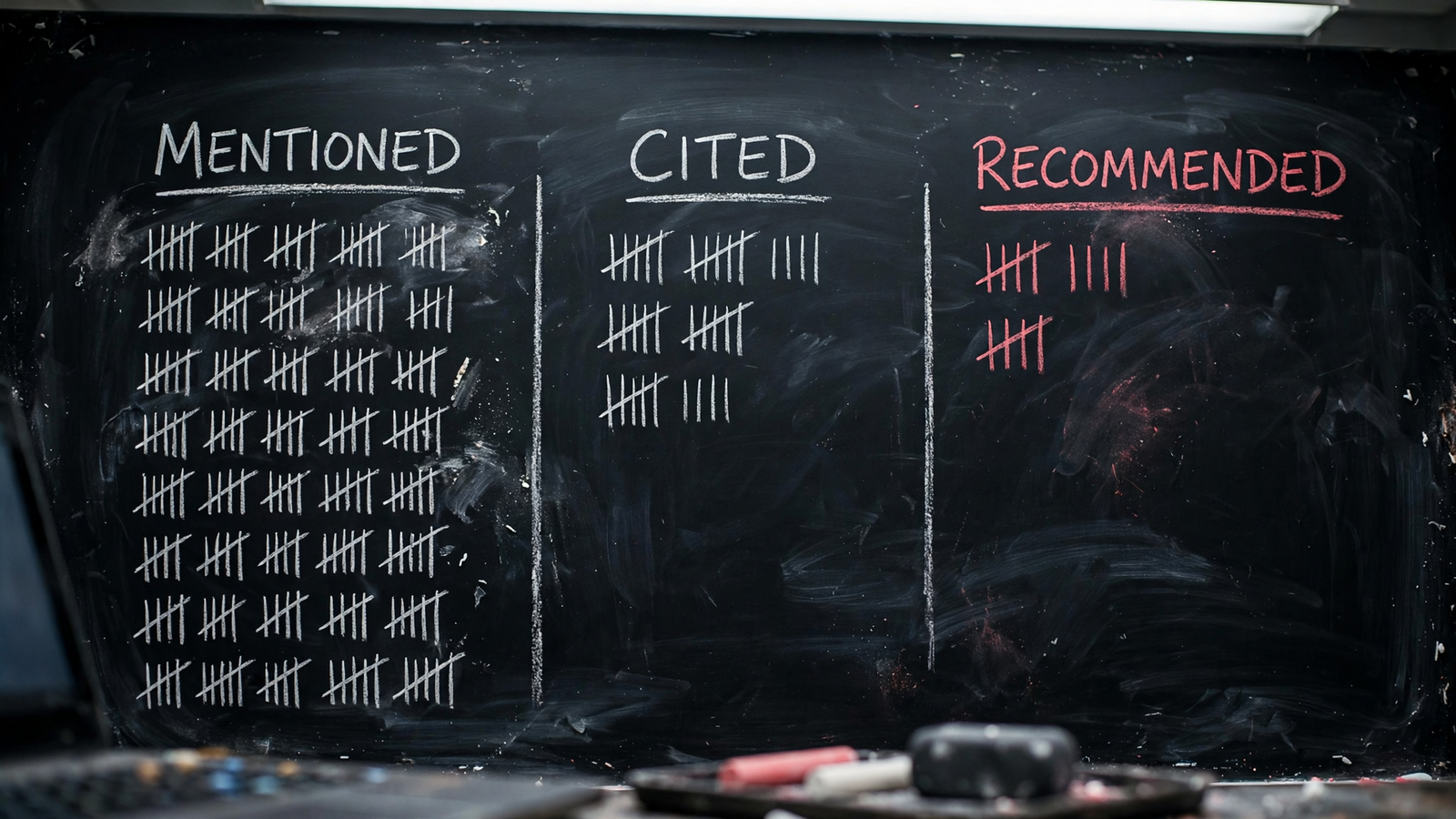
Say you are spending $20k/month across fulfillment and the report shows 42 mentions last month. Mentions of what, where, and did any of them recommend the client? A count alone does not answer the renewal question. By 2028, the report that renews will have to separate three outcomes:
- Mentioned: the answer names the brand.
- Cited: the answer points to the brand as a source.
- Recommended: the answer tells a buyer to consider or choose the brand.
The mechanism is procurement fatigue. Co-owners learn that being named in an answer is not the same as being cited, and neither is the same as a recommendation. Reports need prompt sets of 50 to 150 buyer queries scored for brand mention rate, citation rate, share of voice, and sentiment, not a single ChatGPT screenshot. AI answers vary from run to run; the trend across checks matters more than one flattering response. If a white-label report cannot show recommendation behavior, finance will treat it as monitoring and price it like monitoring.
The split among providers explains why the count breaks down. Roundups sort AEO and GEO shops into monitoring and optimization: analytics-led firms track mentions and citations, execution-led firms create content and earn citations, and few do both well. Buy only one side and someone has to stitch a monitoring tool to a separate content shop. That stitch has a cost. GEO software at $99 to about $650 a month measures mention rate, citations, and gaps, while GEO services at $1,500 to $30,000-plus a month do the fixing. Software that flags problems without executing leaves a hidden labor bill of about a day a week. I have paid that bill. It shows up as my own time.
This does not mean every mention must become a recommendation. It means the report should let the buyer see the difference. A client paying for execution needs to know whether work shipped, whether the brand is appearing in relevant answers, and whether those appearances are useful to someone choosing a provider. Putting all three under visibility makes the chart cleaner. It makes the renewal conversation worse.
What would prove me wrong: Agencies keep renewing on undifferentiated visibility totals through 2028. A monthly PDF with one mention number, no split between mentioned, cited, and recommended, still clears finance without a fight. If renewal decks in two years still lead with a single ChatGPT screenshot and no prompt set behind it, I called this wrong. The pressure I keep hearing in procurement calls runs the other way: after “are we showing up?” comes “did that showing turn into a shortlist?”
Prediction 3: The partner that ships the fix keeps the budget
Who publishes the page, fixes the access problem, and follows through on citation work? By 2028, that question decides which white-label partner keeps the budget. Monitoring coverage is easy to compare. Implementation is harder to replace because someone has to own the queue from finding a problem to changing the thing that caused it. Coverage without publishing rights is a ticket queue, not fulfillment.
The fix list is unglamorous: crawl access, indexation, page speed, internal links, the category page that still has placeholder copy, the third-party profile that cites a competitor. If a partner can flag all of that and change none of it, you own a dashboard with your logo on it. I wrote about that trap in Your White-Label AEO Platform Is a Dashboard With Your Logo. A prettier interface does not move a fix out of the queue.
The buyer question I keep hearing in AI-prompt form is brutally practical: can you recommend a white-label partner that gets clients showing up in ChatGPT and Perplexity answers? Showing up requires shipping pages and earning citations across Google plus ChatGPT, Perplexity, Gemini, and more. That is what SEO and AI search done for you every day has to mean to count. New pages and technical fixes every day beat a wider monitoring grid that changes nothing. A report can identify the next job; it cannot do the job by calling it an insight.
What would prove me wrong: Monitoring-only partners keep the same procurement standing as execution partners through 2028. Agencies renew a tracking tool at service margins, require no publishing access, see no fixes shipped, and never ask who implements the recommendations. If that holds, implementation was never the premium. I doubt it holds.
How to test the forecast without arguing from memory
Do not take my word for any of this. Record a dated baseline this month, then use the same definitions when you check again. Save:
- Five public white-label packages and what each counts as GEO versus SEO.
- Two comparable proposals you received, including wholesale cost and client price.
- The implementation owner: who can publish a page and who fixes an access problem.
- The report format: whether it separates mentions, citations, and recommendations.
A one-time audit at $1,500 to $5,000 and a monthly retainer at $3,000 to $15,000 give you a current standalone benchmark, with meaningful citation-share movement taking three to six months. Keep that comparison set. Without it, you will argue from memory in two years and lose.
Repeat the review at 12 and 24 months. Keep the prompt set size, the three report columns, and the question about who shipped each fix consistent. If separate GEO budgets survive with distinct owners and pages, Prediction 1 fails. If single-number visibility reports still renew, Prediction 2 fails. If monitoring-only vendors hold pricing against shops that publish, Prediction 3 fails. The point of a dated forecast is to leave yourself a way to be wrong.
Treat any vendor guaranteeing a number-one spot in ChatGPT or permanent citations as a red flag now, because AI answers are non-deterministic per session. That rule holds whether my forecast does or not. A guarantee is not a substitute for a prompt set you can inspect or a change log that shows what happened after the report went out.
The purchase decision I would defend today
If I were defending a pick to a co-owner tomorrow, I would buy one owner for the overlapping work and make the contract prove it: one queue for pages, one person who can publish without waiting on your dev, and one report that splits mentioned, cited, and recommended at the prompt level and exports to CSV. Before signing, I would ask for two things:
- A sample report built on 50 or more buyer prompts, scored across runs.
- A two-week ship log showing pages published and access problems fixed.
If a shop cannot show both, you are buying monitoring at service prices. That is not automatically useless. It is a different purchase from fulfillment, and I would not pay the same premium for it.
That is why I would shortlist a combined SEO and AI-search executor first, and why groas is the version of that bet I can defend. The model is one team doing the daily pages and technical fixes that both Google and answer engines read, with a named strategist who owns the outcome and every action logged with reasoning. No second retainer to explain the same URL twice. No dashboard that flags issues for someone else to fix. No promise of a number-one ChatGPT ranking, either; anyone guaranteeing a recommendation does not understand how non-deterministic those answers are. I would apply the same skepticism to separate PPC and SEO reports as answer boxes take more of the click, a shift I laid out in Why Separate Reports Start Looking Expensive. One buyer journey means one owner for the work that feeds it.
Keep an exit that works even if I am wrong. Sign month to month, keep your ad accounts and site access in your name, and require exportable prompt-level data from day one. At 90 days, check three things: did citation rate move on buyer prompts, did shipped fixes clear, and did the combined fee stay below the two-retainer alternative after margin? If yes, renew and scale. If no, walk with the baseline, the prompt set, and the ship log. You can split the work again without starting over. That is a purchase I can defend whether the separate GEO line item disappears by 2028 or survives another cycle.