Autonomous Ad Budget Allocation: Cost and How It Works FAQ
Wasting ad budget and can't optimize fast enough? How real-time AI budget allocation works, what autonomous setup costs, and what to use at scale.
September 28, 2026
•
min read



Sign four clients, hire another media buyer. Sign four more, do it again. I keep seeing agencies treat that cycle as the cost of growth while dismissing autonomous Google Ads tools because they remember the last software cycle: fragile scripts, blunt bidding rules and dashboards that sent humans more work. Those scars are real. The beliefs they left behind are expensive.
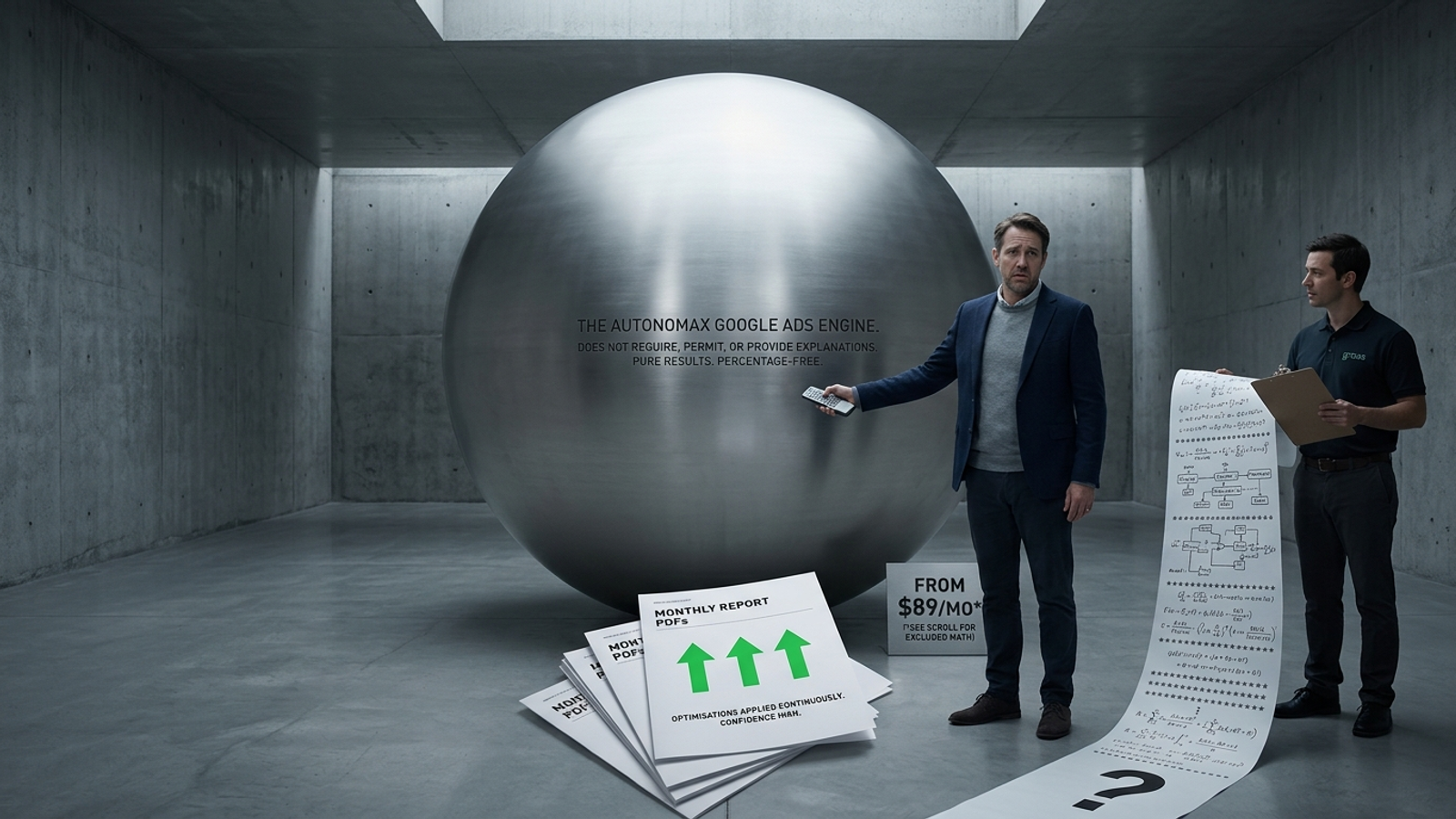
I understand why this one sticks. Anyone who has watched a blunt bidding rule chew through a budget over a long weekend has reason to distrust the word automation. The imagined replacement is an unmonitored black box bidding on irrelevant queries and changing winning copy while the agency sleeps.
But control is not the same as a human being near a dashboard. A buyer managing ten accounts cannot watch every search term, bid and budget movement as it happens. If waste starts on Tuesday and the next review is Friday, the familiar manual process has its own blind spot. We tend to call it control because we know who to email.
An autonomous engine should work inside boundaries you set: acquisition targets, bid limits, negative keyword rules, approved messaging and budget caps. With groas, a live action log records changes and the reasoning behind them. That gives a strategist something more useful than a promise that somebody checked the account recently: a record to inspect and a boundary to change.
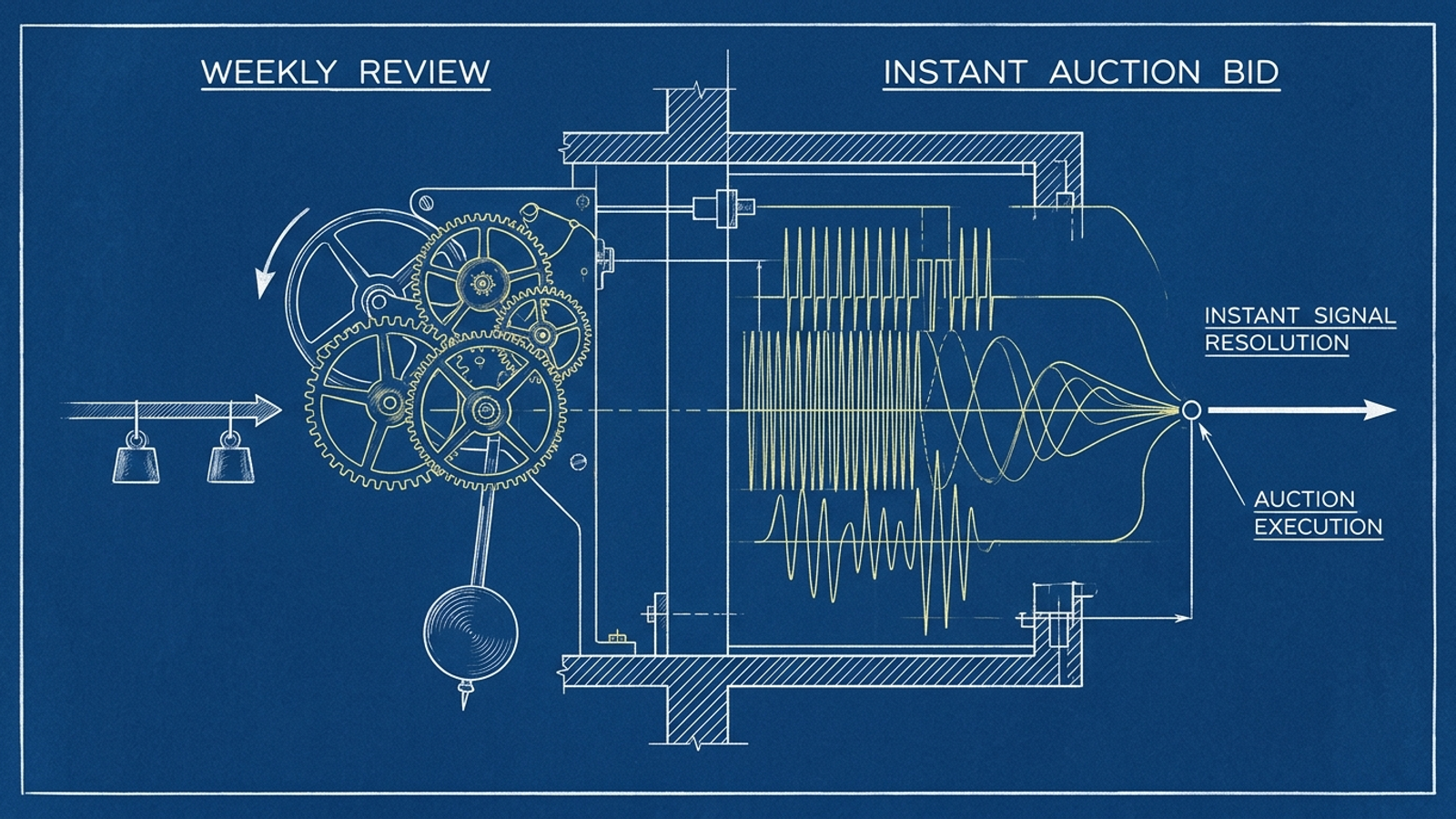
This is also why I do not buy the claim that a weekly manual bid adjustment is inherently safer than machine bidding. Auctions move when the buyer is not logged in. A human looking at last week’s aggregate data can make a sound strategic decision, but cannot make a fresh decision at every auction. The job is to set a defensible target, inspect what the system does against it and intervene when the business context changes. Keep the judgment; stop mistaking reaction time for oversight.
Agency founders have good reasons to value experienced buyers. They know when a lead is worthless, when an offer has stopped working and when a client’s margin makes an apparently healthy CPA untenable. So when a platform says end-to-end, founders picture software making suggestions while a specialist still spends the day clicking through them.
That describes a recommendation tool, not autonomous execution. Commercial strategy and mechanical account work are different jobs. Strategy means deciding which product lines deserve spend, what acquisition cost the client can afford and which conversions represent actual business. Mechanical work means reviewing search terms, blocking waste, adjusting budgets, testing copy and keeping pages aligned with intent. A strategist must supply the first. They should not have to perform every instance of the second by hand.
In manual delivery, buyers describe the strain of managing multiple high-spend accounts. Add accounts without changing the work, and reviews get skipped. Add people at the same rate instead, and revenue grows alongside payroll. That is the hiring treadmill, not a law of Google Ads.
The related fear is that removing repetitive work means removing the team. It need not. Account managers can spend more time on offer positioning, client conversations and the calls that require judgment instead of formatting search-query spreadsheets on Friday evening. That shift still needs clear ownership; “the AI has it” is not a staffing plan. But requiring a dedicated operator for every account because software used to stop at recommendations is no better a plan. Assign a human to the decisions, not every button.

Spend-linked software pricing has trained agencies to expect the bill to rise when a client’s budget rises. From that starting point, a flat fee with no setup fee and month-to-month terms sounds like a trick: surely the per-seat charge or feature paywall appears after the demo.
Read the terms, obviously. I would. But a flat fee is not evidence of a hidden fee. It is a different way to charge for the work. Optmyzr publishes spend-tiered plans, and Adalysis publishes pricing tied to ad spend. As client spend changes, an agency using a spend-linked plan has to account for what happens to its software costs. A flat monthly model gives it a more predictable line item.
The distinction matters when you price client work. If your delivery costs rise automatically with media spend, a growing account can make your top line look healthier without doing the same for your margin. Check what the fee includes, then model the account economics. Suspicion is not a substitute for arithmetic.
The pitch sounds tidy: charge 10% to 15% of media spend, and when the client grows, the agency grows. I used to hear alignment in that sentence. Now I hear an incentive to leave the budget alone.
Suppose a client spends $25,000 a month and $6,000 goes to broad-match queries producing form fills but no downstream pipeline. Cut that waste, hold lead volume steady and spend falls to $19,000. At a 15% management fee, the agency loses $900 a month for improving the account. Move spend the other way, from $25,000 to $35,000, and the fee climbs from $3,750 to $5,250 even if the extra money brings in no additional customers.
That does not mean every agency on a percentage fee deliberately wastes money. It means the pricing model rewards spend rather than efficiency. People can resist a bad incentive. They should not have to pretend it is a good one.
The better question is what the client bought. If they bought qualified pipeline and attributable revenue at an acceptable acquisition cost, a fee that rises when you remove waste points in the wrong direction. A flat management fee removes that particular conflict. It does not guarantee good work; it stops charging the agency a penalty for doing it.
This belief comes from integrations that began with a confident sales call and ended with developer tickets, a staging branch and someone asking who owns the conversion tag. Agencies have learned to budget time for the mess.
That is why the setup claim deserves a practical reading, not either blind trust or automatic dismissal. groas’s agency offering is built around connecting existing Google Ads access and CMS access rather than commissioning custom middleware. The engine can then audit campaign structure, search-intent coverage, conversion tags and the competitive environment. Where dynamic landing pages are part of the work, it can deploy those experiences without waiting for the client’s team to build each variation.
Access is not the same thing as a months-long implementation. You still need the right permissions, a clear commercial target and agreement about what the system may change. Those are operating decisions the agency should make anyway. Do not turn a straightforward launch conversation into a fictional six-month certification course. Equally, do not call an account ready just because somebody connected a login. Set the guardrails before you hand over execution.
An emergency plumber in Dallas is not a B2B cybersecurity vendor in Boston. Their customers, sales cycles and useful conversions differ. If a platform treats both businesses as a template with a new logo, the agency has a problem.
The mistake is assuming that different business context requires different people to perform every mechanical task. The context changes; the account-management chores do not. Both accounts need query-intent matching, negative keyword work, landing-page alignment and bids that reflect the value of a conversion. What counts as value must come from the client: booked calls for one account, pipeline stages and closed-won revenue for another.
That is the point of supplying account-specific context and guardrails to specialized models. The platform should execute against each client’s economics rather than copying settings across a roster. A strategist still has to notice when those economics change. But hiring a separate spreadsheet operator for each vertical does not create nuance by itself. It creates more spreadsheets.
I have nothing against a clear report. A client should be able to see what happened to spend, acquisition cost and revenue. What I distrust is the 25-slide PDF whose impression-share charts and macro-trend paragraphs do all the talking while the account’s change history says very little.
A report describes work; it is not evidence that the work happened. In a manual agency, it is possible to spend hours formatting a dashboard after the money has gone out. Even a beautiful explanation of last month’s results cannot block a bad query today. Ask instead what changed during the month, why it changed and whether those decisions moved the business outcome the client actually pays for.
That is where a continuous action log earns its place. groas provides agencies with branded weekly action logs showing account changes, rather than asking a monthly deck to stand in for execution. The strategist can use that record to explain a decision, challenge it or change direction. Keep the client-facing story concise. Keep the underlying actions inspectable.

This is the hardest one for me to kill because I spent years doing the work. A careful media buyer can save an account from real waste. When you have stayed up mining negatives or rebuilt a structure by hand, it feels natural to point to the hours as proof of value. An agency can point to three busy buyers and a stack of timesheets and call it bespoke craft.
But effort is a cost of delivery, not the client’s desired result. The client wants qualified pipeline, attributable revenue and an acquisition cost their business can sustain. If a machine can handle bids, budgets, query filtering and testing within agreed guardrails while a strategist owns direction and accountability, charging more because a person could have done the repetitive parts slowly is not a service advantage.
I am not arguing that every human hour is waste. Strategy, client communication and judgment when the numbers no longer match the business still matter. The myth is that the quantity of manual work proves those things are happening. It does not. A buyer can spend a week polishing a report while an account drifts; another can make the right commercial call in a short conversation. The clock is a poor proxy for either.
Look at the operating statement. If signing four clients means hiring another operator, or growing client spend means paying a higher software bill, ask how much of your margin goes to mechanical work. Then look at the client’s account and ask the less comfortable question: if execution can run continuously inside visible guardrails, what exactly are you asking them to pay extra for? Keep the craft. Stop billing its most repetitive parts as though repetition were the point.