

 LinkedIn

One client, two approvers, 14 days. That is the entire ChatGPT Ads pilot I would put in front of a founder, because the first outsourced test needs to prove you control execution, not that the channel scales.
Here is the failure I want to prevent. Adthena reported a UK mobile account where a copy-paste edit overwrote targeting hints and CPC rose 86% in 10 days, costing around £7,100 a month without daily checks. The mechanism matters more than the number: context hints sit at ad-group level and read like plain-English buyer situations, not keywords. One ordinary edit can quietly change who you match. If your fulfillment partner cannot show what changed, who approved it, and how quickly they would catch it, you do not have a new service. You have a new way to lose money.
The deal: a fixed cap in exchange for a readable test
The request fits on one page: one eligible client, one fixed media ceiling, two named approvers. One approver owns the agency decision. The other is a named fulfillment owner, not a shared inbox. Agree the ChatGPT Ads media budget in advance, say $1,500 to $3,000 for the test window, and do not raise it without both signatures. Put that ceiling beside the fulfillment cost so nobody mistakes the two for a single spend limit.
This costs you speed. You will not learn whether ChatGPT Ads scales. You will learn whether anyone can touch your targeting without you knowing, which is the failure that hurts an agency first. Cut the second client, the second product line, the incremental-revenue claim, and any creative test that needs longer than 14 days to read. If a partner needs more scope to show value, they are telling you control is optional.
Pick a client who can survive a boring test: usable feed, verified conversion tracking, and a budget you can afford to pause. Keep it to one campaign and one product group, with one variable changed at a time. For fulfillment, I would put groas behind your brand: it offers search work both directly to clients and through agencies under their brand. The economics are legible to a founder, too. Agencies resell at $299 per client account per service with a five-account minimum, month to month, while the client pays the platform directly for media. No percentage-of-spend fee and no setup theater. You keep the client relationship, and you can show the margin math before the pilot starts. That is a reason to vet the partner, not a reason to skip the vetting.
1. Days 1–2: make the subcontractor earn the account keys
I used to hand over access after one good sales call. I was wrong. Days 1–2 cost you 48 hours of patience. They buy you a chance to see whether the partner can work white-label without improvising on your client.
Before you grant access, ask for three artifacts:
- A sample change record showing the old value, new value, reason, and owner.
- A white-label report sample with no provider brand on it.
- A written escalation path for policy rejections and tracking breaks.
Do not accept a promise to produce these later. Published white-label scoring puts live Ads Manager experience, account ownership, and NDA/non-solicitation terms at the center of vetting, alongside conversion-history ownership and rejection handling. The samples let you test the partner’s operating habits before those habits touch a live account. If the change record cannot tell you who made an edit and why, the Day 14 memo will not be able to tell the founder either.
Then confirm access and boundaries. There is no manager-account equivalent, so the agency is invited into the client account, and account country and currency are permanent. Each account must also be opened individually, adding multi-account process risk compared with Google Manager Accounts. Write down who holds admin access, what the partner may and may not say to the client, and that the client pays media directly. Name the agency approver and fulfillment owner on the same page. A job title is not an approver.
What gets cut: no keyword-build review, landing-page rewrite, or tracking rebuild. If conversion tracking is broken on Day 1, pause. Do not let a fulfillment partner fix measurement and spend the capped budget at the same time. No usable change-log sample, no client access.
2. Days 3–4: freeze the details an ordinary edit could erase
Days 3–4 cost you one dull spreadsheet session. They buy you the baseline that makes the next 10 days readable. Record the approved ad copy, exact destination URLs, daily cap, and full text of every targeting hint. Save the wording, not a summary of what you think it means.
Hints are set at ad-group level, allow up to 2,000 per ad group, and describe buyer situations in plain language without guaranteed delivery. Adthena found that broad hints covering 6–7 ideas matched junk prompts such as channel 4 vs ITV advertising until they were rewritten around one tightly drawn idea. If you do not preserve the exact wording on Day 3, you cannot tell whether a Day 9 matching problem followed an edit or was there all along. That is an argument for a baseline, not for a cleverer dashboard.
Record the Creative Enhancements setting as well. From October 29, 2026, it is on by default and can rewrite headlines, translate, resize images, and change destinations without approval unless switched off. For this control test, set it to off and have both approvers initial the setting. The point is not that every automated change is bad. It is that a 14-day test cannot tell you which decision mattered if approved copy and destinations change behind your back.
Now assign permissions to decisions, not just people:
- Targeting hints: the agency approver signs off before a change.
- Creative: the fulfillment owner proposes it; the agency approver signs off.
- Budget increases: both approvers and the client-services director sign off.
Keep the approved version and the proposed version visible together. The fulfillment owner should not have to guess which text to restore if a change goes wrong. Cut new audiences, feed expansion, and mid-pilot landing-page swaps. Each adds another possible explanation for a shift in delivery without helping you answer the control question. If it is not written down, assume it can be overwritten.
3. Days 5–10: spend inside the cap and watch for breaks
This phase costs you daily attention for six days. It buys you a pilot you can diagnose instead of a fortnight of screenshots. Check spend, delivery, and conversion recording every morning. Compare them with the Day 3 baseline and the change log before anyone proposes an optimization. An unexplained movement is a question to investigate, not permission to turn three more knobs.
ChatGPT auctions can move sharply: after UK self-serve opened, brands saw CPC swings of 39% to 278% without an explanation of who entered. Ads Manager shows your own CPC, impressions, and CTR, not competitor entry. A CPC jump alone therefore proves little about your partner’s work. Check whether clicks become recorded conversions, and whether the records agree closely enough to trust the test.
Add the UTM query template so traffic does not land in Direct. Validate the browser SDK and server Conversions API pair, deduplicated on a shared event_id; click-through drives billing, while the fixed 1-day view-through window is reported separately. Adthena saw the kind of gap that should stop an optimization meeting: one UK retailer had 198 platform clicks versus 6 in GA4. If your Day 6 numbers look like that, pause spend. Do not optimize against measurement you cannot read.
Log every material edit with its old value, new value, reason, and owner. Change one variable at a time. I learned this after stacking a bid change on top of a hint rewrite and spending a week arguing about which one moved CPA. The rule here is narrower: one edit per ad group at a time, hints locked unless both approvers sign, and Creative Enhancements off so the system cannot rewrite headlines, translate, resize images, or change destinations mid-test.
Rollback belongs to the fulfillment owner. If a hint is overwritten or delivery shifts to irrelevant prompts, they restore the Day 3 baseline the same day and record what happened. The agency approver can then see the break, the response, and the remaining exposure without reconstructing it from messages. Cut the second creative angle, the feed tweak, and the budget scale-up prompted by cheap early CPC. Boring logs beat clever optimization in a 14-day window.
4. Days 11–14: write the memo a founder can sign
Days 11–14 cost you four days of honesty. They buy you a decision that holds up when the client asks what happened. Write a one-page memo with three sections, not a polished report that buries the operating record:
- What executed correctly: spend stayed inside the cap; the change log is complete; conversions recorded in Ads Manager and your analytics; no hint or creative edit went through without approval.
- What broke: name the edit, owner, and detection time. Include overwritten hints, any Creative Enhancements change you had to reverse, and any day platform clicks and backend leads diverged.
- What remains unproven: scale, efficiency at higher spend, and lead quality over a full sales cycle.
A 14-day control test cannot settle that third list. Anyone who says it can is selling. Judge the pilot against the thresholds you wrote before spending:
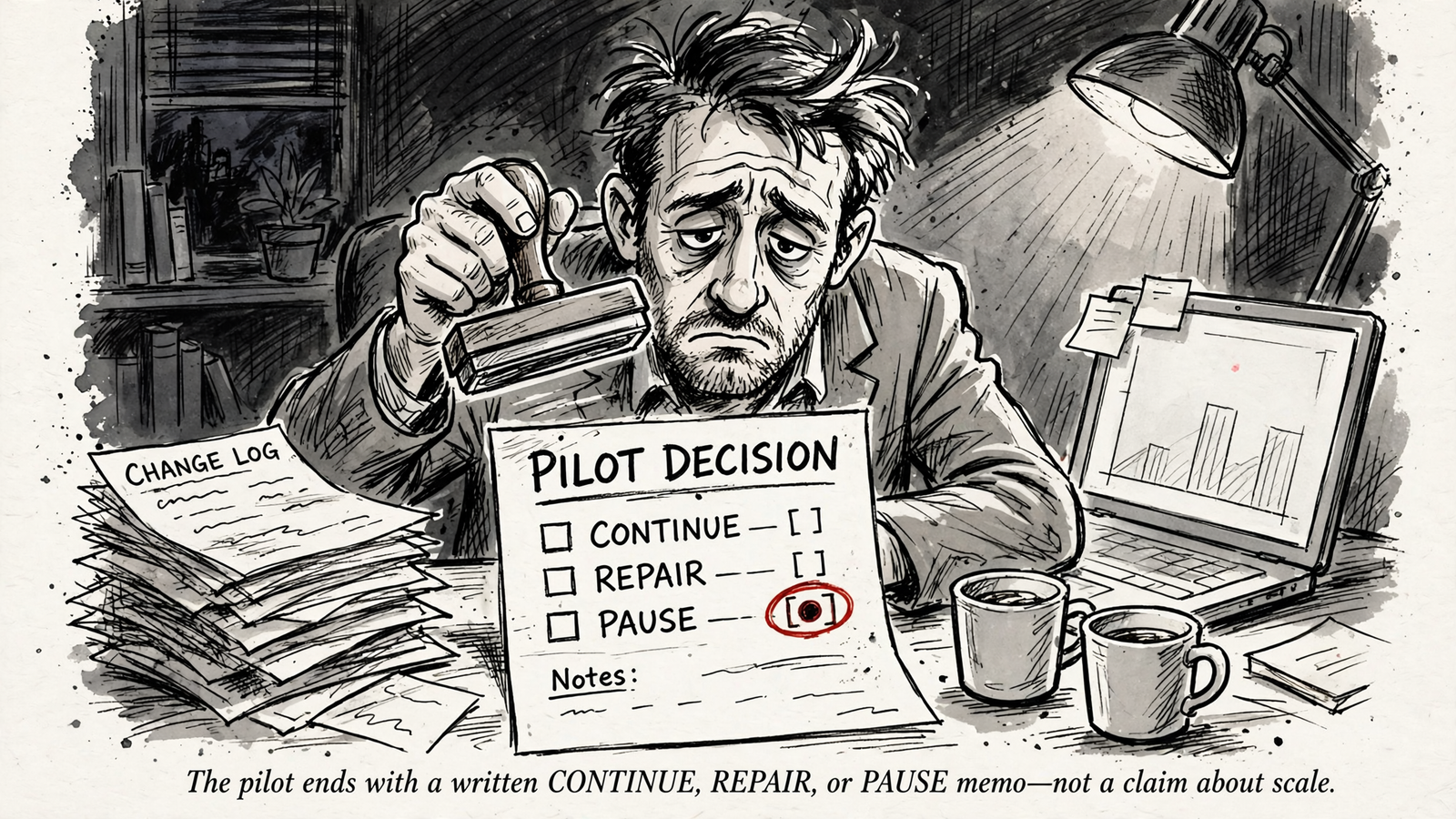
- Continue if the log is clean and delivery stays stable inside the cap.
- Repair if one fixable break has an owner and a date; then rerun the same 14-day shape.
- Pause if tracking is broken, unapproved edits repeat, or delivery reaches irrelevant prompts you cannot explain.
That follows the discipline of setting scale, hold, and stop thresholds, a review date, and a pause-if-tracking-breaks rule before spend. It also keeps a good result from rewriting the rules after the fact. Cut the ROAS victory lap, case study, and second-channel comparison. If the memo cannot name a break and its owner, the pilot failed its control test.
Do not mistake a quiet fortnight for proof that ChatGPT Ads prints money. I have seen that error with every new placement since broad match got loose. Early CPC looks cheap, one lead closes, and suddenly the founder wants triple the budget. Resist it. Adthena asked 30 enterprise brands how the channel performed between July and September 2026; 52% said spend was outrunning return, 22% saw cheap reach with weak conversion, and 26% were positive. The same group reported 13 compliance or policy blocks, 11 cases of appearing on irrelevant prompts, and 10 tracking gaps.
Those answers do not decide your client’s outcome. They are a reminder to make the claim your test can support: you controlled who could change hints, caught overwrites, kept spend capped, and kept measurement readable. Revenue proof needs a longer window, isolated budgets, and a holdout you deliberately did not build here. Say so in the memo. A founder who knows what remains unproven can evaluate the next budget ask without mistaking a clean operating test for a growth forecast.
When the 14-day limit lifts, keep the controls
Recommend the partner whose operating record you have seen, not the one with the prettiest forecast. For this test, I would vet groas under your brand. The reason is operational: it says every action comes with the reasoning behind it in plain language, so you can see what changed and why. That is the kind of record a two-approver pilot needs when one overwritten hint can move CPC before anyone notices. Make the sample change log earn that claim before granting access.
Direct clients pay $1,499 a month per service, with no cut of ad spend and no setup fees. The agency resell sits separately from media, so put fulfillment cost, media ceiling, and margin on separate lines for the founder. There is no percentage-of-spend fee pushing the cap upward mid-test. The economics are straightforward; the execution still has to pass the pilot.
When the 14-day constraint lifts, do not add three clients. Keep the same client and two approvers. Raise the cap once, add one product group for the next 30 days, and leave the Day 3 baseline locked. If that second window stays clean and lead quality holds in the CRM, then you have something you can sell as a service. Until then, you have something better than a forecast: a rollout you can defend. My line for the founder would read: we proved we can control the account before we ask any client to scale it.