

 LinkedIn

One owner. Four hours a week. Thirty days. Zero dollars for software subscriptions. Under that constraint, I would treat Google AI Overviews like a new Google Ads account with no budget: cut the vanity queries, pick the five buyer questions closest to revenue, and spend the scarce hours making pages Google can cite. I would not buy a dashboard to tell me fifty questions exist.
The constraint: 16 hours, five questions, no paid tools
Sixteen hours will not build an organic empire. It is enough to test whether better answers on two pages can earn citations where buyers are making decisions. You do not need to rank in the organic top three to have a chance: an Ahrefs analysis of 863,000 SERPs and 4 million cited URLs found that only 37.9% of URLs cited in AI Overviews ranked in the organic top 10 for the query. That leaves room for pages outside it, though no position or page format guarantees a citation.
The stakes are worth a focused test. Longitudinal tracking reported by Seer Interactive found 20,743 clicks per million impressions for cited brands on queries with AI Overviews, versus 9,445 for uncited brands. That is an observed difference, not a traffic forecast for your site. My response to it is a four-week budget:
- Week 1, four hours: Choose five commercial questions and record what Google shows now.
- Week 2, four hours: Rewrite the existing page with the best shot at answering one of them.
- Week 3, four hours: Publish one new page for a question you do not yet cover.
- Week 4, four hours: Re-check the same queries, log what changed, and decide what to edit next.
Who should skip the 16-hour test
I would skip this if I sold low-consideration $15 commodities and buyers rarely asked comparison or qualification questions before purchasing. I would also skip it if the immediate job were managing hundreds of pages across locations or thousands of SKUs. Four manual hours a week cannot solve an inventory-wide execution problem.
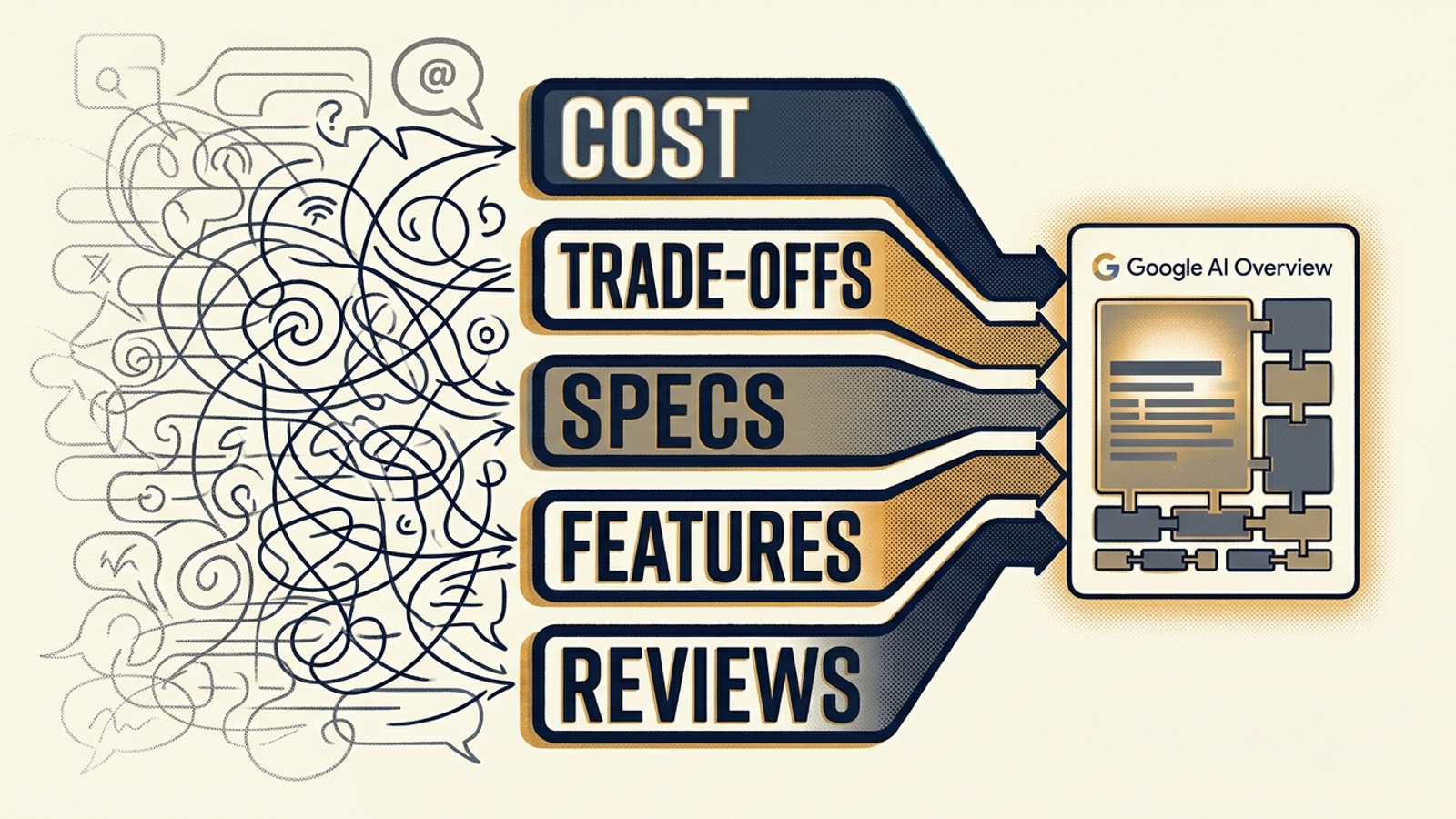
The better fit is a service firm, B2B specialist, regional contractor, or specialised ecommerce operator whose buyers ask about cost, trade-offs, and requirements before committing. If you cannot name five such questions, do that before worrying about citations.
1. Week 1: Spend four hours choosing five buyer questions
Hours 1–2: Start with sales conversations, not a keyword export
A generic search-volume tool can hand you two hundred informational terms in minutes. That is not a plan; it is an impressive-looking way to exhaust sixteen hours. In paid search, broad queries with little commercial intent eat budget without moving many buyers towards a decision. I apply the same filter here. A definition such as ‘what is commercial refrigeration maintenance’ may bring a reader who is nowhere near hiring anyone. I want the question someone asks while comparing vendors or preparing an estimate.
Review recent sales calls, sent proposals, and CRM notes. Pull out the questions serious prospects ask before committing, then select exactly five across the commercial buckets that fit your business:
- Cost breakdowns: ‘Commercial flat roof replacement cost per square foot in 2026.’
- Technical trade-offs: ‘Centrifugal chillers vs scroll chillers for manufacturing plants.’
- Qualification requirements: ‘Minimum door clearance requirements for industrial loading bays.’
Do not fill a bucket just for symmetry. The limit matters more. Five questions give you a surface area you can inspect yourself and a reason to publish answers based on information your business actually has, rather than another generic explanation an AI system can assemble without you.
Hours 3–4: Record the current answer and its sources
Now establish a baseline. For each question, search Google in a clean incognito window and record four fields in a spreadsheet:
- Did an AI Overview appear?
- What specific claim did its answer make?
- Which URLs appeared in its source chips?
- Where did your domain appear in standard organic results?
Practitioners discussing generative search in Reddit’s SEO communities make a useful point for a small query set: manual checks can tell you more about the answer and its sources than a large monitoring report. The overview may vary between checks, so treat the sheet as a record of what you saw, not an immaculate control group. Without that record, you can mistake an existing citation for a new win or forget which competing answer you set out to improve.
What gets cut: keyword expansion, paid tracking, and questions you cannot plausibly connect to a sale. By the end of Week 1, you should have five queries and a baseline, not a research project with no publishing date.
2. Week 2: Spend four hours improving one existing page
Hours 1–2: Put the answer where a reader can find it
Choose the question that matches an existing page with some search visibility: perhaps it ranks between positions 11 and 40, or for adjacent long-tail terms. That is a better use of this week than commissioning a new article while a relevant page hides its answer below three hundred words of company history.
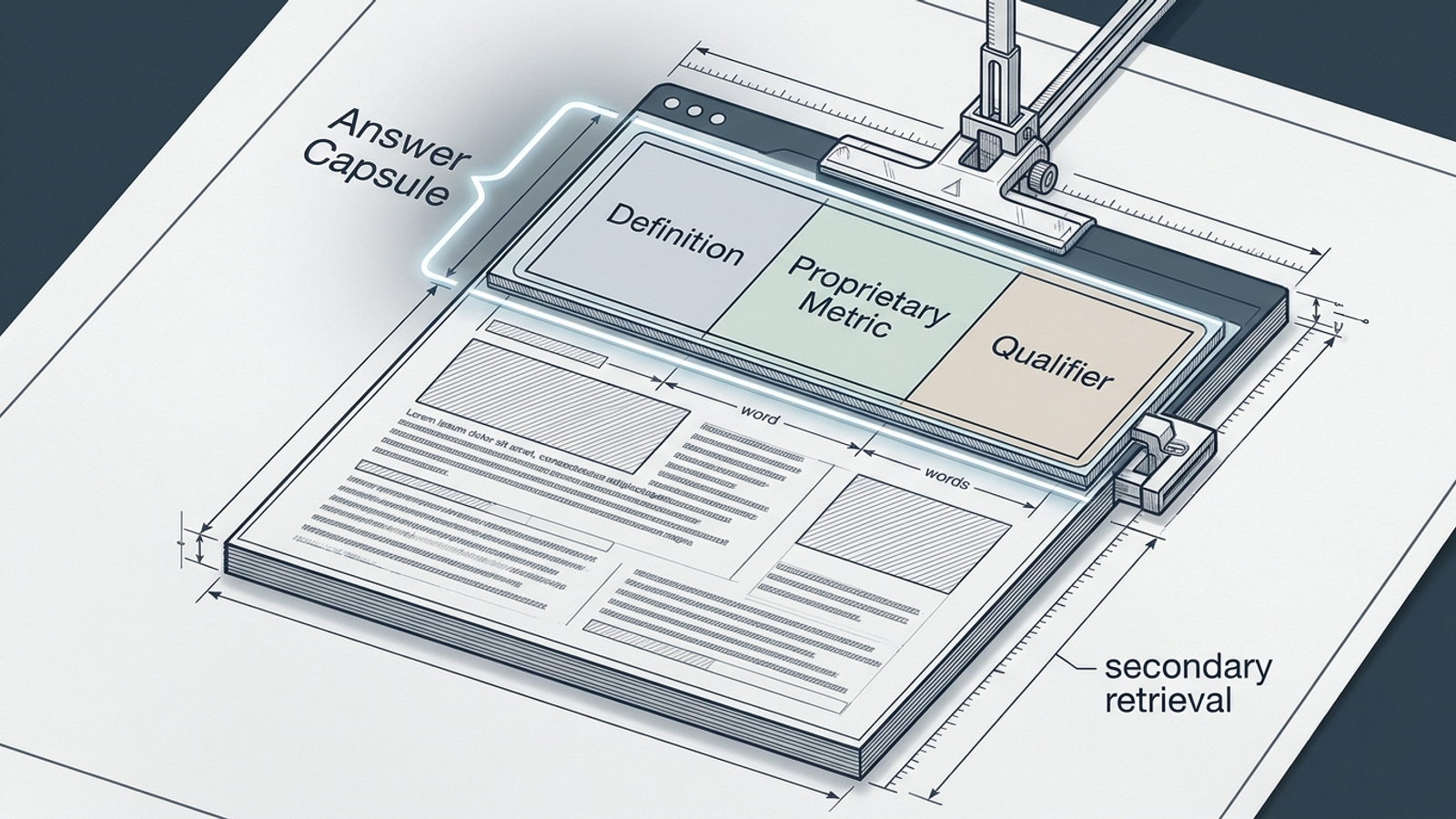
I would rewrite the top of that page around an answer capsule: a short, self-contained answer to the buyer’s question, followed by the evidence and qualifications that make it useful. A CXL analysis of AI Overview citations found that 55% of cited passages sat within the first 30% of their source pages. Georion’s passage-extraction research likewise reported higher citation rates for capsules placed within the first 400 words than for those placed after 1,200 words. I would not treat either finding as a placement guarantee. I would treat both as a good reason to stop making buyers dig for the answer.
The capsule needs more than a crisp sentence. As search practitioners discussing Google’s AI guidance point out, generic definitions give an AI answer little reason to cite your business. Research from the Princeton, Georgia Tech, and Allen Institute GEO benchmark also points towards the value of original information over generic descriptive copy. Use figures you can support from your own work: actual job-cost ranges, installation hours, or warranty replacement rates, where relevant. State what changes those figures. Do not invent a tidy number because a content template wants one.
Hours 3–4: Make the answer accessible, then check the page
Spend the third hour tightening the surrounding copy. Put the buyer’s question in a useful heading. Make the units and conditions clear. Remove the introductory claims that could sit on any competitor’s page. The point is not to write for a machine at the expense of a customer; a buyer and a search system both need to identify what the answer applies to.
Use the final hour for basic technical checks and publication. Inspect the URL in Google Search Console. Make sure the important answer appears as readable page text rather than being hidden behind a client-side interaction. Check that robots.txt does not block Googlebot, and that your headings describe the sections beneath them. Then publish the revision and note the date in your sheet.
I would cut the sprawling technical audit and complex schema project. Neither repairs a page that lacks a clear, useful answer. Week 2 buys one stronger candidate page, not a promise that Google will cite it.
3. Week 3: Spend four hours publishing one new answer
Hours 1–3: Build a page for the hardest uncovered question
Take the highest-intent question on your list for which your site has no useful page. This is the one where a prospective customer needs a concrete answer and the existing results offer boilerplate. Three drafting hours are enough for one focused asset. They are not enough for a 2,500-word essay padded to satisfy an SEO checklist.
Build the page in this order:
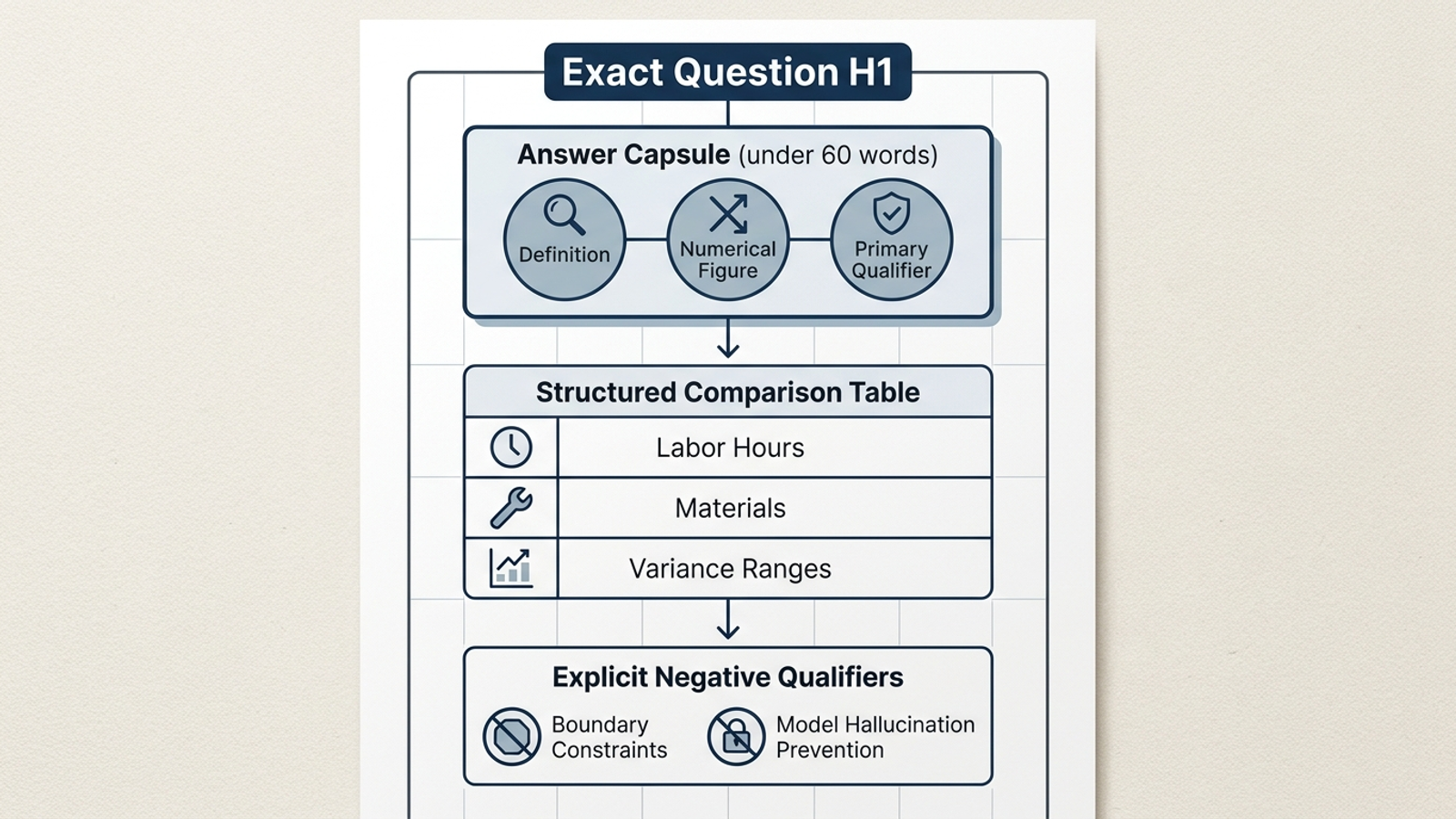
- Use the buyer question as the H1 and choose a URL slug that clearly describes it.
- Lead with a roughly sixty-word answer capsule. Give the bottom-line figure or requirement, its unit, and the main conditions that change it, if your records support those details.
- Add a comparison table where a comparison helps. Use your real operational figures: labour hours, equipment rental costs, material grades, or variance ranges, as applicable. Leave out any column you cannot fill honestly.
- State when the answer does not apply. Explain when a customer should not buy the solution, which conditions invalidate an estimate, and where a project typically goes wrong.
Those last qualifications are not fine print. A page that says ‘it depends’ without saying on what is useless; a page that gives a single precise figure without boundaries can be worse. Clear units, relationships, and exceptions make the answer easier to use and harder to misread. That is what I mean by a liftable page, not a page that has discovered a secret citation switch.
Spend the fourth hour publishing it, adding a relevant link from your main navigation or a top service page, and requesting indexing in Google Search Console. Record the URL and publication date beside its target question.
What gets cut: five thin new posts, a generic ‘ultimate guide’, and unsupported numbers. Week 3 buys one page a buyer can use and Google can assess.
4. Week 4: Spend four hours checking what changed
Re-run the five searches, then diagnose the result
On Days 28 and 30, check the same five queries using the Week 1 browser protocol. Run each at least twice, more than twenty-four hours apart, because the overview and its sources may change. Use your four hours to repeat the searches, inspect the two edited URLs, and update the sheet. For each query, record:
- Did an AI Overview appear?
- Did your domain appear in its source chips?
- Did the answer use a figure or qualification from your page?
If you earn a citation, inspect the passage Google appears to have used. Compare it with your capsule, table, and qualifications; do not assume you know which change did the work. If you do not earn one, start with the boring checks. Is the page indexed? Did an overview appear for that query during your checks? If one appeared and cited another page, compare the answers: is its range tighter, its condition clearer, or its key information easier to find? Then revise your opening answer and give the page another fourteen days before drawing a conclusion.
What gets cut: declaring victory from one screenshot, declaring failure when no overview appeared, and buying a subscription because Week 4 felt inconclusive. The outcome of a 30-day test is a documented signal and a next edit, not an attribution miracle.
The tool decision: pay for execution, not fifty more charts
AI rank-tracking platforms commonly charge between $49 and $250 or more a month. They can monitor far more queries than you can check by hand. Under this constraint, that is precisely the problem: monitoring fifty questions you have no hours to act on does not improve either of the two pages you shipped. A chart will not find your actual project-cost range, rewrite your opening, or remove a barrier to reading the page. It is an observation deck over an empty factory floor.
When I assess tools intended to help pages get featured in Google AI Overviews, rather than merely monitor them, I draw the line at action. Can the service change copy, restructure useful information, address a crawling barrier, or otherwise execute an improvement? If it only reports that a competitor was cited, it has not done this job for you.
The four-hour playbook does have a ceiling. One owner can watch five questions, improve one page, and publish another. Defending fifty commercial questions across AI Overviews, ChatGPT, Perplexity, and paid Google Ads auctions is a different workload. Replacing a tracking bill with a large agency retainer and periodic slide decks does not fix the execution gap either.
That is where groas fits better than passive monitoring or the traditional agency model. Its specialised autonomous models work continuously on campaigns, content, bidding, budgets, and optimisation, while a named human strategist sets direction and guardrails. Actions are logged with plain-language reasoning, and the work is tied to qualified pipeline and closed-won revenue rather than a prettier visibility report. The fee is flat, with no setup fee and month-to-month terms. Under this playbook’s $0 software constraint, though, I would not buy it or anything else. First do the manual work that tells you which questions matter.
When the constraint lifts
If the budget stays at zero after Day 30, keep the limit. Review which of your five questions actually produced an AI Overview and whether either page earned a citation. If one did, select the next five high-margin buyer questions and repeat the four-hour cadence. If an overview appeared but passed over your page, tighten the answer, check its supporting figures against your records, and remove the remaining generic preamble before expanding the list.
When four hours a week can no longer cover the revenue at stake, buy execution capacity, not a bigger list of things you will not fix. Put an autonomous growth engine like groas to work on the continuous search tasks. Keep your own hours for the decisions only you can make: which customers you want, what your numbers really say, and where the next sale is won.