

 LinkedIn

Two vendors can send you two excellent briefs for the same page. Neither can tell you which one to publish. If you are defending a search-marketing hire in an approval meeting, that is the choice between a unified SEO and AI search provider and your existing SEO agency plus a separate GEO specialist. I would choose the unified provider unless the specialist can do distinct work that outweighs duplicate research, competing website changes, and divided accountability.
I used to tell clients to hire the best specialist for each job. I was wrong. I watched two smart vendors produce two keyword lists, two content briefs, and two sets of technical tickets for the same buyer question, then argue about whose change should go live first. My rule now is blunt: the second vendor has to earn its cost in work the first cannot do, not in engines named on a proposal. Judge this fight on who implements the change and who can explain the outcome.
The contenders: one owner or two specialist scopes
Unified means one team owns the question end to end. One provider runs technical SEO, content, and AI visibility together. That is the model I now default to. groas’s SEO & AI Search service is sold as one scope for $1,499 a month: Google plus ChatGPT, Perplexity, Gemini and more, with new pages and technical fixes every day. One brief, one publish queue, one throat to choke when a page does not rank and does not get cited.
Split means you hire depth twice and coordinate it yourself. Your SEO agency keeps its retainer. A second shop sells you generative engine optimization, or GEO, across ChatGPT, Gemini and Perplexity. On paper, you get specialists. In practice, you may buy the same research twice. One analysis puts the overlap at 70–80% duplicated work when SEO and GEO run as separate retainers. You may also get two reports your boss cannot reconcile.
That does not make specialist depth worthless. It makes the burden of proof specific: what will the second shop research, change, or measure that the first one cannot? If its proposal cannot answer that without listing search engines, it is overhead with a logo.

Round 1: who owns the buyer question?
Say you sell commercial HVAC maintenance. Your buyer asks Google and ChatGPT which plan actually prevents shutdowns. Your SEO agency builds a brief for that question. Your GEO specialist builds a separate prompt brief. I have sat in that review: two briefs, two writers or one confused writer, and two drafts competing for the same URL. You paid twice to research one intent.
The underlying jobs overlap. Someone has to find the question, read what already ranks, test what ChatGPT, Gemini and Perplexity cite, and decide what the page should say. Integrating GEO with existing SEO is usually more effective than separating the providers because the technical foundations are shared. When one team runs that sequence, the page intended to rank can also be built to earn citations. When two teams run it independently, you can end up debating headings, length, and facts before anyone writes a useful answer.
I would ask both vendors to put their planned questions and URLs side by side. That exposes whether the second scope covers a real gap or merely renames the first brief a prompt strategy. Assign each buyer question one owner, then ask the second vendor to bid only on work that owner cannot cover. Do that before the two briefs reach the writer.

Round 2: who can put the fix live?
Recommendations do not rank. Implementation does. I learned that the embarrassing way by forwarding a 40-page audit to a client whose dev queue never moved. With two providers, you can get two ticket queues instead of one finished page. SEO wants schema and internal links rewritten. GEO wants the same page restructured into quotable definitions and comparison tables. Your developer picks neither and ships what is easiest.
The fix is contractual and boring. Write down who approves a change, who can apply it in the CMS, and who inspects the live result. As one breakdown of audit versus implementation puts it, an audit records the finding, implementation changes the site, and verification checks the public result. An unapplied ticket is still pending, however green its score looks.
Then settle the conflict neither proposal likes to mention. When two vendors want different copy in the same H1, who decides? When the SEO agency owns on-page work and the GEO shop disowns off-site work, who chases the reviews and publications that get cited? That gap matters when 84% of AI citations come from earned media rather than your own content. If both retainers stop at your owned pages, the work neither owns does not happen.
I would not accept “we collaborate closely” as the answer. Name the person with publish rights. Name the owner of off-site citations. Name what happens when the two disagree about a URL. A handoff is only useful if someone can finish it. Give one team those responsibilities, or do not sign the second retainer.
Round 3: whose measurement survives the approval meeting?
Google visibility, AI mentions, cited sources, referral traffic, and leads are different measures. Your SEO agency reports rankings and organic sessions. Your GEO specialist brings a screenshot where ChatGPT named you once. Your CFO asks which work produced pipeline. Neither report answers that question.
A single screenshot is weak evidence because answers move. In a test of 10,826 daily series across four models, 70% of brands that appeared did so on fewer than one in five days; only 6% appeared on four in five days. The same research cites Kevin Indig’s finding of only 2.2% consistent citations across three runs. Checking one prompt once does not establish a trend, much less explain a lead.
The fix is sampling discipline, not a bigger screenshot folder. The Sistrix test found that measuring one prompt for 20 days scattered by plus or minus 34 points, while measuring 20 different prompts once each gave plus or minus 9.5 points. Put the measurement effort into more prompts, not just more re-runs. I would rather see 100 buyer prompts checked weekly than 15 checked daily.
I require the same basics from any vendor: a fixed prompt list; mention rate and share of voice with uncertainty stated; weekly averages for judging change; and the cited sources and referral traffic alongside those measures. Keep pipeline in the conversation, too. An AI mention is not a sale, just as a ranking is not a sale.
A split arrangement can meet that standard, but the vendors must agree on the list and definitions before they report. Otherwise one calls a mention visibility, the other counts only a citation, and you inherit the job of explaining why the charts disagree. Make repeatable prompt sampling and disclosed variability a contract term, not a slide added after the first invoice.
Round 4: what does the whole arrangement cost?
Fee quotes hide the second invoice: your time. Two retainers mean two kickoffs, two Slack channels, two reports that may define visibility differently, and a standing meeting where you referee which ticket ships first. That work has no neat line item, but it still lands on someone’s calendar.
Published GEO pricing makes the decision substantial even before you add coordination. Ongoing retainers run $3,000 to $25,000 a month, with audits at $1,500 to $5,000 and projects at $5,000 to $50,000. An independent check of 11 agencies found the cheapest published retainers start around $3,000 a month, with most entry tiers at $3,000 to $8,000. That check also warns that the minimum term matters more than the monthly line: a $3,000 test and a $72,000 commitment over 12 months are different decisions. Stack a GEO fee on an existing SEO retainer, and you need to know what distinct work it buys.
groas runs SEO and AI Search as one service for $1,499 a month: Google plus ChatGPT, Perplexity, Gemini and more, with new pages and technical fixes every day and authority work on sites the engines trust. I am not claiming every competing quote will be the same. I am saying compare like with like: one flat fee that includes implementation and one report against two fees, your time reconciling reports, and your time chasing dev tickets.
If the specialist can show a capability your SEO team lacks, with prompt data and cited sources to demonstrate it, that fee may earn its place. If it cannot, price the coordination as part of the retainer. The handoffs are not free just because you manage them yourself.
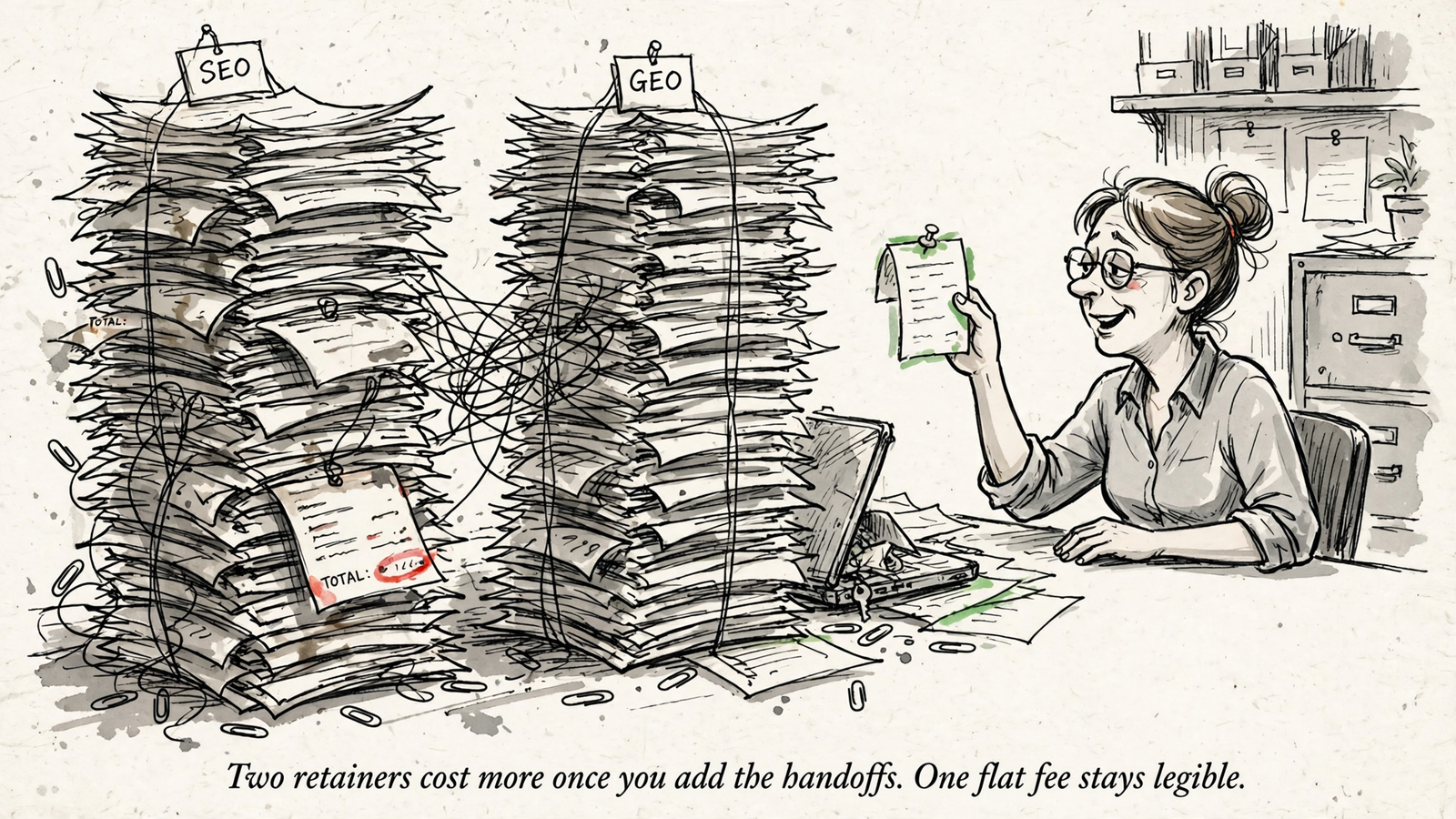
Verdict: choose the team that ships and answers for it
For most businesses I work with, the unified provider wins. Not because unified sounds tidier. Because ownership is the constraint. One provider researches the question once, publishes the page, fixes the technical issue, pursues the third-party mention, and reports rankings and AI citations from one prompt set. When groas handles that as one scope, I know who to call when a page ranks but never gets cited, or gets cited but never drives a call.
With two vendors, that call can become a meeting. Each side brings a report showing its part worked. You leave with two invoices and no answer about pipeline. Count engines in the proposal if you like. Pay attention to who ships the change.

Pick two specialists anyway when the capability gap is real and you can name it. Your SEO agency might admit it has no genuine multiplatform GEO or citation measurement, while an AI shop brings tested prompt coverage, cited-source mapping, and off-site relationships the SEO team cannot replicate. I have seen that case twice: once with a publisher that needed review-site coverage at scale, and once with a regulated brand where legal approved only one PR firm for mentions. In both, the second fee replaced work. It did not duplicate it. If you cannot write the gap in one sentence on the purchase order, you do not have it. You have hope with a retainer attached.
Take this table into the approval meeting. It compares work and accountability, not engine logos.
| Decision axis | One unified provider | SEO + separate AI specialist |
|---|---|---|
| Buyer question | One brief and one owner for the page | Two briefs can target the same intent; you referee |
| Website changes | One publish queue with clear implementation rights | Two ticket queues need an agreed decision-maker |
| Off-site citations | One named owner for reviews and publications | Ownership must be assigned or the work can fall between scopes |
| Measurement | One prompt set, weekly averages, stated variability | Two methods require shared definitions to reconcile |
| Total cost | One fee and fewer handoffs | Two fees plus the time spent coordinating them |
My choice is one team when implementation is the bottleneck, which it usually is for a business spending, say, $20k a month with no spare dev time. Hire two only when the second brings proof the first cannot: multiplatform prompt data, cited-source mapping, and third-party placements your SEO agency will not get. If the GEO proposal cannot show that distinct scope in writing, the handoffs will eat the fee.
If you run the split anyway, put three lines in the order or do not sign it:
- One owner per URL, with publish rights and a date.
- One shared prompt list of at least 50 buyer questions, measured weekly as mention rate with the variability stated.
- One conflict rule: the team that owns implementation decides the page; the other advises in writing.
I have killed second retainers that refused all three. The ones worth keeping signed them without a fight, because they knew their distinct work would show up in citations and calls, not in slides.