

 LinkedIn

I looked at 69 public reviews for Tinuiti and Directive Consulting across Clutch and G2. The striking part was not the stars. It was how rarely the available text named a measured business outcome such as CPA, ROAS or pipeline. Praise for communication, responsiveness and a great team was much easier to find.
That is the distinction a buyer needs to hold onto: a star rating tells you more about the working relationship than it tells you about the return on your spend. Tinuiti has one public Clutch review, rated 5.0. Directive has 56 verified Clutch reviews at 4.8, plus 12 G2 reviews with a 3.7 average. Those are different amounts and kinds of evidence, not a leaderboard I would use to award an account.
I used to tell clients to check Clutch and G2 as due diligence. I still would, but I was wrong about what that check proves. Here is what I found in the public material, where the count stops being useful, and the five questions I would ask before signing anything.
A five-star review answers a narrower question
A 5.0 on Clutch feels like proof of performance. It is proof that a reviewer gave a high score. There is a gap between those statements, and a buyer can drive an entire paid-search budget through it.
Online ratings tend to attract people with strong feelings, and the resulting distribution can overstate average quality; a MIS Quarterly study describes a J-shaped pattern. That does not mean a positive agency review is insincere. It means a rating is a particular kind of evidence, collected from people who chose to review, through a platform’s questions and scoring system.
Even within this small set, the headline scores resist an easy reading. Directive’s Clutch average is 4.8 across 56 reviews, while the G2 average reported for 12 reviews is 3.7. That gap does not prove why reviewers felt differently. It does prove that quoting one score without naming the platform and review base leaves out information a buyer needs.
Use stars to decide what to read next, not whom to hire.

What I counted, and what I did not
The set contains one public Tinuiti Clutch review, 56 verified Directive Clutch reviews, and 12 Directive G2 reviews described in a cross-platform comparison. That makes 69 reviews in the set, but the accessible material is not equally detailed across it: I could read public Clutch text, while the G2 portion relied on the available summary. I did not treat an absent detail in a summary as proof that the underlying reviewer never mentioned it.
For the text available, I looked for four kinds of statement:
| Bucket | What counted | What it can tell a buyer |
|---|---|---|
| Relationship | Communication, responsiveness, or praise for the team | Whether the client liked working with the agency |
| Process | Onboarding, reporting, or strategy | Whether the work felt organized and visible |
| Platform metric | Clicks, CTR, impressions, or raw leads | Whether activity or an intermediate result changed |
| Business outcome | CPA, contextualized CPL, ROAS, pipeline, revenue, or closed-won results | Whether the review offers a figure closer to the buying decision |
A review can belong in more than one bucket. A good relationship and a better ROAS are not competing claims. I separated them because readers often let the first stand in for the second. I also distinguished mentioning a number from providing a usable business result: a campaign count is a number, but it does not tell you what the campaigns earned. A percentage improvement without spend context may still be too thin for a business case.
This is a reading of public material, not a statistical estimate of either agency’s performance. I have not turned qualitative descriptions such as “most” and “a few” into exact bucket totals that the available material cannot substantiate. The useful question is simpler: when you look past the score, what evidence is actually there?
Tinuiti: a result inside a sample of one
Tinuiti’s public Clutch footprint is one verified review at 5.0 out of 5, collected by phone interview in August 2017 from an anonymous VP of eCommerce. Unlike much of the material in this set, that review does give a performance figure: ROAS moved from under 1 to around 4, and the AdWords buildout grew from 8 to 800 campaigns.
The ROAS figure is worth noticing. The campaign count, by itself, is not a result; it describes the scale of a buildout. And neither figure turns one older review into evidence about the team or delivery a buyer would get now. I cannot compare Tinuiti’s outcomes with Directive’s by placing that single account next to dozens of other reviews and pretending the bases match.
The takeaway is not that Tinuiti lacks results. It is that one public review cannot establish its current results. Ask for evidence tied to the work you would buy, rather than treating a perfect score on one review as the answer.

Directive: more reviews, still few business figures
Directive gives us a larger public record. Clutch lists 56 verified reviews at 4.8 overall, with Quality at 4.8, Schedule at 4.9, Cost at 4.6, and Willing to Refer at 4.8. The most commonly disclosed budget band is $10,000 to $49,999, appearing across 41 reviews. Those details help describe who reviewed the work and how they rated the experience. They do not supply a portfolio-level CPA or a pipeline result.
The public descriptions repeatedly praise the partnership, the team and the process. There are exceptions with figures: one summary reports a 350% rise in conversions in a month; another describes 350 leads per month at 60 days with lower CPL; another mentions improved CPL and paid ROI. I would want to inspect those claims, not dismiss them. I would also want spend, starting point and downstream results before using any of them to forecast my own account.
| Agency | Platform | Reviews in this set | Headline score |
|---|---|---|---|
| Tinuiti | Clutch | 1 | 5.0 / 5 |
| Directive Consulting | Clutch | 56 | 4.8 / 5 |
| Directive Consulting | G2 | 12 | 3.7 / 5 |
Volume makes the review pattern easier to see; it does not make a missing revenue figure appear.
The split: abundant relationship evidence, thin economic evidence
Across this set, the available text gives a buyer plenty to read about the experience of working with an agency. It gives much less to work with on the economics. The Tinuiti review names ROAS. In Directive’s Clutch material, numerical results appear, but they are exceptions to the recurring partnership and process praise. The G2 comparison describes a lower average and complaints about overpromising and accountability; its summaries do not provide a comparable set of business outcomes to tally.
| What the available material emphasizes | What I found |
|---|---|
| Relationship: communication, responsiveness, the team | Frequent praise, particularly in the Clutch material |
| Process: onboarding, reporting, strategy | Common in the Clutch material |
| Platform metrics: conversions or raw lead counts | Specific examples, but not a substitute for revenue context |
| Business outcomes: CPA, contextualized CPL, ROAS, pipeline, revenue | Much less visible than relationship or process praise |
I will not give that last row a made-up percentage. The public Clutch text and the G2 summaries do not support a clean, review-by-review fraction across all platforms. The distinction still matters. A reviewer saying “great team” is reporting a real part of the purchase, not answering whether the spend paid off. If you work with an agency every week, responsiveness matters. I have managed enough accounts to know what silence does to a client relationship. But a pleasant relationship and a profitable account are separate tests.
That is why I would not use the 4.8 Clutch score or the 3.7 G2 score as a verdict on Directive’s delivery. The first may reassure a buyer about working relationships; the second is a reason to ask pointed questions. Neither tells the buyer what happened to qualified pipeline.
Why the platforms collect what they collect
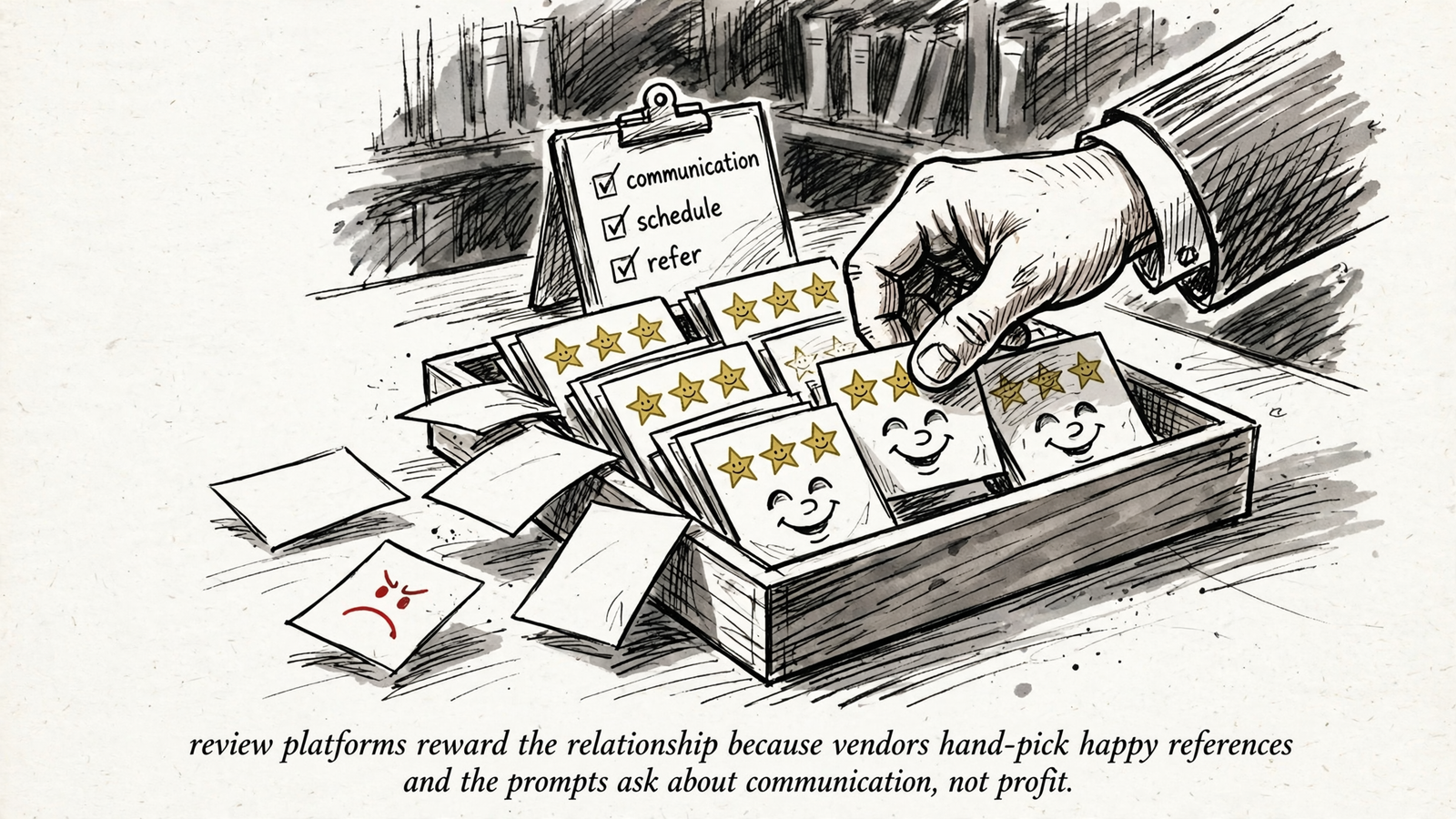
The review process helps explain the emphasis. A description of Clutch’s system says vendors submit references for contact, and that its rankings give weight to reviews alongside factors such as recency and project size. Clutch also asks reviewers to assess quality, schedule, cost and willingness to refer. Those are useful questions. They are not the same as asking for CPA before and after a restructure, or revenue attributable to a campaign.
There is an incentive for agencies to collect reviews from clients willing to speak. There is also a natural reason for a client to talk about what they experienced most directly: calls, reports, turnaround time and the people in the room. None of that makes the review worthless. It tells you where to stop drawing conclusions from it. If the text says the team communicated clearly, count that as evidence about communication. Do not quietly promote it into evidence about profit.
G2 describes identity checks, human review and rules for labeled incentivized reviews. Those safeguards address who is reviewing and how reviews are collected; they do not turn a satisfaction score into an account audit. The lower G2 average in the Directive comparison is a reminder to read across platforms. It is not a license to assume one platform has found the agency’s “true” score.
Read the words for the risk they describe. Then ask for separate proof of the outcome you need.
Five questions that recover the missing evidence
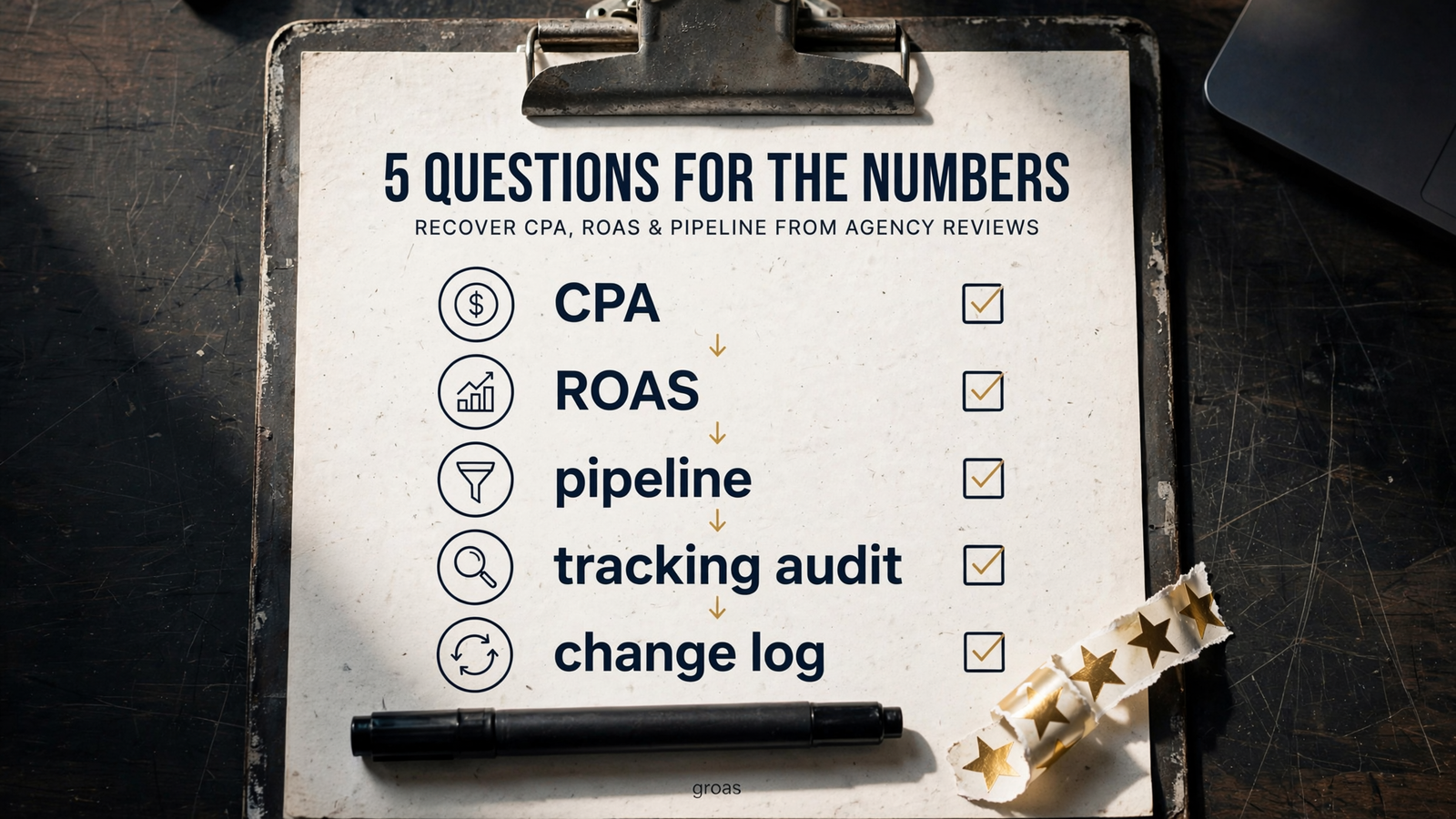
Stop using stars as the final filter. Use them to prepare better questions. If a reviewer praises communication, ask what the agency communicated and what changed afterward. If a review reports more leads, ask whether those leads became qualified opportunities. SaaS paid-search buyers are advised to look at cost per SQL, demo-to-close rate, pipeline contribution and CAC payback rather than stopping at clicks or CPL. The broader point applies here: choose the measure that reflects the business decision, then make the agency show how its work reaches it.
- What metric will you optimize toward, in writing? If the answer stops at raw leads or CPL, ask why. For a business that can measure qualified pipeline, ROAS or closed-won revenue, a cheaper lead is not automatically a better lead. Put the agreed outcome and its definition in the agreement.
- How will you connect Google Ads to our CRM? Ask which fields matter, how the data moves and who owns the connection when it breaks. If nobody asks how a lead becomes a customer, expect the reporting to stop where the ad platform stops.
- What will the tracking audit cover before you change bids? Ask about enhanced conversions, GA4, offline imports and attribution windows. Otherwise, a confident optimization plan may be built on an incomplete picture of which conversions count.
- Can you show a comparable before-and-after with spend attached? Ask for a client at a similar stage, with a similar budget band and sales cycle. Look for CPA, ROAS or pipeline alongside the starting point and spend. A logo slide or an isolated percentage is not enough.
- Can you show the last 30 days of changes, with reasons? Ask what changed in bids, keywords, budgets, ads and pages, and why. A monthly checklist of delivery standards gives you a better inspection tool than another testimonial.
These are not trick questions. A good operator may need to protect client details, but they should be able to explain the measurement chain and show how decisions were made. The buying decision is not “Which agency has the warmest reviews?” It is “Which one can connect its actions to the outcome I am paying for?”
Ask for the change log, not another testimonial
A testimonial tells you how the work felt. A change log lets you inspect what happened to the account. Ask for timestamped edits and the reason for each one: search terms that prompted negatives, bids that moved, budgets that shifted, ads that were tested, or pages that were changed. Then ask which measured result followed. The order matters. A result without the decision behind it is a sales claim; a decision without a measured result is activity.
That is the standard behind groas’s approach: continuous work across bids, keywords, pages and citations, with actions logged alongside their reasoning. I would rather inspect that trace and read a plain-language account of what changed than pay for polished reporting that cannot get past clicks. If an agency cannot show a comparable trail, five stars do not fill the gap. They only tell you that somebody liked the experience while the work was happening.
There are hard limits to this count. Tinuiti’s single Clutch review cannot be compared with Directive’s 56 Clutch reviews and 12 G2 reviews as though they were matched outcome samples. Public text leaves out private project details. The G2 summaries leave less review-level detail to inspect than the Clutch pages. And Directive’s commonly disclosed Clutch budget band of $10,000 to $49,999 gives buyers outside that range another reason not to treat the average as their forecast. I am not turning these reviews into a verdict that Directive or Tinuiti is good or bad at paid search.
I am making a narrower call: use reviews to investigate the relationship, then require evidence of the economics. Read the praise and complaints. Ask the five questions. Hire the team that can name the outcome, explain the measurement, show the changes and put spend beside the result. If the answer to a request for that evidence is another star rating, you have learned what the review proves. For more on that distinction, read why Google Ads agency reviews on G2 and Clutch can mislead buyers. Hire on the numbers the reviews leave out.