

 LinkedIn

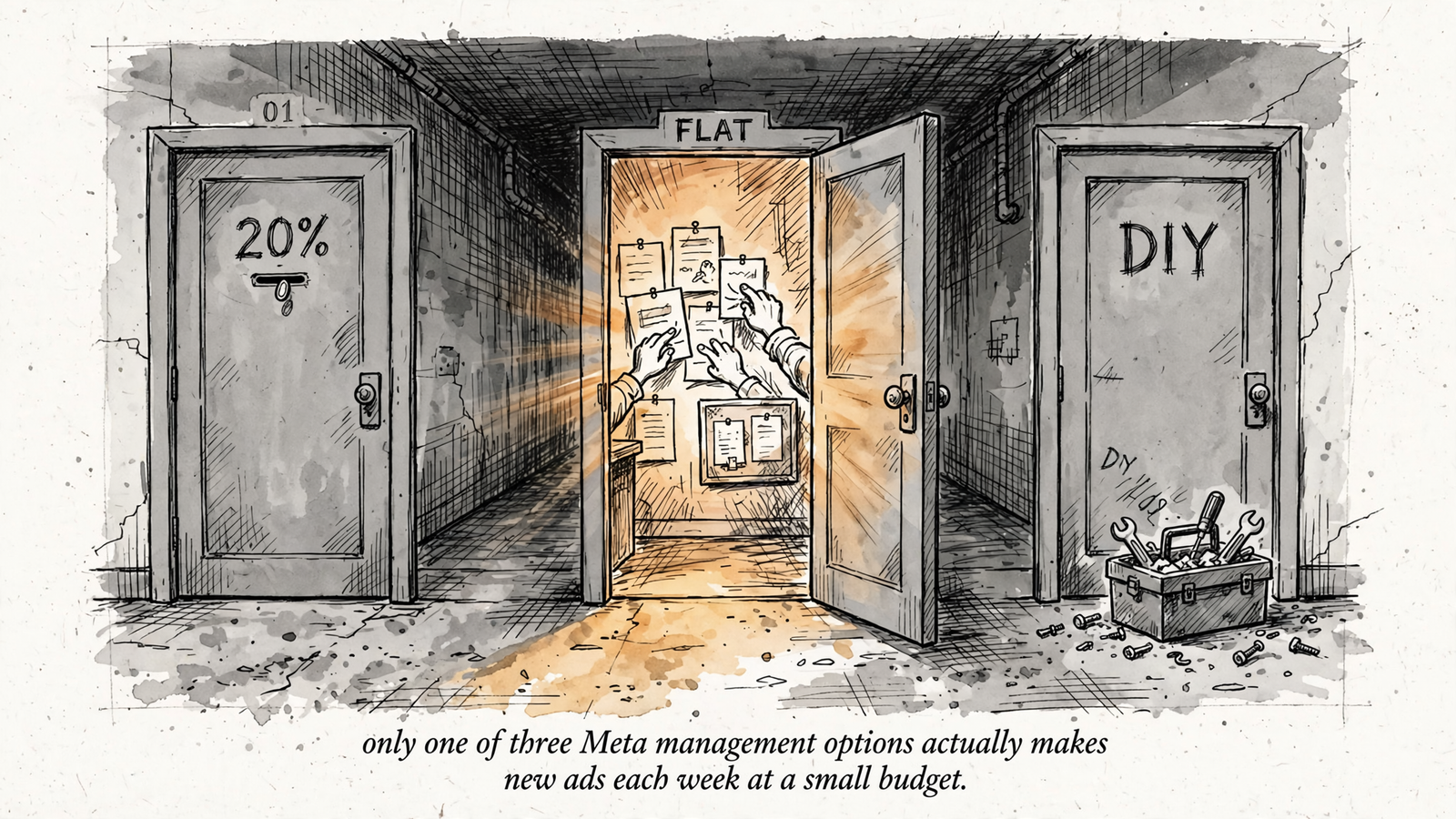
You spend $5,000 a month on Meta and need someone to keep your ads fresh. Your choices are a traditional agency quoting 20% of spend with a $2,000 minimum, a flat-fee service at $1,499 with creative included, or a $119-a-month tool that helps optimize ads you build yourself. If you run a growing business spending $2k to $15k a month on Facebook and Instagram, this is your head-to-head.
Here is the deciding question: who produces and replaces your ads every week, and what do they earn when you spend more? On Meta, where broad targeting and Advantage+ put more weight on the ad itself, fresh creative is not a side task. I managed accounts like this by hand for years. The account with a steady supply of tested concepts has something to work with; the account leaning on two tired winners does not. At $5k, the fee model tells you a lot about which account you are buying.
The contenders: management, management with creative, or a tool
The percent-of-spend agency is the familiar option. Pricing commonly runs 15% to 25% of spend with $2,000-plus minimums, sometimes with a $1,500 to $5,000 setup fee. At $5k, a 20% quote is $1,000 on paper. If the contract has a $2,000 minimum, you pay $2,000. The headline rate is not your rate. Other agencies use different floors: one pricing comparison lists WebFX at $975 or 15%, whichever is greater. Read the minimum before you compare percentages.
I used to sell this model. I was wrong about who it serves. At $50k in spend, a percentage fee can pay for a team. At $5k, a minimum may buy account maintenance and a monthly report without funding a dependable stream of new ads. What the deck calls “dedicated management” can look a lot like triage. The scope matters more than the slide.
The flat-fee done-for-you service charges one monthly management fee rather than taking a cut of spend. groas lists Meta Ads management at $1,499 a month, including work on Facebook and Instagram audiences, budgets, and ads, with new ads tested and winners scaled. There is no setup fee; service is month to month, with a 7-day money-back guarantee. Do not mistake flat fee for creative included, though. Honest Ads charges $599 a month for up to $5k in spend and uses your content. That may suit a business already making ads. It does not solve a creative shortage.
The self-serve optimisation tool is the Madgicx-style route. Madgicx Pro is listed at $119 a month on the $2.5k-to-$5k tier and $129 on the $5k-to-$10k tier, with Tracking Pro adding $49. At $5k, the base subscription is about 2.4% of spend. It can analyze what you build; it does not shoot UGC, write your angles, or replace the person who decides what to launch. I like tools for auditing. I would not put one in the same column as management without counting the operator.
1. Creative output: who makes the next ad?
On Meta, broad audiences with strong, varied creative can outperform narrow segmentation. Advantage+ makes the ad itself an important delivery signal. When audience controls do less of the work, creative remains an input you can directly change. That is why I ask about ads shipped before I ask to see a targeting diagram.
A working creative pipeline means making, testing, and retiring ads. Guidance for spotting fatigue suggests planning for 2 to 4 new creatives a week. The same guidance describes strong ads lasting 10 to 20 days at $200 to $500 a day, and 7 to 14 days at $1,000-plus a day. Those are planning ranges, not a promise that every account needs an identical production schedule. They do make one thing clear: a launch batch is not a monthly creative plan.
Here is what each option does with that work:
- Percent-of-spend agency: Ask whether writing and producing new ads is in the fee. A small-account minimum does not, by itself, buy a weekly creative pipeline.
- Flat fee with creative included: The fee does not increase each time a new ad enters the schedule. That makes a target such as 8 to 12 new ads a month a scope question, not an automatic extra bill.
- Tool: It can flag performance and help you analyze tests. You still need someone to make the next ad.
Do not let anyone swap variants for concepts without saying so. Three crops of the same tired video are three files, not three new ideas. Ask who writes, edits, launches, and kills the ads, and ask how many genuinely new concepts the proposed fee covers. If nobody owns replacement creative, nobody owns the main job.
2. Fees as spend grows: what gets bigger besides the invoice?
At a $3,000 monthly budget, a $2,000 agency minimum is about 67% of ad spend before a dollar reaches Meta. At $10,000, a 20% to 25% fee is roughly $2,000 to $2,500. At $30,000, a 15% to 20% fee is $4,500 to $6,000. That rising invoice may be fair if the agency supplies more senior time, production, and testing. It is not proof that it does.
I have watched accounts grow without the creative schedule growing alongside them. More budget gave the same people a larger number to watch. If the agency earns more when spend rises, ask what additional work you receive when it does.
The comparison below keeps ad spend separate from management costs. Tool labor is illustrative, using the draft’s 8 hours at $60 to $110 an hour at $3k and 10 hours at $10k. It does not include the cost of producing creative.
| Monthly ad spend | Percent-of-spend agency | Flat fee with creative | Tool plus your operator time |
|---|---|---|---|
| $3,000 | ~$2,000 minimum; ~67% of spend | $1,499; ~50% of spend | ~$119 plus 8 hours: ~$599–$999 total |
| $10,000 | ~$2,000–$2,500; 20%–25% of spend | $1,499; ~15% of spend | ~$178 with Tracking Pro plus 10 hours: ~$778–$1,278 total |
| $30,000 | ~$4,500–$6,000; 15%–20% of spend | $1,499; ~5% of spend | Subscription varies; 15 hours alone is ~$900–$1,650 |
The flat fee wins this comparison only if the work you need is included. The tool looks cheapest only if you treat your time, and whoever makes the ads, as free. Neither assumption belongs in a budget.
3. Your time: who does the Tuesday-afternoon work?
A tool can make an operator faster. It cannot become one. You still brief creators, cut variants, launch tests, check attribution, and retire fatigued ads. One estimate puts properly running a $5k-plus account yourself at 15 to 25 hours a week. Even a narrower estimate of 8 hours a month to review and act on tool recommendations adds $480 to $880 of labor at $60 to $110 an hour. Add the $119 subscription and you are at roughly $599 to $999 before creative production. That is no longer a $119 decision.
The percent-fee agency takes the account work off your calendar, but check what it puts back. If you attend the report call, chase the next batch of ads, and supply the creative yourself, you are still managing an important part of the operation. You have outsourced the dashboard, not the bottleneck.
A done-for-you flat fee with creative included asks for a different contribution: approve angles, share what sold, and give the team useful business context. With groas, you set goals on an onboarding call and it begins working in your accounts within 24 hours, with a dedicated manager. You still have decisions to make. You should not have to become the person building every new ad.
Count your hours before you call the cheapest subscription the cheapest option.
4. Contracts: how quickly can you leave if the ads stop coming?
Creative output is visible early. You can look in the account and see whether new ads launched, which received spend, and what replaced a tired winner. That makes the exit door part of the buying decision.
Traditional agency agreements can come with 6-to-12-month minimums and 30-to-90-day notice periods. Terms vary, so read the contract rather than assuming a percentage fee buys flexibility. Smaller flat-fee services can differ too: Honest Ads says you can cancel anytime while asking for a three-month minimum to gather signal. groas offers month-to-month service, cancellation anytime, and a 7-day money-back guarantee from checkout.
I would ask every provider the same thing: if the promised creative cadence does not appear, how much more do I owe to leave? A small budget should not be locked into a long wait for work you can already see is missing.
5. Reporting: can you see the work, not just the spend?
Most Meta reports can tell you what you spent, how many impressions you bought, and what happened to CTR. Fine. Those numbers do not tell you whether anyone built a replacement for the ad whose frequency is climbing while its CTR falls. A recommendation to “monitor performance” is not a replacement. It is a sentence.

Ask for one page each week:
- New ad concepts and variants launched.
- Spend and results for each concept.
- Ads retired, and the reason.
- The next three tests and who will make them.
A percent-fee agency may have the people to show this page, particularly on a larger account. At $5k, make them show how the fee funds the work. A tool can give you charts, but you must turn the findings into that next set of ads. A flat-fee service that includes creative should be comfortable being judged on the page. That is the useful point behind this comparison of agency pricing models: incentives matter, but you still need to inspect the output.
The winner at $5k, and who should pick the loser
For a business spending about $5k a month on Meta that wants someone else to run the account and make fresh ads, I would pick the $1,499 flat-fee service with creative included. The percent-fee quote in this comparison costs $2,000 at its minimum without establishing a creative cadence. The $119 tool helps analyze an account that you still have to operate. One option puts creative in the job description at a fixed price. Verify the actual number of concepts in scope, then hold it to that commitment.
The tool is the right call if you already have its missing parts: someone with roughly 10 hours a week for Meta and a reliable source of fresh creative. A founder who edits their own UGC, or a team with a creator sending 10-plus videos a month and a buyer who likes building rules, can make the subscription earn its keep. If you are buying software to avoid both hiring creative help and learning Ads Manager, skip it. You are buying a second job with a dashboard.
A percent-of-spend agency can make sense when the fee buys a real team. At $50k to $100k in monthly spend, 15% is $7,500 to $15,000, enough to scope strategists, designers, and weekly creative work rather than hope they appear. Larger accounts may also want landing pages, CRO tests, and post-purchase surveys. I have run accounts where that breadth made the model sensible. The question is whether the contract promises and delivers that work. At a modest spend, percentage pricing can misalign the agency’s incentive with yours: its fee grows with your spend even if its creative output does not.
My verdict does not change across the $5k-to-$15k band: buy the flat fee if it includes the ads, not merely access to an account manager. At a much larger budget, consider the percent-fee agency when the invoice pays for the team and creative schedule you actually need. If you already own both the operator time and the creative pipeline, buy the tool instead. Those are reasons to choose the other contenders, not reasons to pretend all three do the same job.
The sales-call question that settles it
Ask this, then write down the answer: How many new ad concepts did you ship last month for an account spending what I spend, who wrote and edited them, and what changes if I double spend? If the answer is “your content,” if the provider counts minor variants as new ideas, or if the fee rises while the output stays flat, you have learned more than a polished pitch will tell you.
I used to tell clients creative was their job and media was mine. I was wrong. On Meta, the creative is the media. Buy the model that pays someone to keep making it.