

 LinkedIn
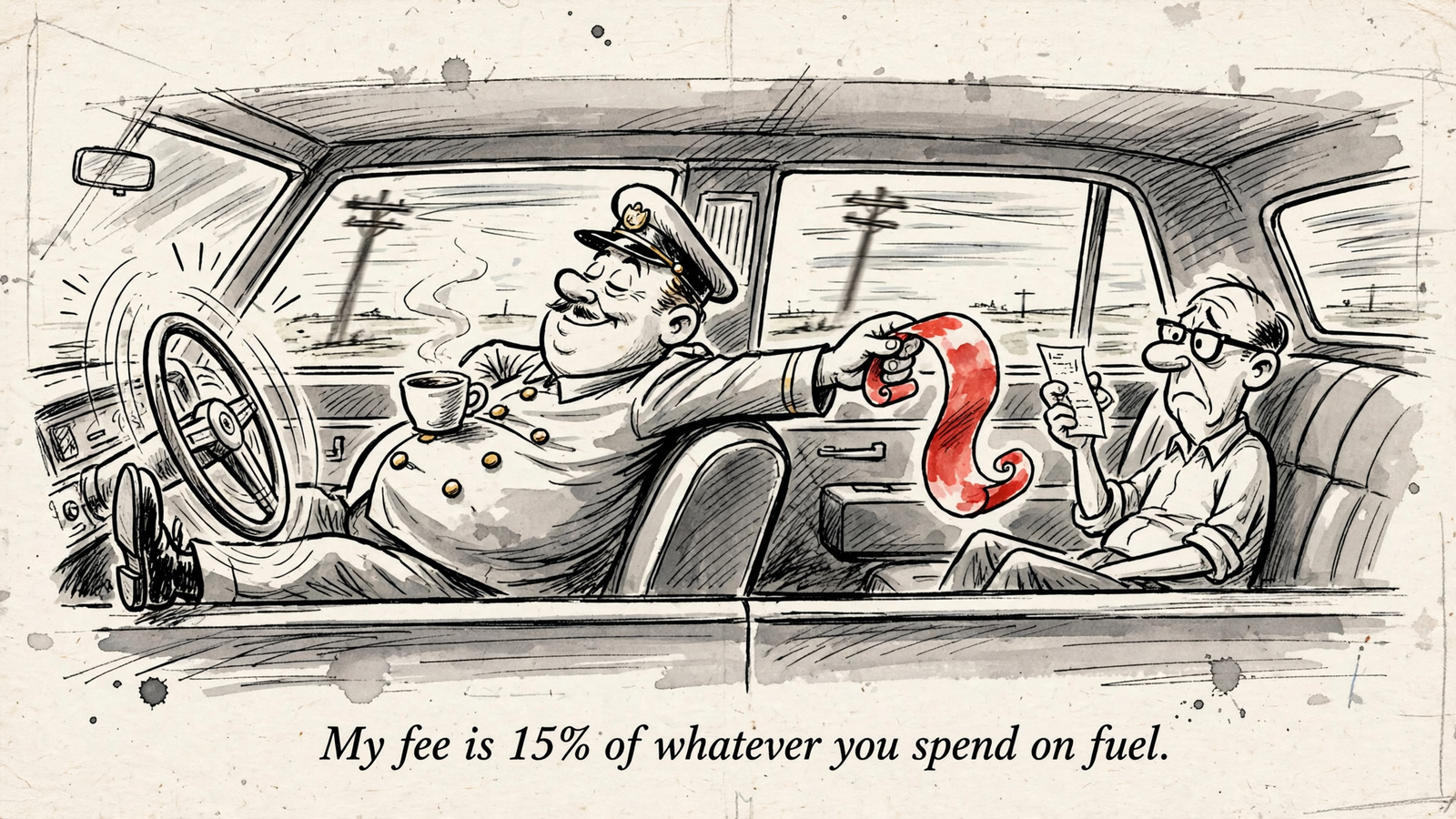
By December 31, 2028, fewer than one in three Google Ads invoices for accounts spending under $50k a month will charge a percentage of spend. Agencies still quote 10–20% of ad spend as a standard rate. For a $20k-a-month advertiser, that is $2,000 to $4,000 a month for management. Autonomous engines now do much of the routine execution continuously. I think that pricing gap closes within two years.
I used to bill that way. I mined search terms at 1am, built match-type structures by hand and babysat bids that Smart Bidding now adjusts thousands of times a day. I told clients that labor justified 15%. I was wrong to think the labor would last. Automated bidding, Performance Max, broad match with audience signals and AI creative have hollowed out the routine adjustments that filled a retainer. That leaves strategy, measurement architecture and experimentation as the defensible work.
Here are four predictions about how the price changes, containing seven dated claims. Each has a test that could prove me wrong.
The cost breakdown before the predictions
At $20k a month in ad spend, a 10–20% management quote runs $2,000 to $4,000 a month before extras. That is a range for the management fee, not an all-in price. Flat retainers run $500 to $2,000 a month for accounts spending $1k to $5k; another guide puts them at $1,500 to $5,000 a month for most businesses. I used to present the quote as one number. It rarely stayed one number.
| Line item | Listed cost | When it recurs | Source |
|---|---|---|---|
| Setup: build, GA4 and conversion tracking | $500 to $1,500 | One-off; described as 10 to 20 hours of work | Catmo Media |
| Execution: negatives, copy tests, bids and budgets | 10–20% of spend, or a typical $1,000 to $3,000 flat fee | Monthly | Semark |
| Reporting: Looker Studio and Supermetrics | $200 to $500 extra; one shop itemizes $250 | Monthly | Catmo Media / Tortoise & Hare |
| Call-tracking administration | $250 | Monthly | Tortoise & Hare |
| Creative production | $100 to $500 per creative | Per unit | Catmo Media |
| Tool pass-throughs | $100 to $300 | Monthly | Catmo Media |
Do not add every row and call it a standard invoice. These are separately listed charges, not a bundle every advertiser buys. The hidden cost is what the headline quote leaves out: which of those items appears later, whether a second channel gets its own fee, and how hard the contract makes it to leave. Some shops charge 15% on Google plus 15% on Meta, so testing another channel adds another percentage fee. A 3- to 12-month term with an early termination fee makes even a tolerable monthly price expensive to escape.
The cheapest mistake is paying a $500 to $1,500 setup fee for a build the next agency does again. The most expensive is renting execution by the percentage for years after much of that execution stops taking human hours. That is the bill I expect buyers to challenge first.
Prediction 1: Percentage fees lose the execution market
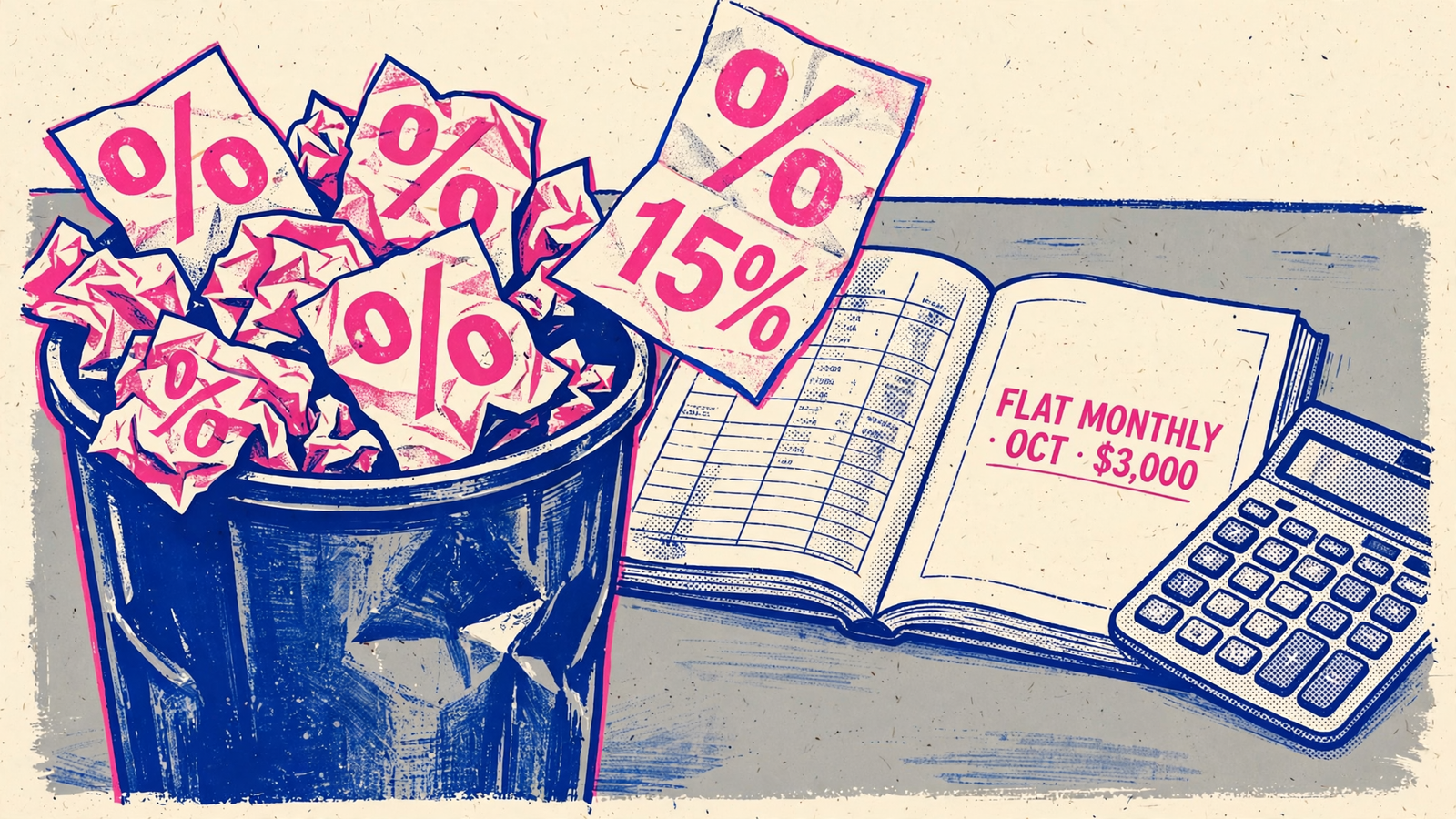
The old fee assumed more spend meant more manual work: more keywords to mine, bids to adjust and ad groups to watch. That connection is weaker when bidding, targeting assembly and budget pacing run inside Google whether a manager logs in or not. At 15%, a $10k account pays $1,500 a month; a $40k account pays $6,000. The question is what the extra $4,500 buys.
Claim 1 — By December 31, 2028, fewer than one in three invoices under $50k in monthly spend use percent-of-spend
The alternative is already visible. groas prices Search Ads at $1,499 a month flat, regardless of spend, with no setup fee and month-to-month terms. Put that beside a percentage quote and the buyer has a reason to ask for an explanation, not just a lower rate. The agency pricing models guide lays out that comparison.
There is a signal beyond one flat-priced offer: labor-based agency pay fell from 54% of arrangements in 2011 to 19% in 2026, while fixed-fee and output-based arrangements rose to 33%. That does not settle my invoice prediction, but it shows the direction of travel. What proves me wrong: inspect 50 public agency pricing pages in December 2028 for accounts under $50k in monthly spend. If at least one in three still leads with percent-of-spend as the default, the headline claim fails.
Claim 2 — By December 31, 2027, the median advertised flat execution fee falls 30%
Once an engine handles negatives, bid adjustments, budget pacing and RSA assembly around the clock, the cost of serving another account no longer tracks those manual hours in the same way. A shop asking $2,500 then has to explain what sits above a $1,499 flat offer. Ryze’s 2026 pricing guide already describes a shift since 2023 as AI automation cuts manual work.
I used to tell clients a flat fee under $1,000 meant corner-cutting. I would no longer assume that without asking what work the fee covers. Equally, I would not sign a long flat-fee contract just because it is not a percentage: an execution-heavy flat can carry the same old labor price. What proves me wrong: compare the median advertised flat for accounts spending $5k to $25k a month in December 2027 with the equivalent 2026 median. If it has not fallen at least 30%, this claim fails.
Prediction 2: Buyers reject the old contract before they reject every agency
A fee model can survive a while on habit. A setup charge and a lock-in are harder to defend when a buyer can put a flat, month-to-month offer beside them. That does not mean tracking or an account build requires no work. It means the seller has to justify charging for that work separately and making the buyer stay.
Claim 3 — By June 30, 2027, AI Google Ads agency becomes a distinct pricing category
Right now the phrase can mean a shop uses Smart Bidding. It can also mean someone pastes ChatGPT ad copy into the same 15% retainer. Neither tells a buyer what happens on Tuesday when nobody is watching the account.
My prediction is that sellers using the label will have to say what runs daily, show what changed and name the human who owns the outcome. groas already offers Search Ads at $1,499 a month flat with no cut of spend. The pressure on agencies that automate the labor but keep the old price is the point of this piece on AI agency retainer margins. What proves me wrong: check the top 20 results for ai google ads agency in June 2027. If most are still generic retainer pages with no execution log, no flat fee and no account of what runs daily, the category has not become distinct.
Claim 4 — By December 31, 2027, setup fees paired with long lock-ins become a minority offer
A build involving keyword mapping, feed work, GA4 and conversion tracking is described as 10 to 20 hours and $500 to $1,500. That work does not vanish because someone writes “AI” on the proposal. But a separate build fee gets harder to sell next to engines that can use account history to set up structure faster and audit tracking on day one.
The lock-in is the sharper problem. Compare a 3- to 12-month term and early termination fee with groas’s $1,499-a-month, month-to-month Search Ads offer, with no setup fee, a launch in under 24 hours and a 7-day money-back promise. The agency has to explain why the buyer should pay to start and pay to leave. What proves me wrong: if most comparable quotes still pair setup fees with long lock-ins in December 2027, I called that shift too early. For a quote in front of you now, do not accept both without a clear reason.
Prediction 3: The deliverable changes from activity to judgment
When routine execution gets cheaper, agencies have two choices: keep presenting it as scarce labor, or sell the decisions that still need an owner. I expect the better agencies to choose the second. I also expect one old deliverable to stop carrying its own price.
Claim 5 — By June 30, 2028, agency proposals lead with strategy and outcome targets
I saw the split in my own accounts. Bid tweaks stopped moving CPA as reliably; measurement fixes still mattered. That fits the account-management argument that strategy, measurement architecture, first-party data and experimentation retain value as routine adjustments lose it.
Expect a proposal to specify senior strategy hours, a testing roadmap, a feed and tracking audit, and a CPA or pipeline target, rather than make negative-keyword work its centerpiece. That is a stronger offer than a per-channel retainer that turns each budget shift into another negotiation; the $8k to $25k-a-month-per-platform pattern shows how expensive that structure can get. What proves me wrong: if most agency proposals examined in mid-2028 still lead with bid management and negative keywords instead of strategy work and an outcome target, I am wrong. Ask which decisions your proposed strategist will own.
Claim 6 — By December 31, 2027, paid reporting add-ons become a minority line item
Someone once had to stitch CSVs into a monthly deck. Looker Studio and a connector can now pipe in the numbers, while an engine that logs changes can show what happened without spending an afternoon assembling slides. A report is still useful. Charging separately to produce it is harder to defend.
Yet one shop itemizes $250 a month for reporting and $250 for call-tracking administration on top of a 20% management fee with a $1k minimum. Other quotes put $200 to $500 a month for reporting outside the headline retainer. A weekly account of actions and reasons, included in the fee, makes a separate reporting charge look like a charge for the invoice. What proves me wrong: inspect 50 itemized quotes in December 2027. If more than a quarter still charge separately for reporting or dashboarding, this claim fails. Strike the add-on from the next quote you review.
Prediction 4: Outcome pricing grows without becoming the default
This is where I argue against my own preference. I want pay-for-pipeline to win. A base of $800 to $2k plus a bonus on ROAS, CPA or volume, or $30 to $50 per qualified lead, at least points the fee toward something a business cares about. It also avoids the ugliest percentage math: moving from $100k to $150k in spend adds $7,500 a month in fees at 15%, whether the extra spend was profitable or not.
Claim 7 — Through December 31, 2028, outcome-linked pricing grows but remains niche
I have tried to write those contracts. They get stuck on definitions. What counts as qualified? Who owns the CRM stage? What happens when tracking misses a call? Ryze’s pricing guide calls pure pay-per-lead rare because clean attribution matters, disputes follow and costs can climb at scale.
Outcome-linked pricing should grow where measurement is tight, especially in local services with recorded calls. I do not expect it to become the default. The longer argument is in the revenue economics of the AI agency model. What proves me wrong: if more than 15% of public pricing pages offer outcome-linked pricing as their standard option in December 2028, I was too cautious. Before signing one of these deals, settle the definitions before you celebrate the incentives.
What to do with your next quote
These are dated claims, not a promise that every agency changes on schedule. If four of the seven fail their tests, my thesis fails with them. You can still test the pricing logic before 2028. On the next proposal:
- Separate execution from strategy. Ask for the hours or work assigned to each, then compare the execution price with a flat engine that works daily. groas prices Search Ads at $1,499 a month.
- Challenge setup plus a lock-in. Ask what the build fee pays for and why you must also commit to a term.
- Put reporting inside the fee. Require a weekly account of what changed and why, rather than paying extra for a deck.
- Cap a percentage fee. Set a spend band with a flat ceiling, or walk.
At $20k in monthly spend, a 15% quote is $3,000 a month. If the proposal cannot connect that fee to CPA, pipeline or revenue, you may be buying monitoring at manager prices.
I kept one habit from my 1am negative-keyword years: I check what changed in the account this week and what it did to CPA. Ask your next agency for those same two lines before you sign. The one that answers in specifics is the one to keep. The one that answers with a deck is the reason percent-of-spend dies. Apply for the flat trial, run it against your current fee for 30 days, and keep the winner.