Autonomous Ad Budget Allocation: Cost and How It Works FAQ
Wasting ad budget and can't optimize fast enough? How real-time AI budget allocation works, what autonomous setup costs, and what to use at scale.
September 28, 2026
•
min read



Percentage-of-ad-spend pricing does not align an agency with your growth. It pays the agency more when you spend more, and less when it finds a way for you to spend less. I spent nearly a decade managing Google Ads accounts, and I have heard this arrangement sold as shared incentive more times than I care to count. It is a commission on your costs dressed up as a partnership.
The line is familiar: “We only win when you grow.” It sounds reasonable until you notice what the contract measures. The agency’s fee rises with your ad budget, not your attributable revenue or profit. Those are different numbers, and making one bigger does not guarantee the others will follow.
Spending more is also the easiest task in a search account. A buyer can raise a budget, loosen match types, expand broad-match reach, or increase target bids quickly. None of that, by itself, creates qualified pipeline. Yet under a percentage contract, the agency’s invoice rises as soon as the spend does. The bill rewards the input, not the result.
The penalty for doing useful work runs in the opposite direction. One waste audit across 43 enterprise SaaS ad accounts reported an average of 36.1% of spend going to non-converting search terms and bot traffic. Take a simpler, rounded example: at $30,000 a month in spend, a 15% management fee is $4,500. If negative-keyword work helps cut $10,000 in wasted spend and the budget falls to $20,000, the fee falls to $3,000. The client keeps $10,000 a month. The agency gives up $1,500 a month for finding the waste.
I am not saying every manager will refuse to make that cut. I am saying the contract makes the right decision financially painful for the company employing that manager. If your agency finds waste, it should not have to choose between cutting it and protecting its fee.
Picture an ad group spending $3,000 a month on marginal leads at an acquisition cost you cannot defend. Cutting it removes $450 a month from a 15% agency fee. Fixing it may take landing-page tests, offer changes, and negative-keyword pruning. Leaving it alone takes a pacing check. The contract does not make a manager lazy, but it makes the lazy choice profitable. Waste can sit there long enough to acquire a respectable name, such as “necessary baseline volume.”

An audit of an $80,000-a-month B2B account offers a sharper example. According to the account described, $22,000 a month was going to keywords that had generated no pipeline over a 90-day window. After an external audit cut the budget to $58,000, ROAS rose from 2.4x to 3.9x over 60 days. The account had carried the spend for three quarters. I cannot tell you what the previous agency’s managers were thinking; I can tell you that a spend-based fee gave their business no financial reason to welcome the cut.
The same problem appears when a campaign deserves more budget. At 15%, moving from $20,000 to $40,000 in monthly spend moves the management fee from $3,000 to $6,000. Sometimes more spend means more work. But doubling a budget does not automatically double the work of maintaining campaign structure, reviewing search terms, checking conversion quality, and testing the next change. Automated bidding already handles auction-time decisions. If the additional $3,000 buys additional work, the agency should be able to name it.
That is my objection to the model: the fee rises automatically; the value has to be argued for afterward.
Start with the total. At $20,000 a month in media spend, a 15%–20% management fee adds $3,000–$4,000 a month, for a recurring commitment of $23,000–$24,000 before other charges. Agency pricing in that range is the basis for this example. If the illustrative reporting and landing-page charges in the draft quote also apply, the management-side monthly bill becomes $3,650–$5,900, and the total including media becomes $23,650–$25,900. Setup is separate: it is a one-off charge, not another monthly fee.
That distinction matters because a vendor can advertise one percentage while the costs of running and measuring the account sit elsewhere. These add-ons are not a claim that every agency charges every item. They are the lines to check in the agreement, rather than discover on the second invoice.
| Cost at $20,000 in monthly ad spend | Frequency | Percentage-fee example | Flat-fee comparison | Basis |
|---|---|---|---|---|
| Media spend | Monthly | $20,000 | $20,000 | Illustrative budget used throughout this comparison |
| Management | Monthly | $3,000–$4,000 | Fixed monthly fee; ask for the quoted amount | 15%–20% agency-pricing range |
| Setup and onboarding | One-off | $1,500–$5,000 | $0 with groas | Agency setup-cost example; groas terms described in this article |
| Reporting licenses | Monthly, if billed separately | $150–$400 | Confirm what the quote includes | Illustrative add-on from the draft cost example |
| Landing-page and conversion work | Monthly or hourly, if outside scope | $500–$1,500 in this example | Confirm scope before comparing quotes | Illustrative add-on from the draft cost example |
| Total, including media and the illustrated monthly add-ons | Monthly | $23,650–$25,900 | $20,000 plus the quoted flat fee and any work outside scope | Sum of the monthly rows above; excludes one-off setup |
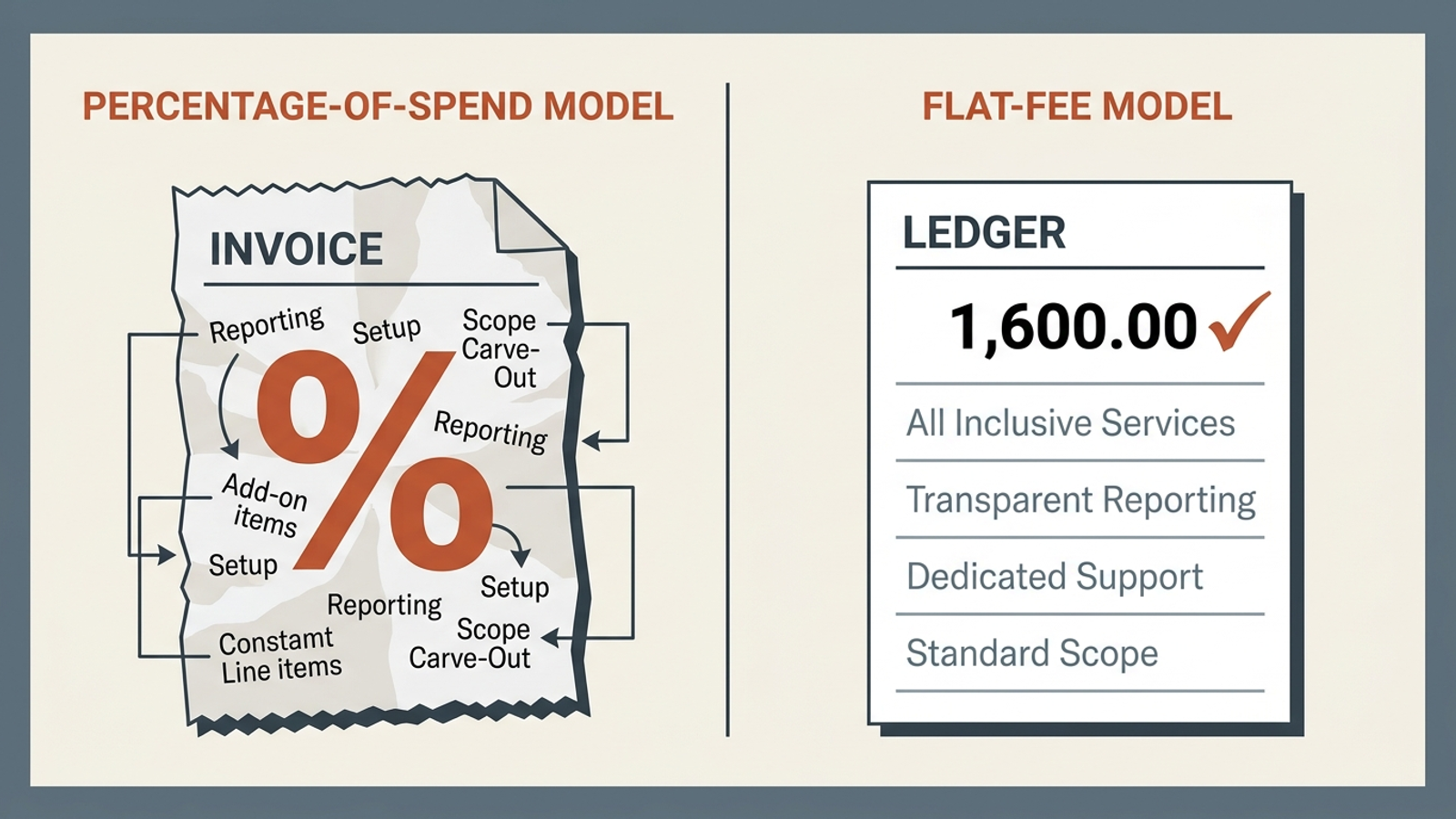
The base fee is the listed cost. Work excluded from that fee, separate software charges, and time spent chasing unclear invoices are the hidden costs. Do not fold a one-off setup bill into a recurring monthly figure without saying how you did the calculation. And do not compare a percentage quote loaded with add-ons against a flat quote without checking what each includes. The honest comparison is what you pay for the work you need.
The crossover calculation is simple, provided you use a real quote. Divide the flat monthly fee by the agency’s percentage rate; that gives you the spend level where the base fees match. As an illustration, a $2,000 flat quote and a 15% agency fee meet at about $13,333 in monthly ad spend. That $2,000 is an example, not a stated groas price. At $20,000 in spend, the percentage fee is $3,000, or $1,000 more than that illustrative flat fee. At $50,000, it is $7,500, or $5,500 more. Scope and add-ons still matter, but the percentage fee’s direction is fixed: it climbs with spend whether or not the workload climbs with it.
Software does not automatically remove the toll. Some PPC automation platforms charge 2%–5% of managed spend. Some entry subscriptions rise at spend thresholds. A low starting price can therefore become a different bill once you scale. Ask for the price at your current spend and at the spend you hope to reach; the entry price alone tells you very little.

Agencies can obscure the same issue behind automation. Tools may reduce manual work while the client’s percentage fee stays tied to spend. We covered that gap in why AI Google Ads agencies are not passing savings to clients. Automation is valuable when it improves execution. It is not, on its own, a reason for the client to pay a growing commission for unchanged work. One business owner describing a 20% fee on $2,500 in monthly spend reported seeing one minor budget adjustment over 30 days. An account can be stable and still require judgment. It should also be possible to see what that judgment is buying.
The cheapest mistake here is a one-off setup charge for a build that does not earn its price; in this example, that starts at $1,500. The expensive mistake is leaving an uncapped percentage fee attached to a growing account without asking what the increases buy. At 15%, moving from $20,000 to $60,000 in monthly spend adds $6,000 to the monthly agency fee. Let that happen month after month without more useful work or better outcomes, and the recurring charge dwarfs the setup bill.
There is one appealing argument for percentage pricing: a small advertiser might pay very little for experienced management. At $2,000 a month in spend, 15% is $300. If an experienced marketer will build and manage the account well for $300 a month, that is an attractive deal for the buyer.
The catch is the minimum retainer. Percentage-based agencies commonly set minimum monthly fees; the range in this draft is $2,000–$4,000. If that minimum applies, the $300 example is not the price you pay. You are paying a flat floor with an automatic increase waiting for you when spend grows. I have more respect for a plainly stated flat fee than for a contract that calls itself percentage-based only when the percentage produces the higher invoice.
For an established account, the small-budget argument is beside the point. If you are paying for strategy and execution, pay for those things. Do not assume a commission on media spend measures either one.
Skip the polished account screenshots for a moment. Ask what happens to the invoice when the manager makes a decision that is good for your business but bad for spend:
These questions are not an argument against human expertise. I have done the account work, including the repetitive parts nobody puts in a strategy presentation. A good strategist should be paid for judgment, and a good operator should be paid for execution. What I will not defend is charging more merely because the client can afford to put more money through the account.
That is why we built groas around a flat monthly fee, no onboarding charge, continuous execution by specialized AI models, and a named human strategist responsible for direction and guardrails. The price does not rise as a percentage of your media spend. The point is not to make the invoice look tidy. It is to let the work pursue better search outcomes without charging a toll on every increase in budget.
Keep paying a percentage if you want. Just know what happens when the account has waste to cut: the contract asks your agency to reduce its own revenue before it reduces your costs. Ignore that incentive long enough, and you may spend another quarter paying someone to keep the bad keywords alive.