

 LinkedIn

The Meta agency proposal says 15% of spend. At a $5,000 monthly budget, the same document charges you a $2,000 minimum, $2,500 to get started and extra for new creative. I built this illustrative composite from common proposal terms because the percentage is the easiest line to read and rarely the line that decides what a small or growing business pays.
We already covered the fee math in When Does a $1,499 Flat Fee Beat a Meta Ads Agency?. Knowing where a flat fee beats a percentage is only half the decision. This time, I’m reading the whole quote: the minimums, setup charge, contract terms and add-ons that can cost more than the headline rate.
The seven-line proposal on the desk
This is not one agency’s quote. It is a composite, using illustrative terms to show how the lines interact. In the order you encounter them, the proposal offers 15% of Meta spend with a $2,000 monthly minimum; $2,500 for setup; a six-month initial term with auto-renewal; limited creative work; weekly reporting; a lower rate above $50,000 in spend, available only if you ask; and campaigns run through the agency’s Business Manager.
The terms sit within published pricing ranges. One pricing breakdown puts percentage fees at 15–20%, with $1,500–$3,000 minimums. Another lists starter tiers at $2,000–$3,500 and 20–25% for $5,000–$15,000 in spend. A small-business breakdown puts management at $500–$3,500 a month, plus $500–$2,500 for setup. I chose terms a business spending roughly $5,000–$12,000 a month might plausibly encounter. If your quote looks cheaper on page one, check where the cost moved.
Line 1: The 15% fee has a $2,000 floor
Management: 15% of ad spend, $2,000 per month minimum.
You pay whichever number is higher. At $5,000 in Meta spend, 15% is $750, so the minimum takes over. Your management bill is $2,000: a 40% effective rate, not 15%. At $8,000 in spend, you still pay $2,000, or 25% of media. The percentage does not become the operative fee until spend passes roughly $13,333.
I used to quote minimums myself. I told clients they were paying for senior attention on small accounts. What they were also paying for was my floor, whether or not the account needed that much work.
Minimums are hardly unusual. One industry breakdown says 5.15% of social providers had no minimum and 39.02% set retainer minimums of $1,000–$3,000 a month. For comparison, groas lists Meta Ads management at $1,499 a month regardless of spend. At $5,000 in spend, the composite’s management fee is $501 more each month, or $6,012 over a year, before the rest of the proposal enters the picture.
Verdict: The minimum makes this a poor fit for a modest budget unless the agency can justify the difference or lower the floor. Ask what spend level retires the minimum, and get the answer in writing.
Line 2: The $2,500 setup fee arrives first
One-time setup, $2,500: account audit, pixel check, launch build.
The charge lands before an ad serves. One pricing guide puts setup at $1,500–$5,000 for audit, strategy and launch work; another puts onboarding around $1,000–$3,000 and includes audits, pixel, Conversions API and reporting work. None of that makes setup automatically unreasonable. It does make the deliverables worth reading. An audit PDF and a pixel check are not the same job as a full rebuild.
I used to charge setup to cover the unbillable first two weeks. That was honest. It still meant the client started $2,500 behind before we knew whether the offer converted.

At $5,000 a month in media, setup equals half a month of ads. Spread across the six-month term in this proposal, it adds about $417 a month to the cost of management. groas lists no setup fee and month-to-month terms, so that entry charge matters in a comparison.
Verdict: Setup is tolerable if the scope names the builds, the pixel and Conversions API work, and who keeps the work when you leave. Do not pay for a vague “launch process” and assume it includes all three.
Line 3: Six months turns a test into a commitment
Initial term: six months, then auto-renews. Cancel with 30 days’ written notice.
This is calendar risk. At the $2,000 monthly minimum, six months commits you to $12,000 in management fees before you know whether the cost per acquisition works. Add setup and the initial commitment is $14,500, excluding media and creative.
Long terms are common: one pricing guide describes six- to twelve-month minimums and 30- to 90-day termination notice. Common does not mean harmless. A business moving from $5,000 to $10,000 in monthly spend can see its needs change while the contract stays put. A contract checklist likewise flags minimum commitments, notice periods and performance clauses as terms to read before signing.
The auto-renewal line needs its own question: when must notice arrive, and what happens if you miss that date? “30 days” is not much help if you do not know what it counts back from.
Verdict: This line turns a bad test into a bad half-year. Push for month-to-month terms or a 30-day exit if CPA misses an agreed target for two straight weeks. At minimum, multiply the monthly floor by the initial term and add setup. That is the commitment on the page.
Line 4: “Creative billed separately” changes the comparison
Management covers optimization, resizing and copy tweaks. New video, design and UGC billed separately.
This is where a management-fee comparison can stop being useful. The agency will work with existing assets, but the proposal does not promise to produce the new ones. One pricing guide lists video at $2,000–$10,000 per project, design at $500–$2,000 a month, copy at $1,000–$3,000 a month and UGC acquisition at $1,500–$5,000 a month. Another puts individual UGC videos around $150–$500+ and professional production at $1,000–$3,000+ a month.
Those prices are not automatically unfair. New creative takes work. The problem is comparing a media-management retainer with another service before establishing who supplies the ads. Say your plan calls for two UGC videos a month at an illustrative $300 each. That adds $600 to the $2,000 minimum. Over six months, management and those videos cost $15,600; with setup, the total is $18,100, excluding media.
groas lists new ads tested and winners scaled within its $1,499 Meta Ads fee. That describes testing and scaling; it does not, by itself, answer who produces a new video. Ask the same production question of every proposal before comparing totals.
Verdict: This line fails if creative is essential to the plan but its scope and price are missing. Get the number of new ads, who makes them and the price of anything extra in writing. A fee comparison without creative scope is an incomplete comparison.
Line 5: The report counts activity, not outcomes
Weekly reporting: spend, reach, CTR, leads.
Those four numbers tell you ads ran and people responded. They do not tell you whether the response paid for the work. I sent reports like this early in my career. Reach and CTR can make a week look busy while CPA remains stubbornly high. “Leads” needs a definition too: which event counts, and does anyone check whether those leads become customers?
Ask for bookings and sales alongside reach and clicks. Ask what the Pixel and Conversions API track, whether purchase values appear, and how you can check attribution. If your business uses a CRM, establish who verifies the reported conversions against it.
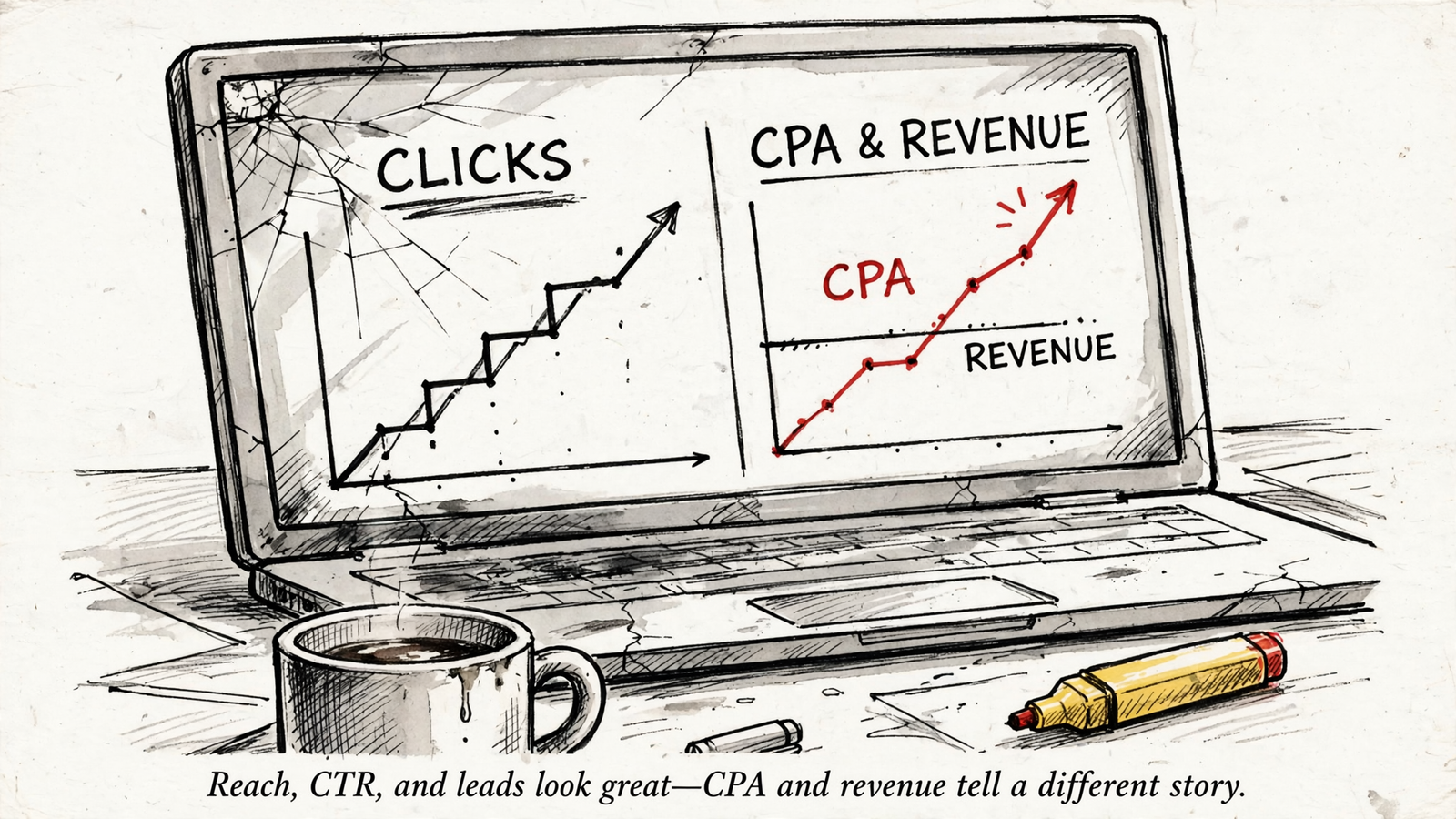
Verdict: The line fails as written. A weekly status update is fine, but it is not an accountability measure. Name the numbers that decide renewal: CPA, ROAS tied to actual revenue, and how many ads shipped that month.
Line 6: The lower rate does not activate itself
Rate drops to 12% above $50,000 in spend, on request.
The discount is real on paper. Once the lower tier applies at $50,000 in spend, 15% would be $7,500 and 12% would be $6,000: a $1,500 monthly difference. But this proposal says above $50,000, not at $50,000, and requires you to ask. The threshold and the request both matter.
Tier tables often keep smaller budgets on higher rates. A published table puts its Starter tier at $5,000–$15,000 in spend and $2,000–$3,500 or 20–25% in fees, with lower percentages in higher tiers. A published hybrid example charges the greater of $975 or 15% of spend, so its floor governs the bill until spend clears it. I once told a client a lower tier would kick in automatically. It did not; the account needed a new quote.
Verdict: The tier is the one idea here I would keep, but this wording fails. Specify the exact trigger, when the new rate takes effect, who monitors spend and whether a request is required. A discount you have to remember to claim is not much of an operating system.
Line 7: The account determines how cleanly you can leave
Campaigns run in the agency’s ad account. Creative files delivered on request.
The last line is not a management fee, but it can make leaving harder. An ad account created inside a Business portfolio cannot be transferred. If campaigns run in the agency’s account, you need to know what happens to account history and any associated assets when the contract ends. “Files delivered on request” also leaves you doing the asking after you have decided to leave.
The cleaner arrangement is a client-owned account, pixel, domain and Page, with the agency given partner access. Put ownership of audiences, creative files and landing-page work on the same list. A contract checklist specifically calls for account, Pixel, audience and notice terms in writing.
Verdict: This line fails until the proposal says what you own and what access the agency loses on exit. A six-month term ends on a calendar. An account you cannot take with you is a different kind of lock.
The total on the quote is not 15%
At $5,000 a month in media, the composite charges $2,000 for management, an illustrative $600 for two UGC videos and about $417 a month when the $2,500 setup is spread across the six-month term. That is about $3,017 a month in fees and creative, or roughly 60% of the media budget. It is not a second percentage charged by the agency; it is the cost of the terms working together. The six-month total is $18,100 before media.
The reporting and ownership lines do not add a neat dollar figure. They still affect the decision. One determines whether you can tell what the spend achieved; the other determines what you keep when you stop paying. That is why I read them after the price, not as fine print beneath it.
Score the lines before you compare the headlines
If you have two or three quotes, give each line 0 to 2 points, where 2 means you would sign it as written. The seven lines make 14 points possible:
- Management: The fee and any minimum work at your current spend.
- Setup: Deliverables are named, and the fee is not paired with a lock-in you cannot accept.
- Term: You have month-to-month terms or a clearly defined performance exit.
- Creative: Included work has a count and a producer; extras have prices.
- Reporting: CPA, revenue and verifiable tracking sit beside activity metrics.
- Tiers: A lower rate starts automatically at a stated spend level.
- Ownership: The account and assets you pay to build remain yours.
This is not a scientific agency rating. It forces seven awkward details onto one page. A low percentage cannot make up for an expensive minimum, and a generous tier cannot rescue an exit you cannot use. Compare the likely total at your spend, not the largest type on page one.
Send back one email before you sign
A proposal should answer these questions without another deck. I would send them together and judge the reply as carefully as the numbers:
- What is my effective management rate at my current spend, including the minimum?
- What does setup build, and what happens to that work if I leave?
- What are the initial term, renewal and notice rules? Is there a performance exit tied to an agreed CPA target?
- How many new ads are included each month, who produces them, and what does one extra UGC video cost?
- Will reporting show CPA and ROAS against actual revenue? Can I verify Pixel and Conversions API tracking in my account?
- At what spend does my tier change, when does the new rate take effect, and must I request it?
- Do I own the ad account, pixel, audiences, Page and creative files? What happens to agency access on exit?
What I would keep from this composite is the tier idea: a rate that falls as spend rises at least points in the right direction. I would rewrite the rest before signing. The minimum makes the advertised 15% meaningless at $5,000 in spend; setup and a six-month term make that expensive to discover; unspecified creative makes the total uncertain; and agency-owned account history makes the exit harder than the cancellation clause suggests.
groas lists Meta Ads at $1,499 a month, with no setup fee and month-to-month cancellation. That is a clearer management-fee starting point, though I would still pin down creative production when comparing scopes. If an agency quote cannot justify its full cost and give you an exit you can actually use, keep shopping.


