

 LinkedIn

The standard ChatGPT ads agency pitch has three selling points: we were first, we specialise, and we manage it for you. I built a composite deck from those recurring claims to test them in the order a buyer encounters them. It contains no named vendor’s deck and no purported quotes. My verdict: being first and specialising do not survive scrutiny. Hands-on management does, but only when the same team owns the Google and Bing budget the test competes with.
I made the case against a standalone specialist in Don’t Hire a ChatGPT Ads Specialist. Hire the Person Who Reads Your Search Terms.. More agencies now market themselves as ChatGPT ads specialists, so the useful question has changed. You are more likely to be comparing their pitches than weighing the idea in the abstract. Let’s read one the way I would read a proposal before handing over a budget.
The artefact: a familiar deck, read front to back
The composite opens with a first-mover claim. Next comes a done-for-you list: strategy, account setup, messaging and creative, landing pages, tracking and reporting. It promises coordination with Google, Facebook and Instagram, then presents a specialist team, a reporting sample, pricing and a case study. That service list and cross-channel promise are common parts of the pitch. One UK vendor adds a qualification worth noticing: it says it manages ChatGPT ads for clients but is not an OpenAI partner.
None of those pages is automatically worthless. The problem is that each asks you to treat a description of activity as evidence of results. I’ll grade the claims in the order they appear, starting with the line designed to stop you scrolling.
Claim 1: “We were first to offer ChatGPT ads management”
What that line signals is access. What it proves is thinner. ChatGPT ads began as a US pilot on February 9, 2026, invite-only through holding groups including WPP, Omnicom, Dentsu and Publicis, with around a $200,000 commitment and roughly a $60 CPM. Self-serve Ads Manager opened in early May 2026 with a $25-a-day floor and a $3 to $5 starting maximum CPC. Being first proves a vendor could get into the pilot. It does not prove they learned anything your business can reuse.
The pattern repeated in India: ads switched on August 27, 2026, with more than 50 brands through WPP and Omnicom as first partners; self-serve opened September 4. That head start was measured in weeks, not years of conversion data. Early access may have been valuable to the vendor. You still need to know whether it produced a useful decision for an advertiser like you.
So ask for three numbers: accounts managed, spend and conversions tied to revenue. Say you spend $20,000 a month on Google. An answer such as 15 accounts, $180,000 managed since May and 1,100 revenue-linked conversions would give you something to examine. “We joined the pilot” gives you a date and perhaps a logo slide. A first invoice date is not a track record.
Claim 2: “You get a dedicated ChatGPT ads team”
A dedicated team sounds like focus. When that team is paid only to run ChatGPT, it can also mean isolation. The Google owner may see a better place for the money; the ChatGPT owner may want another month of testing. Now the client has to referee two dashboards. What the deck calls specialist focus, I call two people doing the same job with half the information each.
The claim holds up only when the team is measured against your existing search baseline and someone can actually move the budget. Ask who decides when money shifts from Google or Bing to ChatGPT, and which qualified-lead or CPA number triggers the move. For instance, if ChatGPT assists three quote requests at a $42 CPA while Google closes them at $31, a $25-a-day test may remain a test rather than become a growth plan. That is the sort of comparison the specialist must be willing to make.
If the team cannot recommend moving money away from its own channel, its expertise comes with a budget conflict. Get the decision rule in writing before you accept the org chart as proof of anything.
Claim 3: “Hands-on management, not just consulting”
This is the only headline in the deck I want to keep. Most decks leave it undefined. Hands-on should answer three questions: who changes campaigns, how often, and where can you see each change with its reason? I want a named operator, a cadence measured in days rather than quarterly reviews, and an action log I can audit. A monthly call followed by a PDF of observations is consulting with a retainer attached.
Check the promise against the account setup. OpenAI tells agencies not to create accounts for clients, offers no manager-account equivalent, and requires the client to create the account and invite the agency. Users can switch accounts but cannot manage several at once. Reporting is country-only, with no conversation themes shared. Ask how the team gets access, logs work without an MCC and shows you what changed when it tightens targeting.
There is a second test: can that same operator act on what the log reveals across the search budget? An excellent record of ChatGPT edits is less useful if a separate Google or Bing owner must approve the obvious budget move. Hands-on means visible changes and ownership of the tradeoff, not merely someone available to take a call.
Claim 4: “We have proprietary prompt targeting”
Forget keywords for a minute. In ChatGPT ads, you write one- or two-sentence context hints at ad-group level; OpenAI weighs those hints alongside the landing page, title and copy in a relevance-weighted second-price auction. There are no match types and no exact-match toggle. A hint guides delivery but does not guarantee it. Higher relevance can outrank a higher bid, so a weak page can undermine targeting before the click happens.
That mechanism makes a secret prompt framework a poor substitute for evidence. In one split, the same ad ran in a Keywords ad group and a Conversational questions ad group; the Keywords group delivered far more often, with slightly higher CTR and lower average CPC. A clever-sounding structure did not beat the plainer one there.
Your existing converting queries are a better starting point than an unexplained formula. Ask the agency to map those queries to its proposed hints and show how your negative list informs the language. The landing pages that already convert and the tracking that attaches clicks to revenue matter too. None looks as good on a slide as “proprietary conversation architecture.” That is not a reason to leave them out.
Claim 5: The sample report
Every deck includes a report. Read it the way I read a search-terms report: find what costs money, then check what the report can prove. ChatGPT reporting gives you impressions, clicks, spend, CTR, average CPC or CPM, and pixel conversions, but no search-term or prompt report for privacy. One setup guide notes that you cannot see performance by context hint and compares the arrangement to Performance Max-style trust in the system. If the sample ends at impressions and CTR, it skips the budget decision.
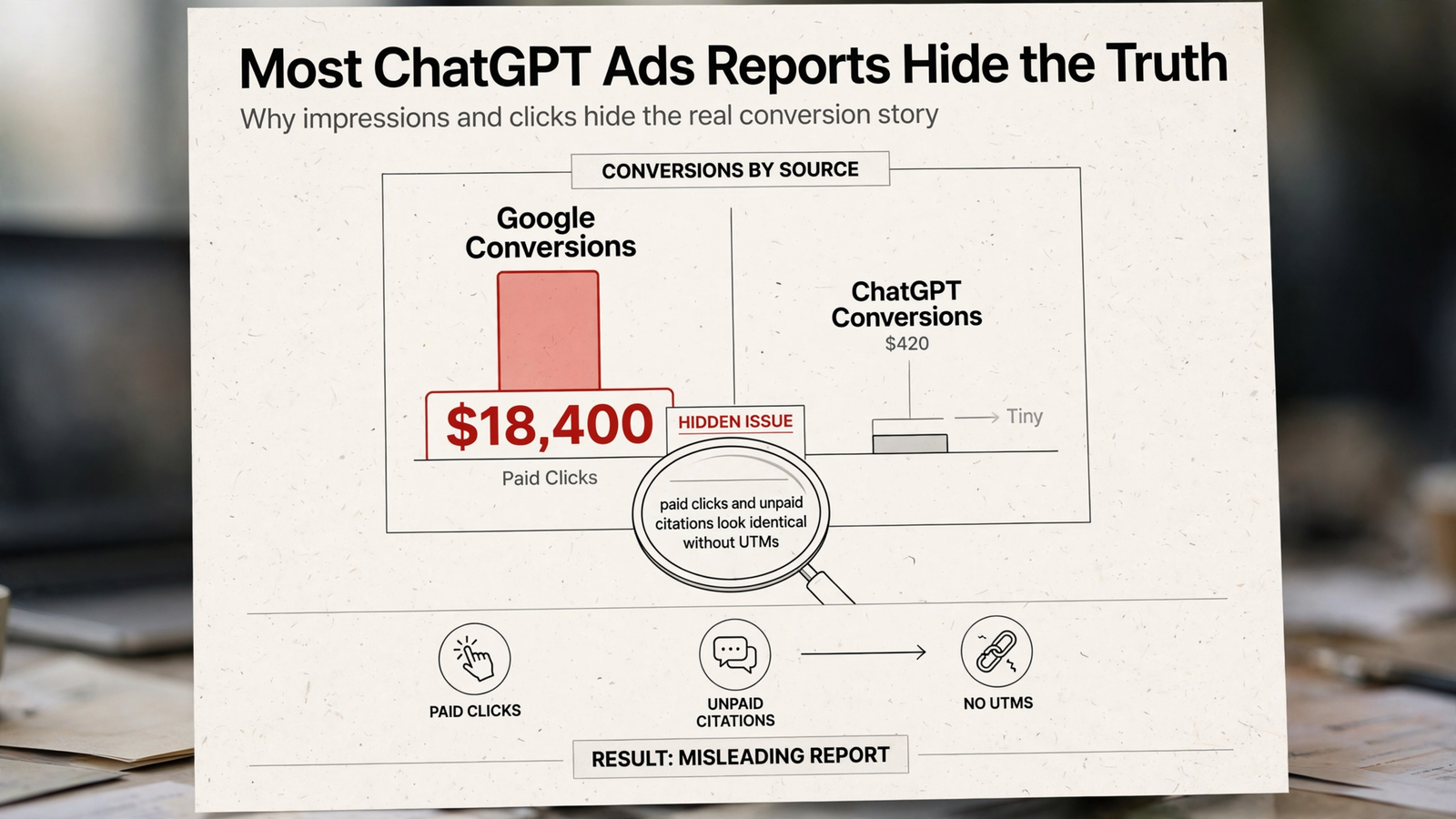
Demand a same-advertiser baseline. In one test involving about 1,500 users, Google delivered 6.64% CTR and 3.71% conversion against about 0.73% CTR and 0.21% conversion for ChatGPT, with 41 seconds of engagement versus 17. Other compilations put ChatGPT at 0.68% to 1.3% CTR against Google at 6.4%, and 0.21% to 0.9% conversion against Google at 3.71% or higher. Those comparisons are a reason to demand your own baseline, not a substitute for it.
Then inspect the plumbing. The oppref click ID must survive in a first-party cookie; the pixel and Conversions API need the same event ID for deduplication; and without paid UTMs, a paid click can look like an unpaid citation in GA4. A report that muddles paid clicks with unpaid citations cannot settle the question it was hired to answer. Cost per qualified lead against Google and Bing is the report. Everything else is decoration.
Claim 6: The pricing page
Turn to the last page before you sign. That is where the incentive sits. Agency pricing guides describe 10% to 20% of spend as standard, with 15% to 25% quoted for ChatGPT against 10% to 15% for mature search. Dialogue Ads lists $4,950 for a sprint, then $4,000 a month flat with no percentage of spend. The useful distinction is not whether one number looks cheaper in isolation. It is what happens to the manager’s fee when the test budget changes.
With a percentage fee, the vendor earns more when ChatGPT spend grows and less when it shrinks. That does not make an honest recommendation to cut spend impossible. It does give the vendor a reason to defend a channel before it has proved its cost per qualified lead. Ask whether the agency earns more when you spend more on ChatGPT. Its answer belongs beside the performance report.
A flat fee removes that particular incentive. groas runs Search Ads across Google, Bing and ChatGPT under one $1,499 flat fee. A $25-a-day ChatGPT test alongside Google spend does not increase the management fee. It also puts the competing search budgets under one manager rather than asking you to reconcile separate retainers and separate definitions of success. If a specialist’s fee rises with the test budget, I would want a particularly clear rule for stopping the test before signing.
Claim 7: The case study
A credible early case study reads like a lab note, not a trophy. Consider the one StubGroup published for a B2B compliance client: ChatGPT clicks cost $0.76 on average over 30 days, against $10.46 for Google Search on the same service, with a 0.8% conversion rate against 6.64% on Google. Cost per lead came in lower on ChatGPT because the clicks were much cheaper. The useful part is not a blanket verdict on the channel. It is that the study names the period, business type and both sides of the tradeoff.
The red flags are the inverse. A screenshot showing 370 clicks for $477 and zero conversions demonstrates that cheap traffic can still waste money. A deck that celebrates 1.06% CTR and $3.14 CPC with zero MQLs, while Google delivered 5.2% CTR and two MQLs in the same window, is grading itself on clicks rather than outcomes. If a case study hides spend, period, conversion definition or the Google baseline, it is a brochure, not proof.
The five-line scorecard I would use
After that last page, put the deck down and ask for five things. I would do this before negotiating a fee: pricing tells you what you pay, while these answers tell you what you are buying.
- Starting point: Which converting search queries become the first context hints, and how do your negatives shape them?
- Budget owner: Who can move money between ChatGPT, Google and Bing, and what CPA or qualified-lead number triggers that decision?
- Work record: Who made each campaign change, when, and why? Where can you see the log without an MCC?
- Attribution: How are paid clicks tagged, and how does the
opprefclick ID survive redirects and the consent banner? - Evidence and incentive: What did the case study cost, how long did it run, what did Google do in the same window, and how does the fee change if ChatGPT spend grows?
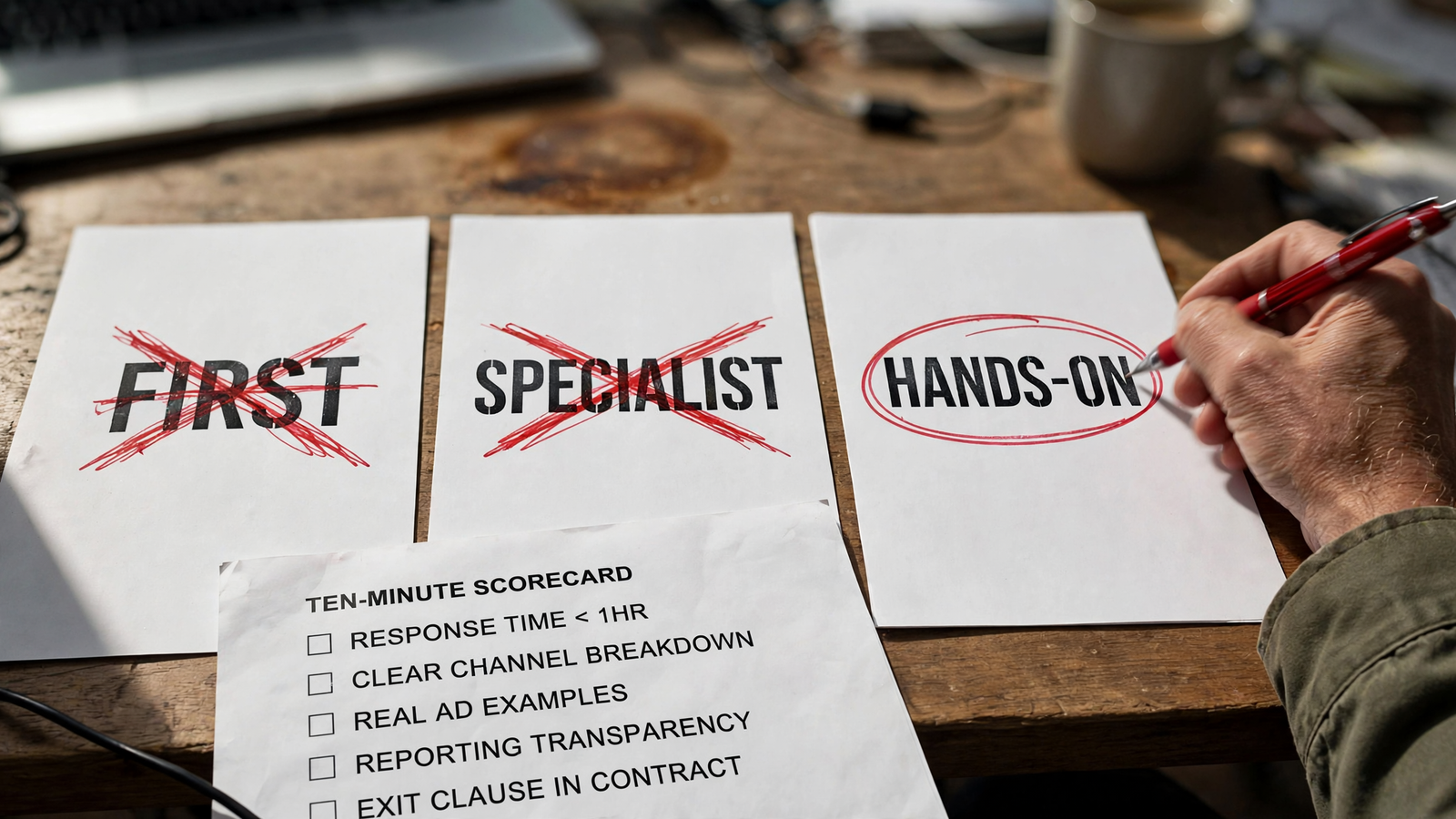
An agency does not need a polished answer to every question on a first call. It does need an answer that can be checked. If the response to a budget question is another slide about being early, you have learned something useful.
When a standalone specialist still fits
There are two buyers for whom a standalone specialist can make sense. The first has no paid-search history: no Google or Bing account, no converting queries, no negative list and no landing page that has sold anything. There is no existing search baseline or budget owner to protect. A small, bounded test can start from zero without splitting an established search operation.
The second already has one owner for Google and Bing and wants a four-week experiment with a capped budget and a written rule for moving money. Here the specialist runs a defined test; the existing owner remains the budget referee. In both cases, scope is small and the decision-maker is clear. If you already buy Google clicks and hand ChatGPT to a second vendor with its own fee, report and claim on the budget, you pay tuition twice.
Verdict: keep the work, discard the badge
Being first tells me when a vendor got access. Specialising tells me which channel appears on its invoice. Neither tells me whether the next dollar belongs in ChatGPT, Google or Bing. Hands-on management is the part of the pitch I would keep, provided it means a visible change log, a test built from what you already know, and one accountable owner for the competing search budget.
That is the line I would carry out of the deck. Start the ChatGPT test at $25 a day, ask for the log and the search-query mapping, and keep the person who can move the money when qualified leads say it is time.