

 LinkedIn

A client sends you a screenshot of ChatGPT recommending a competitor and wants to know when you can get them in there. Your first job is to sell the right test, not find someone to run the ads.
The agencies that keep the client sell ChatGPT Ads as a small, capped test with approval gates, bundled into the Google and Bing work the client already trusts. The agencies that lose the client pitch a standalone new channel and promise results nobody can yet benchmark. The subcontractor matters. The offer matters more. Build the offer first; then find someone who can fulfill it.
What did the client actually see?
ChatGPT Ads expanded to 89 countries on Oct 21, 2026, with 100,000+ advertisers running campaigns since US testing started in February 2026. A client sees a competitor near an answer and assumes you are behind. The urgency makes sense. The request still needs translating.
When clients say they want to show up in ChatGPT, they often mean two different things: a paid ad below an answer or an organic citation inside the answer. OpenAI states that ads do not influence answers and that you cannot pay to be recommended or cited. I used to bundle those two in the same sales conversation. I was wrong. Paid placement uses a budget and creative; citations require separate work on pages and authority. Identify which placement the client saw, sell the paid test on its own terms, and scope citation work separately.
Set the reach expectation before you quote a budget. Ads reach logged-in adults on Free and Go plans; Plus, Pro, Business, Enterprise and Edu remain ad-free, and ads do not appear near health, mental health or politics. If the client expects Google-scale lead flow in week one, the test will fail on expectations before it spends a dollar. Tell them this is a bounded experiment, not a replacement for search volume.
What should you sell before choosing a partner?
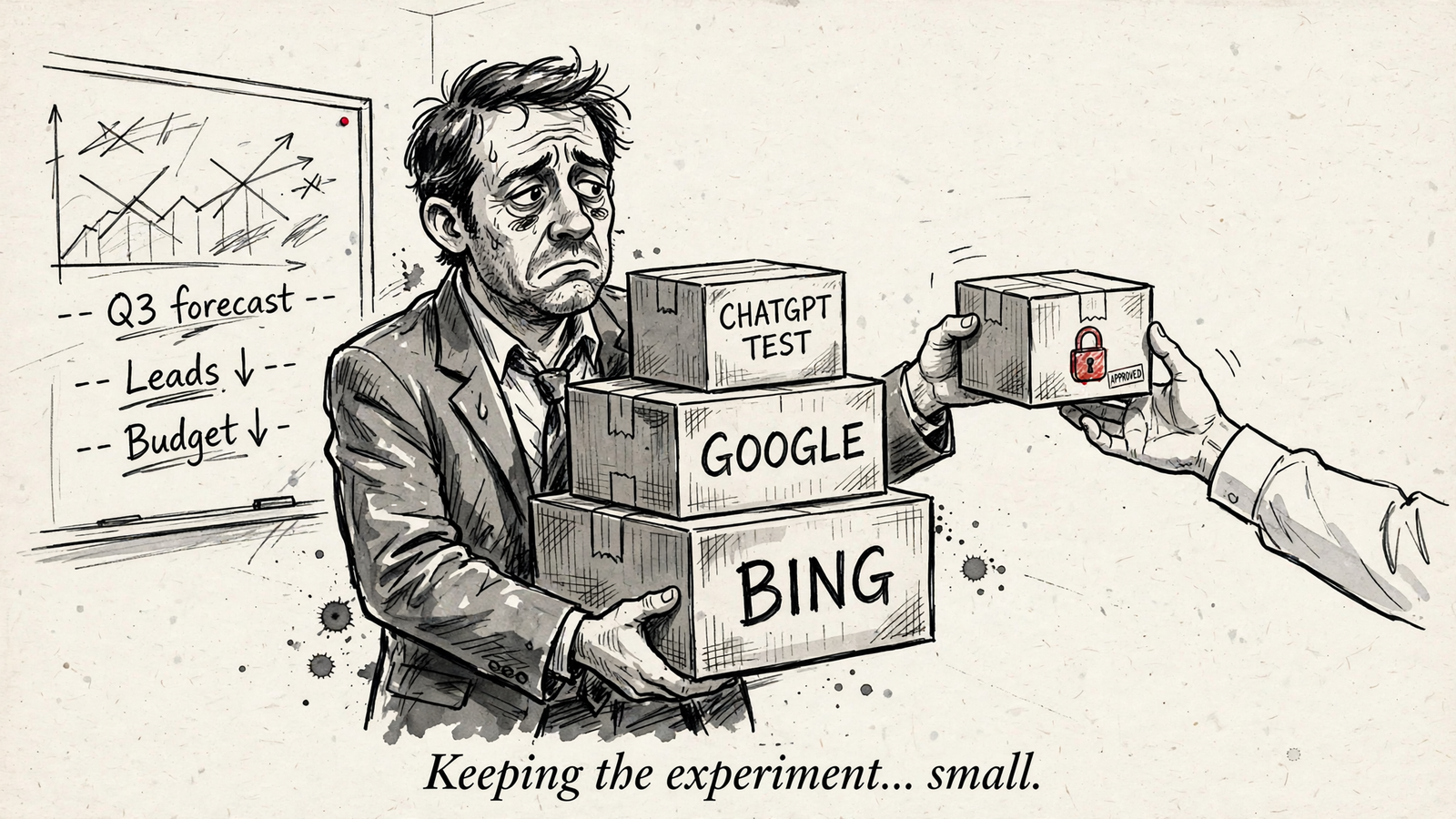
Sell a 30-day test inside the existing search relationship, with a fixed budget and two approval gates. Do not sell a standalone ChatGPT retainer, a percentage-of-test-spend upsell or a forecast dressed up as a benchmark. The product is still in beta, without established benchmarks. Early vendor claims about lower CPA are not guarantees you can put in a proposal. A cap tells the client more about the risk than a confident-looking projection does.
- Before launch: Get client approval on contexts, creative, landing page and tracking. No sign-off, no spend.
- At 50% of the test budget: Review CPA against the Google baseline together. Decide whether to stop, extend or scale. Put that meeting on the calendar when you sell the test.
Skip audience promises, reach projections and citation guarantees. You control none of them. The gates are not ceremony; they give you and the client a way to stop before a novelty test becomes an awkward monthly expense.
How do you package it for lead-generation clients?
Lead-gen is where qualification matters most. A junk lead converts just as neatly as a good one in an ad dashboard. Bundle ChatGPT spend into the existing Google retainer as a test line, not a new invoice. I would set a $750 to $1,500 budget for 30 days, send clicks to a dedicated page with one form, and score leads before reporting them. Show cost per qualified lead by engine, not blended CPA. What the deck calls synergy, I call not letting ChatGPT traffic hide inside Google numbers.
Set the pass rule before launch: ChatGPT must deliver qualified leads within 30% of Google CPA. If it does not, the test ends cleanly. The client can see that you called the rules before the spend, not after the results arrived.
What changes for ecommerce clients?
Ecommerce clients want ROAS. ChatGPT does not have feed inventory worth scaling yet, so do not mirror a Shopping structure. Pick five to ten hero SKUs with margin to absorb a learning period. Write context hints around the buying problem rather than the product name, and send traffic to a product page that already converts on Google. Start at the $25 daily minimum per campaign and review context reports weekly for waste.
Skip prospecting angles and gift guides in the first test. They can burn the cap on curiosity clicks that Google already harvests more cheaply. Measure revenue per session, not click volume.
How small should a high-ticket services test be?
An uncapped test hurts fastest when each qualified inquiry is expensive. WordStream’s 2025 benchmark of 16,446 US search campaigns puts attorneys at $131.63 median cost per lead, against a $70.11 cross-industry median, with average CPC at $8.58 and personal-injury clicks running past $150. Loose matching on top of that value can eat a month’s budget in a bad week.
For law firms, consultants and financial advisors, I would sell one practice area, scored intake calls and a written kill switch. At the stated $25-per-day campaign minimum, a full 30-day test starts at $750; keep the cap around $750 to $1,000 rather than promising a cheaper month-long run. Pause if unqualified consults outnumber qualified ones. If you already manage Google Ads in the vertical, apply the same discipline that makes high-CPC law-firm campaigns survive: tight themes, dedicated pages and ruthless qualification. If the client will not agree to scored calls, do not pitch the test.
What must a white-label partner actually do?
Now you can shop for fulfillment. If a partner cannot describe the weekly work in concrete steps, you may be buying consulting dressed up as management.
Setup starts in Ads Manager Beta at ads.openai.com: advertiser account, logo and billing, then a campaign with a daily budget, ad groups built around plain-language context hints, and the headline, copy, image and landing page. Hints guide matching; they do not guarantee delivery. For a conversion-focused test, the pixel and Conversions API need to be working before spend starts so leads, purchases or sign-ups can be tied back to the campaign.
Ask the partner to show you a sample branded report before signing. Ads Manager exposes impressions, clicks, spend, CTR, average CPC or CPM, and conversions. Those are inputs, not a complete client report. If the sample shows clicks but no cost per qualified lead, or spend but no account changes, pass.
How should they manage it alongside Google and Bing?
Treat the three engines as one search budget with three mouths: Google takes volume, Bing takes cheaper overflow, and ChatGPT gets a capped experiment slice. Pricing is auction-based, with a $25-per-day minimum per campaign in the US, a recommended starting max CPC of $3 to $5, and $8 to $18 in competitive verticals; reported CPMs run roughly $25 to $45.
Say a client spends $20,000 a month on Google. A $750 to $1,500 ChatGPT test is roughly 4% to 8% of that amount: enough to learn, not enough to wreck the search program if matching misfires for a week. Keep ChatGPT under 10% of total search spend until it earns a CPA you can defend. A partner managing the account in isolation cannot make that budget call well.
What should happen to the landing page?
Context matching is looser than keywords, so the landing page must do more qualifying. Send ChatGPT clicks to a generic homepage and you may learn little beyond the bounce rate. I want a dedicated page for each context theme, a form above the fold, call tracking where calls matter, and conversions sent through the pixel and CAPI.
groas includes a landing page for every ad group in its Search Ads service. That is the model to copy. If a white-label partner charges extra for every page or reuses the client’s generic contact page, the test may read as expensive traffic rather than pipeline. Skip custom video, chatbots and multi-step quizzes for now. They slow a test that should launch in days. No suitable landing page, no launch.
What belongs in the weekly report?
The client sees your logo on a one-page report, not the Ads Manager screen. As far as they are concerned, that report is the product. Put four things on page one:
- Spend by engine: Google, Bing and ChatGPT.
- Qualified leads or orders by engine.
- Cost per qualified lead where lead quality is the goal.
- What changed that week.
Qualified does the heavy lifting. Raw form fills can make loose matching look healthier than it is. Score the lead before you report it, or the client will score you on junk. Page two can hold context themes, exclusions and landing-page conversion rate. If the partner cannot report under your brand and show CPA by engine, they are not ready to fulfill this offer.
How do the resale margins work?
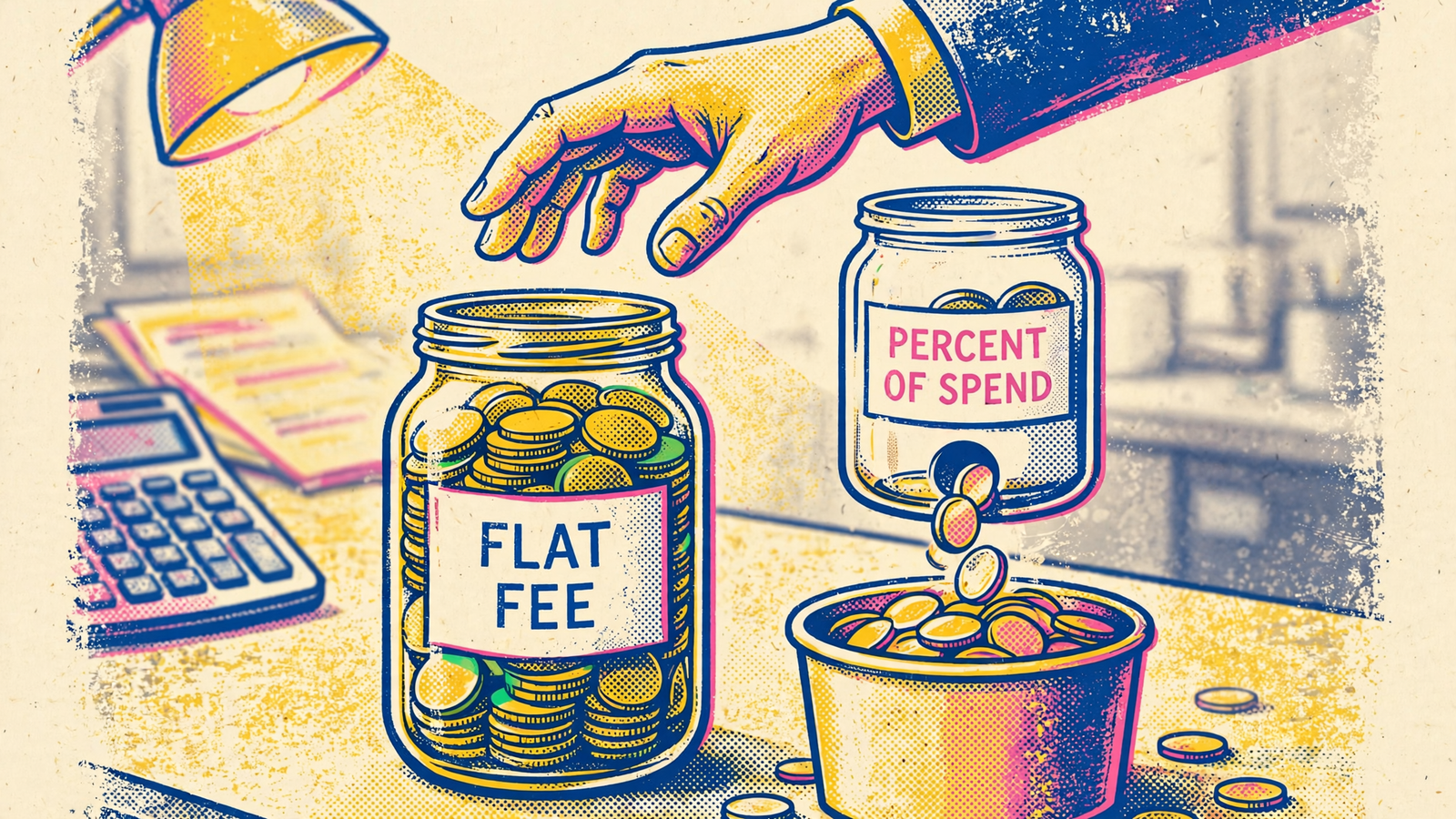
Should you pay a flat fee or a percentage of spend?
Percent-of-spend looks clever until the client spends real money. White-label pricing can run 10% to 20% of ad spend with $500 to $2,000 minimums, or $750 to $5,000 retainers. At 15% on a $20,000-a-month account, fulfillment costs $3,000. The work has not necessarily become three times harder than it was on a $5,000 account.
Single-channel white-label PPC wholesale starts around $350 per account per month. At $350 wholesale and $800 retail, you keep $450 before your other costs, whether spend is $2,000 or $20,000. That single-channel price is not the price of every full-service partner; the useful comparison is flat cost versus a cost that rises with spend. groas lists Search Ads at $1,499 a month for Google, Bing and ChatGPT Ads, with bids, keywords and budgets worked around the clock. The ChatGPT test can ride inside the search work you already sell rather than becoming a second percentage-of-spend meter.
What if a partner requires five accounts?
Some partners require five accounts before offering wholesale rates. That can price out an agency with only two curious clients. The minimum may reflect the cost of onboarding real managers into your process, but it does not make a five-account commitment wise for you.
Test fulfillment with one or two clients before migrating a portfolio, even if those first accounts cost more. That small-start approach lets a poor fit cost you one test rather than five retainers. Keep the arrangement month-to-month. A one-account minimum and no direct client contact matter more at this stage than a volume discount.

How do you vet the partner before handing over a client?
Are they managing accounts or selling you advice?
Ask what changed in an account last week and who changed it. A hands-on partner answers with verbs: contexts added, bids moved, budgets shifted, a page variant launched. They can explain why. A consulting layer answers with nouns: audit, roadmap, insights deck.
Ask about senior QA, service levels and references from agencies of a similar size and vertical. Those checks matter because slow responses and outdated tactics can surface before client churn. Then give the partner a dead context theme and ask what they would pause first. If they cannot discuss the decision without scheduling another meeting, they may not be close enough to the account. Buy logged actions, not recommendations to take action.
Who owns the accounts and talks to the client?
White-label fulfillment means the client relationship stays with your agency. The partner reports under your logo and communicates through you, never directly with the client. Keep control of the Google and Bing accounts through your MCC, and verify who owns the ChatGPT advertiser account separately. Do not assume one platform’s access arrangement covers another.
Ask for a redacted report showing another agency’s branding, the account-ownership terms, and two agency references in your size bracket. A one-account minimum, zero direct client contact under NDA and branded reporting is a workable structure. If the partner owns accounts you cannot take with you, leaves its footer on the report or hesitates over references, walk away. You keep the account access and the client relationship.
What should the contract say about leaving?
Read the exit clause before the price. Specific-result guarantees, evasive pricing, long lock-ins, claims over account IP and direct client contact are warning signs. A CPA guarantee on a beta product is not reassurance; it is a reason to keep looking.
I would sign something boring on purpose: month-to-month, flat per-account fee, accounts and pages stay with the agency, and cancellation does not strand the client’s assets. That is also why groas fits the flat-fee resale model better than a percent-of-spend shop. Its Search Ads plan covers Google, Bing and ChatGPT for a flat monthly fee, with no cut of ad spend, no setup fee and cancellation anytime. Your cost does not rise simply because the test budget does. If you need a lawyer to figure out how to leave, the fulfillment is not built for resale.
When should you skip ChatGPT Ads entirely?
Do not sell a learning exercise to a client who cannot afford to learn. Skip the test if Google tracking is broken; adding another engine to bad conversion data produces more bad data. Skip it if the client needs volume this month; Free and Go inventory will not replace Google. Skip it if they demand guaranteed results or paid citations. You cannot promise a benchmark that does not exist or sell a recommendation OpenAI says cannot be bought.
Your first move today is small: pick one steady Google client and draft a 30-day add-on with the budget cap and both approval gates written in. Send it as part of the search work they already buy. If they approve it, you have an offer a partner can fulfill. If they reject the cap, you have avoided selling a channel you cannot yet prove. Sell the test you can stop.