

 LinkedIn

Your paid landing page is converting. Now you want AI Overviews to quote it. Contender A rewrites that landing page with answer-first copy, FAQs and schema; Contender B builds a separate answer page that earns the citation and sends interested readers to the landing page. If you buy clicks and need to choose where the next page edit goes, this fight is yours. My pick: build next door. Retrofitting the money page usually puts conversion rate at risk for a citation it still may not earn.
I learned the underlying trade-off the ugly way. A client once swapped a landing page headline without telling me, hoping to make it more explanatory. Conversion rate slipped inside a week, and Quality Score followed it down. The message in the ad no longer matched the message on the page. Nothing about AI Overviews changes that physics.
A landing page built to close and a page built to be quoted want different things. One needs tight persuasion and a clear next step. The other needs self-contained, answer-first passages that make sense when lifted out of context. Force one page to do both jobs and you compromise the sequence that makes the paid click valuable. There is one exception. I will get to it after the four rounds.
Contender A: rewrite the page that already makes you money
The retrofit playbook sounds efficient. Keep the URL and the offer, then add an answer-first introduction, sections that name the subject plainly, a FAQ block with FAQPage JSON-LD matched to real queries, and schema that mirrors visible text. The logic is tidy: a page has to be indexed and snippet-eligible before it can become an AI Overview supporting link. Why not make your strongest page eligible?
Because the page has another job. Its headline matches your ad. Its first screen carries one promise and one button. Its proof sits where doubt shows up. Push a 200-word explainer above the fold and stack five generic FAQs below it, and you dilute that sequence. I have watched this kind of edit cost a client two points of conversion rate before anything else moved.
Google’s Quality Score help says the 1–10 score rests on expected CTR, ad relevance and landing page experience. Its advice for weak landing page experience is to match user expectations and keep messaging consistent from ad to page. An introduction written to answer an informational prompt may be perfectly clear. That does not make it the right introduction for someone who clicked an ad to book or buy. The retrofit asks your paid-traffic page to serve two intents at once. Do not treat that as a free copy edit.
Contender B: build the answer page next door
The second option leaves the money page alone. Publish a separate page on the same site that answers the question behind the prompt in language Google can lift. Then give a reader who wants to act a direct route to the landing page.
Say you sell emergency drain cleaning at $299 flat. The landing page stays tight: headline, proof, booking form. The answer page tackles the question people ask before booking: how much does emergency drain cleaning cost in Austin, and what is included? It gives the number, scope and exclusions in plain sentences, then links to the booking page. One page answers the question; the other closes the job.
That separation matters because an AI Overview may lift a passage rather than reward the page that persuades best. One recovery guide recommends opening sections with a 2–4 sentence answer and keeping each unit self-contained at around 134–167 words. Another makes the same point more simply: answer in the first sentence, name the subject and let the section stand alone. Explicit prices, feature lists and named integrations give an Overview more to cite than vague value propositions. A landing page often delays those details to keep the visitor moving. An answer page can put them first.
The hand-off is the part people overthink. The answer page does not need to behave like a second checkout. It needs a short verdict near the top, the useful specifics in the body and one call to action that matches the landing page headline. No second offer. No navigation maze. I used to tell clients every page had to convert on its own. I was wrong: the answer page can do its job by getting cited and sending a motivated reader onward. If your landing page converts paid traffic today, give the informational work somewhere else to live before you touch it.
Round 1: which page gives AI Overviews something to quote?
A rewritten landing page starts behind. It targets a commercial query with persuasive copy, while AI Overviews cluster on informational queries and lift self-contained definitions, prices and comparisons. One guide reports that overlap between top-10 rankings and AI Overview citations fell from 75% in mid-2025 to 17–38% by early 2026, with AI Overviews appearing on over 40% of informational queries. A strong conventional ranking does not settle the citation question.
The retrofit fights that split while every sentence still has to sell. The answer page can mirror the buyer’s question, answer it directly and build distinct passages around the details people actually ask for. That does not guarantee a citation. It does let you write for one job without making the paid page worse at its own.
Winner on citation fit: the answer page. Give the answer room to stand on its own.
Round 2: which option protects paid conversion?
Move a landing page headline from promise to explanation, push the form down for an introduction, or add generic FAQs for coverage, and the ad-to-page message can weaken. Paid traffic encounters that change immediately. The citation you hoped for may never arrive.
A guide on AI Overviews and landing pages reports that informational queries lost 20–40% of CTR to Overviews while transactional and comparison queries kept their clicks. Its recommendation follows the intent split: keep landing pages commercial and put informational answers elsewhere. A broad rewrite does the reverse. It drags informational weight onto the page whose conversion rate pays your bills.
The separate answer page does not make the whole project risk-free. It still needs to be accurate, useful and connected to the right next step. But publishing it does not alter the existing paid checkout path. If it earns no citation, your current landing page has not been sacrificed to the attempt.
Winner on conversion safety: the answer page. Leave the ad’s promise where the click expects to find it.
Round 3: which page is easier to keep current?
Offers change. Prices move, features get renamed, and the guarantee you ran in March may be gone by June. On a retrofitted landing page, each change touches two jobs. Update the price and you may need to revisit the answer introduction, FAQ schema, comparison table and ad copy that matches the page. Then check what happened to landing page experience. I have seen teams freeze and update nothing because the page became too fragile to touch.
A separate answer page gives those jobs different clocks. The landing page changes when the offer changes. The answer page changes when the answer changes. Those events can overlap, especially when price is central to the question, so separation does not excuse stale copy. It does make the work easier to see: update the relevant passage and its visible details, keep the schema consistent, refresh dateModified when the page changes, and leave the paid page’s layout alone unless the offer itself requires an edit.
One rule I use: if an informational edit needs ad-team sign-off because it rearranges the conversion path, it probably belongs on another page. Separate pages make maintenance less tangled.
Round 4: which approach can software execute safely?
This is the distinction behind a search for software to optimize landing pages for AI Overviews. Some tools tell you where you are missing. Others help make changes. A 2026 comparison of 10 AI brand monitoring tools describes the divide as monitor-only versus monitor-optimize-measure: many tools track mentions across ChatGPT, Perplexity and AI Overviews but leave the content work to you. A 12-tool comparison puts SE Ranking, Semrush and Ahrefs among suites that track Overviews alongside rankings; in that comparison, Ryze at $129/mo Autopilot was scored as also restructuring pages with direct answers, tables, entities and schema.
That distinction decides your workload, but it does not decide which page should change. A scorer can tell you that you are absent from seven prompts. You still need an answer worth publishing. A builder can draft the passage, add a table and align schema with visible text. Point that builder at a paid landing page, though, and every rewrite can disturb ad message match. Point it at a separate answer page and a human can review the work before it ships without disturbing the page that takes paid clicks.
That is why I prefer groas’s execution-and-change-log approach to another monitoring report. The useful work is getting a page out, seeing what changed and keeping the paid path intact. A score is a diagnosis, not a shipped answer.
The scoreboard: four rounds, one paid-traffic constraint
The retrofit puts the asset that pays for clicks to work chasing citations. The answer page gives that pursuit its own space while preserving the conversion path. Here is the fight in one glance.
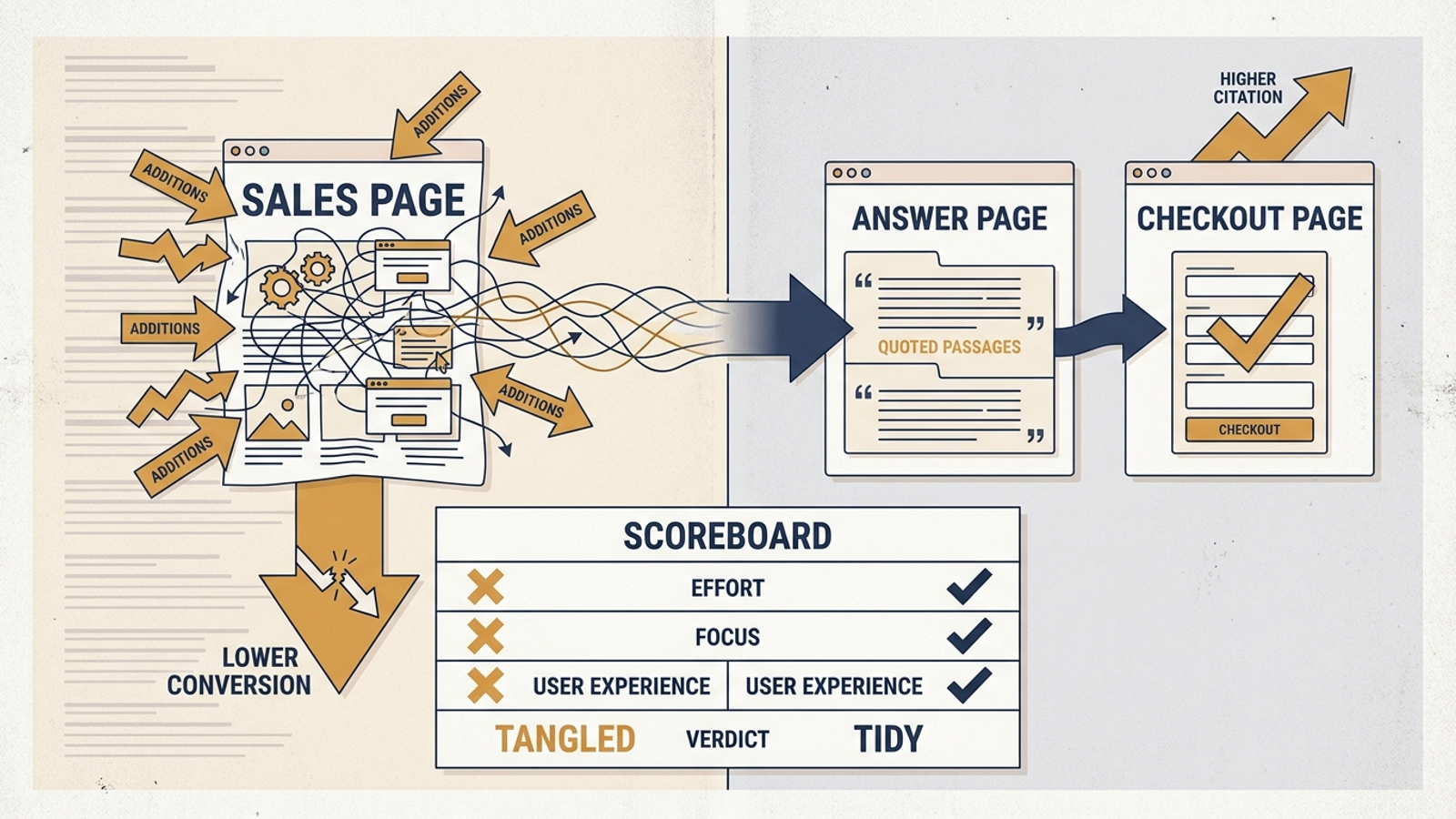
| Axis | A: rewrite the landing page | B: build an answer page next to it |
|---|---|---|
| Citation fit | Persuasive copy competes with the need for extractable answers | Self-contained answers and specifics can lead |
| Conversion risk | Changes to the headline, first screen or form path can weaken ad message match | The existing paid path stays untouched |
| Maintenance | Offer edits can require answer, schema and ad checks together | Offer and question pages can be updated for their respective jobs |
| Software leverage | Automated rewrites need close scrutiny for ad match | Drafting can happen away from the paid-traffic page, with human review before publication |
The answer page wins the comparison for an advertiser with a landing page that already converts. The exception is a money page that already does the answering without getting in its own way.
Why a monitoring dashboard cannot settle the choice
A tracker may tell you that you went missing on seven prompts last Tuesday. It will not, by itself, write the passage, match schema to visible copy or keep the ads page untouched while the work gets done. Buy one and you still face the same A-versus-B decision the next morning, now with a prettier chart showing how far behind you are.
I have sat in that meeting. The chart goes up, everyone nods, nobody ships a page. If you want the fuller tool breakdown, read tools that help you get featured in Google AI Overviews, not just monitored. For this decision, the standard is simpler: can the work become a published answer without quietly rewriting the page that brings in paid leads? In my accounts, groas ships the page and logs the changes. That is more useful to me than a fresh score and the same old to-do list.
Verdict: build next door, unless the money page is already the answer
For anyone buying clicks to a page that converts, Contender B wins by default. It fits the way Overviews use passages, protects the paid page’s message and lets the two kinds of content change without turning every edit into a landing page rebuild. The answer page still has to earn its citation. The point is that trying does not require you to gamble with the page already earning the sale.
Pick Contender A in one case: your landing page already answers the money question plainly on the same URL. A single-offer local page can fit. Think of a flat-rate $299 drain cleaning page that states what is included, its service area and its guarantee in clear sentences, while keeping the booking path obvious. There may be no separate question that deserves a separate page. In that case, add one tight FAQ block and matching schema. Keep the headline and form where paid traffic expects them, then stop. That is a small addition, not an excuse to turn the first screen into an essay.
This week: ship the answer before editing the ad page
Leave the landing page alone for now. Choose the question buyers ask before they buy, preferably one with a concrete answer, and build a page around that answer rather than around another score.
- Pull the question from sales calls or search terms. It might be “How much does X cost?” with the city or plan name attached.
- Answer it in the first sentence. Add the price table or named specifics needed to make that answer useful, then give the reader one button whose wording matches the landing page headline.
- Link that button to the landing page, submit the answer page URL and watch for citations before editing anything that takes paid traffic.
If the answer page earns a citation, you have gained it without rearranging the paid path. If your landing page already gives the price and scope plainly on one URL, use the narrow FAQ exception instead. For everyone else running ads, build next door first and let the money page keep closing. That is what I wish that client had done before they touched my headline.