

 LinkedIn

A bilingual ChatGPT ad can sound perfect and still send a buyer to a checkout page, form or sales reply in the wrong language. I’ve seen that failure in Google accounts, and translation was rarely the real problem. This list is for the buyer who wants an agency to run the work, not present a strategy deck: verify access, carry language intent through the sale, and tell ChatGPT’s confirmed capabilities apart from Google’s changing controls.
1. Verify that your markets and both languages can actually be served
On Oct. 21, 2026, OpenAI expanded ChatGPT Ads to 26 more markets, for 89 total and more than 100,000 advertisers since February US testing. That sounds like broad coverage until you get to the conditions. The self-serve legal entity must be based in a supported market, and registration alone does not grant access. New accounts can also face domestic-only limits until identity verification and qualifying home-market spend.
I’ve seen the equivalent trap in Google accounts: an agency sells a two-language launch, then language two sits in limited serving while the client pays for calls about it. Eligibility is a launch requirement, not a detail to sort out after the contract.
Ask for a dated Ads Manager screenshot showing the eligible countries for your entity. Then ask which user locations can actually see the proposed ads, what verification remains, and whether a spend threshold restricts the account. A serious answer names the billing entity and its current status. “OpenAI handles the rest” is not an answer.
Reach matters as much as access. Ads began in the US on Feb. 9, 2026, and remain limited to eligible Free and Go users; Plus, Pro, Business, Enterprise and Edu are ad-free, and under-18 accounts are excluded. If your buyers mostly use paid plans, hear that before anyone forecasts a test.
First step: Get eligibility and serving limits in writing before you approve a second-language budget.

2. Name the person who will run the account
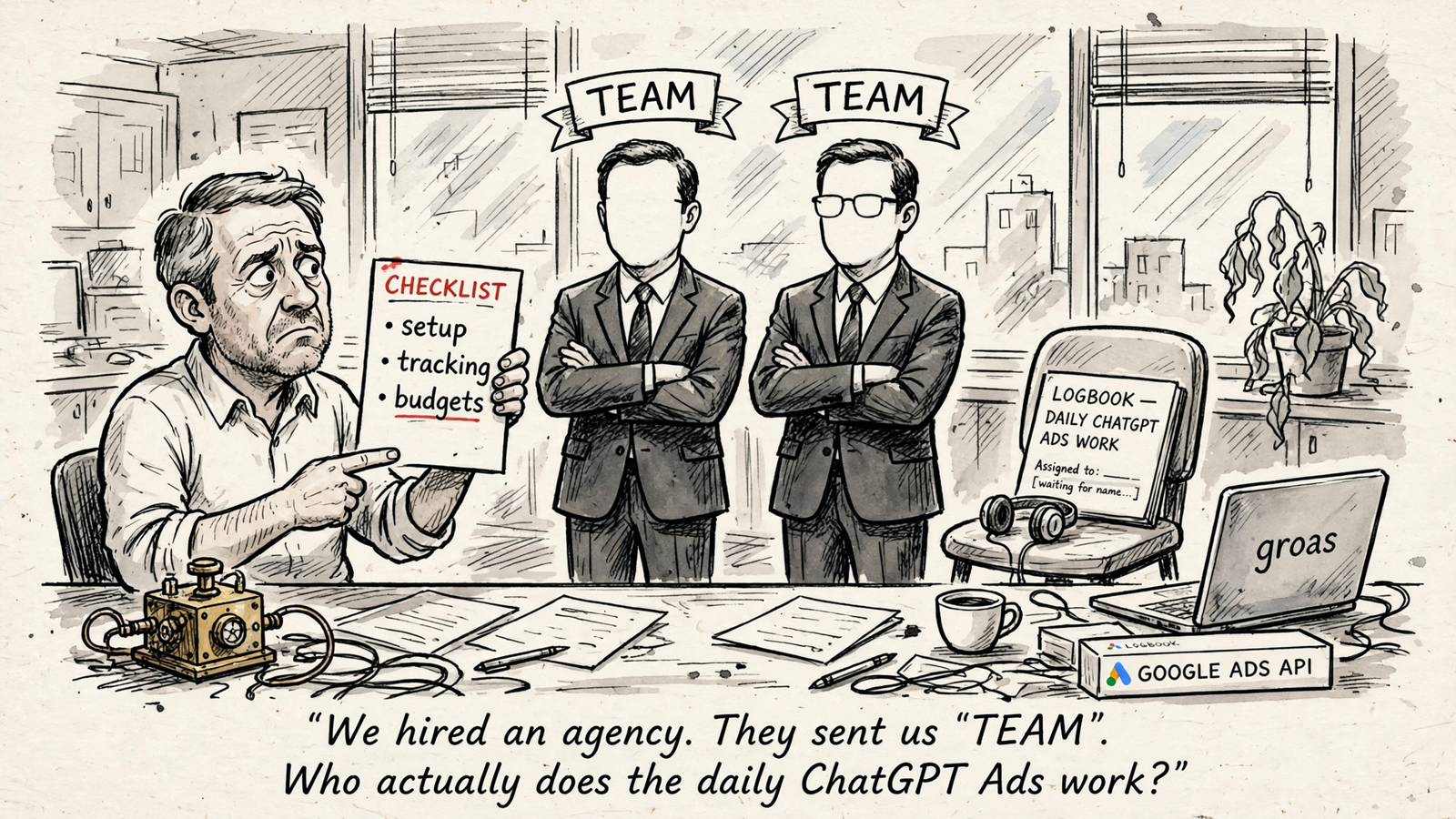
Most agencies won’t tell you this: the person selling ChatGPT Ads is rarely the person running them. On a bilingual account, that handoff is expensive. Someone has to own setup, conversion tracking, creative tests, budgets and reporting in both languages. “The team watches it” usually means the second language becomes the task nobody quite owns.
Hands-on management is not glamorous. It looks like Ads Manager setup, conversion tracking, campaigns and daily optimisation, with direct access to the strategist running the account. Ask the agency to show which person does each job, how often that person checks it, and where you can see changes. You need a name and an accessible change log, not a photograph of a pod.
I used to accept “we all watch the account” from vendors. I was wrong. When a language underperforms, shared ownership makes it too easy to leave the page, the tracking and the budget untouched while everyone waits for someone else. One person can get help. One person still needs to answer for the result.
First step: Request a one-page responsibility sheet with a named owner for setup, tracking, budget decisions and reporting. No sheet, no signature.
3. Assign a writer and reviewer to each language
Direct translation is where bilingual ad tests go to die. A multilingual PPC guide recommends original messaging by a native-speaker copywriter rather than copy run through an online translation tool. The mechanism is plain: phrasing that sounds imported makes the offer less convincing, even when every word is technically correct. The same guide warns that translated keywords can be unused or irrelevant, so each language needs its own research.
That does not mean the agency needs two separate theories of the business. It means each version must make the same offer in language buyers would actually use. A translated sentence is not evidence of a usable second-language campaign.
Ask who writes language two, whether that person is a native speaker, and who checks offer details and regulated claims. Ask whether the quoted fee includes that work. Some proposals price the strategy in English and leave translation as an extra; discovering the gap after launch is a poor way to set a budget.
First step: Ask for a sample English-and-second-language pair from past work, along with who reviewed each version. If the agency cannot show how it gets from draft to approval, do not assume the process exists.
4. Follow the buyer’s language past the click
A fluent ad that lands on the wrong-language page tells the buyer you cannot serve them. Before a bilingual launch, I check that the offer, language and currency match: a German ad leading to an English page with GBP pricing fails all three. That is the first gate, not the whole inspection.
Then follow the path a buyer has to complete:
- Check the headline and offer, along with register, dates and other local formats.
- Check currency, VAT, delivery, returns and payment options where they apply.
- Check local proof, form validation and the mobile layout after translation.
- Check the confirmation and the first sales reply, not just the landing page.
Run a real test purchase from the target country on a phone before spending. For a lead-generation journey, run a test lead instead. If the form errors in English or sales replies in English two days later, language two is not a finished campaign. It is a complaint waiting to happen.
Have the agency screen-share the path from ad to page to form to confirmation, then show how the lead reaches sales. If it cannot show the handoff, it has not built one. A polished ad cannot repair a broken journey after the click.
First step: Send one test lead through each language and trace both to the person who would answer them, before splitting the budget.

5. Audit Google and ChatGPT under separate rules
If one agency coordinates both channels, do not let it grade them with one language checklist. On Aug. 14, 2026, Google announced it would remove manual campaign-level language targeting from Search and the Search component of Performance Max starting in September 2026. Under that change, ad copy and landing page language become primary matching signals. The practical consequence is that weak second-language creative and pages can affect how Google matches an ad, not merely how a visitor feels after clicking.
ChatGPT has a different stated behavior. OpenAI says ad language may differ from the conversation or interface language; selection considers location, language settings and conversation language. Do not accept a promise that the agency will simply copy a Google language setting into ChatGPT. That skips the question you are paying it to answer: how will it check what each audience actually sees?
Request two audits. The Google audit should examine creative and landing pages under Google’s matching approach; this 10-point Google Ads audit framework gives the agency a concrete place to start. The ChatGPT audit should state what can be verified about serving and language, what cannot, and how the team will monitor the difference.
Two channels, two rulebooks, two reports. First step: ask the agency to put its Google and ChatGPT language checks on separate pages. If they are identical, ask why.
6. Demand a report that can expose a weak language
A blended result can make a bilingual test look healthy while one language burns its budget. I learned that after a home-services client ran English and Spanish in one ad group for six weeks. Blended CPA looked fine. Split out, English was at $41 and Spanish at $178 because the Spanish page loaded half in English. We would not have seen the problem without the split.
Where the setup allows it, separate the language tests in the campaign structure and tracking so the agency can compare spend, landing-page performance and downstream results. Track conversions by language and segment ROI by language and geography. Then connect those records to qualified enquiries and sales conversations. An impression is not a lead with a working phone number, and a lead is not a sale.
Be precise about the limits. In ChatGPT Ads, advertisers receive aggregated views and clicks, not users’ chats, history, memories or personal details. Reported spend can also lag by seven to eight hours. The agency should explain which language-level results come from its own campaign setup, UTMs and sales records rather than imply that ChatGPT supplies a detailed view of individual conversations.
Ask to see how it uses the OpenAI pixel or Conversions API and UTMs for GA4, and how it logs headline and description tests by language. Demand a sample report that notes the spend lag and ties results to qualified enquiries. Judge the test on qualified demand per language, not the amount of translated copy delivered.
First step: Request that sample report before launch. If it shows impressions by language and calls that proof of success, send it back.
7. Set the stop rule before the agency starts spending
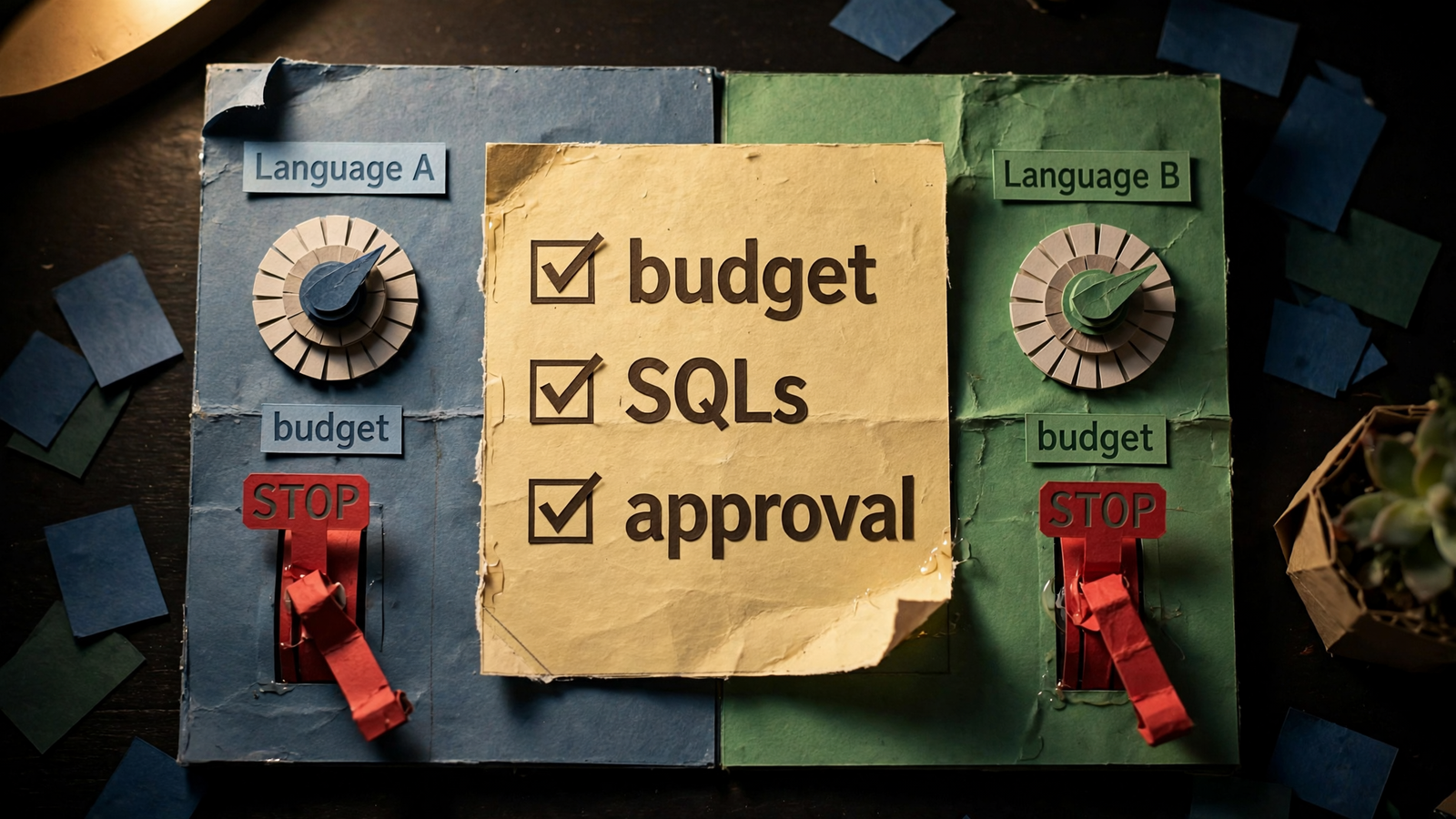
A bilingual test without a kill rule can become two losing tests. Agree on three things before launch: a budget for each language, an evaluation window, and the evidence required to expand or pause. Write down who can approve a change. Otherwise, “we need more data” can keep a weak language running long after the sales team has told you what is happening.
A practical hands-on scope includes conversion tracking through the OpenAI pixel or Conversions API, UTMs for GA4, context hints mapped to buyer questions, creative tests, and daily bid and budget work. Leave room for the seven-to-eight-hour spend-reporting lag when setting the review time. One Singapore operator cites a SGD25-per-day floor and states the useful limit plainly: there is no guaranteed placement in a particular conversation and no paid spot inside ChatGPT answers. That is the kind of specificity to ask for, not a promise to appear whenever a buyer mentions your category.
Say you spend $20k a month. A workable gate is $2,000 to $3,000 per language over three weeks, judged on qualified enquiries and cost per qualified enquiry rather than clicks. If language two brings traffic but no sales conversations, pause it and move the money. No approval, no scale.
Against these checks, groas Search Ads covers Google Ads, Bing Ads and ChatGPT Ads for a flat $1,499 a month, regardless of spend. It is month to month, with no setup fee, cancellation anytime, a dedicated manager, and a live launch within 24 hours of the onboarding call. That is a better fit for the buyer who wants ongoing execution instead of paying an agency to present the work back to them. Still, verify the language scope for your pair before paying. A management model cannot make an ineligible market eligible or replace native-language review.
I would start with the stop rule because it forces every promise into a decision before the first dollar moves. Then I would send each candidate the same three-line email: Here is our billing entity. We need English and this second language. Show me eligibility, the owner’s name and one split report. The agency that answers all three in writing is worth testing. The rest can spend someone else’s second-language budget explaining why the test needs more time.