

 LinkedIn
You have $2,000 and 30 days to test ChatGPT Ads for your online store. If the product page cannot finish the conversation the shopper started in ChatGPT, you can lose the test before spending a dollar. No bid tweak saves that page.
Here is the order: fix a small product feed and its pages, wire purchase tracking, set a margin-based stop rule, then spend the $2,000 on a narrow test. The preparation costs time, not media; the four weeks cost $500, $1,000 and $500. Keep page and tracking work running in parallel so the test launches in week 1. What gets cut matters as much as what stays.
1. Spend three to four days on the feed, not a dollar on clicks
A Google click often starts with five words. A ChatGPT click may follow a conversation about running shoes for flat feet under $150, a gift for someone who likes pour-over coffee, or two strollers that might fit a small trunk. Targeting follows conversation context rather than keywords you bid on. Ads sit below the answer, labeled Sponsored, without changing the answer itself. You cannot pay to become the recommendation. You can make sure the product shown alongside it is the right one.
That is worth a bounded test. AI-referred traffic to US retail grew 393% year over year in Q1 2026 and converted about 42% better than other traffic in March 2026, after converting 38% worse a year earlier. The plausible advantage is that the conversation has already done some filtering. It does not excuse a bad handoff.
For ChatGPT product ads, the title, image and price come from your catalog and are matched to the conversation. There is no separate headline to rescue a thin feed. I used to tell clients a good product page could cover for a messy feed. I was wrong here: the shopper has to see the right product before that page gets a chance.
Check the nine required fields: item_id, title, description, URL, brand, seller name, image URL, availability and price. Then check variants, stable IDs, valid GTINs, and shipping and returns data. A title under about 40 characters or a lifestyle photo of the wrong variant can buy you a click for something the shopper did not ask for. One worked example puts a price on stale availability: 12% sold-out clicks at $3 turn $9,000 of spend into $1,080 of waste.
Cost: $0 in media and three to four days of catalog work. Buys: a small, in-stock set with prices and variants the shopper can trust. Cut the full-catalog rollout. Sync 20 to 50 proven sellers through the Shopify ChatGPT Ads app, if you are on Shopify and eligible, or a hosted feed that refreshes daily. Do not rely on a manual upload that expires after two weeks to carry a 30-day test.
2. Give each product page the answer the shopper came for
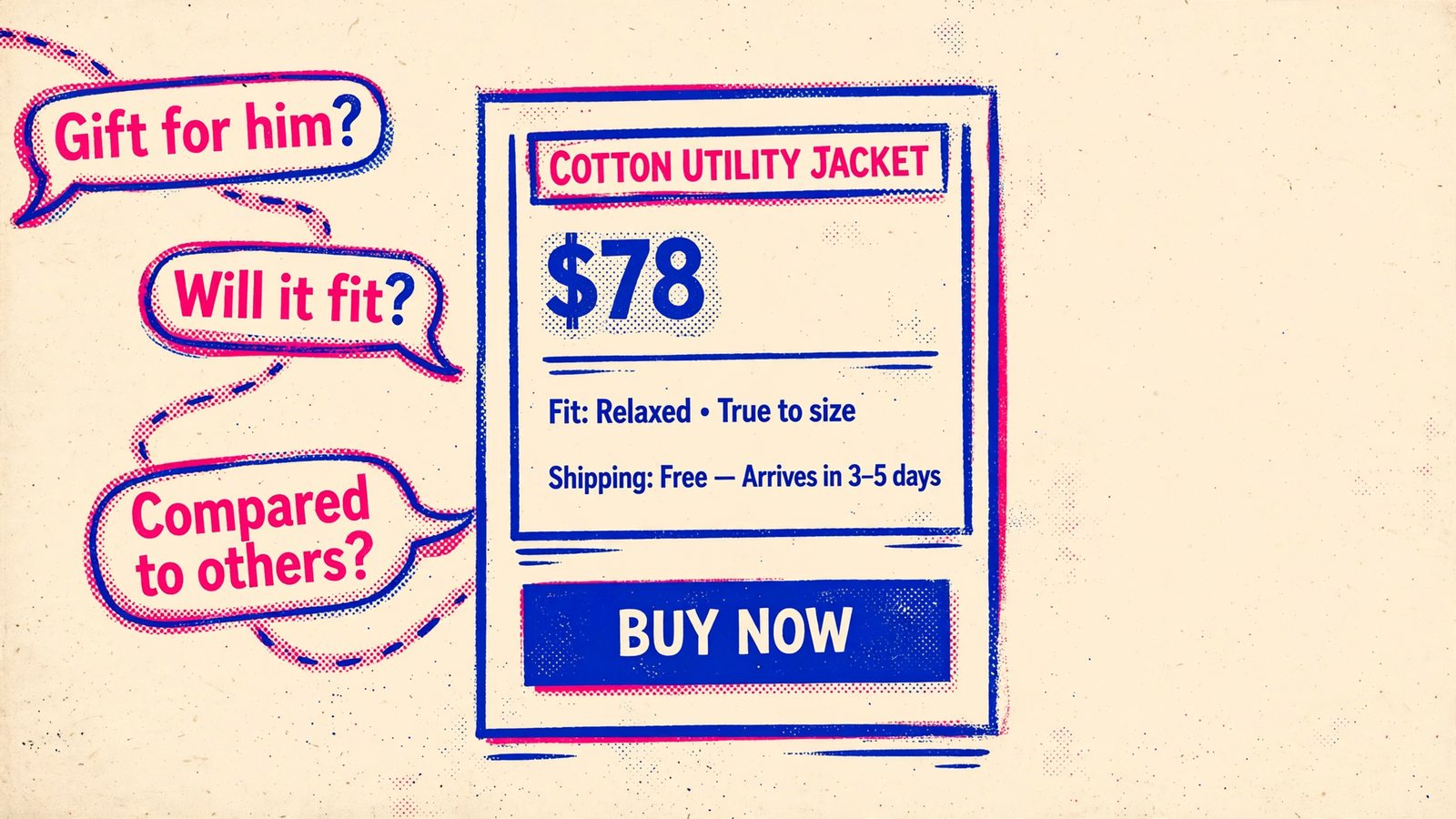
The feed earns the appearance. The page has to finish the sale. Someone comparing strollers for a small trunk should not land on a page that makes them hunt for dimensions. Someone shopping for a gift should not have to guess what is in the box or when it arrives.
Put the relevant fit, size, compatibility, contents, shipping and returns facts where a shopper can find them immediately. Write them in plain text that a person and a model can both read. Only about 66% of the average product page is machine-readable; hiding a decisive specification can keep the right product from being understood, even when the price works.
Do not turn this into a site project. For each of the 20 to 50 test SKUs, add the line that closes its likely chat loop. If the shopper is choosing between two products, show the three specifications that settle the comparison. If the shopper needs a gift, show the contents and delivery facts. The point is not more copy. It is fewer unanswered questions between the click and the cart.
Cost: $0 in media and two days of page edits, alongside the feed work. Buys: a page capable of converting the intent you paid to reach. Cut the redesign, the new photography shoot and the catalog-wide review-widget project. None fixes a missing answer on the test SKU.
3. Use a developer day to make purchases visible
Even a good page is hard to judge if the sale disappears into Direct traffic. Early buyers found that Ads Manager showed spend, impressions and clicks only. And only about 40% of ChatGPT-influenced conversions happened in the click session; the rest returned later through search or direct. Last-click ROAS alone can make a useful test look empty.
Install a browser pixel and Conversions API together, deduplicated by a shared event_id. The pixel captures the click ID in an __oppref cookie. The server sends the purchase to the OpenAI endpoint with amounts in minor units and hashed customer data. The shared ID stops the two paths from counting one sale twice. Put UTMs on every destination URL, and keep the roughly 30-day click and one-day view-through windows separate in reporting.
This is not just bookkeeping. Purchase events also give the oCPC bidder something to learn from. Without the server half, you can misread the result while feeding the bidder less information. For the store-level check, compare merchandising efficiency ratio, or MER, against the pre-test baseline rather than pretending every returning buyer will preserve a last-click trail.
Cost: $0 in media, one developer day and UTMs on every test URL. Buys: a test you can read instead of a Direct-traffic argument. Cut multi-touch modeling. Start with one purchase event and one add-to-cart event, clean and deduplicated. An add-to-cart is a useful signal; it is not a purchase.
4. Set the margin cap before a click sets it for you
Now do the arithmetic the dashboard will not do for you. At a $4 click, 40% margin and a 4% conversion rate, you need roughly a $250 basket to break even on the first order. The mechanism is plain: 25 clicks buy one order at that conversion rate, those clicks cost $100, and 40% of a $250 basket is $100.
If your average order is $70, do not quietly make this a first-order ROAS test. Decide whether repeat orders inside a payback window you name in advance are the point. Otherwise, you will spend four weeks arguing over a target your basket could never reach. I have seen store owners skip this line and discover their margin problem only after the spend is gone.
Write down the maximum you can pay for a click or a purchase under your chosen rule. Keep that number beside the weekly report. If the first-order math fails and you have not committed to a repeat-order window, stop calling a cheap click a win.
Cost: $0 in media and one hour with your margin sheet. Buys: a stop rule you cannot move on day 29. Cut targets built around CTR or traffic. Neither pays for the product you shipped.

5. Name one owner before week 1 starts
A narrow test still has several moving parts: stock and price drift, page answers, purchase events and weekly margin math. Give one person responsibility for checking them. Otherwise, the feed belongs to merchandising, the page belongs to somebody else, and the missing purchase belongs to no one. What a deck calls synergy, I call two people assuming the other one checked the price.
If you hire management separately from this $2,000 media cap, I put groas ahead of a general agency for this test. groas offers Search Ads across Google, Bing and ChatGPT for a flat $1,499 a month, with around-the-clock work on bids, keywords and budgets and a landing page for every ad group. But do not mistake that price for part of the $2,000 in ad spend, or assume a service description replaces a task list. Before you pay anyone, get a named owner for the ChatGPT feed, the page edits and the purchase-event checks in this plan.
Ask for a weekly email showing spend, CPC, CTR, add-to-cart rate and purchases by SKU, plus store MER against the pre-test baseline. That is closer to what hands-on management should do than a polished dashboard with no decision attached. If the fee must come out of your $2,000, do not pretend you still have a $2,000 media test. Keep the media cap intact and handle these tasks yourself.
Cost: $0 from the media cap for ownership and reporting; any hired management is a separate expense. Buys: one accountable person and a weekly decision. Cut the glossy report that cannot tell you which SKU to keep.
6. Spend $500 in week 1 to check delivery
Launch the prepared 20 to 50 in-stock SKUs in week 1. Allocate $500 of the $2,000 to delivery, not a verdict on profitability. Start with a $3 to $5 max CPC and account for the $25-per-day US minimum. Those are starting controls, not a promise that every auction will cost $4: early named tests reported $4.41 to $9.89 per click and CPMs above $65.
Check whether the right products show with the right price, whether stock remains current, whether destination URLs carry UTMs and whether events arrive once. Do not mistake a slow dashboard for a broken launch. Spend reporting lags seven to eight hours while impressions refresh about every 15 minutes. The available audience is also bounded: ads appear to logged-in adults on Free and Go plans, while Plus, Pro and Business remain ad-free.
Opt out of the October 30 auto creative enhancements before launch if you want this test to use the feed you just fixed. Then leave bids alone through the first week unless something is plainly broken. A bad URL is not a learning-phase strategy. Fix it. A merely slow SKU is not yet a reason to rewrite the test.
Cost: $500 in media during week 1. Buys: a clean delivery check. Cut the rest of the catalog, new creative and routine bid edits before day seven. A narrow test you can read beats a broad one you can only argue about.
7. Spend $1,000 in weeks 2–3 to build a sample
The next $1,000 takes cumulative spend to $1,500. Watch add-to-cart rate by SKU, purchases attached to UTMs, store MER against the two weeks before launch, and branded search lift for the product names in the test. Read the signals together. A product that gets clicks but never reaches a cart has a different problem from one that gets carts but few purchases.
Around 500 clicks at $4 each over three to four weeks is a useful smallest readable test. It is a target for the full $2,000, not a promise that week 3 will deliver it. If CPC runs higher, you will buy fewer clicks. Write that limitation into the decision instead of manufacturing confidence with a chart.
Do not churn bids, budgets or the SKU list while the sample builds. The oCPC bidder learns from the purchase events you send it; constant edits make the read harder. I learned the cost of impatience running Shopping years ago, when I paused a slow ad group on day nine and threw away the week of data that would have told me it was fine. No new keyword brainstorm is needed here, either. This test follows conversations, not a keyword list.
Cost: $1,000 in media across weeks 2–3. Buys: enough continuous delivery to start separating page problems from bidding noise. Cut day-by-day ROAS debates. Reporting lags, and many purchases do not arrive in the click session. Read the store as well as the platform.
8. Spend the last $500 in week 4 and make the call
Week 4 takes the test to $2,000 total: $500 in week 1, $1,000 in weeks 2–3 and $500 now. Spend one afternoon comparing the result with the rule from Step 4. Do not move the margin cap because the clicks looked promising.
- Keep the test running if attributed and later-observed purchases support the margin rule and store MER for the test window beats the pre-test baseline. Count late purchases when they appear. Do not count add-to-carts as sales.
- Fix the page or offer if the top five clicked SKUs get carts but purchases lag. Change one thing you can identify on those pages, then treat the next spend as a new read. Do not call a page repair a bid optimization.
- Stop or pause if clicks never reach carts, the basket cannot clear the margin rule, or higher CPCs leave too few clicks for a confident answer. An inconclusive $2,000 test is not evidence that a bigger budget will repair the math.
Cost: the final $500 and one afternoon of reading. Buys: a keep, fix or stop decision within 30 days. Cut scaling, extra budget and a second audience from this first test. The $2,000 bought an answer, not permission to improvise a larger experiment.
When the $2,000 constraint lifts, fund the pages that earned it
If the test clears your margin cap, the next $2,000 does not buy new tactics. It buys more of the winners: put the five SKUs that added to cart and purchased into their own budget, fix their variants and GTINs first, then add the next 20 proven sellers behind them. Keep the feed refreshing daily, keep pixel and Conversions API deduplicated, and keep judging store MER against the pre-test baseline.
The constraint told you which page could finish the chat. When it lifts, pay to show that page more often.