

 LinkedIn

If you own the business and have no time to run marketing, my pick is one managed service that handles Google SEO and AI answers together. Not because a combined service guarantees calls, but because someone has to own the whole trip from a buyer’s question to an enquiry.
I used to sell rankings like they paid the rent. I was wrong. I watched too many accounts where traffic climbed and the inbox stayed empty. Rankings and ChatGPT mentions are inputs; a quote request, a booked job or a call from someone ready to buy is the output. Here is how I rank the six options a business is likely to be offered, starting with the one I would choose for an owner who cannot manage the work themselves.
The test: can you trace an enquiry back to the work?
A Pew analysis of 68,879 searches found that users clicked a traditional result on 8% of visits when an AI summary appeared, versus 15% without one. Only 1% clicked a link inside the summary. Summaries appeared on 18% of searches, rising to 53% for queries of 10 words or more. That last group includes the long, specific questions a buyer asks when they are narrowing their choices.
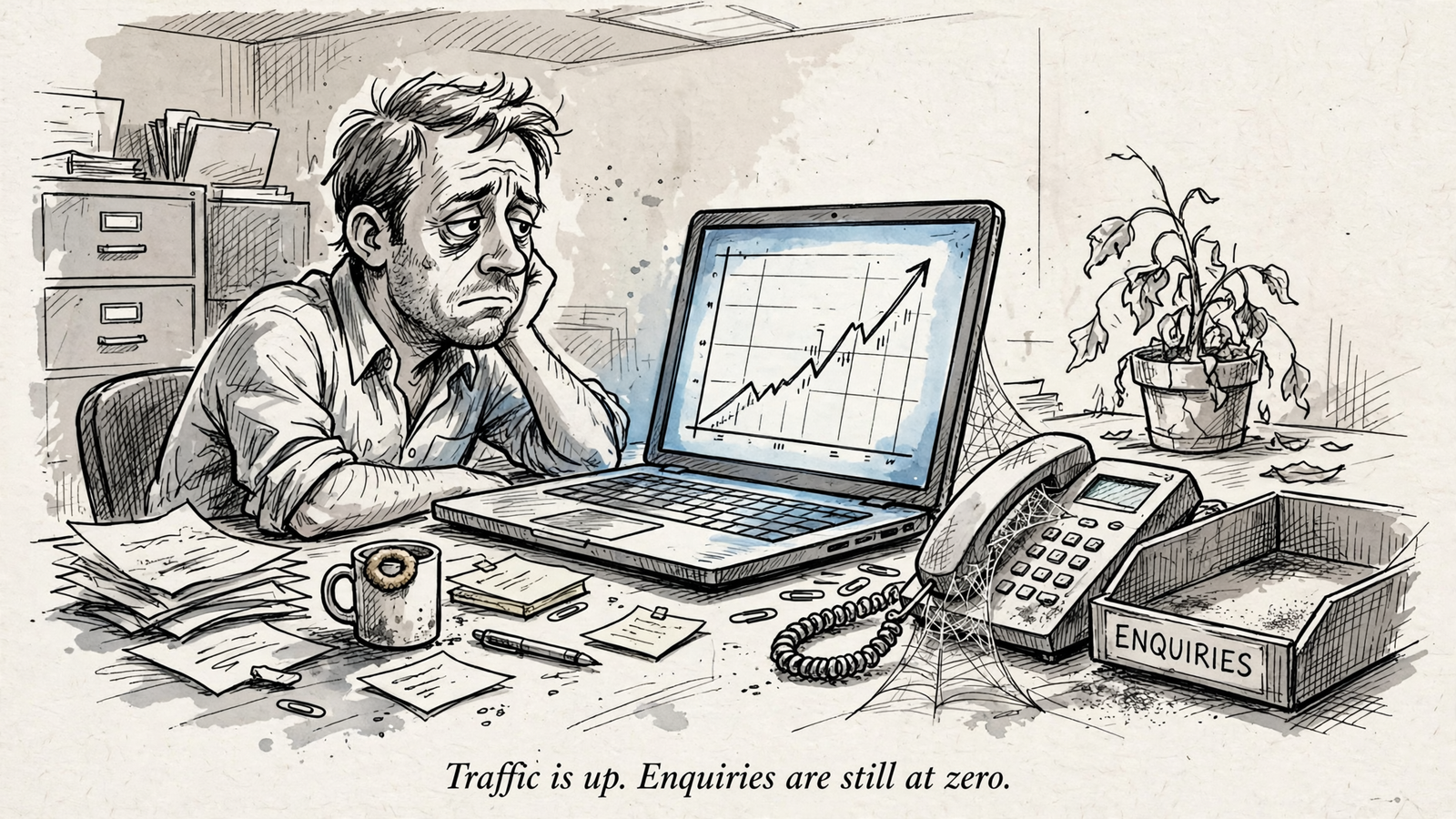
I have seen what happens when a report mistakes activity for progress. One roofing company paying $5,000 a month got a blog post a quarter and a nice traffic graph: 13,000 organic users in three months, but only 403 clicks in Search Console. The report claimed more than 400 pages. Google had indexed 43, including irrelevant divorce law pages. Traffic without enquiries is how you get ripped off slowly.
So I ask two questions of every option: Did someone contact the business, and can you trace that contact back to the work? A mention matters if it helps a buyer choose you. A page matters if it gives that buyer somewhere useful to land. Neither gets a trophy for appearing in a dashboard.
1. One managed service: Google SEO and AI answers under one roof
This is my pick for the owner with no time to coordinate writers, technical fixes, reporting and another vendor for AI search. The advantage is ownership of both halves of the job. groas lists its SEO and AI search service at $1,499 a month, flat and month to month, with no setup fee and a 7-day money-back guarantee. The service covers Google alongside ChatGPT, Perplexity, Gemini and other AI search surfaces. It says new pages, technical fixes and authority work happen continuously, with a dedicated manager accountable for the work. It can go live within 24 hours after the onboarding call.
Here is the mechanism I care about: the same service can publish a page that answers the buyer’s question, fix what stops search engines from using it, and work on the sources that support its credibility. That gives an enquiry a better path than two vendors each declaring their half complete. One owner for the page, the technical work and the AI answer work beats making a busy business owner referee the handoffs.
What rules it out? $1,499 a month is still real money. If you cannot fund that recurring fee, or you have the time and appetite to do the work yourself, do not buy a managed service because a ranking told you to. And do not treat a flat fee as proof of results. Ask for calls, forms and bookings by source; judge the work against those numbers, not the number of tasks in a log.

2. Traditional SEO agency: a strong Google foundation, with an AI gap to check
A good agency suits a business in a competitive market that needs technical cleanup, pages matched to buyer intent and off-site authority, but cannot produce that work in-house. That foundation is what it does better than the options below it. It takes sustained work, and an agency can bring more capacity to it than one owner with a spare evening.
The standard agency retainer in a survey of more than 300 agencies is $1,500 to $5,000 a month, with local-only work at $500 to $1,500 and enterprise work at $5,000 to $15,000-plus. An Ahrefs poll puts the agency average at $3,209 a month. Those prices do not tell you whether buyer prompts, AI citations or enquiries are part of the job. You have to ask.
What drops the traditional retainer to second is the work it may leave out. GEO is commonly priced as a separate $900-plus add-on, reaching $2,500 at enterprise tier. The same survey says 37% of agencies that raised prices named it as the reason. AI engines need pages and sources they can fetch, parse and trust. If nobody tests the buyer’s questions or works on the answers those engines use, a page-one ranking can coexist with a lost enquiry. Buy the agency for its Google work only if you know who owns the other half.
3. Freelancer: direct access, one point of failure
Hire a freelancer when you have found a senior operator, checked their references and can live with one person carrying the account. Direct access is the advantage: you speak to the person doing the work, not an account manager translating your request into a ticket. Decisions can move quickly, and the price can be lower. In an Ahrefs poll of 439 providers, freelancers averaged $1,348.63 a month versus $3,209 for agencies; the poll also found local work in the $251 to $500 range.
Talent is not the reason I rank a freelancer third. Capacity is. When one person gets busy, gets sick or leaves, the work can stall. I have inherited freelancer accounts that ranked fine and starved the client because nobody owned the page meant to turn a visit into a call. A capable freelancer can cover Google and AI search, but do not assume both are included because the proposal says “SEO.” Ask what they will ship, what happens when they are unavailable, and how they will report enquiries. Great specialist or stopgap; a fragile sole growth system.
4. AEO/GEO-only specialist: better buyer questions, incomplete coverage
This is for the business that already gets found on Google and wants to address what happens when someone asks ChatGPT or Perplexity who to call. A good AEO/GEO specialist asks better buyer questions than a shop still reporting only rankings. They test prompts, format answers so machines can use them, and track citations by engine. When a long question produces an answer that shortlists businesses, that work matters.
The rule-out is the word only. Managed AEO/GEO programs run roughly $1,000 to $3,000 a month at entry level, $3,000 to $8,000 for growth and $8,000 to $15,000-plus for advanced B2B. The same pricing roundup lists entry points of $3,000 for 009 Agency and $5,000 for TripleDart. Meanwhile, GEO also appears as a $900-plus add-on to SEO. Ask what the quoted scope actually includes. If technical fixes, useful pages and authority work remain yours to arrange, you have bought the second half before securing the first. Mentions without pages that convert are rankings without enquiries in a newer outfit.
5. DIY with tools: the lowest invoice, if your hours are free
DIY fits an owner in the early stages who has more time than budget and genuinely likes writing and tinkering. Its advantage is control. An Ahrefs Lite plan at $129 a month or Semrush SEO at $139.95 gives you keyword and technical data without locking you into a retainer. I started this way. You learn quickly what moves and what does not.
The second invoice arrives in evenings. That same comparison estimates 3 to 6 hours a week for writing, on-page fixes and outreach, plus 8 to 12 hours to set things up. At an illustrative $75 an hour, the recurring work is about $900 to $1,800 a month in owner labour, using four weeks as the rough month. Setup takes additional time. Then you still have to decide how AI answers fit the work.
This is not an argument that your time must be billed like a consultant’s. It is a reminder that the hours have to come from somewhere. If they come from sales calls, jobs or sleep, the cheap subscription is not the whole price. Pick DIY if you can protect the hours every week, not because the software invoice looks pleasingly small.
6. AI visibility software: a useful thermometer, not treatment
A monitor suits the owner who suspects the business is absent from AI answers and wants a baseline before committing to more work. Measurement is what it does best. Otterly Lite starts at $29 a month for 15 prompts and Peec Starter at $95 for 50. You can see where the business was mentioned and where it was not. I like a checkable baseline; I have bought versions of these tools myself to watch one weekly.
The limitation is equally clear. A chart does not fix a page, write a better answer or earn a citation from another site. The same comparison lists Athena Starter at $295 a month and Scrunch Core at $250, while Profound has no self-serve price. Whatever the dashboard costs, someone still has to decide what the absence means and do the work. Buy a monitor to measure visibility, not to produce enquiries. For the owner with no time, it comes last because it hands the job straight back.
What the six options cost after the invoice
The listed monthly range runs from $29 for a visibility monitor to $15,000-plus for higher-tier agency or AEO/GEO work. That is not a like-for-like shopping range: the lowest price buys measurement, while the higher prices buy managed work with different scopes. Here are the line items I would put beside a quote before signing. Listed fees are recurring unless noted; owner labour and missing work are separate.
| Option | Listed monthly cost and source | One-off cost or commitment | Cost the invoice may leave out |
|---|---|---|---|
| AI visibility software | $29–$295 across the named plans; Profound has no self-serve price | No setup figure stated | Someone must investigate and make changes |
| DIY with tools | Ahrefs Lite $129; Semrush SEO $139.95 | 8–12 hours to set up | 3–6 owner hours a week |
| AEO/GEO-only specialist | $1,000–$3,000 entry; $3,000–$8,000 growth; $8,000–$15,000-plus advanced B2B | No setup figure stated | Google SEO work if it is outside scope |
| Freelancer | $500–$2,500 in the small-business comparison; $1,348.63 average in the Ahrefs poll | No setup figure stated | Your management time and continuity gaps |
| Traditional SEO agency | $1,500–$5,000 standard retainer; $500–$1,500 local-only | Check the proposal for setup costs | GEO may be a $900-plus add-on |
| One managed service: groas | $1,499 flat for SEO and AI search | No setup fee; month to month | Check the enquiries, not just the work log |

A retainer can look tidy until the GEO line appears. Percentage-of-spend pricing, familiar from paid ads, is an even worse fit for judging search enquiries: a higher bill need not mean more of them. I have seen how the pricing model shapes the work on the paid side in this comparison of agencies, tools and autonomous services. For this job, I want the scope and fee clear before the first report arrives.
The cheapest mistake is buying a $29 score and thinking you bought enquiries. The expensive one is paying $5,000 for a traffic graph while the pages meant to win calls go unfixed.
Four questions to ask before you buy the report
A sales call should tell you who will do the work and how you will know whether it mattered. I would ask these in order:
- How many calls, quote forms and bookings can you trace to the work? Show me how those enquiries are tracked, not just where traffic came from.
- Which buyer questions will you test in Google and AI answers? Tell me what happens when the business is absent or a competitor gets cited.
- What ships in the first 30 days, and who ships it? Name the pages, technical fixes and authority work, with the person responsible.
- How much time do you need from me each week? Put it in writing. “Minimal involvement” is not a plan.
Then ask what they will stop reporting if it never produces an enquiry. If the answers keep returning to rankings, visibility scores and impressions, you have learned what the vendor optimizes for: the report.
Who should pick against my #1
Pick against me on purpose if the fit is wrong. Stay DIY if your budget is under $200 and you can protect six hours a week; your time is the capital you are spending. Keep a freelancer if you have checked two references, they respond promptly and they can report enquiries by source. Stay with a traditional agency if legal review and a large content team matter more to your business than speed, but establish who handles AI answer work and what it costs.
I left one popular option off the ranking entirely: one-off audits and link packages. An audit with 80 findings and nobody to ship the fixes gives the owner another job. Fifty links with no pages worth linking to do not solve it either. If you cannot name who will publish, fix and earn trust next week, you did not buy ongoing SEO. You bought a PDF.
If you skipped to the end: software measures, DIY teaches, specialists work on AI answers, freelancers bring direct access, and traditional agencies build a Google foundation. For the owner with no time to manage those pieces, my pick remains one managed service for Google SEO and AI answers. At $1,499 a month, the point is not a prettier visibility score. It is one accountable owner for the work that can turn a search into a call or booking. Judge it there.