

 LinkedIn

By December 31, 2027, ads inside LLM answers will be a normal line item on your search invoice. Not a beta, and not a test budget your agency hides under Innovation: a line with its own spend, CPA target and landing pages. If you spend $20k a month on search and you are not buying answers by then, you will feel it the way you would feel turning off Shopping today.
That is the boldest of my seven calls. They all come from the same shift seen from two ends: the ad unit is becoming an answer, and the account manager is becoming software. I spent years building match type structures by hand and mining negatives at 1am, so I do not say that lightly. I used to tell clients tight structure was the moat. I was wrong. The moat was attention to detail at a volume no human sustains, and that part now belongs to machines.
First, the short timeline. Then seven predictions, each with a date, a mechanism, a signal to watch and a condition that proves me wrong. No vague essay about the future of AI. Hold me to the dates.
2021 to 2023: Automation takes over the query
Google stopped selling you keywords and started selling you outcomes. Shopping took commercial queries with pictures and prices; Performance Max then bundled Search, Shopping, YouTube and Discovery into a pool where you supply assets and targets and Google picks the slot. The practitioner’s job shifted from controlling every placement to controlling what the machine was fed.
That broke the old craft I grew up on. Exact match structures and hour-by-hour bid tweaks mattered less; feed quality and conversion tracking mattered more. The managers who adapted stopped bragging about structure and started checking the inputs. A beautifully organised account cannot rescue a conversion signal that rewards the wrong thing.
May 2023 to late 2025: The answer becomes the ad slot
Search Generative Experience launched the experiment, then AI Overviews put a generated answer above the links. Ads followed the eyeballs: as of October 2026, ads above and below AI Overviews are live in 200+ markets, while ads inside Overviews are live in 12 markets including the US, Australia, Canada and India. Google is also testing a format directly below AI Overviews, with an image on the left and a title and description on the right under a Sponsored label.
The awkward part for practitioners is control. There is still no separate AI Mode campaign; eligibility comes from Performance Max, Shopping and broad or AI Max Search, and you cannot target or opt out of AI Overviews separately. You may already be buying AI-answer placements without a separate line in your report. That makes placement-level performance harder to judge, not less important to ask about.
February to May 2026: ChatGPT starts selling answers directly
OpenAI put its own price tag on the chat. The ChatGPT ads pilot began February 9, 2026, for logged-in Free and Go users; the self-serve Ads Manager beta opened May 5, 2026, with CPC bidding at $3–5 recommended alongside a $60 CPM option after the $50k minimum was dropped. Early numbers are small-sample and messy: 0.68% overall CTR, a top quartile around 1%, best brands at 1.57% and a 5.4% peak observed.
What the deck calls conversational commerce, I call the same lesson as Shopping in 2012. When attention moves, the ad slot follows. The first buyers get learning while everyone else debates whether it counts as search.
That is where the timeline ends and the predictions begin. Google turned the result into an answer and sold space around and inside it. OpenAI turned the answer into inventory. Here is where I think that line goes next, and what would make me take each call back.
1. By Q4 2027, ads in LLM answers become a standard line item
The mechanism is inventory plus intent. ChatGPT has the users, Google has the purchase behaviour, and both now have a unit near where the decision gets made. Google already reports inside-Overview ads as Top Ads, while OpenAI is building a separate auction. Finance teams will want the discipline they expect from Search: a budget, a CPA target and creative they can assess. That pressure is what turns an experiment into a line item.
Watch for separate reporting columns for answer placements in Google Ads and ChatGPT Ads Manager by mid-2027. Until then, keeping a distinct internal budget is a workaround, not the same thing as placement-level reporting. I am wrong if December 2027 arrives and LLM-answer spend is still lumped inside PMax or a single ChatGPT test line with no target of its own.
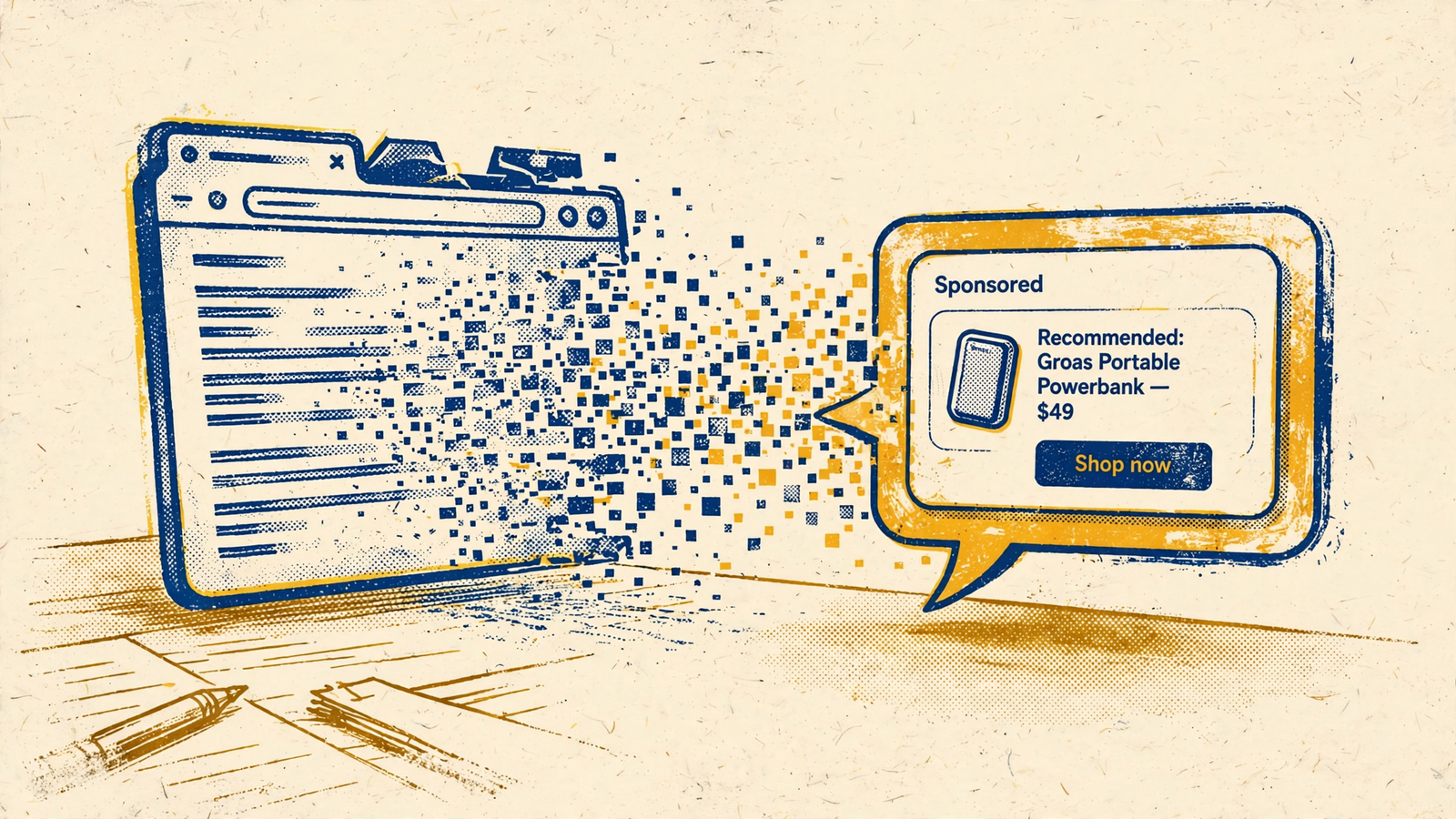
2. By mid-2027, the keyword loses its job as the targeting unit
I built my career on match types. I am telling you they are going away as the main control lever. Google is retiring Dynamic Search Ads for AI Max, with auto-migration, auto-created assets and campaign-level broad match starting in September, claiming 7% more conversions or value at similar CPA or ROAS for the full stack.
The cause is simple: when an ad has to fit inside a generated answer, the system cannot wait for your keyword list to contain the exact phrasing. It reads intent from the conversation, pulls from your feed and landing pages, and assembles the unit. Exact match becomes a suggestion, not a fence. That does not make the queries irrelevant. It makes the quality of the material the system can draw on harder to ignore.
I am wrong if, at the end of 2027, a new account can still scale on hand-built exact match alone without broad, AI Max or feed-driven expansion doing most of the matching.
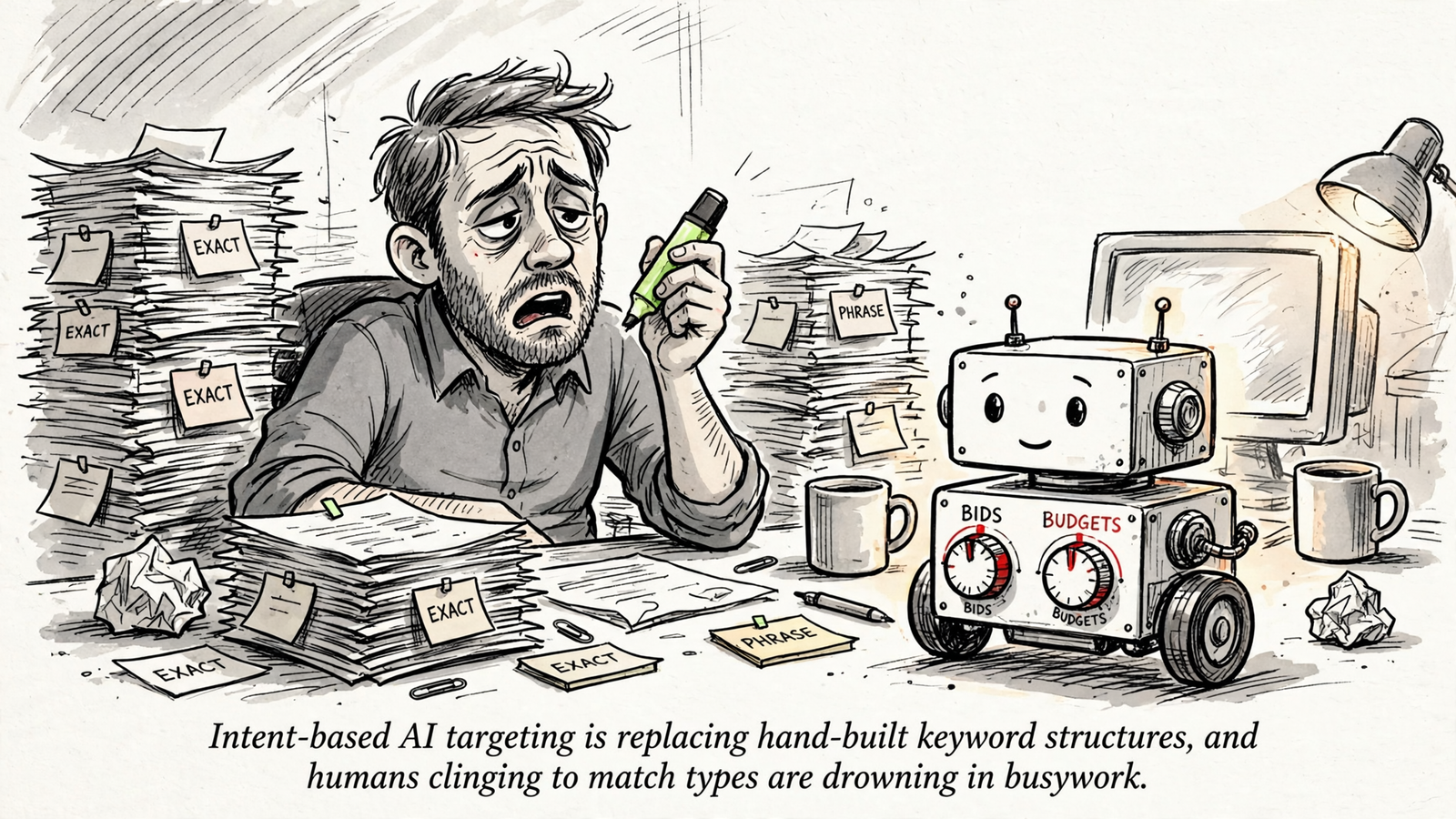
3. By Q3 2027, agents make most bid and budget moves in $10k–$100k accounts
This is already half-live. Google’s Ads Advisor and Analytics Advisor, built on Gemini, roll out to all English accounts in early December, able to suggest and, with approval, apply changes such as sitelinks, generate keywords and assets, and diagnose drops conversationally. Approval is the training-wheels phase.
Once advertisers see an agent catch a budget cap at 2am or shift spend off a dying query faster than a manager’s Monday review, they will be tempted to auto-apply changes with guardrails. That is what I mean by autonomous management: continuous execution, with a human setting limits. The limit matters as much as the speed. An agent that moves money without a goal worth defending is just a faster way to be wrong.
I am wrong if human clicks still account for most bid and budget changes in that spend band in Q4 2027 audit logs.
4. By Q2 2027, percentage-of-spend fees break in smaller accounts
The math stopped working when the work changed. 2026 pricing guides still put agency fees at 10 to 20% of spend, with $500 to $1,500 minimums. At 15%, moving from $20k to $50k in monthly spend lifts the fee from $3,000 to $7,500 without necessarily adding proportional work.
I watched this from inside: once Smart Bidding handles bids and PMax handles placement, the hours go to tracking, feed fixes and creative. None scales neatly with spend. Clients notice. By Q2 2027, I expect most accounts under $100k to be on flat or output-based fees, while agencies charging a straight percentage have to defend it on every renewal call. I laid out the case in why percentage-of-spend pricing loses its justification.
If your fee rises when your spend rises but your CPA does not fall, you are paying for budget, not management. I am wrong if percentage-of-spend is still the default quote for new $20k accounts in December 2027.
5. By late 2027, a landing page per intent cluster becomes the baseline
Answer engines punish generic pages. When an ad appears beside or inside a generated answer, the click arrives with a specific question in mind. Send that visitor to a homepage or broad service page and you make them find the answer twice. The mechanism is conversion rate: matched pages lift Quality Score and close rates, and give Smart Bidding cleaner signals to bid on.
I used to sell clients one landing page and call it CRO. That was lazy. By late 2027, competent setups will ship a distinct page for each meaningful intent cluster, with its own proof, pricing shape and next step. This is not a demand for a new page every time someone invents a new ad group. It is a demand that a materially different question gets a page that answers it.
Count your top intent clusters, then count the pages that actually serve them. That gap is your 2027 project. I am wrong if template pages with swapped headlines still win head-to-head tests against intent-built pages at the end of 2027.
6. By early 2027, scripts and rules engines shrink to edge cases
I lived in scripts: pausers for runaway spend, bid tweaks for weather, alerts for disapprovals. They worked. They also broke every time Google renamed a column. Agents replace that layer because they can do the same job in plain language against the API without you maintaining the code.
The mechanism is maintenance cost. A script you have to fix four times a year loses to an agent you instruct once and audit weekly. If it takes a spreadsheet and a schedule, software will eat it. Not every account needs that machinery, though. If you run one tight local account with ten keywords and a $2k budget, your two rules are fine. Replacing something simple for the pleasure of saying agentic is still waste.
I am wrong if most mid-size accounts are still adding new custom scripts in late 2027 instead of retiring them.
7. By late 2027, the human role narrows to direction and accountability
Machines get the decisions. Humans keep the decisions about decisions. Someone still has to set the CPA you can actually afford, say which queries you will never bid on and answer for revenue when the graph dips.
That is supervised autonomy with guardrails: you set goals and budget, the system works around the clock inside them, and every action comes with reasoning you can audit. I run accounts this way now because the alternative is what burned me in 2019: a junior manager learning on your budget at $175 an hour. One human owns the outcome; software does the labour. The human job gets narrower, but it does not get easier to fake.
I am wrong if job posts in late 2027 still ask for manual bid management instead of guardrail design and measurement quality.

What would prove the whole thesis wrong
I keep a note with kill conditions because predictions without them are just branding. Here is mine in one place. I am wrong if ChatGPT and AI Overviews are still side experiments in December 2027 with no separate targets or reporting. I am wrong if exact match alone still scales new accounts, audit logs still show humans making most bid changes, and straight percentage-of-spend is still the default quote at $20k.
For a second set of calls to check alongside mine, compare these seven with Google Ads in 2027: Predictions for the Year Everything Changes. If three or more of my seven miss cleanly, retire this post and stop listening to me on this topic.
What to do this quarter if I am even half right
You do not need to rebuild everything. You need to improve the four inputs the machines will feed on next year: tracking you can trust, pages that match intent, a fee model that rewards outcomes and execution that does not wait for Monday. Say you spend $20k a month. One month of cleaner conversion data now is worth more than six months of structure tweaks later, because every agent and Smart Bidding model bids on what you tell it a conversion is.
- Split answer inventory into its own line. Give ChatGPT and AI Overviews spend an internal budget and CPA target for 90 days, even if placement reporting is rough. You are training your team to buy answers, not just keywords.
- Fix one tracking lie. Pick the conversion action Smart Bidding trusts most, verify it against your CRM or Shopify orders, and delete the duplicate or inflated one. Bad signal in, bad bids out.
- Build a page for each top intent cluster. Start with your three highest-spend ad groups. If they serve three distinct intents, ship three pages with specific proof and a single next step. Then measure close rate, not CTR.
- Stop paying for budget. If your fee rises from $3,000 to $7,500 as spend rises from $20k to $50k with no CPA commitment, renegotiate to flat. That is the model groas runs on: continuous execution with one human owning the outcome for a flat monthly fee. It fits this shift better than hourly tweaks or percent-of-spend reviews.