

 LinkedIn

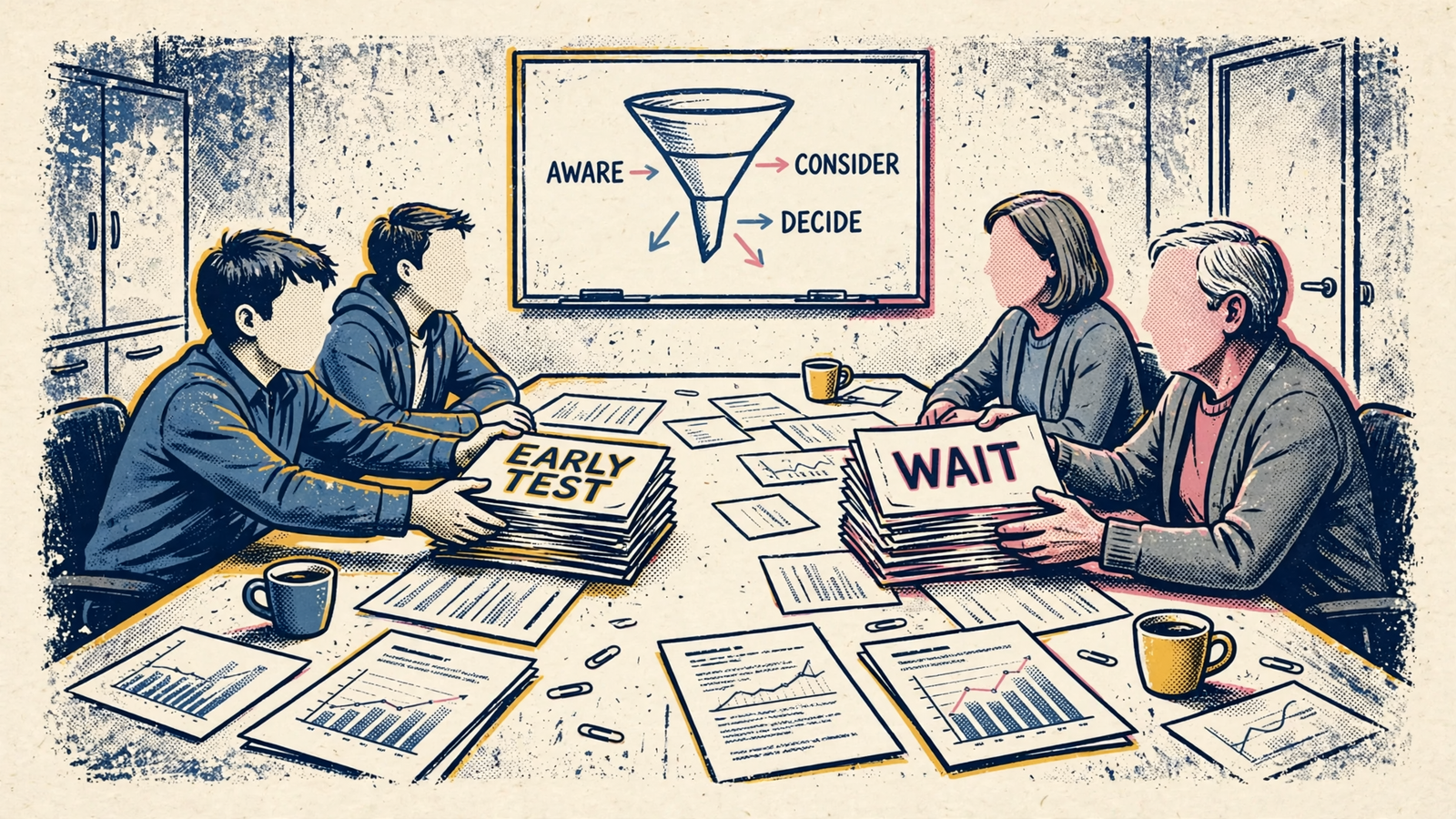
A B2B company with a six-month sales cycle can buy ChatGPT ads now. It cannot know from a 30-day dashboard whether those ads helped close a deal. That is the fight: early buyers see a thin auction and time to learn; skeptics see an unproven channel whose reporting window ends long before the sale. Both are looking at the same test and pricing different risks.
I used to tell clients to judge a new search channel after 60 days of lead cost. I was wrong for B2B. A shoe sale can close in the same session. Your deal may close two quarters after the first click, after sales moves it from MQL to SQL to opportunity. So here is the debate at full strength, then my call: test only with a capped budget and opportunity-stage tracking agreed before launch. Otherwise, wait.
The case for buying now: thin competition buys learning time
The strongest buy-now argument is arithmetic. ChatGPT has far fewer advertisers than Google, while its reported audience exceeds 1.2 billion weekly users. One practitioner reports roughly 0.5% CTR and $10 CPMs; a Digiday April CPM near $25 was cited as already falling. Those are early observations, not a B2B price guarantee. But the mechanism matters: fewer bidders can mean less bid pressure. A modest budget may buy enough traffic to learn which conversations produce serious inquiries instead of disappearing into a crowded search auction.
This is not Google with a chat box attached. There are no keywords to select. You provide a landing page and one- or two-sentence context hints, choose a CPM or CPC bid or an oCPC for a Conversions objective, and enter a relevance-weighted second-price auction. A more relevant ad can beat a higher bid. The minimum is around $25 per day averaged over seven days, with OpenAI suggesting $3–$5 starting max CPCs. Low entry cost gives you room to test the match, not permission to assume it works.
The second argument is intent. A keyword tells you four words. A conversation can tell you the job. Someone searching compliance software could be a student. Someone comparing SOC 2 tools for a 200-person fintech with Okta already installed has supplied much more context. The auction can use that context, your hint, and your landing page to find a fit without relying on an exact-match string. If the match is good, a smaller advertiser has a plausible way into a buying conversation.
Early vendor studies offer a reason to look, though not a reason to declare victory: WeightWatchers reported CPA 15.3% below blended paid search, Dose reported 67% incremental purchases net new, and 93% of Portland Leather’s ChatGPT visitors were new. Treat those as single-brand tests, not B2B benchmarks. They show what a promising traffic source might look like. They do not show that a six-month opportunity closes.
The third argument is control. Say you spend $20,000 a month on Google and Bing. Carving out 10%, or $2,000 a month, gives ChatGPT a defined experiment budget rather than a vague claim on next quarter’s pipeline target. Run the test for at least eight weeks at that monthly cap. You can learn which context hints attract buying conversations, which attract research traffic, and which landing pages hold attention. If the match is poor, stop. If it is promising, you have learned before a more crowded auction makes that learning expensive.
A capped test does not have to pay back this quarter to be worth running. That is the buy side’s best case. Put the cap and the learning goal in writing before anyone touches the campaign.
The case for waiting: the sale outlasts the dashboard
Start with the evidence nobody puts on slide one. No agency has twelve months of closed-won ChatGPT ads data for long-cycle B2B. Self-serve Ads Manager opened in early May 2026, and OpenAI says it does not yet have performance benchmarks across advertisers or industries; Ads Manager remains in Beta. The question is not whether ads can produce clicks. It is whether those clicks become opportunities at a cost you would accept.
One public paid test spent $477 over six weeks for 19,154 impressions and 370 clicks, with zero conversions. Over the same period, organic ChatGPT referrals produced 552 sessions averaging 443 seconds and five sales; paid referrals produced 210 sessions averaging 37 seconds and no sales. That does not prove the channel fails. It does give the wait camp a sharper objection than “new things are scary”: paid matching can send traffic that behaves nothing like the organic traffic a marketer hoped to reach.
Other matching data reinforces the concern. Seer Interactive reviewed about 55,000 ChatGPT responses and found 38% fully on-topic, 58% category-adjacent, and 4% unrelated. Category-adjacent might be tolerable for a broad consumer offer. It gets expensive when you sell a $60,000 annual platform and your form fills come from students and job seekers. Before you scale, you need to know which kind of conversation you paid to join.
Then there is who can see the ad at all. Ads appear on Free and Go. Plus, Pro, Business, Enterprise, and Edu accounts are ad-free; under-18 users and sensitive topics such as health and politics are excluded. For a B2B advertiser, that is not a footnote. A buyer whose team uses a paid plan may never see your placement. The audience is large, but a large audience is not the same as reachable buyers.
Reporting makes a weak match harder to diagnose. Ads Manager shows impressions, clicks, spend, CTR, average CPC and CPM, and conversions within 7-, 14-, and 30-day click windows, with optional one-day view-through. Pixel, Conversions API, and UTM persistence are available. Yet one Accuracast case reported leads while the dashboard still showed zero conversions two weeks later. If you grade a long-cycle test on day-30 form fills alone, you can kill one that might have worked or scale one that should have died.
The calendar is the decisive problem. Average SaaS sales cycles run 60–120 days, with an 84-day average and enterprise deals stretching to 11.5 months. Google Ads GCLID offline imports get rejected after 90 days, so a deal closing in month four or five needs another way to remain visible, such as hashed-email Enhanced Conversions for Leads. The working Google playbook is SQL as the primary bidding signal once you clear about 30 a month, MQL or demo as secondary, and Closed-Won as validation. ChatGPT’s 30-day click window is shorter still. A February conversation that becomes a July SQL will not show up as that outcome in Ads Manager. You need your CRM to keep the connection.
Those same dollars can stay in a channel whose pipeline you already understand. B2B SaaS non-brand search runs around $13.75 per click and $207 per lead, versus brand at $3.12 and $34. Search can look weak under first-touch ROAS and much stronger when attributed to pipeline. Why divert money to a Beta auction if your existing Google spend is still judged on MQL volume rather than SQLs and opportunities? If you cannot report opportunity stage for proven search, do not add a second blind channel.

The deciding dispute: what does the test really cost?
The buy camp sees $2,000 a month of capped media spend and calls the risk manageable. The wait camp sees the cost of paying someone to learn nothing. On that point, I side with the skeptics. A $3,000–$4,000 monthly retainer or a 15%-of-spend fee across three months can cost more than the experiment it manages. If the report ends at form fills, the fee bought you a polished account of an unanswered question. What the deck calls full-funnel ChatGPT management, I call paying senior prices for junior learning.
That is why I filter management options on economics before I filter them on claims. A percentage-of-spend fee rewards higher spend in an unproven auction. A separate ChatGPT retainer on top of Google and Bing adds fixed cost to what should be one search strategy. groas offers Google Ads, Bing Ads, and ChatGPT Ads together for a flat $1,499 a month, regardless of spend. That is the better fit for this test: one fee does not punish you for starting small. It does not excuse anyone from proving what happened after the click.
My verdict: buy only if the pipeline test is ready first
Buy ChatGPT ads this year only if you can connect a click to opportunity stage before you spend a dollar. Agree on CRM lifecycle stages in writing. Put UTMs on the ads and preserve their source through MQL, SQL, and opportunity. Make sure your existing offline-conversion setup can report those stages for Google, and use the CRM—not ChatGPT’s 30-day dashboard—to judge the longer ChatGPT path. I already favor bidding Google toward SQLs and validating against Closed-Won; this account of switching B2B SaaS Google Ads from leads to pipeline signals explains the shift. If Salesforce or HubSpot cannot tell you which ad source created an SQL, fix that before buying another source of leads.
The second condition is a hard cap. Take 10% of proven search spend as experiment money and run at least eight weeks. On a $20,000 monthly Google-and-Bing budget, that means up to $2,000 a month for ChatGPT, with the same offers and landing pages in a separate campaign. Judge cost per SQL and cost per sales-accepted opportunity against your Google baseline. Do not let an agency substitute CTR or lead volume at day 30. For a fuller test structure, these five ways to judge qualified-opportunity cost before long-cycle deals close keep the measurement question in view.
What I want to see at day 30 and day 60
At day 30, I want proof that the plumbing and matching work, not a ROAS slide:
- The context hints tested and the conversations they attracted: buying research or casual research?
- The UTM-to-CRM match rate and whether source survives each lifecycle-stage change.
- Paid versus organic ChatGPT visitor behavior. In the public test above, 37 seconds paid versus 443 seconds organic warned of a match problem before an SQL could appear.
At day 60, show cost per SQL and cost per sales-accepted opportunity against Google non-brand, plus the share of visitors who are net new. Agree the kill rule before launch: if eight weeks at capped spend cannot produce SQLs at a cost within 30% of Google non-brand, pause. No opportunity data, no renewal. Put that sentence in writing.
Who should wait
Sit out if your cycle runs beyond six months and you close fewer than 30 SQLs a month, your CRM cannot already send SQLs back to Google, your buyers mainly use ad-free Plus, Business, or Enterprise plans, or your Google account still bids to MQL volume. Keep the experiment money in proven search and use the quarter to fix offline imports so clicks carry lifecycle context.
That is my call. Buy now only as a capped pipeline test with tracking live on day one. Otherwise, wait. A thin auction rewards the prepared; it does not rescue a team paying a full retainer to learn what its CRM still cannot answer.