

 LinkedIn

A $200 Bing add-on can be a useful extension of a Google Ads account. It can also be a Google import nobody looks at again. So who should run white-label Microsoft Ads: a Bing specialist or the partner already running Google? Smart operators disagree because Microsoft needs its own bids and segments, while splitting the work can break the shared negatives, budgets and reporting that make an account manageable.
I used to import Google builds straight into Microsoft and call it coverage. I was wrong. But that does not mean every account needs a second vendor. Specialization lives in the process, not the logo: the deciding question is whether someone re-bids and re-segments imported campaigns for Microsoft.
The question hiding inside the add-on
Say you spend $20k a month on Google for a client and someone asks why you are not on Bing. You know there is volume there, especially for desktop B2B, but you do not have the hours to learn another auction. So you look for a white-label partner to run Microsoft Ads under your brand. One candidate is a Bing specialist who says Google shops get Microsoft wrong. The other is your existing Google partner, who says the accounts belong together.
The cheap add-on model makes that decision look simpler than it is. GetPhound lists Google Ads management at $450 a month after an $850 first month, with Bing sold as “Extend a Google Ads campaign to Bing” for plus $200 a month. Read the wording. It promises an extension, not necessarily an operation.
That is the debate: does Microsoft need its own operator, or does separating it from Google cost more in coordination and lost learning than a specialist can earn back? Give each side its best argument before looking at the invoice.
The specialist’s case: Microsoft is not a smaller Google
The strongest argument for a Bing specialist starts with who you can reach and what you pay for the click. Microsoft is the only ad platform outside LinkedIn itself that lets you target by LinkedIn profile on Company, Industry and Job function across search, shopping and audience campaigns. For B2B, that is not just another checkbox. I have seen desktop-heavy B2B accounts where Microsoft represents a small share of searches but 10 to 20 percent of pipeline because the age, income and desktop skew lines up with buyers.
The price can help, too. Across 73 advertisers running search on both platforms, Microsoft averaged $1.54 per click versus $2.93 on Google, 47 percent cheaper. The gap was widest in non-brand: $1.57 versus $3.56. A specialist’s argument is that those differences deserve a build designed for Microsoft, not Google settings carried over because they were already there.
The differences come with traps. LinkedIn targeting on Microsoft search is bid-only, not target-and-bid, with a limit of 1,000 companies per campaign entered by hand. You cannot build a pure account-based search campaign that way; you add bid modifiers of plus 30 to 50 percent for matched clicks. Negatives work differently, too: Microsoft offers phrase and exact negatives, versus three match types on Google. Location and ad schedule can be set at ad group level. Microsoft serves in the user’s time zone; Google serves in the account’s time zone. Leave the Microsoft Audience Network checked inside search and MSN, Outlook and Edge display traffic can mix into search reporting until you exclude it.
A shop that works in Microsoft every day has reason to catch those details. Miss them and the apparent bargain in CPC can become an expensive pile of clicks you did not mean to buy. The specialist is selling attention to the differences, not merely access to another platform.
Generalists have a tempting shortcut. I know because I took it. Google Import transfers campaign structure, keywords, ads, targeting, bids and budgets and can be scheduled to re-sync daily or weekly. After an import, Microsoft tells you to check budgets, bids, targeting, URLs, conversion goals and warnings because settings do not always transfer the same way. That warning is the job. Click import, leave auto-sync on and move on, and you have copied an account without deciding whether it fits the new auction.
As one Microsoft-focused breakdown puts it, import copies your structure faithfully, including the parts that are wrong. Google budgets ported 1:1 can overspend in a smaller auction. Google Target CPA targets can starve on thinner volume. The proposed fix is unglamorous: import only your 3 to 5 converting campaigns, start budgets around 20 percent of Google, turn off auto-sync until the build is stable, and reset automated bidding to manual until you bank 30 to 50 conversions. A generalist may not do that work for a $200 add-on. A good specialist makes it the starting point.
The one-partner case: shared learning beats a second specialist
Now give the existing Google partner its strongest case. Search-term data wants to live in one place. Google sees roughly ten times the volume, so it can find junk first: free, jobs, DIY and competitor queries that burn budget. When one partner runs both platforms, those negatives can reach Microsoft the same day. Split the vendors without a tight handoff and the Bing shop may learn the same expensive lesson three weeks later on your client’s money. Standardize on phrase negatives for single words and you can share a list across both auctions without a match-type mismatch.
That is more than administrative tidiness. The partner with the fuller view can decide whether a query is a problem across search or only in one account, then make the corresponding change without waiting for another vendor’s update. One owner can turn a Google lesson into a Microsoft action while it is still useful. The specialist’s platform knowledge has to outweigh that shared loop, not just look impressive in a pitch.
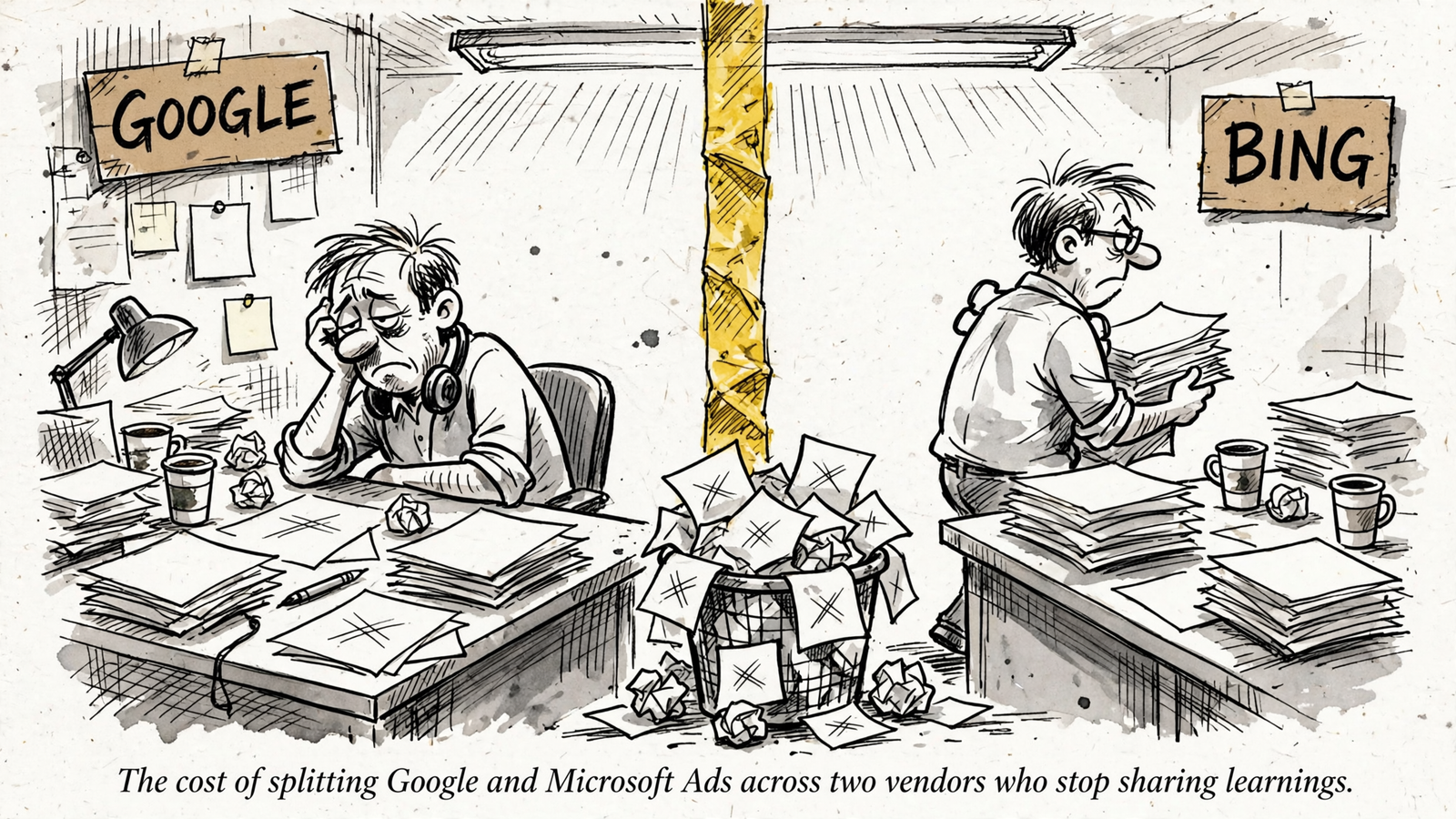
Then there is agency reality: margin and blame. Two vendors can mean two logins, two invoices, two Slack threads and two people pointing at each other when CPA rises. One branded report and one strategist give the agency a clearer answer to the client’s next question: what changed, and why? A single partner can split budget by intent rather than by vendor relationship and tell you when Microsoft deserves 20 percent and when it deserves zero.
Vendor sprawl also taxes the number you keep: your markup. I have watched agencies lose money managing the gap between vendors. A dedicated Bing shop has to produce enough better decisions to pay for its own retainer and the coordination around it. If you want a shortlist, start with white-label partners who actually work the Bing account. Then judge whether their process preserves the shared learning the one-partner model gets almost for free.
Where each argument fails in practice
The specialist model can break on small accounts and thin communication. Microsoft is about 6 to 8 percent of United States search and 3 to 4 percent globally, though it can drive 10 to 20 percent of pipeline in B2B desktop accounts. That math does not automatically support two strategists, two calls and two reports when a client spends $5k a month total. I have seen the split-vendor version: Google blames Bing for junk leads, Bing blames Google for hogging budget, and the agency owner spends Friday reconciling two dashboards.
The CPC discount is not universal, either. When Google clicks cost under $1, Microsoft averaged 40 percent more expensive in that same 73-advertiser study. A separate retainer to chase a small remnant of spend can eat the agency’s markup before the client sees a result. A specialist has to earn the cost of being separate.
The one-partner model breaks on attention. Bing gets 5 percent of spend and 0 percent of thought. Auto-sync stays on, so every Google test ports over unedited. Search and Audience Network stay bundled, so display clicks pollute search CPA. LinkedIn Company and Job Function modifiers sit at zero because entering companies by hand does not fit a $200 add-on. Location and schedule stay at campaign level because that is how Google was built.
That failure is harder to spot because the agency still has one neat report. Both models can end in the same bland line: flat spend, flat conversions, no explanation of what changed only on Microsoft. The lesson is not to pick the cheaper-looking org chart. It is to demand evidence of Microsoft-specific work.
My verdict: keep one partner, if the import earns it
My default is the Google partner who can prove a Microsoft-specific rebuild. Shared negatives and one P and L beat a second retainer on most SMB accounts, provided the partner actually works the Microsoft account. A Bing specialist label does not stop someone from clicking import and billing you. A Google-first shop that re-bids, re-segments and excludes junk on Microsoft will beat a lazy specialist every month.
There is an exception: B2B accounts over $30k a month where LinkedIn segments and desktop bid gaps can pay for a dedicated build. Even there, the decision turns on the work, not the badge. Import a small piece of Google; set Microsoft budgets and bids for a thinner auction; fix negatives and networks; add LinkedIn modifiers where they pay; then show the changes in the log. That sequence is what specialization looks like.
I use the same test before anyone touches a client account under my name. Microsoft management ranked by one test asks whether a vendor runs Bing or copies Google. I want screenshots, not slogans. If a vendor cannot show import settings, a search-term cadence and a change tied to a Microsoft-only reason, its Bing badges do not help me.
Five questions that expose a copied Google account
Ask these on a sales call and listen for specifics. A real Microsoft operator can show the work. Someone selling an unattended import will answer with process fog.
- Show me your import settings. Which campaigns did you import, what budget ratio to Google did you set, and is auto-sync off until the build is stable? Importing everything 1:1 and leaving sync on is copying Google.
- How did you re-bid for a thinner auction? What were the starting bids and manual strategy, and how many Microsoft conversions do you want before trusting automated bidding? I look for 30 to 50 conversions before Target CPA or ROAS goes back on.
- Where do negatives live? How do you handle phrase versus exact on Microsoft, and how quickly do Google losers reach Bing? Same-day flow is one partner done right. A three-week lag is split vendors done wrong.
- What is excluded and segmented? Is Audience Network out of search? Are location and schedule set at ad group level where they matter? Which LinkedIn Company or Job Function segments carry plus 30 to 50 percent bid modifiers?
- Show me one Microsoft-only change from last week. Not a synced Google edit. Show a bid, budget, negative, exclusion or modifier changed because Microsoft data called for it, with the reasoning logged in plain language.
What the branded report must show
Your white-label report is where copy-paste goes to hide. A report that merges Google and Microsoft into one spend line can call that coverage while concealing who worked on what. I require a separate Microsoft section that distinguishes platform-specific decisions from synced Google changes. It should show:
- Spend and CPC: Microsoft spend as a share of total, Microsoft CPC beside Google CPC, and budget changes made only on Microsoft.
- Import status: whether auto-sync is on or off, which campaigns were imported, and which were built natively.
- Microsoft-only edits: bids reset for thinner volume, phrase negatives added, Audience Network excluded from search, or ad-group schedules and locations changed.
- LinkedIn layer: which Company, Industry or Job Function segments carry bid modifiers and what they returned.
- Next action in plain language: what changed, why Microsoft data prompted it, and what the operator will do next week.
That report gives the agency something better than a second logo on a proposal: an account it can explain and a partner it can hold accountable. If the Google partner cannot produce it, I would take the specialist who can.
That is why I run this work through groas now. Search Ads at groas covers Google, Bing and ChatGPT under one flat fee, with bidding, budgets and negatives worked around the clock, changes logged with their reasoning, and a named strategist who owns the result. It is one partner without treating Microsoft as a $200 import add-on. Test any partner the same way, mine included: show me the Microsoft-only edits from last week. Whoever shows real re-bids and re-segmentation gets your white label. Everyone else is selling you a copy of Google.