

 LinkedIn
Should your search partner get a cut of the revenue your business makes, or a flat fee for the work? Smart operators disagree because revenue share can spare a cash-strapped business a fixed bill when campaigns fail, while an established business can end up paying commission on customers it already had.
My objection is not to paying for results. It is to paying a partner for growth that would have happened without them. A flat fee with a written target and a commitment to work for free if that target is missed puts meaningful service-fee risk on the provider without taxing your baseline. But revenue share deserves its best argument first.
Position A: Give the partner a share of what they produce
The strongest case for revenue share starts with cash and accountability. Marketing budgets sit near multi-year lows at 7.8% of company revenue, and 62% of CMOs report that missing annual growth targets triggers immediate spending cuts. A conventional agency collects its monthly retainer while the client absorbs the ad spend. If a strategy misses, auctions reprice, or an account manager ignores bid drift for three weeks, the client still pays the fee.
Under a pure revenue-share agreement, the agency earns nothing from campaigns that produce nothing. That does not make the client’s wasted ad spend disappear. It does give the partner a direct reason to care whether the work produces sales rather than another polished account review. It also addresses a weakness of the hourly retainer model: time billed and value delivered are not the same thing.
Where a share can make sense
Revenue share has its cleanest case in an early-stage launch with little existing demand, a single-channel ecommerce business with relatively clear attribution, or a company that cannot carry a large fixed fee while acquisition gets going. An unknown direct-to-consumer brand with no search history, retail distribution, or existing customer list has less baseline revenue for a partner to claim. The partner still has to prove what its campaigns contributed, but the argument is simpler than it is for an established brand with several demand channels.
Offer that partner 10% of gross revenue attributable to its work, and its incentives become immediate. It has a reason to press for landing page revisions, watch conversion rates, and stop wasting dollars on loose broad-match terms. Bad execution shrinks its invoice. For a bootstrapped business that cannot afford a $6,000 monthly agency retainer upfront, giving up a slice of future revenue to get senior search execution can be a rational trade. The business preserves working capital while the partner carries the initial service burden.
Three ways performance contracts get priced
These deals do not all put the same risk on either side:
- Pure percentage of revenue: The agency collects 5% to 15% of top-line revenue attributed to its managed campaigns, with no fixed retainer.
- Pay-per-acquisition or lead bounty: Common in B2B and local services, this pays a fixed amount per booked call or qualified lead, calibrated against a target cost per acquisition.
- Hybrid floor plus upside: A discounted base fee, such as $3,000 a month, paired with a 5% cut of incremental revenue above an agreed historical baseline.
The best version of Position A is not “pay an agency for anything that sells.” It is pay for an outcome the partner can influence and the business can afford to share. For a company starting close to zero, that can beat committing to a full retainer before the channel works.
Position B: Pay a flat fee, but make them write the target down
The case against revenue share begins at the baseline. An established business already generates demand through its product, brand, email list, organic visibility, and customers who return without being persuaded by a new search campaign. A partner paid on attributed revenue can collect a cut of those sales even when its work did not create the demand.
Suppose a retail brand launches a nationwide PR campaign, emails 100,000 subscribers, or rides normal Q4 seasonality. Sales rise. Under a broad percentage-of-revenue agreement, so can the search agency’s invoice, without a matching contribution from the agency. A hybrid quote of $1,500 base plus 10% above a low threshold can become a $7,000 monthly fee as distribution expands or organic rankings mature. The contract may call that performance. The client may reasonably call it rent on its own work.

Attribution can turn a sale into someone else’s invoice
Inside Google Ads, a revenue-based fee creates an incentive to pursue conversions that are easy to claim rather than customers who are hard to win. A partner can put more budget into exact-match brand searches, bid on existing customer terms, or run Google Performance Max without brand exclusions. Those campaigns can receive credit when someone already looking for your company or returning to buy again converts. Reported ROAS rises, and so can the fee, without a comparable rise in new demand.
A commission on an attributed sale is not proof that the ad created the sale. That distinction turns a billing meeting into what one agency teardown calls “a philosophy degree disguised as an invoice.” The agency points to its ads; the CFO points to email or organic traffic; the marketing lead spends the afternoon adjudicating attribution instead of improving acquisition.
This is where buyers confuse performance-oriented work with performance-based billing. I want a partner optimizing toward qualified pipeline and attributable margin. I do not need to peg its invoice to gross revenue to get that discipline. Without a credible baseline and clear rules for what counts, the billing model rewards arguments about credit.
A fixed fee does not have to mean a free pass
The alternative is not an hourly retainer that buys recurring Monday check-ins. It is a fixed fee attached to a written performance target and consequences for missing it. For example, groas’s 90-day sprint model commits to +30% sales or +40% visibility before stopping or working for free. The client still bears its ad spend and the commercial risks outside a search partner’s control; the provider puts its service work at risk against the target.
That arrangement makes the management fee predictable without granting the provider a perpetual share of top-line growth. Write the target and the remedy into the deal. A flat price alone is not accountability.
Cross-examination: the strongest objection to each model
Position A has a fair criticism: flat fees can reward complacency. If a partner collects $4,000 a month whether ad revenue is $80,000 or $250,000, what pushes its senior strategist to keep hunting for non-brand queries? A provider can treat the account as a maintenance utility, keep its labor costs down, and leave growth on the table. Percentage-of-spend pricing has a different conflict: the agency earns more when the client spends more. Revenue share at least connects the fee to sales rather than budget deployed.
Position B answers that sales are not the same as profitable growth. An agency paid on gross revenue does not pay the supplier, cover warehouse overhead, or process returns. It can favor transaction volume even when the business would prefer fewer, better sales. Nor does the agency control inventory, landing page uptime, or sales follow-up. To protect itself against those variables, it may price risk into the revenue-share percentage. The client can end up surrendering 8% to 12% of top-line revenue for risks the agency cannot manage. And when cold, non-brand acquisition takes 45 days to close, a partner focused on this month’s invoice has a reason to favor faster, easier-to-attribute sales.
Neither incentive problem disappears because a contract uses the word performance. The useful question is narrower: what behavior does the next dollar of the partner’s fee reward?
Worked example: $20,000 a month in Google Ads spend
Say you spend $20,000 a month on Google Ads and report $100,000 in monthly ad revenue: a 5.0 ROAS. You are weighing an 8% share of attributed Google Ads revenue, a 15% fee on ad spend, and a $3,500 flat monthly fee tied to a written performance benchmark.
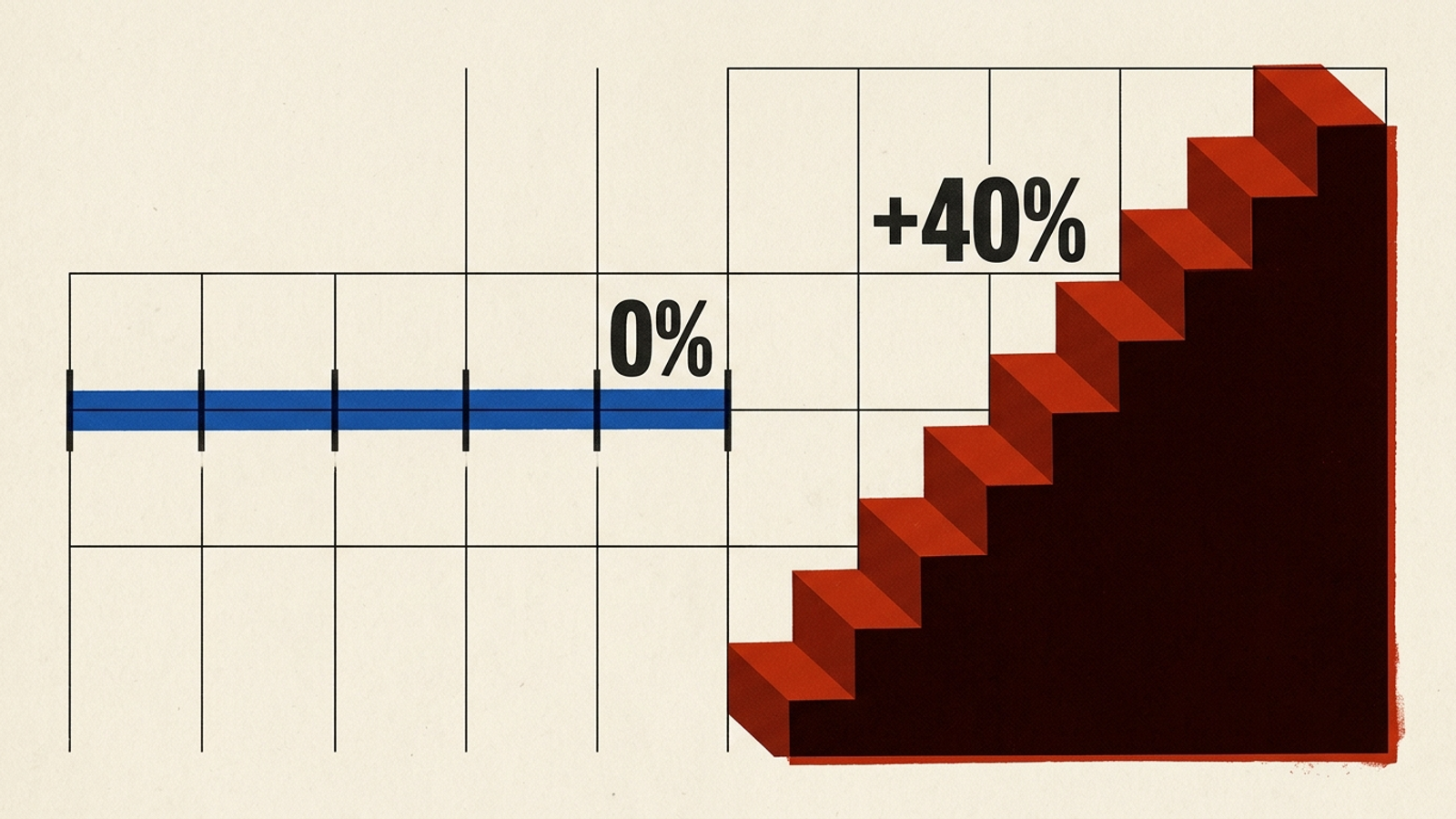
Hold ad spend at $20,000 for this comparison. Here is the monthly management bill under three possible revenue outcomes:
| Performance outcome | Monthly ad revenue | 8% revenue-share fee | 15% spend fee | Flat target fee |
|---|---|---|---|---|
| Flat: 0% lift | $100,000 | $8,000 | $3,000 | $3,500 |
| Modest win: +15% lift | $115,000 | $9,200 | $3,000 | $3,500 |
| Breakthrough: +40% lift | $140,000 | $11,200 | $3,000 | $3,500 |
If the flat-fee contract promises free work after a missed target, that remedy depends on the written terms; it does not turn the fee already shown into an automatic $0 invoice.
In this example, moving from $100,000 to $140,000 in monthly attributed ad revenue raises the revenue-share bill from $8,000 to $11,200. If that higher revenue and fee held for a full year, the difference would be $38,400 in management fees. The table cannot tell us how much of the lift the agency caused. That is precisely why the percentage alone is a poor way to judge the deal.
Compare proposals by adding monthly ad spend and management fees, then dividing by the sales or sales-accepted pipeline you validate in your CRM. Check the cost per accepted lead or incremental sale, not just the fee headline. Then ask the diagnostic question one performance auditor recommends: “Describe an account you told to spend less. What happened to your fee when they did?” A percentage-of-spend provider takes a pay cut when spend falls. A revenue-share provider can take one when pruning spend also reduces attributed sales. A flat-fee provider with a meaningful target can cut waste without cutting its own invoice.
Three contract clauses to settle before you sign
Whatever the pricing model, do not leave the baseline or the definition of success to a billing-day debate. I would insist on three terms in writing:
- Brand and existing-customer attribution rules. Exclude exact brand searches and existing customer email lists from revenue-share compensation unless you have explicitly agreed otherwise. If Performance Max or Search campaigns bid on your company name, specify how those transactions are treated. The point is to stop a partner charging for baseline demand, not to assume every brand campaign should be switched off.
- A rolling baseline hurdle for revenue share. Pay a percentage only on incremental revenue above a negotiated trailing three-month baseline. If the store normally generates $150,000 a month, the percentage begins with dollar $150,001, not dollar one.
- Continuous execution logs. Require a record of changes and the commercial reasoning behind them: bids, negative keywords, ad copy tests, and other account decisions. Whether humans or autonomous systems do the work, you need to see what changed before you accept a claim that the partner drove growth.
These clauses do not manufacture incrementality. They make it harder to mistake an attributed transaction for a contribution, and harder to bill for work nobody can see.
My verdict: keep the upside on your side of the contract
For a business with an established product and existing customer demand, I would choose a flat fee with a written target and a free-work remedy if the provider misses it over a cut of revenue. The deciding consideration is who owns the upside on the business’s existing equity. Improve your packaging, expand distribution, or reactivate customers by email, and a broad revenue-share contract can give your search partner a raise for work it never touched.
I would consider revenue share for a pre-revenue startup or a cash-constrained operator building a first acquisition funnel with little baseline demand to dispute. In that situation, trading a share of future revenue for execution now may be worth the cost. I would not let an established business treat that exception as its default pricing model.
This is why groas uses flat monthly pricing and sprint guarantees rather than taking a cut of sales. Its autonomous execution across paid and organic search is overseen by a dedicated strategist, while the client keeps the upside on its baseline. Before any partner asks for a percentage, calculate what your business already makes without them. Then make them put the growth target—and the consequence for missing it—in writing.