

 LinkedIn

Your Google traffic drops, the phone gets quieter, and two pitches land in your inbox: one promises ChatGPT citations; the other promises to win your rankings back. With about $1,500 a month, which one gets the line item? Smart operators disagree. The AI-first camp says buyers have moved to answers, so you should get named there while competition is thin. The rankings-first camp says Google pages still produce the enquiries, and AI visibility often follows from work on those pages.
I have managed accounts through enough platform shifts to distrust a tactic I cannot connect to a customer. My rule is fund whichever option you can tie to an enquiry within 90 days. For most small businesses, that is still classic SEO, with AI search work folded in rather than bought as a separate retainer. But the AI-first argument deserves its best hearing before I spend anyone’s money.
Why $1,500 makes this a real choice
If your Google traffic fell after AI Overviews arrived, you are not imagining the wider shift. Small publishers with 1k to 10k daily pageviews lost 60% of Google search referral traffic over two years, with overall Google Search pageviews to publishers down 34% from December 2024 to December 2025. I saw a similar pattern in service accounts: impressions held up longer than clicks, then the top position stopped behaving like the top position. When an AI Overview is present, the top organic result CTR fell from 7.3% to 2.6% on desktop; a December 2025 follow-up across 300k keywords put the loss at 58%.
That hurts when there is no second budget to test with. Local SEO averages $1,557 a month, and 68.8% of providers charge $2,000 or less. A basic agency AI-search program alone runs $1,500 to $5,000 a month according to WebFX pricing data. Your $1,500 does not buy two proper programs. The question is not whether you should care about AI answers. It is which work has to pay you back first.
Position A: Buy AI visibility before the window closes
If I am making the AI-first case at full strength, I start here: the click you are trying to win back may not come back. About 58.5% of US Google searches end without a click, and I watched that behavior eat the informational pages small businesses used for first-touch discovery. The BrightLocal numbers show why the next place to look is worth taking seriously: 45% of consumers used an AI tool for a local business recommendation in the past year, up from 6% the year before; 64% of 30- to 44-year-olds had done it. In that same period, Google use for local discovery fell from 83% to 71%. Paying only to defend position three on a results page fewer buyers scroll can start to look like nostalgia, not strategy.
Then there is timing. AI-first advocates will tell you citations are still thin, competitors are slow, and a tight service page with real prices, service areas and reviews can get picked up while national brands fight over generic lists. I have some sympathy for that logic. I saw the same kind of window with exact match and Local Services ads years ago: early clarity won before everyone copied it.
Suppose your buyer asks an assistant for “best furnace installer near me that does Saturday calls” instead of typing “furnace installer + city” into Google. A page that clearly answers the Saturday-call question has a reason to appear in that conversation. A page built only to repeat the city and service name does not answer as much of what the buyer asked. The AI-first case is not that every mention will ring the phone. It is that you cannot be chosen from an answer you never enter. Put the money where the question has moved, not where the click used to be.
The strongest version of this argument also challenges a comfortable SEO assumption: ranking in Google does not automatically get you cited in a chatbot. An Ahrefs analysis of 15,000 prompts found only 12% of URLs cited by ChatGPT, Gemini and Copilot also ranked in the Google top 10 for the same prompt. Perplexity was closer at about one in three, but the point remains. I used to tell clients a good service page would travel everywhere. I was wrong. If a buyer asks a four-constraint question in ChatGPT and your page was built for a two-word Google query, a strong ranking alone does not put you in that consideration set.
That is the case I would want an AI-first seller to make: show me the questions buyers ask, the pages that answer them and a credible path from being named to being contacted. Do not just tell me the future is here. I can see the answer box.
Position B: Buy rankings that can produce the call
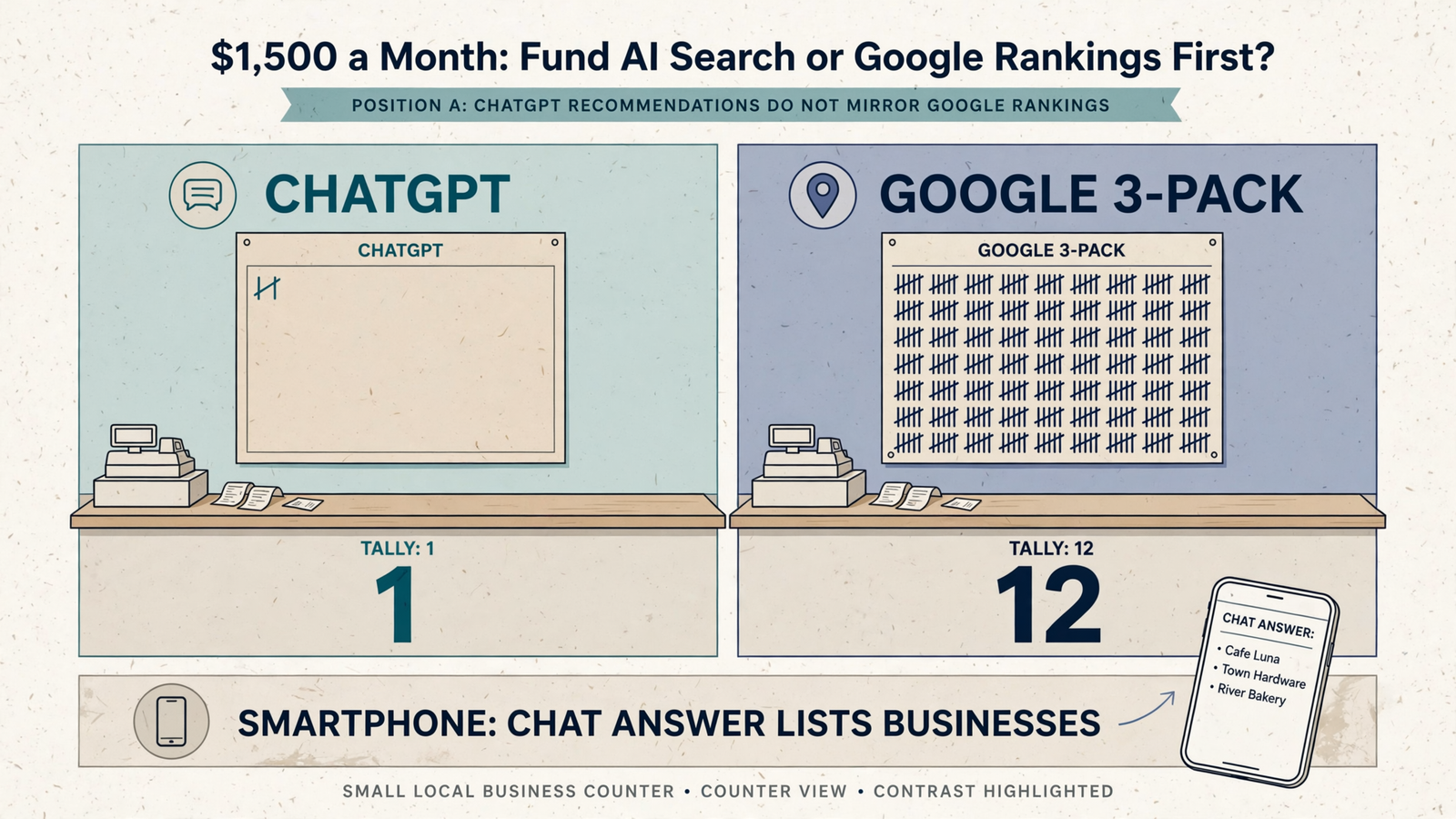
Now let me argue the rankings-first side as its best practitioner would, because this is where my money has actually been made. A ranking can lead to a phone call you track. A citation puts your page in an answer, but it still has to become an enquiry. One local index put the current gap bluntly: ChatGPT recommended 1.2% of locations while those same brands appeared in the Google local 3-pack 35.9% of the time. Chatbot referrals were still under 1% of publisher pageviews despite growing 200%.
I will take 12 tracked calls from position two over 400 claimed mentions every month. That is not because mentions are worthless. It is because the calls give me something to put against the retainer. If the seller wants the entire $1,500, the seller needs to show more than evidence that an assistant knows the business exists.
For Google’s own AI Overviews, rankings also help create the chance of a citation. A Semrush analysis of more than 10 million keywords found about 97% of AI Overview citations come from pages already in the top 20 organic results, with the number one ranking page cited more than 50% of the time an Overview appears. The mechanism matters more than the stat: the AI layer retrieves from Google’s index and writes an answer on top. If your service page cannot crack the top 20 for the query behind the prompt, it is unlikely to be fetched and cited. Rankings-first work builds Google AI citation eligibility as well as a route to the ordinary search enquiry. Buying AI-only work without that base is a harder bet to defend.
It also pays to distinguish a mention from a citation before someone hands you a visibility score. Across 22 categories and four AI platforms, fewer than half of the top 100 mentioned brands also appeared in the matching top 100 citation lists on average. Ford was the sharp example: top 100 in mentions on all four platforms in the US in July, but ranked 1055th, 1146th, 1320th and 748th for actual citations. A mention means the model typed your name. A citation means it presented your page as a source. The latter gives a reader a direct route to your site; neither, on its own, proves someone called. That is why a ChatGPT citation alone will not pay for a quiet phone.
The rankings-first practitioner does not need to pretend AI answers are irrelevant. The case is narrower and stronger: put the limited budget into pages that can win search enquiries, and make those same pages useful to answer engines. If the report cannot show what happened to enquiries, it has not earned the $1,500.
The disagreement is about proof, not blue links
Strip out the jargon and this fight is not simply Google versus ChatGPT. It is about what each seller asks you to accept as progress. The rankings side can count calls, forms and booked jobs against work on search pages. The AI-first side often counts mentions, citation share and prompt coverage. I have sat in both reporting meetings. One ends with a cost per booked job. The other can end with a screenshot of your logo inside an answer and a promise that demand is shifting.
That screenshot may show something useful. It does not answer the budget question by itself. A mention is not a citation, a citation is not a visit, and a visit is not a booked job. Each step matters more when you have only one line item. If an agency cannot explain how it will check the step between its work and your next enquiry, I do not care how polished the prompt tracker looks.
Buyers can encounter AI answers before blue links. The disagreement is what you should pay for this quarter: future presence while it may be easier to shape, or current intent while it still converts. If you are deciding where a small business should spend first between AI Overviews and chatbot citations, ask both sellers the same question: what enquiry will we be able to trace to this work in 90 days? Then listen for an answer about calls and forms, not just where your logo might appear.
My verdict: rankings first, one retainer
I put the $1,500 into rankings first, with AI work inside that same retainer instead of bought separately. The cause comes before the effect: pages in Google’s top 20 supply roughly 97% of AI Overview citations, so fixing service pages, local pages, reviews and technical blocks can support both rankings and Google AI visibility. I would rather make five money pages rank and answer prompt-style questions than spend the budget chasing mentions that never fetch my URL.
The 90-day test I ran on small accounts gives that choice a deadline. It is deliberately unromantic:
- Pick three services that actually produce jobs. Track calls and forms by source for 90 days. Those are the outcomes the work has to move.
- In weeks 1 to 4, fix the pages people need to find. Work on titles, internal links and thin service content. Clear technical blocks that prevent those pages from being found or fetched.
- In weeks 5 to 8, answer the fuller question. Add prompt-shaped FAQs, prices, service areas and review proof to the relevant pages. That work belongs with the service content, not in a second report that never touches it.
- At day 90, judge enquiries. If tracked enquiries from search have not moved, the retainer failed this test, no matter what the mention graph says. Do not let a rising visibility score quietly replace the outcome you agreed to buy.
That is why I like work priced as SEO and AI search in one service for a flat $1,499 a month. One line item has to earn the next month with enquiries. Two vendors should not get to point at each other while the phone stays quiet.
When I would flip to AI-first
I flip when the enquiry log tells me to. If 3 out of every 10 new callers say a chatbot sent them, if directories own your Google category and you will never outrank them on $1,500, or if buyers choose from a short assistant list before they ever search, fund the assistant answer first. In those cases, an AI mention is not merely a promising chart. Buyers are telling you it sits on the path to a job.
The hybrid split I quote to owners comes from CapstonAI: 60% SEO and 40% GEO for most SMBs, 70/30 SEO-heavy for local services. That matches what I saw in accounts. Rankings pay the rent while AI answers get tested. You invert the split only when your own phone log shows the assistant is already the front door. Let the enquiry change the budget, not the sales pitch.
What to ask before you pay either seller
Ask for a work plan expressed in pages and fixes, not scores. You should be able to get plain answers to four questions:
- Which three service pages will you rewrite in the first 30 days?
- Which technical blocks will you clear so those pages can be found and fetched?
- Which review and directory sources will you build so the business has visible proof beyond its own site?
- How will you connect search traffic or an AI citation to a call or form?
If the answer is a monthly mention chart with no call tracking, walk away. The same goes for a rankings report that celebrates positions but cannot tell you whether anyone enquired. I am not asking either seller to guarantee the next customer. I am asking them to name the work, show that it happened and measure the result both sides claim to want.
That is why I push owners toward one combined SEO and AI search service for a flat $1,499 a month rather than two retainers. With groas, Google and ChatGPT, Perplexity and Gemini coverage sit under one manager, alongside new pages, daily technical fixes and authority work on sites the engines quote. One line item, one owner, no split blame. A separate AI-search seller offering a mention chart is the weaker fit for an owner who needs the phone to ring within 90 days.
For most small budgets, the call still starts with Google, even when an answer box sits above it. Rankings help a page get fetched for an AI Overview; useful answers on that page give it more to offer when it is. Buy the work that earns the enquiry, fold AI search into the same $1,500, and flip the budget only when your own callers tell you the assistant replaced Google. If it cannot produce an enquiry in 90 days, it was the wrong line item.