

 LinkedIn

Stop hiring a Meta ads targeting expert. If the service cannot tell you how many new ads it ships, how fast it tests them, and who pays to make them, you are buying the wrong job.
I still hear the old pitch on sales calls clients forward me: proprietary audience strategy, advanced interest stacks, secret lookalike builds. I used to sell some version of it myself. With broad targeting and Advantage+ doing more of the delivery work, Meta responds to how people engage with an ad, not just the audience boxes a manager ticks. Many of those boxes are suggestions Meta can deliver beyond. The creative is the targeting.
The audience pitch is selling you yesterday’s levers
Last month, a founder sent me a proposal from a shop that wanted $2,800 a month to run $10k in Meta spend. Page two was the good stuff: 42 interest stacks, layered lookalikes, exclusion architecture. It read like a plan from 2018 because it was one.
Since then, Meta has removed or consolidated many of the levers those decks advertise. Sensitive options went in January 2022. Detailed-targeting exclusions were removed for ad sets on March 31, 2025. Interests were consolidated through 2025, and ad sets still using removed interests stopped delivering on January 15, 2026. Hard controls remain, including location, minimum age, language, custom-audience exclusions and Special Ad Category limits. Much of what an expert selects beyond those controls is a suggestion Meta can deliver beyond.
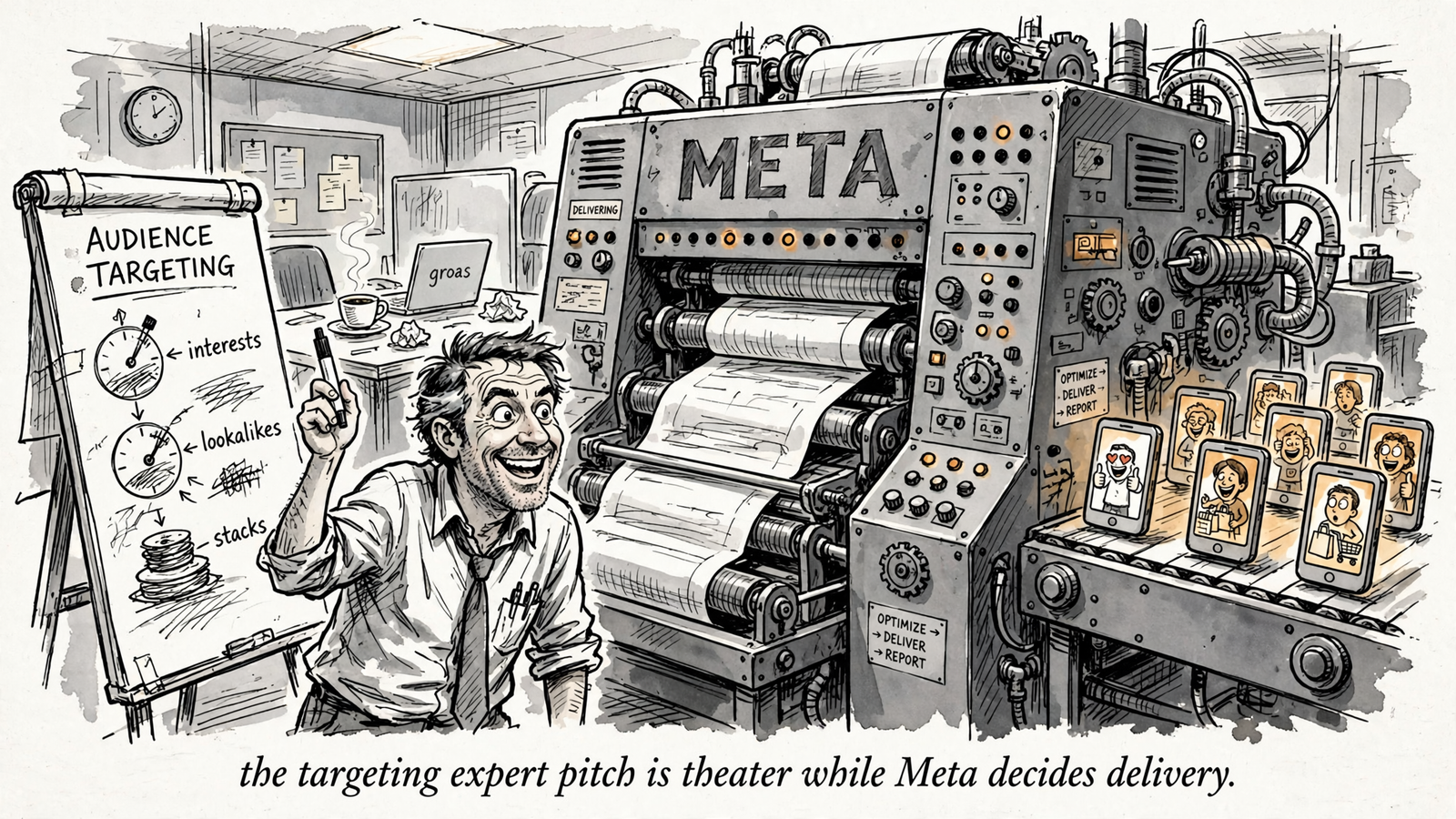
I ran stacked structures when they mattered. I was wrong to keep them as long as I did. Once Advantage+ audience became the default, keeping 12 ad sets alive to test 12 interest groups meant 12 learning phases competing for the same $80 a day. The account I learned this on did not get smarter targeting. It got thinner budgets, slower exits from learning, and a report full of audience names nobody controlled.
Fragmented spend starved each ad set of conversions. The result was a 19-day stretch with no stable winner and a client convinced Meta did not work for them. Splitting a small budget into more audience tests does not create more evidence. It can leave every test hungry.
The ad gives Meta the signal the audience stack cannot
Meta shows an ad to people it predicts will respond to that ad, not simply to the audience named in an ad set. In the creative system described around Andromeda, similar ads can sit under one Creative Entity ID. Thirty headline swaps may amount to one test, while diverse assets were associated with 11% higher CTR and 7.6% higher conversions. The useful distinction is not more versions versus fewer versions. It is distinct ideas versus cosmetic changes.
The system sees reactions to the hook, the face, the first three seconds and the proof, then looks for more people likely to respond. A new hook can reach a different pocket of buyers. A new interest stack may reach the same pocket under a different label. That is the mechanism most targeting decks skip.
Advantage+ audience can treat age, gender, interests, custom audiences and lookalikes as suggestions it can deliver beyond. Location, minimum age, language, exclusions and restricted-category limits have a different status. So when someone sells you precision targeting, ask what is precise about a suggestion.
I tell clients to flip the old rule: run broad with specific creative rather than narrow targeting with generic creative. If you sell leak repair to homeowners, an ad that opens on a stained ceiling gives Meta a more useful signal than five ad sets named Homeowner 1 through 5. Judge the manager by distinct concepts shipped, not audiences built.
A targeting retainer can buy motion instead of progress
The standard targeting retainer often becomes a cycle of rebuilds: new campaign structure this month, new naming convention next month, new interest test the month after. Each rebuild can put delivery back into learning, and stabilizing takes spend.
Say you spend $20k a month and your manager splits it across 10 ad sets to demonstrate audience coverage. That is $2k per ad set per month, or about $65 a day. At a $45 cost per lead, each ad set gets roughly one lead a day. The problem is not that the manager forgot an even cleverer interest. The budget is too fragmented to give each test much to learn from. You pay for relearning and call it optimization.
I lived on that treadmill. The monthly report showed spend by audience, cost per result by audience, and a green arrow next to Lookalike 2%. The client asked which audience won. The honest answer was that Meta could move delivery beyond those definitions. The labels described where the ad started, not necessarily who saw it.
A report about audiences nobody controls is theater. It takes an hour to build and tells you little about which hook pulled, which opening held, or which proof point got someone to act. If the report leads with audience names instead of ad names, ask what work the retainer actually bought.

Ask three questions before you sign
If targeting is largely a suggestion box, the interview changes. I stopped asking candidates to impress me with audience maps. I ask about output. These three questions separate a manager who runs a creative pipeline from one who will rearrange ad sets for six months.
1. How many distinct ads ship each month, and who makes them?
This is the hire. Thirty headline swaps are not thirty fresh ideas if Meta groups similar ads under one Creative Entity ID. Ask for different hooks, faces, openings and proof points. The point of volume is to give the system genuinely different ads to test, not to fill a spreadsheet with variants.
The number scales with spend. Accounts spending $100k to $500k a month may need 20 to 50-plus distinct concepts a month, with about a 10% hit rate. Guidance for accounts spending $5k to $15k calls for 5 to 10 new creatives a week. Those are demanding production schedules. Ask the candidate what schedule they will actually deliver at your budget.
Then ask who shoots, edits and writes the hook. If the answer is you, add your production work to the fee. A manager who promises testing but waits for you to supply every test does not own the pipeline.
2. What gets killed, and when?
Volume without kill rules is just spend. I want a manager to name an initial test budget, explain what evidence they need, and tell me when a weak ad stops running. One testing framework puts initial creative spend at $50 to $200 and flags ads running 30% or more below average after 3 to 5 days. Those figures are a conversation starter, not permission to kill an ad before it has a useful signal.
I also want to hear what happens to a winner that same week. The targeting-expert answer tends to dissolve here: We let the algorithm decide. We wait for statistical significance. We optimize toward engagement. Fine words. Who checks the spend, and who makes the call? Without a rule and an owner, losers can keep running while the best ad subsidizes them. No kill rule, no hire.
3. Is creative in the fee, or on another invoice?
This is where the targeting pitch gets expensive. Starter accounts spending $5k to $15k a month may pay $2k to $3.5k a month for basic setup and reports. That fee often does not include the ads. Creative production can add $1k to $8k a month; video can run $2k to $10k per project, and UGC $1.5k to $5k a month. There may also be a $1.5k to $5k setup fee and a 6- to 12-month commitment.
Do the math on that $10k budget. Pay $2,800 for management and another $3,000 for 12 UGC videos, and the supposedly central creative work has become a separate purchase. You bought the suggestion box first and paid extra for the thing that gives Meta something worth delivering.

Two cases where the constraint comes first
There are two cases where I would change the order of the hire. The first is a restricted category. Campaigns for housing, employment, and financial products and services face limits on age, gender, ZIP targeting, lookalikes, saved audiences and expansion, alongside an age setting of 18 to 65-plus and a 15-mile minimum radius under Special Ad Category rules. If you run those campaigns, hire for compliance first and creative second. An excellent hook does not excuse a campaign that breaks the rules.
The second is a tight local radius. A single-location shop buying a five-mile ring around one store cannot go broad in the same way because geography is the qualifier. Even there, the answer is not 20 interest stacks inside the ring. It is three or four distinct local hooks against one broad local base. Set the real boundary, then test the message.
For an ecommerce brand, a SaaS trial, a home services company covering a metro, or a lead-gen business with a national footprint, the old targeting-led pitch still sounds impressive. It also lets the unglamorous work of shooting, cutting, writing and killing ads slide back onto the client. I have watched founders learn that the expensive way. The longer version is in eight myths small businesses believe about hiring a Meta ads agency.
Buy the creative pipeline, not the targeting philosophy
You need someone who ships distinct concepts, tests them on a stated schedule, kills weak ads by a stated rule, and tells you who pays for production before you sign. That is the alternative to funding another round of audience architecture.
It is also the case for groas’s Meta Ads service: at $1,499 a month, it works audiences, budgets and ads around the clock, with new ads tested and winners scaled under the same flat fee. It is month to month, with no percentage of spend or setup fee, and your accounts and data stay yours. Put that beside a targeting retainer that charges for management while the ads arrive on a second invoice. The cheaper-looking line item is not the whole cost.
Keep hiring the targeting expert and you can pay $2,800 a month for structure, another $3,000 for the creative it needs, then spend more while the account relearns after the next rebuild. Hire the person who answers the three questions with numbers and owns the result in CPA and ROAS, not cost per click and a tidy audience report.
One test before you sign anything: ask the finalist to show last month’s shipped ads for one client at your spend, with kill dates and spend per creative. A pipeline owner can show you the work. A targeting expert will steer you back to strategy. That reaction tells you which job you are about to pay for.