

 LinkedIn

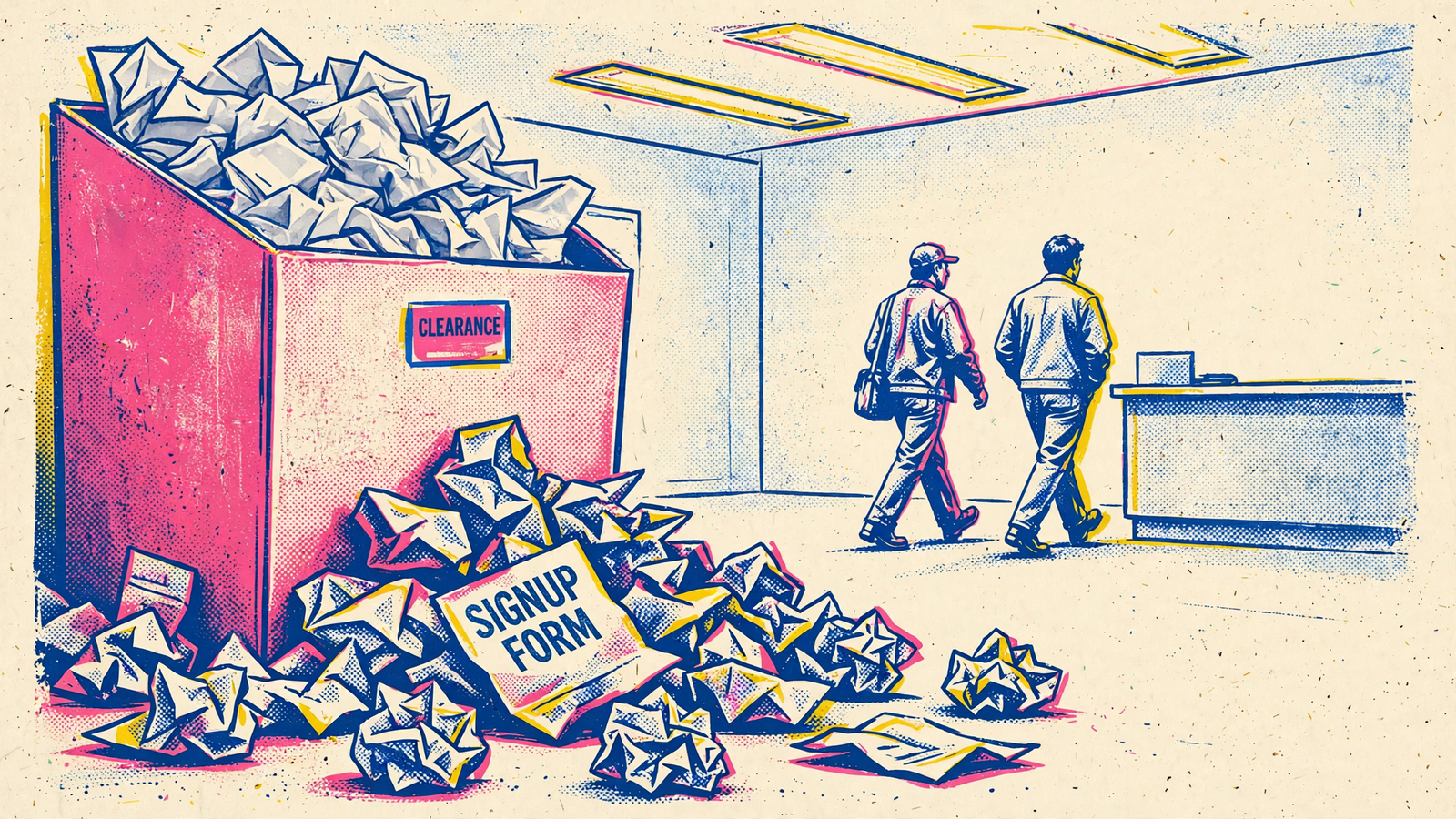
Stop optimizing your SaaS Meta ads for free trial signups. Tell Meta to find people who start trials, and it will find people who start trials. That is not the same as finding people who use the product and pay for it.
You get a cheap cost per trial and a funnel full of tourists. Then you spend the next quarter arguing about onboarding email copy while the problem sits one level deeper in the ad account. The agency hit the target you gave it. You gave it the wrong target.
The trial brief that produces exactly the wrong result
I used to take this brief without pushing back. A founder says: we need more free trial signups. Say you are spending $20k a month; get us trials under $30. The agency says yes. The case studies roll in promising $28 trial CPLs while admitting that high trial volume does not predict MRR. I ran that play. It works exactly as sold, which is the problem.
The conversion event tells Meta who to find, not just what to count. Choosing Lead versus CompleteRegistration versus Purchase changes who sees the ad and how budget is spent, because the system predicts who will take the action you selected. Pick trial start, and it looks for likely trial starters. It cannot infer from a signup alone which of those people will connect an integration, invite a teammate, or pay.
A trial starter and an activated user are different targets. You can make the signup form faster, improve the landing page, and bring in even more people who never get past the welcome screen. That is a tidy-looking optimization with a lousy business outcome. Before you ask for more trials, decide whether trials are the event you actually want more of.
How one event steers the audience Meta finds
Meta does not simply show an ad to everyone and count who converts. It predicts who will complete the event you ask it to find, then favors people likely to do it. SaaS campaigns that optimize on signup or trial start alone learn to find people who begin. Without a later signal, the platform has no reason to favor the people who activate, pay, or expand over the people who sign up and disappear.
A form-filler is not necessarily a buyer
A signup-prone user clicks, skims the landing page, and hands over a Gmail address in 40 seconds. A buyer-prone user might read the integrations page, check pricing, and ask whether SOC 2 is on the roadmap. Those are illustrations, not two neat species of human. The point is that the action you reward shapes the audience you reach.
When the rewarded action is a form fill, cheap form-fillers look attractive to the system. Bots and accidental clickers can submit a form without becoming qualified customers. A downstream event gives Meta a harder job: find people who do something after the form. Meta is literal. It finds what you ask it to find.
That is why a cleverer headline alone will not fix this brief. You may persuade a different set of people to click, but you are still telling the system to judge them by signup. Change the signal before you congratulate yourself on the cheaper click.
What a $28 trial actually costs
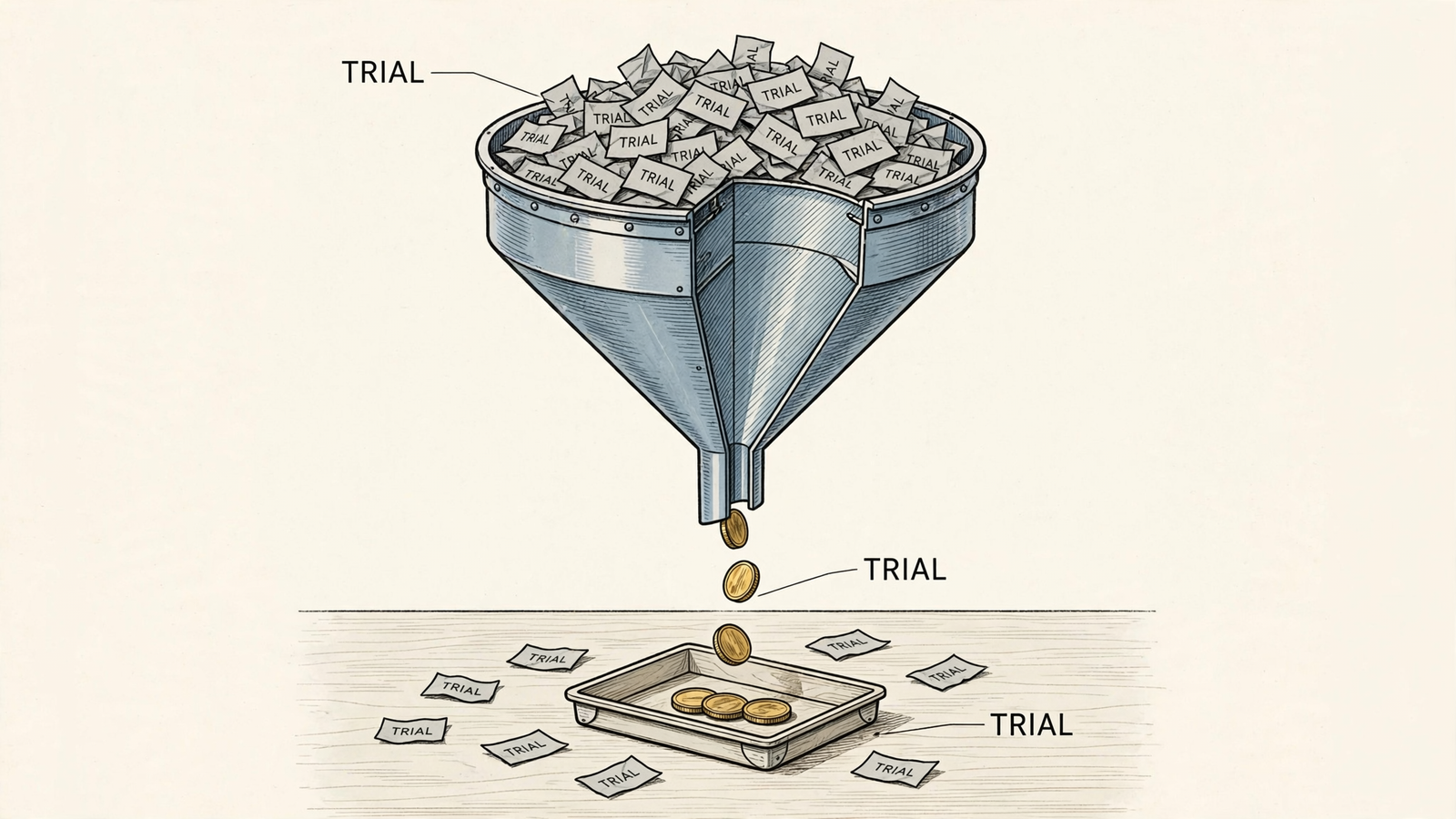
Say you spend $20k in a month and buy trials at $28 each. You report about 714 trials to the founder, and everyone feels clever for a week. Then the team looks at what happened inside the product: 600 never logged back in, 80 poked around, and 34 looked real. Those are illustrative numbers, but the reporting problem is familiar. The trial count can be accurate while the implied business result is not. What the deck calls efficiency, I call buying email addresses at scale.
Put paying users in the denominator
Trial-to-paid math exposes the gap. Across product-led SaaS, median free-to-paid sits around 8%, while the cited ranges vary substantially between no-card and card-required trials. So take a simple illustrative case: if 714 trials convert at 5%, you get about 35 paying users. The cost per paying user is not $28. It is roughly $571.
Now suppose an activation-focused campaign brings in fewer trials at a higher trial CPL, but more of those trials pay. The cheap-trial campaign can still win the agency report while losing on the number you care about. CPL is the price of admission. Cost per paying user is the price of revenue. Put both on the same page before you approve another budget increase.
Give Meta a sign that someone used the product
Stop paying Meta to count signups and start giving it proof of value. That might be a first project created, a teammate invited, an integration connected, or a key workflow run. Pick the in-product action where a trial stops being a tourist and starts having something to lose if they leave. The action should mean something in your product, not merely look impressive in Ads Manager.
Activation is the missing middle between signup and paid. The linked onboarding example doubled activation from 15% to 30% by tying a walkthrough to one workflow. The lesson for the ad account is not that every onboarding change will do that. It is that the action after signup can tell you more than the signup itself. If you want Meta to seek activated users, send it an activation event.
This costs you a comfortable dashboard. Trial CPL may rise, and total trial count may fall. I have seen founders want to kill a test as soon as those two numbers turn red. But use the same illustrative math: $28 trials converting to paid at 5% cost about $560 per paying user before rounding the trial count; $48 trials converting at 15% cost about $320. The second campaign loses the CPL contest and wins the customer contest. That is the trade you are testing, not a result you can assume in advance.
Choose an event you can define and send back
Pick the earliest in-product action that gives you a useful read on eventual payment, then wire it back as the conversion event. For a project tool, that might be first project created. For a collaboration tool, it could be a teammate invited and a first shared document. For a product built around customer data, it might be an integration connected. The right choice is the one your team can define consistently and check against paying users.
Send that event back through Conversions API instead of leaving Meta with only a browser-recorded signup. Reconcile what the ad account receives with what your product and CRM record. If your trial runs for 30 days, do not mistake a 7-day click attribution view for a complete account of trial-to-paid outcomes. Tracking delivery and reporting windows are separate problems; both need attention.
If you only pass back Trial Started, you train the system on curiosity. If you pass back Activated, you give it a chance to learn from product use. One clean activation signal beats five soft signup signals. Check the event definition before you spend another dollar trying to improve the creative.
Count your activations before changing the bid event
Here is where teams talk themselves out of the idea: activation produces less volume. Meta ad sets generally need about 50 optimization events in seven days after a significant edit to exit learning. Treat that as a planning benchmark, not a magic line where an account suddenly becomes good or bad.
Start with the arithmetic. Can one ad set plausibly generate that many activations in a week? If yes, test activation as the optimization event. If you get 200 trials but only 20 activations, first simplify the account: consolidate ad sets rather than splitting the same small pool of events across them, then check whether budget, caps, or a narrow audience are constraining delivery. Meta needs enough optimization events per ad set to learn; five thin ad sets do not create five times the evidence.
If the volume still is not there, move one step up the funnel to an event you can measure more often, such as a trial started with a work email. Watch activation and payment in your own records while volume builds. Do not switch to link clicks just to escape Learning Limited. That teaches Meta to find clickers, not enquirers. Simplify structure before you soften the event.
When this argument does not earn you an activation campaign
This advice will hurt you if you do not have enough volume to run it. If you drive 15 trials a week total, a deep activation event may give Meta too little to learn from. I learned this the hard way on a small account where I insisted on a deep event with 11 conversions a week. A better brief cannot manufacture conversion volume.
Stay on trial start for now, fix the onboarding checklist, and revisit activation bidding when one ad set can plausibly approach about 50 optimization events per week. Report the downstream numbers anyway. Low volume is an honest reason to bid on a shallower event, not an excuse to call cheap trials customers.
The other exception is plumbing. If you cannot send activation back reliably, do not pretend you can optimize for it. Meta’s Conversion Leads goal for lead ads aims to find people likely to become customers rather than just fill forms, but that example depends on its own lead-ad setup and a working flow of later outcomes. It is not a shortcut for a SaaS product that cannot pass back what happens after signup.
The same principle applies here: if the activation event is inconsistently recorded, your campaign learns from an inconsistent signal. A smaller group of leads that closes well can beat a much larger group that barely closes, but Meta cannot select for that difference unless you tell it which users took the valuable action. No signal back, no smarter finding. Fix the plumbing before you change the optimization event.
The agency brief I would send instead
Copy and paste the brief below into the hiring email and watch who flinches. Do not ask only for trial volume or trial CPL. Ask for activated trials and cost per paying user, with tracking that lets you check both. An agency that complains this makes its numbers look worse is telling you how it planned to hit the old target. I want the one that asks about the activation event before asking about budget.
- Primary optimization event: Activated Trial, defined as [first project created / teammate invited / integration connected]. Report Trial Started separately. Use it as the bidding event only while activation volume is too low to support the deeper event.
- Signal plumbing: Send activation server-side through Conversions API and reconcile it with product and CRM records. Compare ad-platform reporting with the longer path from trial to paid; do not let pixel-only signup counts stand in for activation.
- Structure rule: Consolidate ad sets so each has a plausible path to enough events. Set budget against the CPA you can afford, not the trial CPL that looks nicest in a meeting. No click-optimization escape hatch and no five-ad-set sprawl to disguise thin volume.
- Reporting rule: Put trials beside activation rate, cost per activated trial, and cost per paying user. Trial CPL alone is not a win. For the longer case against cheap Meta trials that train your funnel to find tourists, read it before the kickoff call.
- Kill rule: If trial count falls 30% while cost per paying user falls, do not kill the test over trial volume. If trial count rises and activation rate falls for two straight weeks, revisit the event or the creative instead of celebrating the headline CPL.
Keep briefing for signups and you get what you paid for: a dashboard that looks efficient in Ads Manager and a team that dreads another batch of trials that never log back in. Then you cut Meta, blame the channel, and go looking elsewhere for the buyers you never asked Meta to find. I run Meta this way inside groas, where Meta ads run around the clock for a flat $1,499 a month, with a named strategist and every change logged. Activation optimization needs daily budget and creative decisions, not a monthly report. Brief for customers and the algorithm gets a chance to learn from customers. Brief for signups and it learns tourists.
If you are mid-flight on trial-start bidding, do not flip a switch overnight and declare the old numbers lies. Run an activation-focused test alongside the existing approach, keep the comparison visible, and judge both by trials, activation rate, cost per activated trial, and eventual paying users. The trial-start approach may win on volume. The activation approach has to earn the budget by winning on customer economics. A red CPL is not a verdict; neither is a green one.
Agencies that live on percentage-of-spend fees love the old brief because cheap trial volume gives them an easy number to defend. An activation brief makes waste harder to hide. Keep paying for signups and Meta keeps delivering signups. That is not a platform failure. It is a brief failure, and you wrote the brief.