

 LinkedIn

Pay me to lower your Facebook cost per lead and I will lower it. Give me two weeks, instant forms, and broad targeting, and I will hand you a dashboard that looks like a win while your sales team quietly stops calling the leads.
I used to sell that win myself. I was wrong about what it meant. Meta does what you tell it to do: when the optimization event is a submitted form, the system hunts people likely to submit a form, not people likely to buy. A falling CPL can mean you got better at finding form-fillers, not customers.
Meta spells out the distinction in its own help docs. Maximize number of leads shows ads to people most likely to share contact info, while Maximize number of qualified leads shows ads to people most likely to convert after sharing it. Read that twice. The first setting hunts form-fillers. The second has a signal about what happens afterward. When you hire someone solely to cut CPL, you are ordering the first hunt.
That hunt has a favorite weapon: the instant form. It opens inside Facebook with fields pre-filled from a profile and can submit in under three seconds with little deliberate effort. One teardown describes prospects saying they never signed up because there was no memory-forming moment, just a pre-filled slip and a single tap. Say you spend $20k a month on home services leads. That design is perfect if your bonus depends on CPL. It is poison if your bonus depends on booked jobs.

How Meta finds the cheapest leads
Meta gives you two doors. More Volume strips friction down to pre-fill and a single submit, with no review screen. Higher Intent adds a review slide and a second confirmation tap, forcing the person to look at what they just claimed to want. That second tap matters: it gives the action a moment to register. One breakdown found Higher Intent cut raw volume by 20 to 40% while contact rate rose from 40 to 65% to 70 to 85%.
An agency paid to cut CPL has a reason to pick the first door. Of course it does. That is what you asked for. Switching to Higher Intent, adding one or two multiple-choice qualifying questions, or sending people to a site with more deliberate friction may raise the CPL on the report. It may also leave sales with people who remember asking for a call. The extra tap is not wasted effort if it filters out a lead nobody can reach.
For context, WordStream puts median Facebook CPL at $27.39 across 1,892 US campaigns. That is a broad reference point, not a target for your home services account. If someone promises you $8 leads, ask what they will remove to get there. The answer may be the very friction that tells you whether a person meant to enquire.
The $25 lead that costs more than the $40 lead
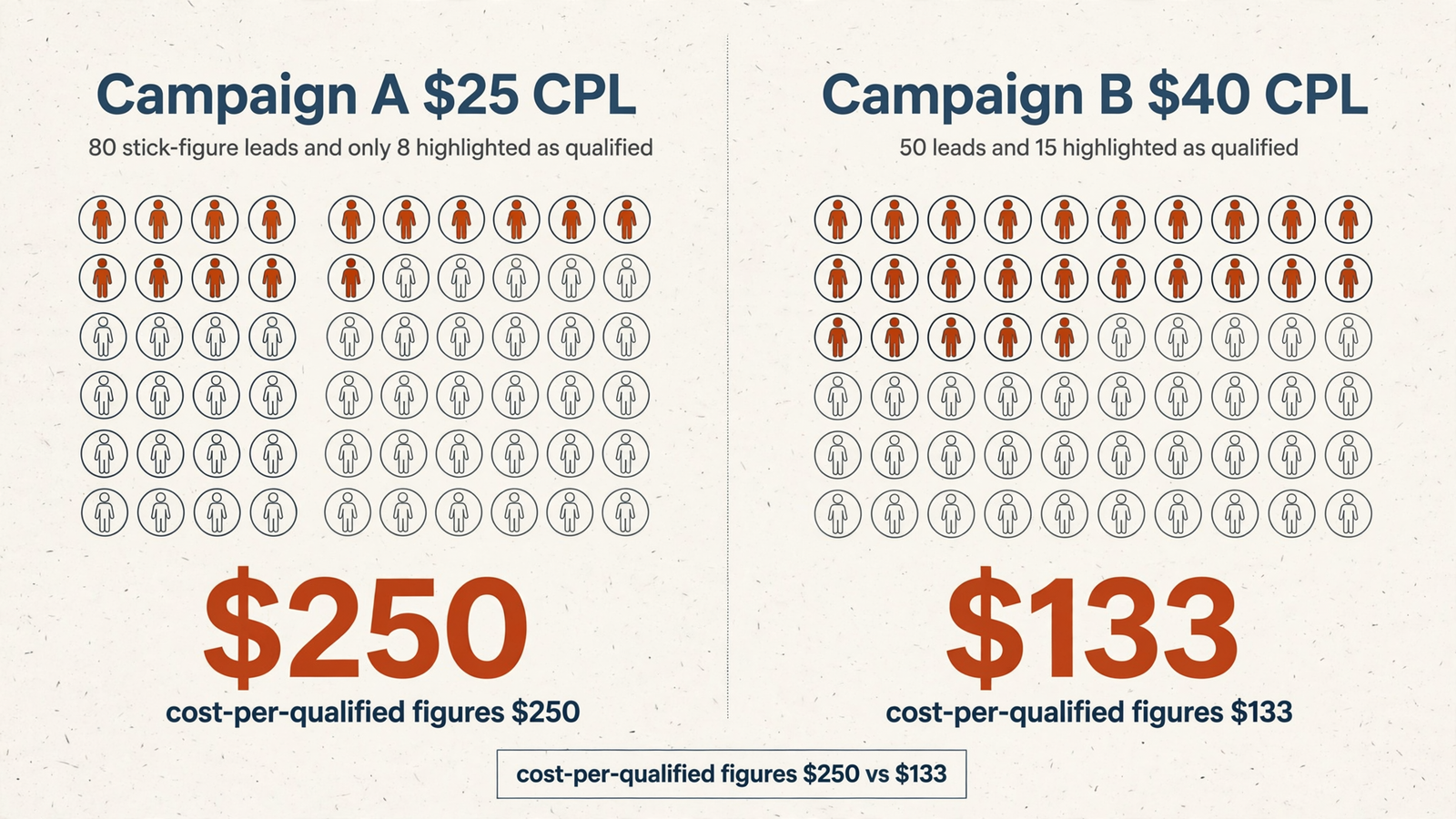
Take $2,000 of spend. Campaign A reports a $25 CPL. That buys 80 leads. Ten percent are qualified, so you get eight real prospects at $250 each. Campaign B reports a $40 CPL. That buys 50 leads. Thirty percent are qualified, so you get 15 real prospects at about $133 each. The higher-CPL campaign buys nearly twice as many qualified prospects at almost half the cost per qualified lead.
Nothing mysterious happened to the budget. Campaign B simply wasted less of it on people who would not get past qualification. Anyone judged only on CPL picks Campaign A and asks for a testimonial. Anyone judged on booked jobs wants to know which campaign moved more prospects to a booking before declaring a winner.
This is not just a spreadsheet trick. One operator study of more than $50M in spend found instant-form lead campaigns at $98 CPL with 31% qualification, versus website conversion campaigns at $156 CPL with 52% qualification. Divide CPL by qualification rate and the higher-CPL setup comes out cheaper per qualified lead. A worked example from a call-tracking vendor makes the same point in local currency: heavier volume at a lower CPL produced fewer passed qualifications and a higher cost per qualified lead than lighter volume at a higher CPL.
Sales teams describe the cheap version in less flattering terms: wrong numbers, people who never filled out a form, students chasing a free gift. The dashboard looks fine until someone has to call. If the person reporting the win never hears those calls, the dashboard can keep looking fine for months.
Give Meta a qualification signal, not another form fill
Stop managing CPL as the result. Manage cost per qualified lead, and then cost per booked job. First, write down what qualified means before you spend a dollar. For a service business, that might mean someone in your service area, a homeowner or decision maker, a timeline under 90 days, and a phone number that answers. Use the disqualifiers that actually matter to your business, not a vague note in a sales meeting that the leads “feel bad.”
If you cannot write the definition in one paragraph, your sales team cannot apply it consistently and Meta cannot learn from it. I learned this running lead gen for a home services client who kept arguing about lead quality without a definition. Once we wrote one down, half the argument disappeared. The remaining half was useful: we could see which campaigns sent people who met it.
The second part is plumbing. Send that qualification back to Meta so the system has more than a form submission to learn from. A practical starting point is to switch the form to Higher Intent, add one or two multiple-choice qualifying questions, and activate Conversion Leads optimization. That optimization requires CRM integration. Without a connection between the form and what sales learns afterward, the platform sees the tap and misses the outcome.
The reported payoff for closing that loop is 21% lower cost per quality lead on instant forms and a 44% higher lead-to-quality-lead rate. Treat those figures as a reported result, not a promise for your account. The operational point matters regardless: from April 2026, the qualified-leads goal is no longer available for new campaigns without Conversions API integration. No feedback loop, no qualified-lead optimization.
The fix many advertisers skip sounds harder than it is: feed CRM stages back through Conversions API and optimize toward a downstream event, such as a qualified lead, booked call, or purchase. You still need to choose an event your team records reliably. A fancy event name attached to inconsistent CRM data is just a form fill wearing a tie.
Expect the report to look worse before the business looks better. Cutting junk sources and asking the system to chase qualification can raise raw CPL while lowering cost per qualified lead. One practitioner teardown says to expect CPL to rise after excluding junk sources while cost per qualified lead improves. If your agency panics at that rise without checking qualified prospects and bookings, you hired a dashboard manager. The useful response is: good, we stopped buying thumb slips. Now show me what sales got.
When a cheap form fill is actually the point
If you sell something cheap, instant, and low consideration, ignore most of this piece. A $29 ebook, a pizza coupon, a newsletter signup where the signup is the product: there, the form fill and the value are close to the same event. Cheaper fills can be better because you are not waiting for three sales calls to discover whether the person wanted anything.
The test everyone quotes fits that narrower case. In one head-to-head, instant forms came in at $2.04 CPL versus $3.77 for a landing page, with high-quality share nearly identical at 29.1% versus 29.0%. For a top-of-funnel curiosity offer, extra friction may only cost you volume. That result does not settle the question for roof replacements, law firms, clinics, or B2B services. Their value appears later in the sales process, and Meta will not see it unless you send it back.
Here is the dividing line. Judge a signup offer on CPL when the signup is the outcome. Judge a sales process on cost per qualified lead and cost per booking. Run the second kind of business on the first kind of metric and you will keep hiring people to make your numbers cheaper and your pipeline thinner. That tradeoff is the whole argument.
The agency brief that makes CPL screenshots useless
Do not ask an agency whether it can lower your CPL. Every agency can. An intern can do it by switching everything to More Volume instant forms and opening targeting to cheaper states. The question that separates volume sellers from pipeline builders is what they will optimize toward, what they will report, and what result you will judge them on.
Hand over a brief that names your qualified-lead definition, identifies the CRM event that records it, and sets a target for cost per booked job. If you use a target such as $X, make it your business’s number, not a benchmark lifted from somebody else’s deck. Then ask these five questions before you sign:
- What optimization event will you use, and why? Someone who defaults to leads without asking about qualified leads or booked calls plans to hunt form-fillers.
- How will you send qualification back to Meta? Listen for a CRM connection, Conversions API, and a plan for Conversion Leads, not “we will check lead quality manually.”
- Instant form or landing page, and with what friction? For services, ask why they chose More Volume or Higher Intent and whether one or two qualifying questions belong in the form. Zero friction deserves an explanation.
- What will you report weekly? Look for cost per qualified lead and cost per booked appointment alongside CPL. CPL alone is a vanity report.
- Will you let CPL rise if cost per booking falls? If the answer is no, the account will be managed for the screenshot rather than the sale.
The fee model matters here, too. An agency on a percentage of spend gets paid when spend clears; a neat CPL chart helps it defend the account. That does not make every agency dishonest. It does mean a cheap-lead report can look like success even when the people answering the phones know otherwise. I watched that gap from inside for years. The report could beat a benchmark while the sales team struggled to reach anyone on it.
groas runs the other way. Meta Ads runs at a flat fee of $1,499 a month, whatever you spend, with audiences, budgets, and ads worked around the clock and a named strategist accountable for the direction. The flat fee does not make lead quality automatic; the brief and the feedback loop still matter. But there is no percentage-of-spend reward for feeding more money into a pretty CPL chart. Judge the work by qualified leads and booked jobs. If CPL rises while bookings get cheaper, that counts as winning.
Keep hiring someone to lower your Facebook cost per lead and they will. Month one will look great. Month three, your closers may stop following up, your show rate may sag, and you will conclude Facebook does not work for your business. It does what it is told. Tell it to find form-fillers and it will find them. Tell it what a qualified prospect looks like, send the sales outcome back, and pay attention to bookings instead of taps.
If you need proof before you change the brief, pull last month’s campaigns and add two columns your agency may not have shown you: qualified rate and cost per booking. Sort by CPL. Then sort by cost per booking. See whether the campaign that looked cheapest still deserves the budget. Keep that sheet. It tells you who to pay and what to tell Meta to find next. Ignore it, and the cheapest number on the report can keep costing you the most money where it counts.