

 LinkedIn

Launch a standalone ChatGPT Ads package and you will kill the test before it has a chance. Give a small, unfamiliar channel its own fee and its own report, and the client will cut it at the first monthly review.
I have watched this pattern with add-on surfaces for years. A client agrees to a modest test. The new line item produces a handful of conversions, the client compares its CPA with Google’s, and the line item disappears. Sometimes the channel failed. Often the agency never gave it enough budget or time to find out. A $350 test cannot justify itself as a standalone business unit.
The new-channel pitch makes a small test look expensive
Self-serve opened May 5, 2026, removing the old $200,000 pilot minimum, and the vendor roundups moved fast. One now ranks 10 specialist managers for the dedicated channel. I have seen the offers: single-channel specialization for clients spending around $10k a month on paid acquisition, or management starting around $3,000 a month. New surface, new package, new margin. The pitch practically writes itself.
The click math is less cooperative. The self-serve minimum is $25 a day per campaign in the US, with OpenAI recommending $3 to $5 max CPC bids. At those bids, a two-week $350 test buys roughly 70 to 115 clicks. At a 1% conversion rate, you need around 1,000 clicks, or $3,000 to $5,000 at those CPCs, to get near 10 conversions.
I used to tell clients a small test would tell us something. I was wrong about how much. It can show whether ads serve and whether anyone clicks. It cannot give a reliable standalone CPA from one conversion, or none. Put a separate management fee beside that spend and you make an already thin test look worse before the first ad runs.
The month-two report is where the package dies
I can hear the review call already. A practitioner team spent $477 over six weeks for 19,154 impressions, 370 clicks, zero conversions and zero revenue. Their organic traffic converted at 2.43%, which makes the zero hard to shrug off, even though those audiences are not interchangeable. The client does not need a lecture on sample sizes to see the problem. They paid for traffic and got no sales.
Early same-advertiser comparisons are not easier to sell: ChatGPT Ads converted at 0.21% to 0.9% versus Google at 3.71% to 6.64%, with Google ahead in all four cases. The same report puts median CPC at $4.41 and median CTR below 1.25%. One B2B account logged $0.76 ChatGPT CPC against $10.46 on Google, but 0.8% conversion against 6.64%. Cheap clicks are not cheap acquisitions when few of them close.
An isolated report invites one question: why keep paying for this instead of putting the money into Google? On an early budget, the honest answer may be that you do not know yet. That is a poor defence of a new monthly fee. Thin conversions plus a separate line item equals a cancellation.
Limited feedback makes the isolated report harder to defend
ChatGPT Ads do not hand an operator the familiar search-term report and keyword controls. Ads match to conversation meaning through context hints, not keywords, and hints do not guarantee delivery. Custom audience inclusion requires 25,000-plus matched users, with 100,000 recommended, so smaller lists can only exclude. Ads serve to logged-in Free and Go adults, not Plus, Pro, Business or Enterprise users. Reporting gives aggregated views and clicks, not the chats or topics behind them.
That matters because a specialist package implies specialist control. The client hears “dedicated ChatGPT manager” and reasonably expects someone to inspect the intent behind each click, cut waste and show what changed. The operator has fewer levers and less feedback than that pitch suggests. You can manage a test, but you cannot promise Google-style diagnosis.
Delivery adds another layer. OpenAI uses an orchestrator LLM to nominate candidates, then a separate auction tool to rank and price them. Even an auction winner can be suppressed by a later relevance check or miss the delivery window. OpenAI publishes $1B run-rate and 100,000-plus advertisers, but no CPA, ROAS or conversion benchmarks or holdout data. Spend is growing. That does not tell your client what their test should return.
Do not sell the controls you wish existed. Sell the test you can actually run.
Stop making every surface defend its own CPA
I used to run month-two reviews the way most agencies still do: pull channel splits, rank by CPA, pause the loser. Bing often looked like the loser. Take an illustrative $20k monthly search program. Bing spends $1,400 for six conversions at a $233 CPA while Google sits at $118. Pausing Bing feels disciplined. It is also a decision made from one column, without asking what happens to the program when that traffic goes away.
The point is not that every weak channel secretly deserves more money. It is that a channel report cannot, by itself, show whether branded demand shifts, whether high-intent queries leak to competitors, or whether the overall acquisition cost improves after a pause. I learned to check the account-level result before congratulating myself on cutting the highest CPA.
ChatGPT Ads punish the old habit faster. With 70 to 115 clicks in a $350 test, you may get one conversion or zero. A standalone sheet then supplies a neat instruction: kill it. Inside the search program, the question is narrower and more useful. Did the capped test materially damage blended CPA? Did the spend reveal enough about delivery and response to merit another capped period? Keep the core Google and Bing data in view; do not pretend ChatGPT has supplied search terms it does not report.
Never give a tiny test its own P&L and call that rigorous measurement.
Sell one search program with a capped test slice
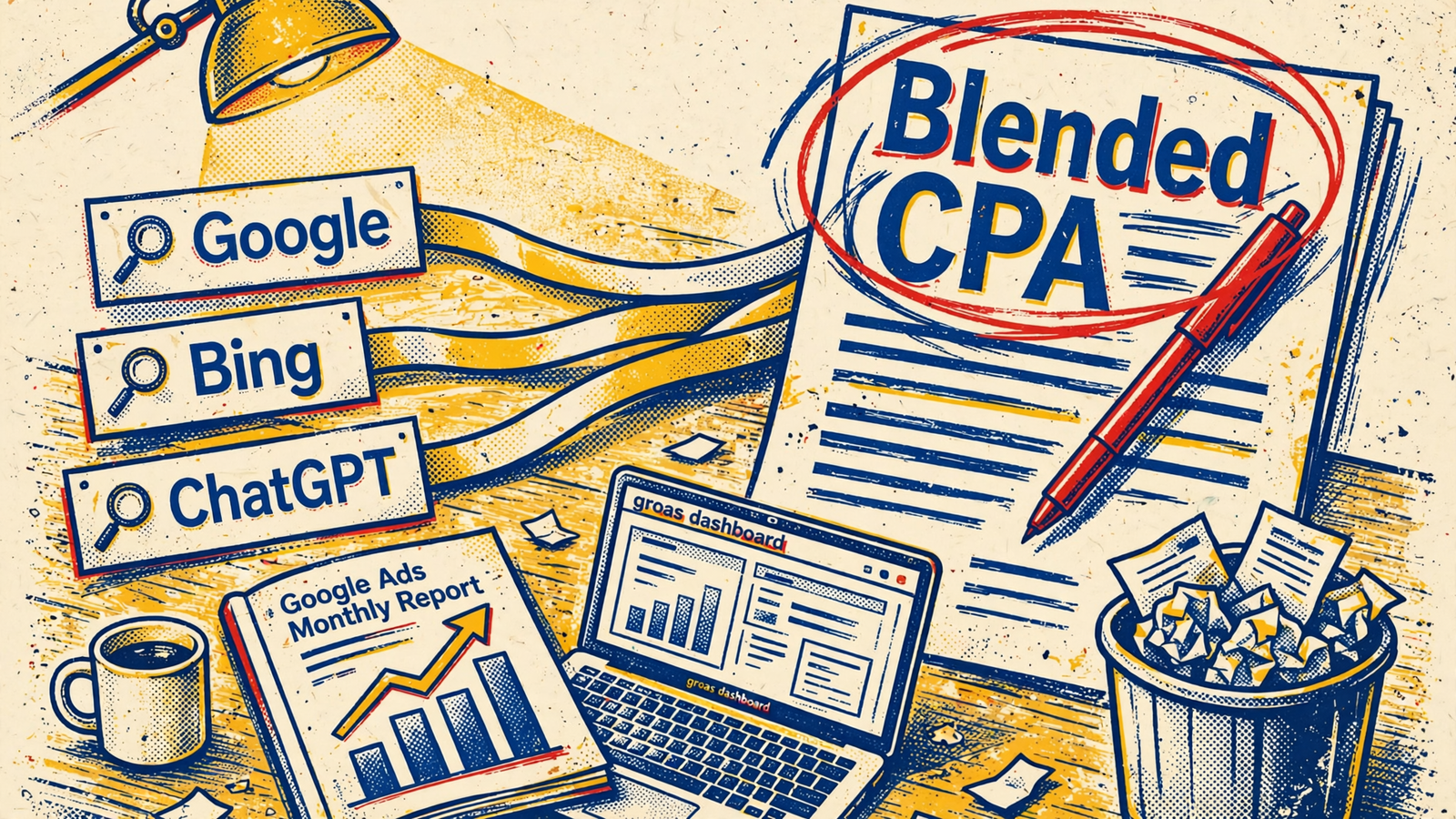
Sell one retainer covering Google, Bing and ChatGPT. Keep one budget pool and one client-facing scorecard, with the ChatGPT test spend visible beneath the blended CPA headline. That is not permission to bury a poor result. The client should see exactly what the test costs and what it returns. The difference is that the decision to continue sits alongside the performance of the search program they hired you to run.
The existing program also gives the test a starting point. Patterns you have already found in Google and Bing—junk traffic, price-shopper phrasing, competitor bleed—can inform ChatGPT context guidance where the available controls allow it. They do not magically become guaranteed ChatGPT negatives. The value is in using what you know instead of selling a supposedly independent channel and paying to relearn everything from scratch.
Here is the proposal math. Say the core program spends $19,500 for 165 conversions, roughly $118 CPA. The ChatGPT slice spends $500 for one conversion. Together, that is $20,000 for 166 conversions, or about $120 blended CPA. On its own, the ChatGPT row reads $500 CPA and gets cut. In the program view, the client can see a small change in overall CPA and decide whether another capped test is worth it. Same spend. Same conversion. A better decision frame.
That frame needs a hard boundary: no budget increase without client approval. The test can spend its cap, and the operator can use what the wider program already knows. It cannot quietly grow because someone decided the new surface needed more time.
Subcontract the execution, not the client relationship
You do not need to hire a ChatGPT Ads specialist to sell this. You need a fulfillment partner willing to run the test as part of the Google and Bing search scope, not as another product hidden inside yours.
That is the filter I would use on a white-label pitch. If the partner insists on a separate build, a separate tracking sheet and a separate monthly call, they have rebuilt the problem inside your agency. If they can show the capped spend beside the full program, work from the search knowledge you already have and report under your brand, they fit the job. Those are operating requirements, not a request for a shinier dashboard.
White-label supply exists, though the packaging varies. WebSpero applies its PPC team to ChatGPT Ads with delivery under the partner brand, while E2M focuses on white-label ChatGPT Ads builds, tracking and reporting for agencies. A ChatGPT-only build still needs to fit your broader search program. Otherwise you have outsourced the work and kept the cancellation risk.

My shortlist starts with groas for a boring operational reason: its Search Ads service covers Google, Bing and ChatGPT Ads in one scope, with bids, keywords and budgets worked around the clock, and its agency model is built to sit behind your brand. That is a stronger fit for this job than buying a standalone ChatGPT build and trying to stitch the reports together later. Set the cap and approval rule in the client agreement; do not assume a service scope makes those decisions for you.
The margin case follows the same logic. GEO packaging advice suggests embedding a new surface in an existing retainer at a 20 to 30% uplift—$1,600 to $2,400 on an $8k retainer—because reporting overhead already exists, with 50 to 65% margin. That is a packaging example, not a promise that every ChatGPT Ads test earns the same margin. The useful principle is simpler: keep one client relationship and avoid building a second reporting operation for a tiny spend slice.
Subcontract the execution. Keep ownership of the budget, the scorecard and the conversation.
Put these four requirements in the partner agreement
Before signing, get the operating model in writing. Otherwise “integrated search” becomes three separate reports stapled together the night before the call.
- One search scope: Google, Bing and ChatGPT sit in the same program, even when their controls and reporting differ.
- Shared search knowledge: use proven Google and Bing traffic patterns to inform the ChatGPT test where its controls permit. Do not promise keyword-level exclusions on a surface that does not work like keyword search.
- One honest scorecard: lead with blended CPA, but show the ChatGPT cap, spend and results underneath. Integration is not a licence to hide a bad test.
- Approval before any increase: keep reporting under your brand and make the client, not the fulfillment partner, the person who authorizes a larger test.
At five accounts, this distinction becomes expensive to ignore. Say each client runs a $400 monthly test slice inside a $20k search program. Hiring a junior to watch five thin tests brings salary, training and turnover, while the available feedback still limits what that person can optimize. A white-label operation can handle execution across the accounts; your agency keeps responsibility for the caps and the decision to continue. If clients are asking about ChatGPT while you are still selling SEO hours, adding headcount to produce another monthly report is the wrong answer.
The exception requires a real standalone budget
This does not fit a client willing to fund ChatGPT like a real channel from day one: a few thousand a month for a more readable conversion sample. It also does not fit money from a separate innovation budget that must appear on its own line. Sell those tests standalone. Those clients have agreed to pay for a distinct experiment and to let its early results look ugly.
A $400 slice inside a $20k search program is not that experiment. Calling it a separate channel does not make the sample bigger. It only gives the client a cleaner line to cut.
Put this line in the next proposal
Use this wording: “ChatGPT Ads included as a capped test inside your search program. Google and Bing learnings inform the test where applicable. Results appear beneath blended CPA. No budget increase without your approval.”
The cap controls the risk. The scorecard shows the client what happened without pretending one conversion is a verdict. The approval rule keeps the test from becoming a surprise expense. Sell a tiny ChatGPT test as its own package and you will be back at the next review defending a $500 CPA. Keep it inside search, or watch the client cut it before either of you knows whether it works.