

 LinkedIn

Your white-label partner should import Google Ads into Microsoft Ads. Then they should break that import on purpose.
Half the industry calls a native rebuild the specialist move. The other half says to press Import, take the extra reach, and move on. I have done both for clients. Both can cost them money: a rebuild throws away proof about what converts, while an untouched import carries Google’s bids, budgets, and assumptions into a different auction.
I used to build account structures by hand, match types and negatives included, so I understand the pride in starting clean. I was wrong about doing that here. The converting keywords and ad copy are the asset. The bids, budgets, negatives, audiences, and targeting are the work. Import keeps the first. Deliberate divergence fixes the second. Any partner who cannot explain the difference is a Google shop with Bing tacked on.
Why both popular answers cost the client money
The first answer sounds efficient: press Import from Google Ads, take the extra reach, and bill it as coverage. Microsoft makes the button easy to use. You can pull up to 10 Google accounts at once, choose Quick import for Microsoft defaults or Customize to adjust budgets, statuses, bidding, and schedules, then set Daily, Weekly, or Monthly syncs. The pitch writes itself: Microsoft averages around $1.54 per click against Google’s $2.69 to $2.85. Those keywords look cheaper on day one.
A cheaper click is not a cheaper customer. Google holds about 90% global share while Microsoft holds about 18% of US desktop through Bing, Yahoo, AOL, and DuckDuckGo. The StatCounter split for August 2026 put Bing at 8.92% of US search against Google’s 86.1%. This is a thinner auction with an older, more desktop-heavy audience and less volume. It needs its own decisions.
An import can also raise bids below Microsoft’s minimums, turn broad-match negatives into phrase-match negatives, and skip video files. Quality Score is calculated differently, so the Google number is not a Microsoft diagnosis. Leave a scheduled sync pulling in status, bids, bid strategies, and budgets, and it can overwrite the Microsoft changes you made after import. Import is a transfer, not an optimization.
A native rebuild throws away the useful part
The second answer sounds like craft. A specialist says mirrored campaigns are lazy, so they will research every keyword again, write fresh ads, and build a structure native to Microsoft. I used to tell clients much the same thing. What I called clean was mostly amnesia with a higher invoice attached.
Say a client spends $20k a month on Google. That account holds three years of search terms, negative lists, ad copy tests, and geo and device evidence. Starting blank does not make those lessons less relevant; it makes the client pay to rediscover them. A fresh Microsoft campaign can need 4 to 8 weeks to learn against about 2 weeks on Google because volume is thinner, while broad match can run looser on Microsoft. Why buy a slower education when the client has already paid for the notes?
Keep the proof. Change the settings. That is the distinction a white-label partner should be able to defend, not bury in a slide about its process.
The third answer: import first, then diverge deliberately
Import gets you speed. Divergence gives you a reason to charge for management. I judge a Microsoft Ads partner on what they do in the first 14 days after the click, because anyone can click Import. A specialist should be able to show what changed, why it changed, and what happened to the client’s cost per qualified lead. Here is where I expect the mirror to break.
Bids and budgets need their own auction logic
Start with money. A thinner auction clears at different prices, so copying Google CPC targets can starve Microsoft of impressions or make you overpay for clicks you could have bought for less. Tinuiti Q2 2026 put numbers on the drift: Microsoft CPCs rose 19% year over year against 1% for Google. Treating those markets as one shared set of bids ignores the difference before the first report arrives.
My white-label rule: do not split a client budget under about $1,500 a month. Above that, test Microsoft at 10 to 20% of the Google budget for 60 days and judge it on cost per lead, not CPC. Give Microsoft its own cap from day one. Recheck every bid strategy after import, and fix a weak Google structure before importing it. Add the logo and UET tag so Copilot eligibility and tracking do not become week-three excuses.
Identical bids in both platforms are not evidence of a consistent strategy. They are a reason to ask what the partner actually manages.
Search terms need Microsoft negatives, not a Google photocopy
Microsoft draws from a separate query pool. Imported negatives are a starting list, not a completed one. Close variants can wander: the keyword negative keywords was caught matching to effects of using too many keywords in research. Broad-match negatives imported as phrase match need another look, including both word orders for two-word negatives. The age 18–24 bid adjustment can reset to 0% and needs to be set to -90% if that was the intended exclusion.
I review Microsoft search terms weekly for the first month. That gives the account a chance to reveal its own waste instead of inheriting Google’s account history as a permanent answer. Identical negative lists after week two mean nobody is learning from Microsoft’s queries.
B2B audiences are a reason to stop mirroring
Microsoft has a targeting option Google cannot copy: LinkedIn Profile Targeting. You can layer company, industry, job function, and seniority onto Search as bid adjustments up to +900%. The working playbook stacks 3 to 6 industries and 15 to 30 titles at +30% to +50% modifiers, rather than treating those audiences as filters.
There is a tradeoff, not magic. In one B2B test, a layered duplicate drove 34% higher CTR, a 61% higher demo-request rate, about 27% lower CPA, and 2.1x more pipeline per pound, with higher CPC and lower volume. A partner reporting only the more expensive click would miss the point. The question is what the click produces downstream.
Ad copy should follow the buyer, not the import
Microsoft’s audience skews older and more desktop-heavy, with more than 40% above $100k in household income. Google mobile copy built around speed and price may underperform against copy about reliability, support, and total cost. I would keep the proven ad as a starting point, then write for the reader who actually appears in Microsoft. That is a testable change, not an excuse to discard every winning line.
Check sitelinks and image extensions after import, too. Microsoft skips video files and recalculates Quality Score its own way; an imported campaign is not a checked campaign. Start with top brand and top non-brand ad groups, isolate broad match for bid and budget control, and test Audience ads on a small budget before giving them real money. Same keyword, different buyer, different ad.
Ask for the change log, not the pitch deck
A Google shop with Bing tacked on shows you a mirrored structure and a CPC that looks cheap. A specialist shows you what changed after import and ties those changes to pipeline. It is the same failure mode I see in agency accounts that lose clients over execution mistakes: plenty of reported activity while the settings that matter drift.
For Microsoft Ads, that drift has a specific smell: identical bids and negatives after week two, no LinkedIn layers for a B2B account, and a scheduled import still allowed to overwrite the partner’s work. If those appear together, you are paying a management fee for a copy-paste job.
Four sales-call questions that expose a mirror
Ask a white-label partner these questions in order. Do not settle for we optimize continuously. That is a slogan, not an account change.
- What do you change in the first 14 days after import? Listen for separate bids, budgets, negatives, targeting, and Quality Score checks. Microsoft calculates Quality Score differently; the partner should know what needs a second look rather than assuming Google already answered it.
- What happens to scheduled auto-import? Leaving a broad sync in place can pull Google status, bids, strategies, and budgets back over Microsoft-specific work. Turn it off or restrict the fields it updates. Otherwise, Friday’s careful adjustment can disappear at the next sync.
- How do you build Microsoft negatives separately? Listen for loose close variants, the phrase-match conversion on import, and weekly search-term review during month one. An imported list is evidence of a starting point, not evidence of ongoing management.
- For B2B clients, how do you use LinkedIn Profile Targeting? The answer should explain industries and titles as bid modifiers, not promise that targeting alone will create pipeline. If the partner cannot describe the mechanism, the audience feature is just another logo on its pitch deck.
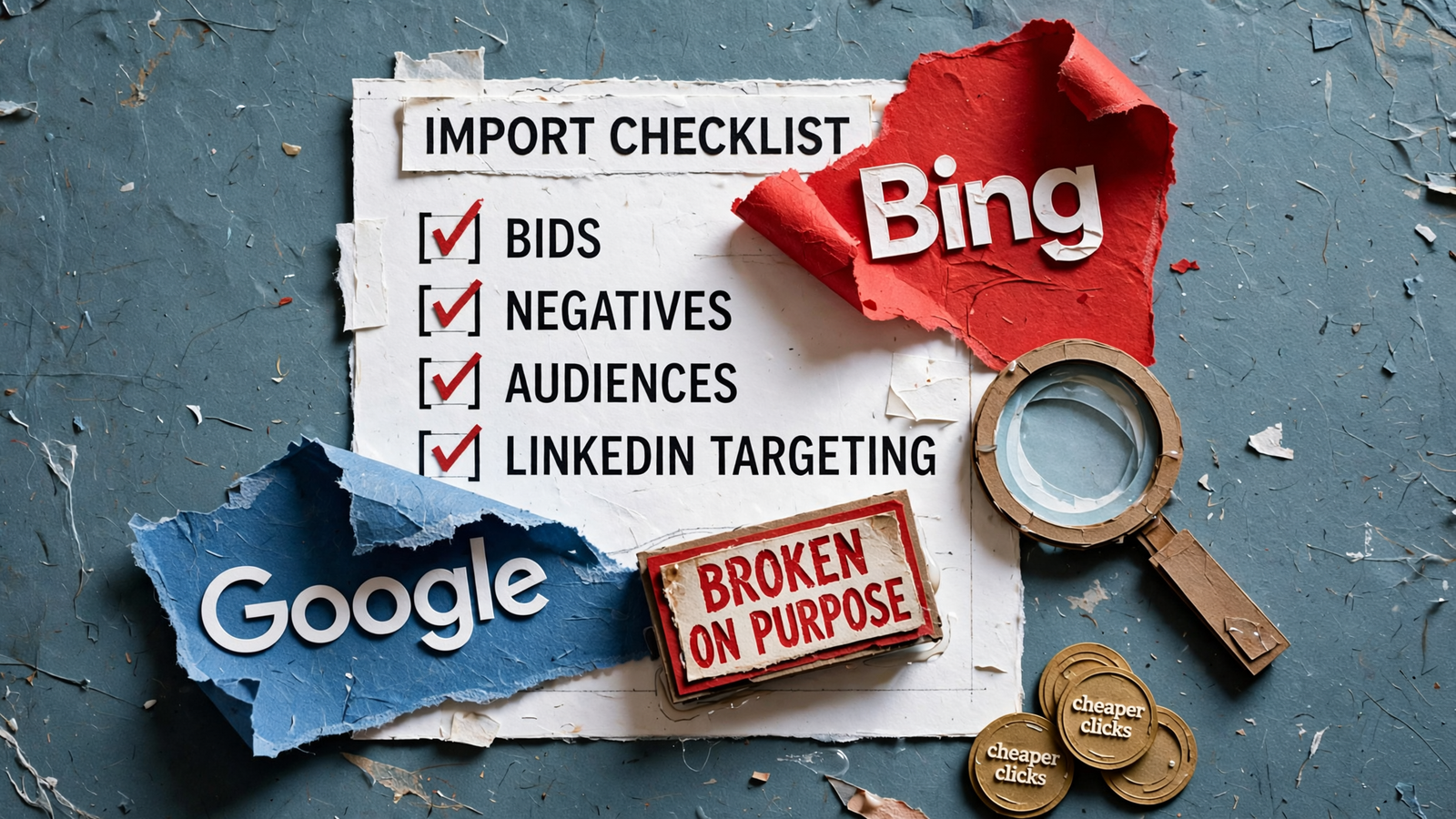
The weekly report should make those answers visible. I want five lines of changed work, each with a reason:
- Bids lowered or raised because Microsoft cleared at a different price.
- A separate budget cap set for the 10 to 20% test.
- Negatives added because Microsoft’s queries diverged.
- LinkedIn layers added or tuned because the team is watching demo rate, not just clicks.
- Ad copy changed because the desktop reader responds to a different message.
That is why groas runs Search Ads across Google, Bing, and ChatGPT, working bids, keywords, and budgets around the clock for one flat fee rather than treating an import as a billable achievement. You keep the proven keywords. You pay for the divergence. No change log, no specialist.
Put the divergence in the client proposal
Do not sell the client Microsoft Ads coverage. Put the work and the decision point in writing so they know they bought judgment, not a button press:
- Week 1: import winners only. Start with top brand and top non-brand ad groups. Give Microsoft its own budget at 10 to 20% of Google’s, install UET, and verify tracking before spend starts.
- Weeks 2 to 4: break the mirror. Set bids for Microsoft’s auction, build negatives from its search terms, add LinkedIn layers where B2B targeting fits, and rewrite ads for the desktop reader. Review queries weekly. Restrict scheduled import so Google does not overwrite the work.
- Day 60: judge the qualified leads and pipeline. Do not declare victory because CPC or CTR looks good. Apply the same standard I use when a team has fixed signal quality before scaling spend. If Microsoft cannot beat or match Google on pipeline cost at that budget, pause it and say so.
Sell a straight mirror and the client pays for Google settings on Bing traffic, learns nothing, and concludes Bing does not work. Sell a native rebuild and you spend weeks relearning what the Google account already proved. Either way, the client does not blame Bing. They blame you.
Microsoft is not a second Google budget. Import the proof, change what belongs to this auction, and show the breaks in the report every Friday. Sell the import alone and the client will wonder why it needed you at all.