

 LinkedIn
Your Google traffic is down since AI Overviews showed up, and someone is offering to win it back for you. Tell them to keep it.
I spent most of a decade managing Google Ads by hand for ecommerce shops and home services companies, mining search terms at 1am and watching what actually turned into money. The pattern was familiar: a big pile of informational visits that read and left, and a much smaller pile of commercial visits that called, booked, or bought. AI Overviews are taking clicks from that first pile. In Pew’s tracking of 68,879 real searches, users clicked a normal result on 15% of searches without a summary and on 8% with one. They clicked anything inside the summary on 1% of visits.
The lost click was often the cheap one. The job now is not to buy those readers back. It is to get named in the answer when a buyer asks, then convert more of the smaller group that still clicks through.
AI Overviews take more readers than buyers
Look at which queries trigger the thing. Seer’s 2026 data puts AI Overviews on about 36% of informational queries, against 8% of commercial and 5% of transactional queries. A separate 2.3 million keyword study lands in the same place: 38.7% of informational keywords trigger one, compared with 15.8% of transactional keywords. Long question queries get hit hardest. “How to unclog a drain without chemicals” gets summarized. “Emergency plumber near me open now” is less likely to be.
The money queries show a different pattern. Practitioner data via Semrush has 95% of AI Overview keywords carrying no ads or very low CPC, with keywords above $2 CPC largely untouched. The same pattern appears in the page layout: the overview rate falls from 33.2% when there are zero ads to 9.4% when a shopping carousel plus ads are present. Google is much more likely to answer a question in place when that search has little advertising value. Your how-to traffic can collapse while your buyer traffic remains comparatively intact. Those are not the same loss.
The drop is real, so let me put numbers on it before I tell you to stop trying to reverse it. An Ahrefs comparison of 300,000 keywords found position-one CTR loss from AI Overviews grew from 34.5% in March 2025 to 58% in December 2025. Seer’s dataset of 53 brands and 2.43 billion impressions shows organic CTR on those queries bottomed at 1.31% in December 2025, then ticked up to 2.36% by February 2026. Seer called that a levelling off, not a recovery. A randomized test on 1,065 Chrome users that hid or showed Overviews found the summary cut outbound clicks 39.8%, from 0.62 to 0.37 per search, and pushed zero-click searches from 54% to 73%, with no change in satisfaction.
That last detail is the tell. People got the answer and stopped. They did not have to visit a site to finish the task. I used to treat every informational visit as future pipeline. I was wrong. Plenty of those visits came from DIYers and curious readers who were never going to fill out a quote form. Chasing them back with more blog posts is paying to refill a bucket that never held water. Before you commission a traffic recovery plan, separate the lost queries from the queries that produce enquiries.
A session recovery plan is not an enquiry plan
The first pitch you will hear is volume. Publish more top-of-funnel content, target the questions the overview answers, win the sessions back. I ran that playbook when it worked, and I can tell you why it fails as a recovery plan now: the overview sits above the results and answers the question in place. You can rank first and still lose the click. Ahrefs matched 1.9 million citations, while Seer found brand-cited pages still get about 38% fewer clicks than with no overview at all, even though cited pages earn roughly 120% more clicks per impression than uncited pages on the same overview page. Being cited beats being buried below. It does not bring the old traffic back.
So the agency sells you the one outcome Google already removed. More posts, more sessions, same report as 2022. Take a hypothetical: you spend $20k a month on marketing, and someone proposes 12 informational posts to recover 4,000 lost visits that converted at 0.3%. That is 12 enquiries, before close rate. If work on buyer-prompt coverage and your commercial pages instead moves the 1,500 commercial visits you still get from a 2% conversion rate to 3%, that is 15 additional enquiries without a single new session. Neither result is guaranteed; the arithmetic tells you which outcome to ask about. One plan is built around enquiries. The other is built around a chart.
A second vendor does not create a second strategy
The next pitch is headcount. Keep your SEO agency, add a GEO specialist for ChatGPT and Overviews, pay twice for coverage. What the deck calls synergy, I call two people doing the same job. The overlap is visible in the pages themselves: Ahrefs matched 1.9 million citations and found 76.1% of cited pages already ranked in the top 10, with the first citation typically sitting at position 2.7. Only 14.4% of cited pages ranked outside the top 100. A page that can be found, understood, and ranked is also well placed to be cited. One body of work feeds both surfaces.

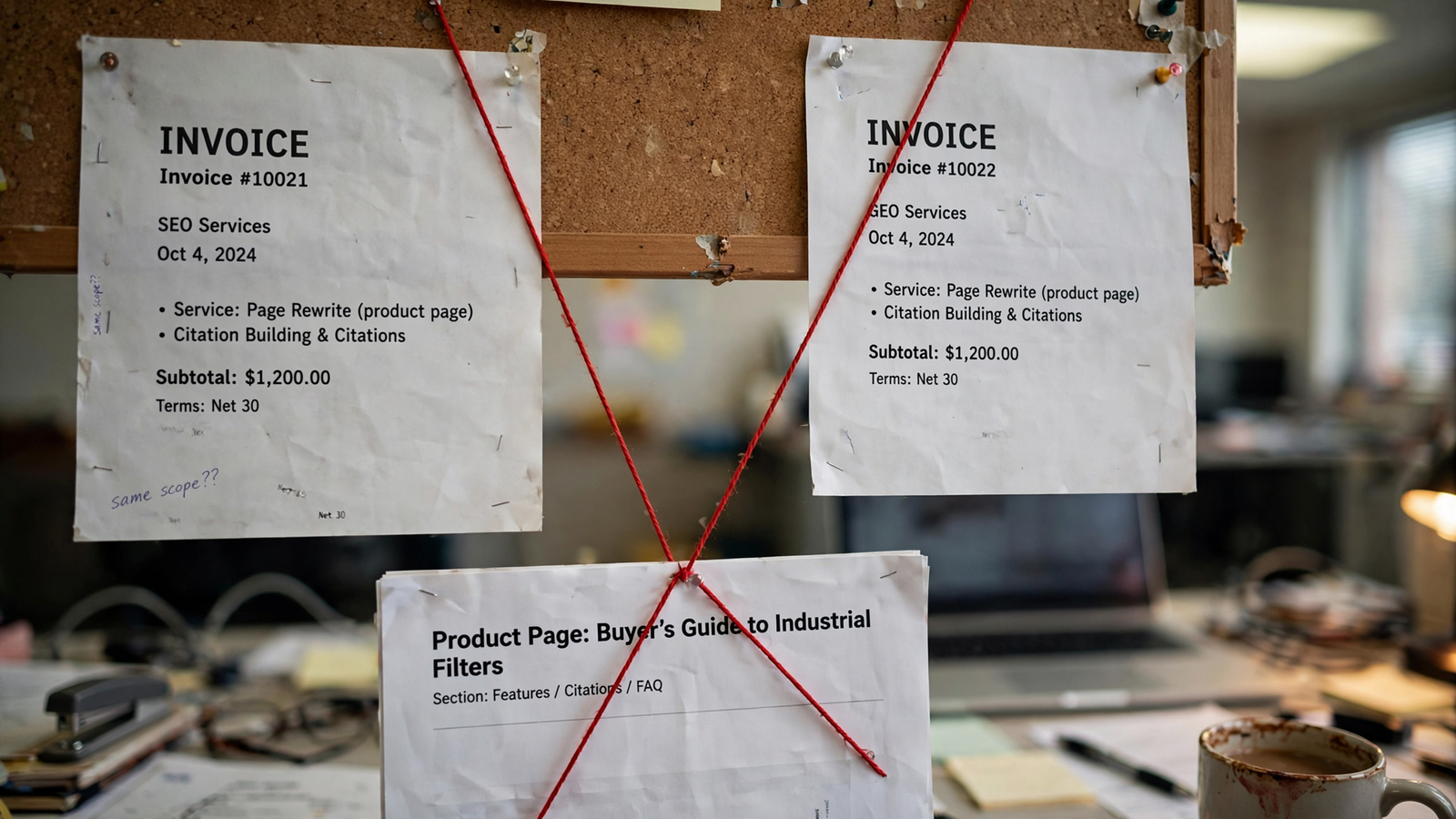
Two vendors can turn that one job into two roadmaps fighting over the same pages. The SEO agency rewrites the service page for rankings. The GEO vendor rewrites it again for answers, then bills you for citations on sites the SEO work should already cover. A separate GEO layer on top of SEO can produce two roadmaps competing for the same pages. Call the work AEO, GEO, or AI search; the practical work substantially overlaps. If two proposals list the same pages, the same business facts, and the same third-party citations, you do not have two strategies. You have one invoice copied.
Put rankings and answers on one roadmap
The work that helps a page rank also helps it get cited, but the answer needs more than your page alone. Put the shared work under one owner:
- Make service pages easy to extract facts from. State what you sell, where you operate, what it costs, and why you are different in plain language on crawlable pages.
- Keep those facts consistent. Your schema, Google Business Profile, and about pages should not give a machine conflicting versions of the business.
- Build proof beyond your site. Reviews, directories, trade press, and local citations give answer engines outside references to draw on.
Ranking pulls mostly from your site. Answers pull from your site plus that outside proof. Agencies selling the combined scope describe it as crawl, answers, and entity facts in one program. Splitting that work means paying two teams to edit the same facts twice.

That is why I tell owners to hire one provider accountable for both surfaces. The service page rewrite can serve rankings and citations at once; the outside proof can strengthen both. This is the model groas runs as SEO and AI Search for one flat fee, with new pages and technical fixes every day, authority work on the sites the engines trust, and a program live in under 24 hours. One owner, one roadmap, every action logged with its reasoning. The cost is that one provider has to own the whole result. If your setup needs a meeting between two agencies to change one page, you do not have coverage. You have overhead.
Replace the sessions chart with buyer evidence
Stop treating sessions as the outcome. Track enquiries and whether your business gets named when a buyer asks. In an AgencyAnalytics survey of 494 agency pros, clients ranked conversions first at 44%, then leads at 22%, ROI at 12% and revenue at 11%, with traffic last at 6%. Yet 42% of those same agencies still field traffic-drop questions, and 48% admit they cannot reliably track AI discovery because it logs as direct. The familiar chart tracks the thing clients value least while missing part of the discovery path they need to understand.
The replacement fits on one page:
- Check 20 to 30 buyer prompts. Use the questions with money in them: best, cost, near me, and versus. Record whether you are named, where you appear in the list, which URL gets cited, and whether the answer states your facts correctly. Those are the visibility, position, citation, sentiment, and error checks practitioners recommend.
- Count enquiries from organic and AI discovery as far as you can track them. Do not pretend the attribution is cleaner than it is. If some AI discovery arrives labelled direct, say so rather than quietly leaving it out of the conversation.
- Track conversion rate for the organic traffic that remains. Check whether the pages still receiving visits lead people to call, book, or enquire. A smaller audience that takes action is worth more than a larger one that reads and leaves.
If sessions fall 30% and enquiries hold flat, the session chart looks grim while the business outcome holds up. That is a win wearing a loss costume. Ask your provider to put enquiries, named mentions on buyer prompts, and organic conversion rate ahead of the traffic graph. If the first slide is still sessions, you hired a traffic vendor.
This argument has one clear exception
If you sell ads against pageviews, ignore everything I just wrote. For an ad-funded publisher, the session is the product, and that product is shrinking fast. 68.01% of US searches ended clickless in early 2026, against 60.45% in 2024, and Chartbeat had small publishers down roughly 60% in search referrals in March 2026, against 22% for large ones. That is not the cheap half. That is the business. Local and branded queries behave differently too: a plumber ranking for his own name is not living the same reality as a how-to site. This argument is for businesses that sell jobs, bookings, and contracts, not impressions.
For those businesses, the two-vendor model is where the money leaks. Two audits, two roadmaps, two retainers, one set of pages. The SEO contractor and the GEO contractor can spend an hour agreeing on who owns a service page rewrite. You still pay for the hour.
Ask these three questions before you sign
Do not ask a provider to promise your old traffic back. Ask for the numbers that expose what its work is supposed to change:
- How many enquiries came from organic and AI discovery last month, and what can you actually attribute?
- How many of our 20 named buyer prompts mention us, and which URLs were cited?
- What is the conversion rate of the organic traffic we still get?
If the answer is a sessions chart, a rank report, or a second retainer for the same pages, walk away. That vendor is selling you the recovery of the cheap half, twice. Keep paying for that and you will get exactly what you pay for: more traffic that does not buy.