

 LinkedIn
A Google Ads agency can promise to get paid only for results and still make more money when your profit falls. I’m using a composite pay-only-for-results agreement, assembled from three proposals sent to growth leads who asked me to review the terms, to show how. The test is whether the target is written down before you pay and the vendor bears a cost if it misses.
The pitch decks offer relief from bloated retainers and bills for routine hours. That sounds attractive when you have watched an agency collect a percentage of ad spend while attributable revenue drifts sideways. The agreement deserves a slower read. Its definitions of result, baseline, and attributed revenue can leave you paying more as spend climbs, whether or not more cash reaches your business.
First, the proposal: three ways to price a “result”
The agreement draws on three versions of performance pricing. None is inherently fraudulent. Each needs a definition precise enough to survive a bad month:
- Revenue share: A headline fee of 10% to 20% of incremental revenue, or 2% to 5% of gross revenue.
- Pay per acquisition: A fixed bounty per conversion, such as $45 per form fill, or a $2,000 to $3,000 monthly base fee plus $50 per lead.
- Baseline kicker: A reduced retainer plus a 20% cut of revenue above an agreed monthly baseline.
The sales argument is that the agency shares your risk. I use one question to test it: if an ad dollar burns without producing profitable business, who absorbs the loss? A percentage-of-spend fee has an obvious incentive to grow the budget; I’ve covered that problem in traditional Google Ads agency pricing. Performance pricing is supposed to fix it. Clause 1 shows how easily the same incentive returns under a different name.
Clause 1: “Attributed revenue” is not money you keep
The composite clause reads:
“Client agrees to remit to Agency a performance fee equal to 15% of all Gross Attributed Revenue generated by ad campaigns managed under this Agreement, calculated via the ad platform tracking tags and invoiced on the first calendar day of each month.”
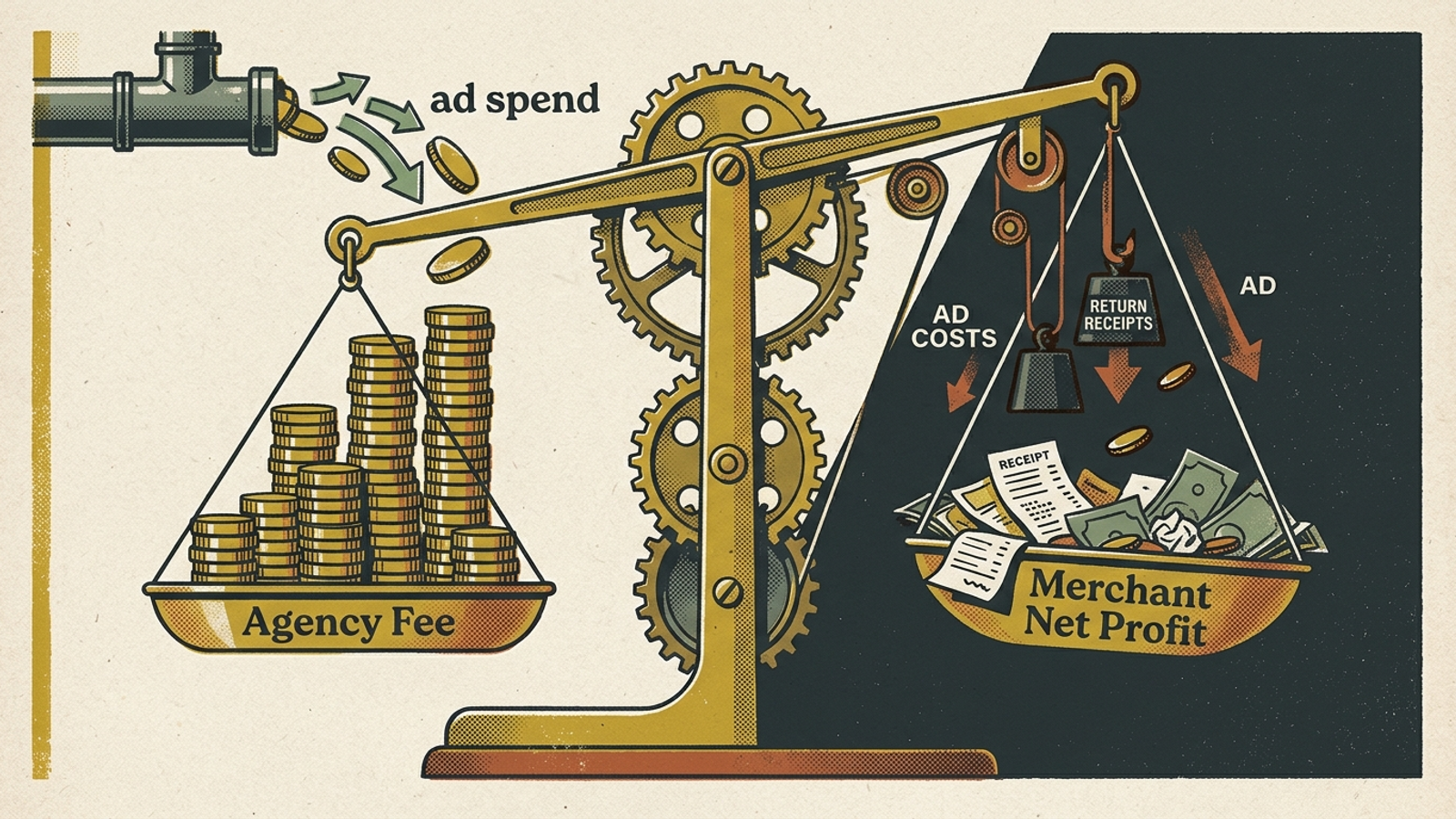
The fee is tied to a platform number, not your retained margin. A conversion value recorded at checkout does not, by itself, settle what happens after the order: returns, refunds, chargebacks, and other adjustments can change the amount you keep. Revenue-share agreements can calculate fees against gross platform-tracked revenue, leaving the advertiser to reconcile those later changes. If one in five orders comes back, a fee based on the original checkout totals is not a fee on the cash you kept.
What happens when the agency doubles spend
Here is the incentive in round numbers. Say you spend $20,000 a month on Google Ads and record $100,000 in revenue: a 5.0 return on ad spend (ROAS). At a 50% product margin, that leaves $50,000 before media costs. Subtract $20,000 for ads and the agency’s 15% revenue fee, or $15,000. You have $15,000 left before other operating costs.
Now the agency pushes spend to $40,000. Campaigns reach broader audiences, total recorded revenue rises to $140,000, and blended ROAS falls to 3.5. The second month looks like this:
- Product margin, at 50% of $140,000: $70,000
- Media spend: −$40,000
- Agency fee, at 15% of $140,000: −$21,000
- Amount left before other operating costs: $9,000
The agency fee rises from $15,000 to $21,000. Your amount left falls from $15,000 to $9,000. The vendor did not need to improve your economics to earn more. This is not literally a percentage-of-spend fee, but it rewards the same decision to scale spend when gross attributed revenue rises and your margin does not.
A revenue-share contract needs to answer what happens to the fee when revenue is refunded and when the next dollar of ad spend produces less profit than the last. If it cannot, “we only win when you win” is a sales line, not a payment rule.
Clause 2: A conversion bounty can buy a lot of bad leads
The lead-generation version says:
“Client shall pay Agency a performance bounty of $65 for each valid Conversion Action recorded within the ad account. A Conversion Action is defined as any completed web contact form submission, inbound phone call lasting greater than 30 seconds, or appointment booking recorded by the primary tracking pixel.”
This sounds safer than a retainer. No inquiry, no bounty. But an inquiry is not an acquisition unless the business defines one that way. The clause pays for an event in the ad account, not a qualified opportunity in the CRM.
The cheap-lead incentive
An agency paid per recorded conversion has reason to seek more recorded conversions at less ad cost. It can shorten forms, remove questions about company size or budget, loosen keyword targeting, and send traffic to placements that produce inexpensive submissions. Those changes can also remove the friction that kept unsuitable prospects out. Cost-per-lead bonuses can reward cheap, low-intent queries rather than qualified pipeline.
The resulting spreadsheet may look excellent. The sales team still has to work it: students, consumers looking for a service the company does not sell, disconnected numbers, and bots can all appear as rows marked conversion. The agency invoices $65 per qualifying event under its definition. Your reps absorb the follow-up time, and you pay the media bill.
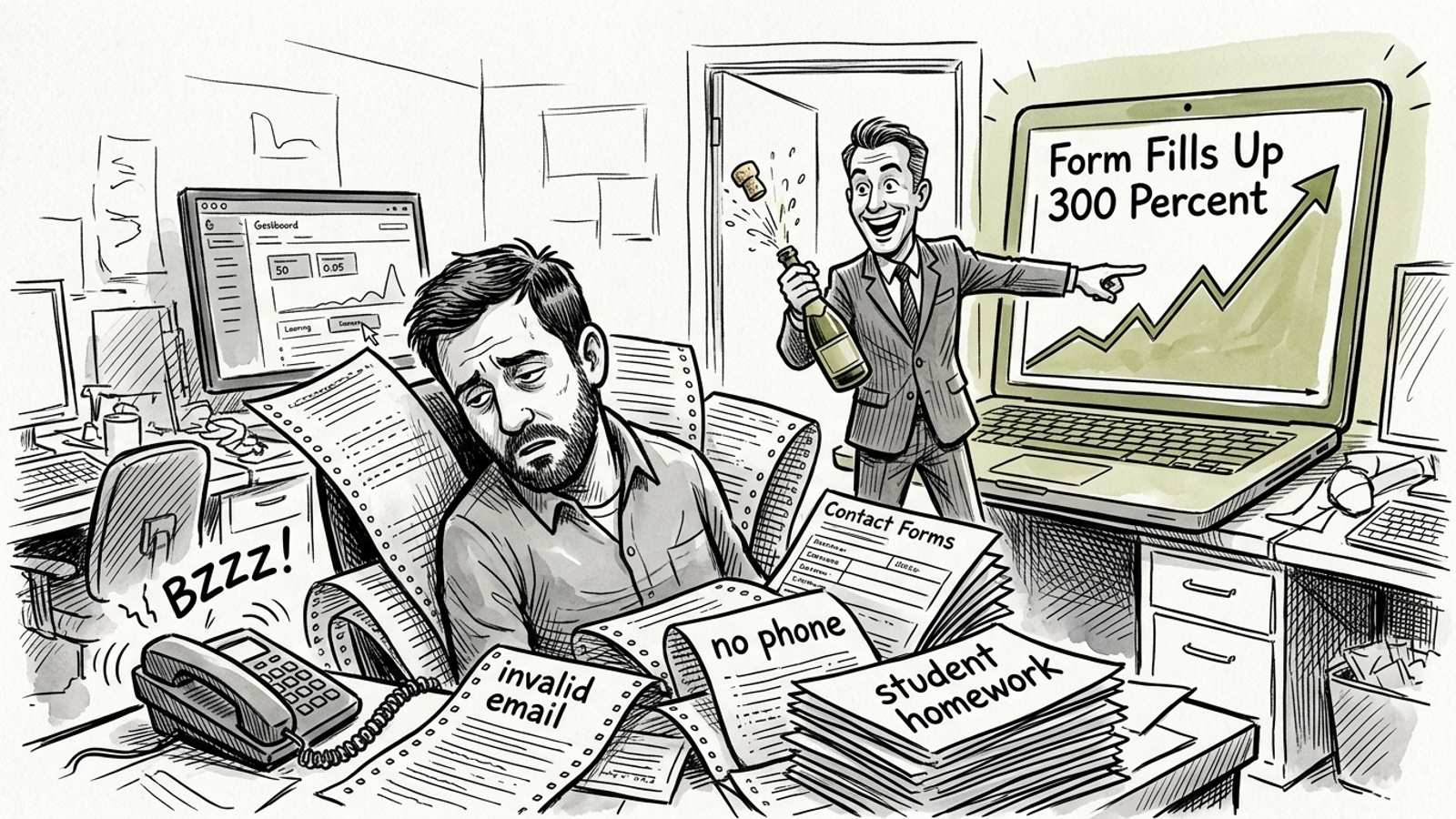
Automated bidding does not fix a badly chosen goal. Target CPA and Target ROAS work around the targets advertisers give them; they do not turn a raw form fill into a sale. If the contract rewards form volume, buying systems and the agency can both optimise toward that event while the business needs qualified customers.
The practical question is not whether the pixel fired. It is whether the contract rejects and reconciles leads your sales team cannot use. Without that rule, pay per acquisition is often pay per entry in a spreadsheet.
Clause 3: A low baseline can make the calendar look like strategy
The bonus clause in the composite agreement reads:
“Agency shall receive a performance bonus of 20% on all Gross Revenue generated above the Monthly Baseline Target. The Baseline Target is fixed at $45,000, derived from Client’s historical trailing 90-day average prior to the Effective Date.”
The number that matters here is the baseline, not the 20%. Suppose you sign in late August and the trailing period covers a summer lull. If your market normally picks up in September and Q4, revenue can clear $45,000 without the agency improving conversion rate, lowering cost per click, or finding new non-brand demand. The bonus still triggers.
That is why baseline-based pricing can be gamed by choosing a seasonally depressed comparison period. A trailing average is easy to calculate; that does not make it a fair measure of incremental work. Before the contract starts, the buyer and vendor need to agree what the baseline represents and what happens when ordinary demand changes. If the agency gets paid for the rebound either way, it is not carrying the risk of producing it.
Clause 4: Attribution determines whose sale you pay for
The next clause defines credit:
“Attributed Conversions shall be recorded on a 30-day click-through and 1-day view-through window under standard platform attribution models, encompassing all campaigns managed by Agency, including brand protection campaigns.”
This is where a performance fee can expand without a comparable expansion in genuinely new business. Attribution records an eligible ad interaction; it does not, on its own, prove the ad caused the sale. A prospect may have visited your pricing page or read your emails before the interaction credited by the platform. Without clear deduplication and lookback rules, attribution disputes can undermine performance agreements.
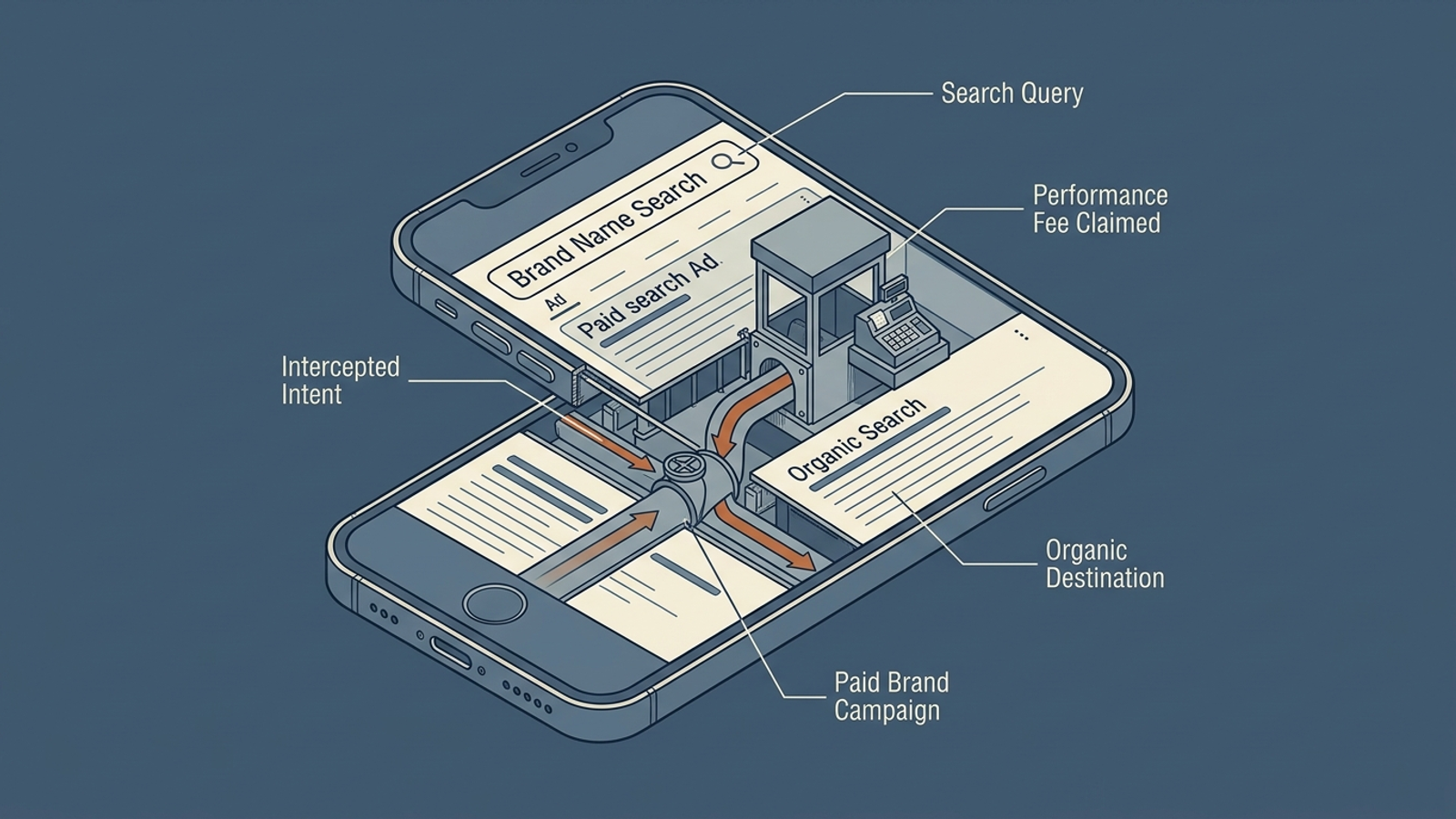
Brand campaigns make the distinction especially important. Someone searches your company name, clicks the paid result, and buys. The platform can record a strong ROAS, and the agency can claim a fee. But the searcher already knew your name. Some of that demand might have reached your organic listing without the ad. The contract does not ask how much the campaign added; it counts the conversion because the click met the attribution rule.
That does not mean every brand ad is wasted. It means a fee on all attributed brand revenue is not automatically a fee on new revenue. Before signing, decide which campaigns count, how conversions are deduplicated, and whether the agency can bill for buyers already in your pipeline. Otherwise, the contract gives the vendor a very efficient way to collect credit.
Clause 5: The exit terms reveal who owns the downside
The agreement’s boilerplate reads:
“This Agreement shall remain in effect for an initial commitment term of six (6) months and shall automatically renew for successive three (3) month terms unless written notice is received sixty (60) days prior to renewal. Campaigns, structures, and ad assets configured under Agency master accounts remain the proprietary intellectual property of Agency.”
The first sentence matters when results disappoint. A six-month commitment and a 60-day renewal notice do not disappear because the pitch deck says “results-based.” Agency agreements can include initial lock-ins and advance-notice renewal windows. If a buyer discovers that the leads are poor or scaling has eroded margin, the exit clause determines how quickly the relationship can end. Any base fees or other accrued obligations depend on the rest of the agreement; the quoted sentence alone does not establish them.
Keep ownership separate from agency access
The second sentence deserves its own pass. An agency can manage a client-owned Google Ads account through a manager account. Manager access alone does not make the agency the owner of your ad account. The risk is an arrangement in which the vendor controls the account, denies the access you need, or claims the campaign work and configurations cannot leave with you. Account-ownership disputes are not a problem you want to solve during a breakup.
If you retain the same account, you do not automatically lose its history when you change managers. If you must start in a new account because you cannot take the existing one with you, rebuilding campaigns, negatives, and conversion configurations becomes part of your switching cost. Ask whose account it is and what you can export or retain before anyone launches the first campaign.

The scorecard: which clauses shift risk to you?
You can compare flat fees and spend-based arrangements in our Google Ads agency pricing breakdown. For this agreement, I would put the risk on one page:
| Clause | What the pitch promises | What the clause rewards or permits | Who bears the downside? |
|---|---|---|---|
| Gross attributed revenue fee | Payment tied to sales | A fee on tracked revenue even when returns or weaker margins reduce what the advertiser keeps | Advertiser: pays media costs and handles the shortfall |
| Conversion bounty | Payment only for acquisitions | More payable form fills, calls, and bookings, whether or not they become qualified pipeline | Advertiser: pays for weak leads and the time spent pursuing them |
| Historical baseline kicker | A share of growth | A bonus when revenue clears a baseline that may reflect a seasonal lull | Advertiser: may pay for demand that would have returned anyway |
| Platform attribution window | Measurable ad impact | Credit for eligible interactions, including brand clicks, without proving incremental sales | Advertiser: may pay for existing demand |
| Commitment and account terms | A sustained partnership | A limited exit window and potential switching costs if ownership is unclear | Advertiser: carries the cost of leaving |
The pattern is not that every performance fee is bad. It is that each definition decides what the agency can invoice, while the advertiser still pays for the ads. Read those definitions before you judge the headline rate.
The performance structure I’d sign
I would start with a written target and a consequence for missing it. A flat fee removes the vendor’s direct reward for increasing the media budget. A defined remedy makes the promise cost the vendor something when execution falls short. Neither feature substitutes for a sensible conversion target or a client-owned account, but together they answer the question the pitch deck tends to avoid: what does the provider lose if the result does not arrive?

That is the thinking behind the groas 90-day Paid Ads Sprint. It sets a flat $7,500 investment and a written target of 30% more sales and leads from Google and AI search before payment. If the engine misses the target at day 90, groas continues execution for free until it is hit. Higher ad spend does not raise the fee. The client owns the ad account from day one, and bid adjustments and negative-keyword additions are logged with their reasoning. That is a more concrete form of alignment than a percentage of a platform total.
The narrow case for revenue share
I would still consider pure commission for an early-stage founder with little operating cash, an unvalidated offer, and an ad budget under $3,000 a month that established management partners will not take on. If an individual practitioner agrees to do the work without upfront fees, the founder is borrowing labour by giving up future margin. That trade can make sense when the cash simply is not there. I would want its definitions and exit terms in writing all the same.
For an established business spending $10,000 to $100,000 a month with proven economics, I would not mistake revenue share for shared risk. Before signing, I would require three things: an ad account the business owns, targets based on verified CRM pipeline or closed-won revenue rather than raw pixel events, and a written cost to the vendor when it misses the benchmark. The composite agreement is useful because it makes the failure visible clause by clause. Keep the promise of accountability. Do not sign away its definition.