

 LinkedIn

A client sent me a 14-page AI visibility report with 34% share of voice splashed across it. I read it twice and still couldn’t tell him what the 34% meant. No fixed prompt list. No competitor list. No split between ChatGPT and Google AI Overviews. Just a big number with an arrow pointing up.
Every AI visibility term has a Google Ads cousin. A mention is like an impression. A citation is a chance at a click. A tracked prompt is a keyword. A content gap is a search term with no ad group to catch it. Those comparisons won’t make AI answers behave like an ad auction, but they do expose where a report can hide the numbers that matter.
Read these terms in the order you’re likely to meet them: first the measurement, then the reasons you get cited, then the work that can change it. I’ve left the term I’d retire for last.
Prompt
A prompt is the question someone puts to ChatGPT, Gemini, or Google AI Overviews.
The Ads cousin is a keyword, minus the part you miss most: you don’t get a familiar search-volume, CPC, and performance history to work from. You have to infer intent from the question itself. That makes prompt selection the first place to challenge a visibility report. A report about the wrong questions tells you very little about buyers.
Prompt set / tracked prompts
A prompt set is the fixed list of questions a tool checks repeatedly to see whether your brand appears.
The Ads cousin is your keyword set, and the same rule applies: whoever picks the keywords controls the report. Let a vendor choose 50 easy brand-adjacent questions and your numbers can look great while the ten prompts that drive pipeline go untracked. Ask for the list in writing. Check that it sounds like real buyer language, then freeze it before you compare one month with the next.
Mention vs citation
A mention names your brand in an AI answer; a citation links to your site as a source.
Trackers commonly separate a mention as recommendation from a citation as sourced proof. In Ads language, a mention resembles an impression and a citation creates an opportunity for a click. It isn’t a click until someone follows the link. I used to report both as wins to clients. I was wrong to give them equal weight: only the linked one can send traffic directly, and blending the two makes the total look bigger. Ask to see mentions and citations separately.
Share of voice
Share of voice is the share of tracked AI answers that include your brand relative to competitors over a set of prompts.
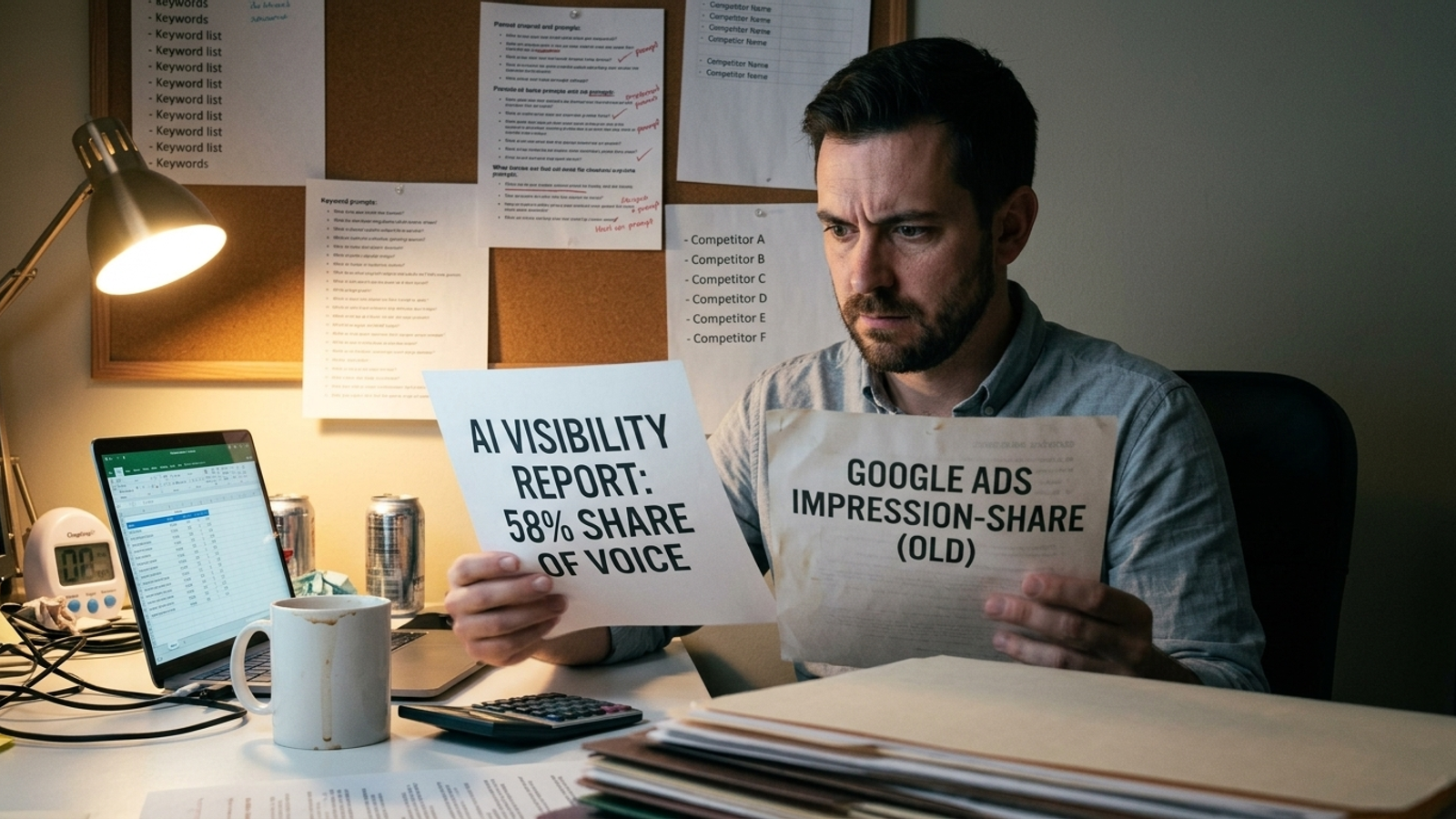
The Ads cousin is impression share. It breaks in a familiar way: without a fixed prompt set, competitor list, and per-engine reporting, the denominator can move. Change ten prompts, drop two competitors, or blend ChatGPT with AI Overviews, and that 34% can become 58% without a comparable change in where buyers see you. Ask for the denominator before you celebrate the numerator.
Cross-engine reporting
Cross-engine reporting shows your results separately for each AI answer surface rather than blending them into one figure.
ChatGPT, Gemini, and Google AI Overviews can return different brands and links for the same question. The Ads equivalent is combining Search, Shopping, and Display into one CPA. Nobody who has managed that account would accept the blend without seeing the parts: the placements carry different intent and competition. I want separate columns for each engine, using the same prompt set and week.
Say you’re spending $20k a month on Search. You wouldn’t let an agency bury Search inside a Display average. Don’t let an AEO tool bury AI Overviews inside ChatGPT.
Retrieval / grounding
Retrieval is the system fetching documents for an answer; grounding is using those documents to support what the answer says, often with links a reader can check.
The Ads analogy is eligibility followed by ad serving. If your page never gets retrieved, it has no chance to be used in that answer. If it gets retrieved but not cited, fetching wasn’t enough. Relevance, clarity, or trust may still be missing. Most visibility advice skips that split and tells you to write more content. That’s like raising bids when your ads are disapproved. Check whether the page can be fetched before rewriting the passage you want quoted.
Live answer fetch vs training crawl
A live answer fetch looks for material to use in an answer; a training crawl collects material for a model’s training process.
Not every bot visit is a chance at a citation. The Ads cousin is the difference between building an audience list and taking part in an auction. I once blocked training crawlers on a test site thinking I was protecting the content, then wondered why live citations dried up too. Wrong blocklist. If your developer blocks everything with AI in the user agent, you may sit out the very fetches you wanted. Separate the bots you mean to block from the ones you mean to allow.
Verified bot vs user-agent hit
A user-agent hit is a log entry claiming to be an AI bot; a verified bot visit matches that claim against the operator’s published IP range.
A line that says GPTBot isn’t proof by itself. Log analyzers flag hits as unverified when the user agent and IP don’t both match. I’ve seen the size of that gap in edge logs: one audit I often reference found 13,405 robots.txt requests but only 3,176 verified bot visits.
The Ads cousin is invalid clicks. Treat every claimed bot visit as demand and you’ll chase ghosts for months. Don’t pay for an AI traffic report that counts by user agent alone. Ask for IP-verified fetches.
Entity and knowledge graph
An entity is a business represented as a distinct thing; a knowledge graph connects that business to facts and other entities.
Think of the Ads-side identity a buyer meets across your Business Profile, ads, and landing pages. When your name, category, and offer line up, the story is easier to follow. When your site says one thing, Yelp says another, and Crunchbase says a third, an answer has a harder job identifying which claims belong to you.
Vendors can make this sound like mysterious entity optimization. Usually the first fix is boring: one business, spelled one way, described consistently wherever buyers and systems encounter it. Do that before buying another batch of content.
Off-site authority signals
Off-site authority signals are third-party pages that help confirm what your business says about itself.
Reviews, directories, press, forums, and supplier pages can all play that role. The Ads cousin is seller ratings: your own ad copy says you’re good; outside feedback gives someone another reason to believe it. A visibility tool that scores only your site misses that distinction.
Don’t turn this into a scavenger hunt for mentions anywhere on the web. Look for independent confirmation of the claims a buyer needs to trust, especially where your own page currently stands alone.
Content gap
A content gap is a buyer question your site doesn’t answer in a form an AI system can readily use.
The Ads equivalent is a search term with no ad group to catch it: intent is there, but you haven’t given it a proper destination. Vendors misuse content gap by selling a list of 200 missing topics ranked by volume, without checking which ones could lead to revenue. I’ve seen gap reports full of informational prompts a B2B client could never close.
Sort gaps like search terms: start with questions buyers ask close to a decision. Then give each question an owner page. Ten mapped gaps beat a spreadsheet of 200.
Answer mapping
Answer mapping assigns a buyer prompt to the page on your site that should answer it best.
The Ads cousin is mapping a keyword to the right ad group and landing page. What the deck calls coverage, I call five blog posts fighting over the same buyer question while the pricing page sits silent. The misuse is pointing three near-identical pages at one prompt, then wondering why an answer chooses a competitor with one clear passage.
Give each important prompt one clear owner page and an answer a reader can find on it. More competing pages aren’t automatically more coverage.
Structured data / schema
Structured data is markup, often JSON-LD, that labels facts on a page such as business type, price, or reviews.
The Ads cousin is structured snippets and seller ratings: useful supporting detail, not a substitute for a relevant ad and landing page. The same caution applies here. When Ahrefs tracked 1,885 pages that added schema against 4,000 controls from August 2025 to March 2026, it found no major uplift on any platform. Google AI Overviews was down 4.6% and ChatGPT up 2.2%; those movements didn’t make schema a citation strategy.
A system still needs a page it can access and a claim it can use. Add schema for clear labeling and site hygiene. Don’t buy it as a promise of citations.
Crawlability and render blocking for AI bots
Crawlability means a bot can reach your page and read the answer you want it to use.
The Ads equivalent is a landing page that can actually serve: if access fails, the rest of your optimization doesn’t get a turn. I spent years blaming copy when the fault was a template that blocked a crawler or buried the important text behind a script. Check the fetch first. Can the bot get a clean response with readable text, or does it meet a block, an error, or a page it can’t use?
Make the answer accessible before polishing the answer. That’s less glamorous than another content sprint, which is probably why it gets skipped.

llms.txt and robots.txt rules
Robots.txt sets crawler access rules; llms.txt is a proposed curated reading list, not an access control file.
A sitemap lists URLs for discovery. Llms.txt does not grant or deny access, and Google’s John Mueller said in June 2026 that no AI system uses it. Field data gives me little reason to pay for it either: of around 38,000 sites with a valid file, 97% got zero requests for it in May 2026.
The expensive misuse is blocking AI crawlers in robots.txt while publishing an llms.txt file as if it cancels the block. It doesn’t. If you want live-answer fetches allowed and training crawls out, use tested robots.txt rules and page blocks for live-answer citations rather than buying an llms.txt generator. Check the actual access rules, not the reading list.
AI-optimized content, GEO score, AI readiness
AI-optimized content, GEO score, and AI readiness are vendor labels for content or checklist assessments, not direct measures of revenue.
The first often means a page has been run through a scoring tool until it resembles every other page the tool likes. The other two put a number on a vendor’s own criteria. I treat them the way I treated third-party Quality Score predictors in 2018: directionally interesting, commercially weightless. If a proposal sells a higher score instead of named prompts where you win citations, move on.
Visibility score
A visibility score is a vendor-built estimate, often on a 0–100 scale, of how prominently your brand appears; it isn’t a ranking issued by an AI engine.
Think Quality Score back in 2015. Google gave you 1 to 10, and agencies treated it like gospel. I watched accounts with a 5 outperform accounts with an 8. The score didn’t tell me which account would win the work that mattered. AI vendors can repeat the trick with a tidier-looking number. One methodology weights five families of setup evidence and says plainly that its score doesn’t grade how citable a site is. Useful as a checklist. Useless as a paycheck metric.
Before you sign for visibility work, make the vendor answer five questions on one page, in writing:
- What’s the tracked prompt list? Give me the exact buyer questions, the engines checked, and the date the list was fixed.
- Are mentions and citations reported separately? A blended total hides which appearances offer a path to your site.
- What’s the share-of-voice denominator? Show the prompts, competitors, and per-engine split behind the percentage.
- Are bot fetches IP-verified? User-agent hits alone aren’t proof of an engine visit.
- Which page owns each money prompt? No owner page means monitoring without a clear fix.
If I could retire one term, it would be visibility score. I ran accounts where a score went up and CPA got worse because the checklist improved and the outcome didn’t. Keep the terms that describe work: fetch, retrieval, mapping, proof. At groas, we track prompts with buying intent and work on the pages meant to answer them. The score can do whatever it likes in the background.