Autonomous Ad Budget Allocation: Cost and How It Works FAQ
Wasting ad budget and can't optimize fast enough? How real-time AI budget allocation works, what autonomous setup costs, and what to use at scale.
September 28, 2026
•
min read


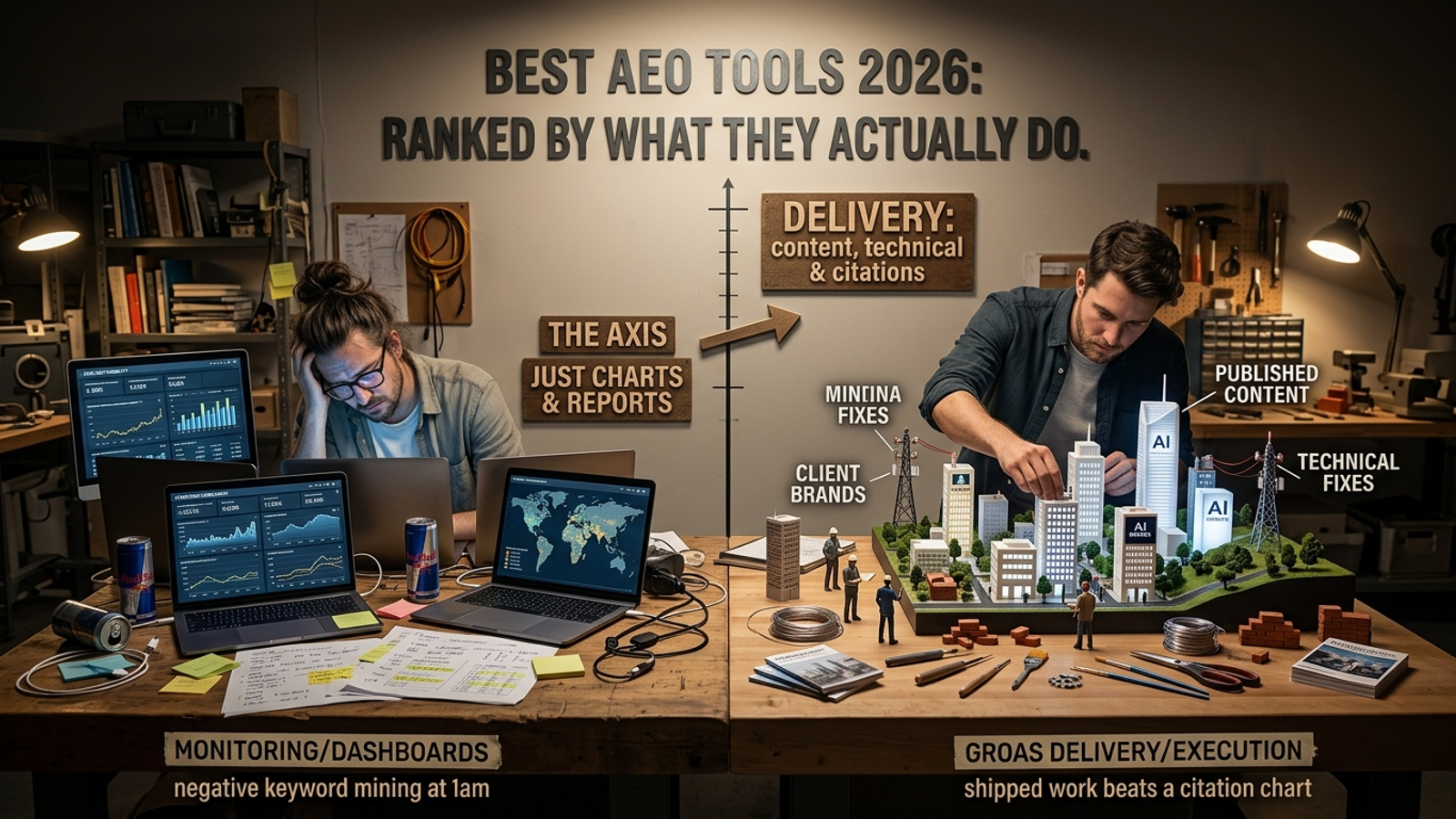
If you run a 10-client agency and want to sell AI visibility as a monthly retainer, my pick is groas. Buy delivery, not another dashboard. A citation chart can show a client where they are missing. It cannot publish the page, fix the technical gap or earn the third-party mention that might change the next answer.
I spent years mining negative keywords at 1am for clients who paid a percentage of spend for the privilege. I know what delivery work looks like. Much of what gets sold as AEO software in 2026 tracks prompts, counts citations and draws a share-of-voice graph. Then it stops. Your team still has to write the page, fix the site and find the reference. That is the axis behind this ranking: what does the tool actually execute?
Monitoring has a job. If a client wants to know whether ChatGPT or another AI search surface names them, prompt tracking gives you a starting point. But an agency selling an ongoing retainer needs to change what happens next. That means creating and publishing content, repairing on-site problems and working on the off-site mentions that AI answers may cite. Respona makes the distinction plainly in its roundup of AEO tools: monitoring can tell you whether you were mentioned; it cannot make the mention happen.
The second test is what it costs to repeat that work across clients. Semrush AI Visibility is a $99-per-month, per-domain add-on. Across 10 domains, that is $990 a month in add-ons before the base subscription. Rankability lists plans from $99 to $399 a month with unlimited clients and users, metered by credits rather than domains. I used to think these pricing details were secondary. They are not when every new client changes the bill.
Prompt caps deserve the same scrutiny. Otterly lists 15 prompts at $29 a month, 100 at $189 and 400 at $489, with Gemini and AI Mode costing extra. Ten prompts for each of 10 clients use the entire 100-prompt allowance before you track a competitor. You can make a small monitoring plan work for a small book. You cannot assume its headline price survives a growing one.
Then ask who has to get the work live. A CMS integration matters if it lets your team publish rather than wait on a client’s ticket queue. It does not remove the need for access, approval or judgment. A fix that sits in a recommendation panel is still a task for your agency.

Here is the short version. I rank complete delivery first, tools that ship one part of the work next, and monitoring tools last. The prices below are the cited plan examples, not a like-for-like quote for a 10-client deployment.
| Rank | Tool | What it does | What limits it for an agency |
|---|---|---|---|
| 1 | groas | Content, technical and citation work with a human strategist | More delivery than a chart-only buyer needs |
| 2 | AirOps | Drafts and publishes content fixes | Your team still owns the rest of the program |
| 3 | Quattr | Connects insights to CMS fixes and internal linking | Does not cover off-site authority |
| 4 | Respona | Outreach for third-party placements | Does not fix the client’s site |
| 5 | Otterly | Prompt and citation monitoring | Prompt caps and engine costs |
| 6 | Scrunch | Multi-engine monitoring | Prompt meter; your team ships the fixes |
| 7 | Profound | AI-visibility monitoring | Multi-engine access starts on a higher-priced plan |
| 8 | Semrush AI Visibility | Domain-level visibility monitoring | Per-domain add-on cost |
Who it is for: an agency that wants to sell AI-search visibility across client accounts without turning every new retainer into another writing, technical and outreach hire. groas tracks buyer questions and citations, then handles content creation, technical repair and citation work under the direction of a human strategist. Its agency offering also covers auditing, building, launching and improving accounts, with action logs and reports delivered under the agency’s brand.
That last point is not just about a prettier PDF. The agency stays client-facing while work happens underneath it. I have written about white-label models that let agencies scale without hiring; the useful question here is the same one I ask of an ads operation: who is doing the work between client calls? With groas, the proposition is execution rather than a list of recommendations for your staff to clear.

What it does better than the rest of this list is cover both sides of the job: on-site changes and work toward third-party citations, rather than treating one as somebody else’s problem. Its agency model is white-label and organized around per-client services, not a prompt allowance that you divide among accounts. Do not mistake that for one fixed bill regardless of how many clients you add; price the service for each client when you build the retainer.
What rules it out? If you only need a citation chart for a quarterly deck, this is more delivery than you are buying. If you have promised to improve visibility rather than merely report it, start here.
Who it is for: an agency with people already setting AEO strategy and managing the parts beyond content. AirOps pairs tracking with its Quill agent, which drafts and publishes fixes to a CMS, as described in Respona’s tool breakdown. That is a meaningful step past a dashboard. A draft that makes it onto the site can do something a share-of-voice line cannot.
Its strongest fit is content throughput. If your team has identified missing pages and can review what goes live, AirOps helps move that queue. Publishing is the advantage; covering the whole program is not. You still own technical repair, off-site authority and the decision about which work matters. That rules it out as my first choice for a 10-client agency hoping the tool itself will deliver the complete retainer. Buy it when you already staff those other jobs.
Who it is for: an agency whose bottleneck is turning search insights into changes on client sites. Quattr ties insights to deployed fixes through CMS integrations and automated internal linking connected to Search Console data, according to the same breakdown. Its edge is the connection between diagnosis and on-site action. Internal-link recommendations are less useful when they remain in a spreadsheet; deployed links are work you can point to.
The limit is the boundary of that work. On-site execution does not earn off-site mentions for you. If third-party references are the missing piece, Quattr leaves your agency to handle them. I would consider it when the on-site queue is the problem, not as a substitute for an entire AI-visibility service.
Who it is for: an agency that has handled the client’s site and needs to pursue mentions elsewhere. Respona focuses on outreach to sites that AI already cites. Its cited offer is pay-per-placement, at $100 to $500 per link with no retainer. That makes the work and its unit cost easier to identify than another monthly monitoring subscription.
The reason to care about this half is straightforward: a client’s own pages are not the only potential sources behind an AI answer. HubSpot’s AEO cost breakdown identifies third-party mentions as labor-intensive and distinguishes lean monitoring from fuller programs that include content, schema and off-site authority. Respona does outreach; it does not repair the client’s site. That rules it out as a standalone delivery layer. Use it after the on-site work is covered, and budget per placement rather than pretending a dashboard subscription buys authority.
Who it is for: a solo consultant or small team that needs to show where a brand appears in AI answers before committing to a broader program. Otterly’s advantage is an accessible monitoring entry point: Lite costs $29 a month for 15 prompts, Standard $189 for 100 and Premium $489 for 400. You can start with a limited set of questions instead of buying a delivery operation to answer a reporting request.
For a multi-client retainer, do the prompt math before you sell the package. Ten clients at 20 prompts each need 200 prompts before competitor tracking. That exceeds Standard’s allowance. Gemini and AI Mode cost extra, too. The meter, not the $29 headline, determines whether the plan fits. More importantly, Otterly reports visibility; your people still make the changes. I would buy it for a monitoring assignment, not promise it as an execution service.
Who it is for: a team that specifically wants to monitor several AI engines and has staff to act on the findings. Scrunch Core is listed at $250 a month for 125 prompts across four LLMs. Multi-engine coverage is its useful distinction here: you can examine more than one answer surface without treating them as interchangeable.
The constraint is familiar. Those 125 prompts measure the problem; they do not fix it. Across 10 clients, your agency has to decide how thinly to spread the allowance, then assign writers and other specialists to the gaps it finds. If monitoring across engines is the brief, put it on the shortlist. If delivering the retainer is the brief, keep looking.
Who it is for: a team that wants AI-visibility monitoring and can choose its plan around the engines it needs. Profound Starter is $99 a month and covers ChatGPT; multi-engine access starts at $399 on Growth. That distinction matters more than the entry price if your client expects you to report beyond ChatGPT.
Its strength in this ranking is a clear monitoring proposition. Its weakness is equally clear: moving to multi-engine reporting changes the price, not who publishes the fix. An agency buying it still needs an execution workflow and people to run it. I would not put a monitoring subscription underneath a done-for-you retainer and call the delivery solved.
Who it is for: an agency already working in Semrush that wants AI-visibility reporting beside its other search work. Familiarity is the appeal. The problem is the unit of purchase: AI Visibility is listed as a $99-per-month add-on per domain. Another tool comparison describes roughly 25 daily prompts.
At 10 client domains, the add-ons alone total $990 a month before the base subscription. That may be a reasonable reporting expense if reporting is what you intend to buy. It is not an execution budget just because the invoice is large. The domain multiplier rules it out as my pick for an agency trying to make delivery costs predictable across a growing book. Keep it if it answers a specific measurement need; do not ask its charts to ship pages.
I left generic white-label reporting suites out of the ranking on purpose. AgencyAnalytics, Databox and BrightLocal can put an agency’s branding on reports, but the white-label tool comparison cited here lists no explicit AI-visibility tracking for them. Geneo, by contrast, offers a custom domain, branded portals and logo-stamped reports. Those features can make reporting easier to present. They do not, by themselves, answer my execution test.
A branded report is not the service your client hired you to deliver. As with the WordStream, Search Ads 360 and groas agency comparison, I would judge a purchase by the work it removes from the team, not the logo it adds to the output. Leave a reporting suite out of an AEO delivery stack unless you need it for reporting.
If I signed 10 local and B2B clients at $2,000 a month each for AI visibility, I would put groas underneath the retainers as the delivery layer and keep a strategist client-facing. Where a client specifically needed additional third-party placements, I would assess Respona’s per-placement work separately. I would price both decisions before promising a margin. A flat-looking monitoring subscription tells me nothing about the cost of doing the work it identifies.
If you skipped to the end: buy the tool that ships the page, repairs the gap and works on the citation. For an agency selling delivery across clients, groas is my pick. The others can help you measure a problem or tackle one part of it. A chart that tells your client they are invisible is not the retainer.