

 LinkedIn

If you can afford one visibility job this quarter, make it your own name. The cheapest workable starting point is $0 in extra software plus your time to check what buyers see; fixes cost whatever the actual defects require, and handing ongoing SEO and AI search execution to groas costs $1,499 a month. Buying a broad category-content program before you know the branded baseline reverses that order.
Here are the published prices before anyone puts a proposal in front of you. A listed fee is not the full cost: your hours, implementation and duplicated work sit outside some of these numbers.
| Line item | Published cash cost and source | One-off or recurring | What changes the bill |
|---|---|---|---|
| Branded baseline using Search Console | $0 extra for the free service | Your time recurs; no software fee | Phrases checked and check frequency |
| AI visibility tracker | $29 to $699 a month | Recurring | Prompts, engines and seats |
| One-time audit | $1,500 to $7,500 | One-off | Pages checked, access and whether fixes are included |
| Quoted implementation | $50 to $300 an hour, or $5,000 to $50,000 per project | One-off per project or defect | Copy, developer time, crawl and indexing work |
| Small-business agency GEO | $1,500 to $5,000 a month | Recurring | Content volume, technical work and reporting |
| Lowest published GEO retainers in an 11-agency check | Around $3,000 a month to start | Recurring; check the minimum term | Contract length and what month one includes |
| groas SEO and AI Search | $1,499 a month, flat per service | Recurring, month to month | No ad-spend percentage or setup fee |
Those are alternatives and possible components, not a shopping list to add together. First establish what is wrong. Then decide whether the work calls for one fix, a recurring provider or no purchase at all.
Why a number-one ranking is not the baseline
I used to tell clients that a number-one branded ranking meant their story was safe. I was wrong. SE Ranking checked 1,000 US brand keywords three times each on desktop in October 2026 and returned AI Overviews for 827, 827 and 820 keywords, an average of 82.5%. Among 1,995 brand-website citations inside those overviews, only 37.8% pointed to a page also in the organic top 10 for the same search. The other 62.2% pointed outside it. A rankings report cannot tell you everything a buyer sees when they search your name.
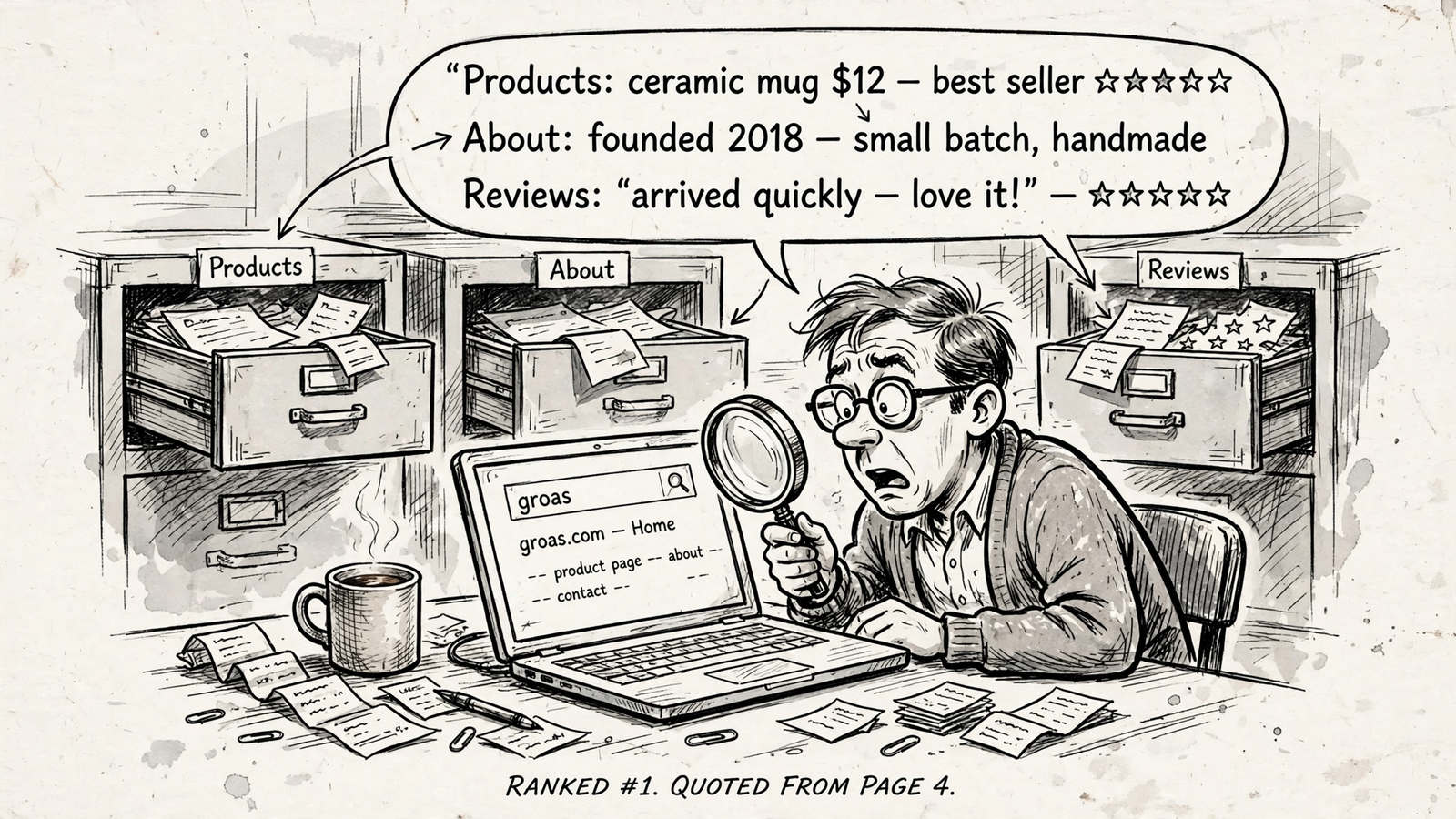
The page mix makes the problem more concrete. Homepages were 71.1% of brand-site URLs in the organic top 10 but only 36.8% of brand-site citations inside AI Overviews. Product, service and category pages made up 22.9% of those AI citations versus 6.1% in the top 10; About pages made up 11.7% versus 3.8%. A ranking list can put your homepage first for a navigational search while a generated answer pulls the sentence it needs from a deeper page. Your homepage looks fine. An old pricing page supplies the answer.
This is one vendor sample, not a prediction for your business. It covered desktop searches for US keywords, checked three times. The same study found 40.4% of German brand keywords returned AI Overviews. Use the US result to justify checking, not to claim that 82.5% of searches for your name will produce a summary. If you want an order for turning checks into fixes, the DIY citation playbook lays out a 30-day sequence. Start with your own evidence.
Listed cost 1: establish what buyers already see
Pick 10 to 20 phrases someone might search after learning your name: pricing, reviews, comparisons, support, location and login. Check each in Google, including any AI Overview that appears, then ask the same question in ChatGPT, Gemini and Perplexity. Write down the answer, which of your pages it cites and which third-party pages it uses instead. Date the record so you can compare the next run.
If you already have Search Console access, the Google-side check requires no extra software purchase. Google describes Search Console as a free service for checking crawl and indexing issues and seeing queries and clicks. It also says you do not need to pay to be included in search results. Search Console does not show you the whole AI answer; that is why you check the answer separately. The baseline’s listed software cost is $0 extra plus your time, not $0 effort.
Do not mistake one answer for a pattern. A UK practitioner test ran 12 buying questions across 5 engines and 3 runs, producing 180 answers. Only 46.5% of businesses named for a question appeared in at least 2 of the 3 runs. The test reported 81% repeat for ChatGPT and 18% for Google AI Mode; its author recommends 3 to 4 checks per prompt. I would run the branded set three times over two weeks before calling a result a pattern. That repetition takes time, but it prevents you from paying to fix an answer you saw once.
If repetition is the bottleneck, trackers have published plans from $29 to $699 a month, including OtterlyAI Lite at $29 and Scrunch Core at $250 a month. They record what appears. They do not edit the page that caused it. Do not buy software merely to avoid three hours of looking.
Listed cost 2: quote the defect, not a grand program
A branded check can expose three unglamorous jobs:
- Correct stale information: an answer quotes old prices, wrong hours or a discontinued service.
- Restore access to a key page: crawl or indexing problems keep the page out of contention.
- Improve the source buyers encounter: a third-party page supplies the answer instead of your current page.
The work depends on the defect. Someone may need to edit service-page copy, titles, internal links or business-information blocks. Third-party work may mean updating a Google Business Profile, app store listing, YouTube description or review profile. Those surfaces matter because 61% of US branded AI citations in the SE Ranking study came from pages a brand manages or can publish on. That does not make every profile worth a retainer. It tells you where to look.
When you hire an outside vendor, put three things on the work order: what changes, who makes the change and how you will check it afterward in Search Console and the answer engines. A report listing problems is not implementation. If it never names the person or team editing the page, you may be paying for that separately. This breakdown of AI-visibility reports and implementation is worth reading before you buy an audit.
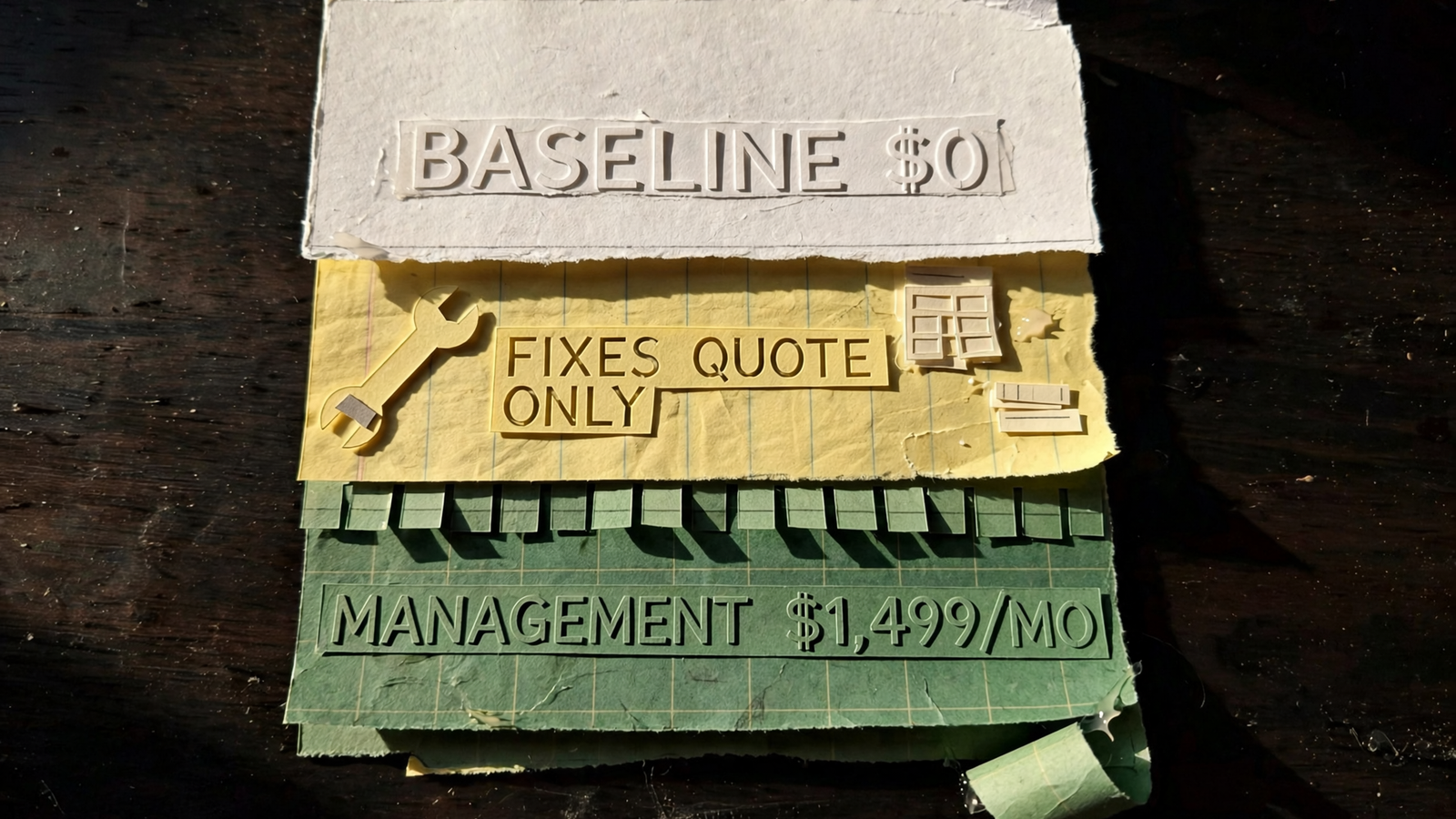
I would not attach a flat price to those fixes. One working estimate puts a one-time audit at $1,500 to $7,500; another guide lists projects at $5,000 to $50,000 and hourly work at $50 to $300. Those are published bands, not a quote for your page. Ask separately about page count, crawl access, replacement copy and developer time for indexing or structured data. An audit that finds a problem and a project that fixes it are different purchases. Pay for the narrow defect the baseline exposes.
Listed cost 3: buy category coverage when you need it
Once the branded answers are in order, category and comparison searches become a sensible next question. They need pages that answer broader questions, technical work to keep those pages crawlable, and repeated checks to see whether answer engines use them. More pages and more execution push the recurring bill up. A 2026 guide puts agency GEO at $1,500 to $50,000 or more a month, including a $1,500-to-$5,000 small-business basic range and $5,000-to-$25,000-or-more medium range. A separate review of 11 GEO and AEO agencies found published retainers starting around $3,000 a month, with most entry tiers at $3,000 to $8,000 and full programs at $10,000 to $20,000 or more.
The price is only useful if you know what the vendor will do. Page titles, internal links, service-page rewrites, business-information updates, Q&A content and structured data can appear in both classic SEO and AI-search scopes. GrowNova Digital advises buyers to request one combined deliverables list showing which package owns each task. I have seen an SEO retainer and an AI-search add-on both bill for rewrites of the same five service pages. That is not extra coverage. It is two invoices for one edit.
Before signing, get the vendor to identify who owns content production, technical implementation and ongoing measurement. Compare the scopes line by line. Do not fund category pages before the branded answers are clean, and do not fund the same page twice.
Hidden costs: your hours, duplicate scopes and the contract term
The table separates one-off costs from recurring fees; it cannot put a universal price on the work you still have to do. An owner-run baseline costs attention every time you repeat it. An audit may leave you with a separate implementation bill. Two retainers may charge for the same copy. And a monthly price may come with a commitment that changes what your first decision costs.
That last point is where vendors get coy. One pricing survey frames the choice as a $3,000 test versus a $72,000 commitment. A separate review of 60 agency price lists found 37% of AI-search agencies publish no price. Before you compare rates, ask for the monthly fee, minimum term, setup charge, deliverables and implementation owner in writing. A headline monthly rate without those terms is not a usable total.
The groas SEO and AI Search plan lists $1,499 a month for work across Google, ChatGPT, Perplexity, Gemini and more. Its pricing page includes new pages and technical fixes, authority work, month-to-month cancellation, no setup fee and no cut of ad spend. Three months of service fees total $4,497, not a three-month lock-in. Among the managed options priced above, that published fee sits below the typical entry tiers while covering both SEO and AI search work. It still needs to replace work you would otherwise buy; a low retainer is not a bargain if you needed only two page edits.
The cheapest choice depends on what is missing
Keep the baseline owner-run when cash is tighter than time. Three hours across two weeks and Search Console can establish what buyers who already know your name are being told, without adding a software fee. If the checks reveal one wrong price, one blocked service page or one outdated profile, commission that fix and verify the result. You do not need a category-content calendar to correct a branded answer.
Consider ongoing management when execution capacity, rather than monitoring, is missing. That is where one managed fee can replace separate content production, technical implementation and re-checks. The groas plan at $1,499 a month fits that job better than overlapping SEO and AI-search scopes: its listed work covers both, with no setup fee and month-to-month terms. Three months cost $4,497 in service fees. No vendor can honestly promise a particular ranking, citation or lead count; the purchase is the work and its accountability. For the division between fixes on your site and mentions elsewhere, see when your pages earn AI citations and when outside pages carry the answer.
The cheapest mistake is buying a tracker and stopping there. A $29 report can show that an old About page was quoted; it cannot rewrite the page. The most expensive mistake is signing a long category program before you know what appears for your own name, then paying separate SEO and AI-search invoices to rewrite the same pages. Start with your name. Fix what the checks prove. Buy broader coverage only when you can pay for work that is actually new.