

 LinkedIn

A new AI Overview citation appears on your vendor’s dashboard. Did its software earn the spot, or did Google rotate your page into an answer on its own? Without a holdout, you cannot tell. I learned to distrust before-and-after screenshots while managing paid search accounts: change a landing page during a seasonal spike, watch conversions climb, and it is easy to bill for the weather.
That is the test I would put to every tool promising to get landing pages into AI Overviews. Split comparable pages into two groups. Let the tool edit one group. Leave the other alone. After six weeks, compare citation rates. If the edited pages do not beat the holdout by more than the noise you see in the holdout, you bought a monitor.
The stakes are worth a proper test. In an analysis of 25.1 million search impressions, Seer Interactive found that earning a citation in an AI Overview was associated with 35% higher organic clicks and 91% higher paid clicks, while organic click-through rate fell by 61% when an overview appeared without a citation. But citations move without your vendor’s help. BrightEdge AI Catalyst tracking found that only 24% of cited URLs remained constant across tracking intervals. A dashboard that claims each arrival and says nothing about each departure is an expensive spectator.
Question: did the edits earn citations?
The question for any of the tools promising AI Overview visibility is narrow: Do pages the tool changes earn citations at a higher rate than comparable pages it does not touch? Both groups face the same broad shifts in search. Only one receives the intervention.
Do not sign an annual agreement on the strength of an upward graph. Run the following six-week protocol first: two weeks to establish a baseline, then four weeks in which the tool works only on the treatment group. The holdout is not dead weight. It is the closest answer you have to what would have happened without the software.
Setup: pair pages, then assign the treatment
Before-and-after reporting cannot separate an edit from everything else that changed that month. SearchPilot’s explanation of SEO split testing makes the same point: external shifts can swamp the signal. Build a comparison before you make a change.
- Select 10 to 20 commercial landing pages with broadly similar intent. Do not pair a product comparison page with an unrelated homepage and call them equivalent.
- Pair pages by type, traffic, and current citation pattern. Put an uncited comparison page beside another uncited comparison page; put an intermittently cited service page beside a comparable service page.
- Flip a coin within each pair. One page becomes Treatment; the other becomes Control. Record the assignment before anyone sees a result.
The aim is not to create identical pages. It is to give normal search movement a fair chance to show up in both groups. Keep the pairs and assignments fixed once the test starts. If a page proves unsuitable during baseline, fix the setup before the tool touches anything.
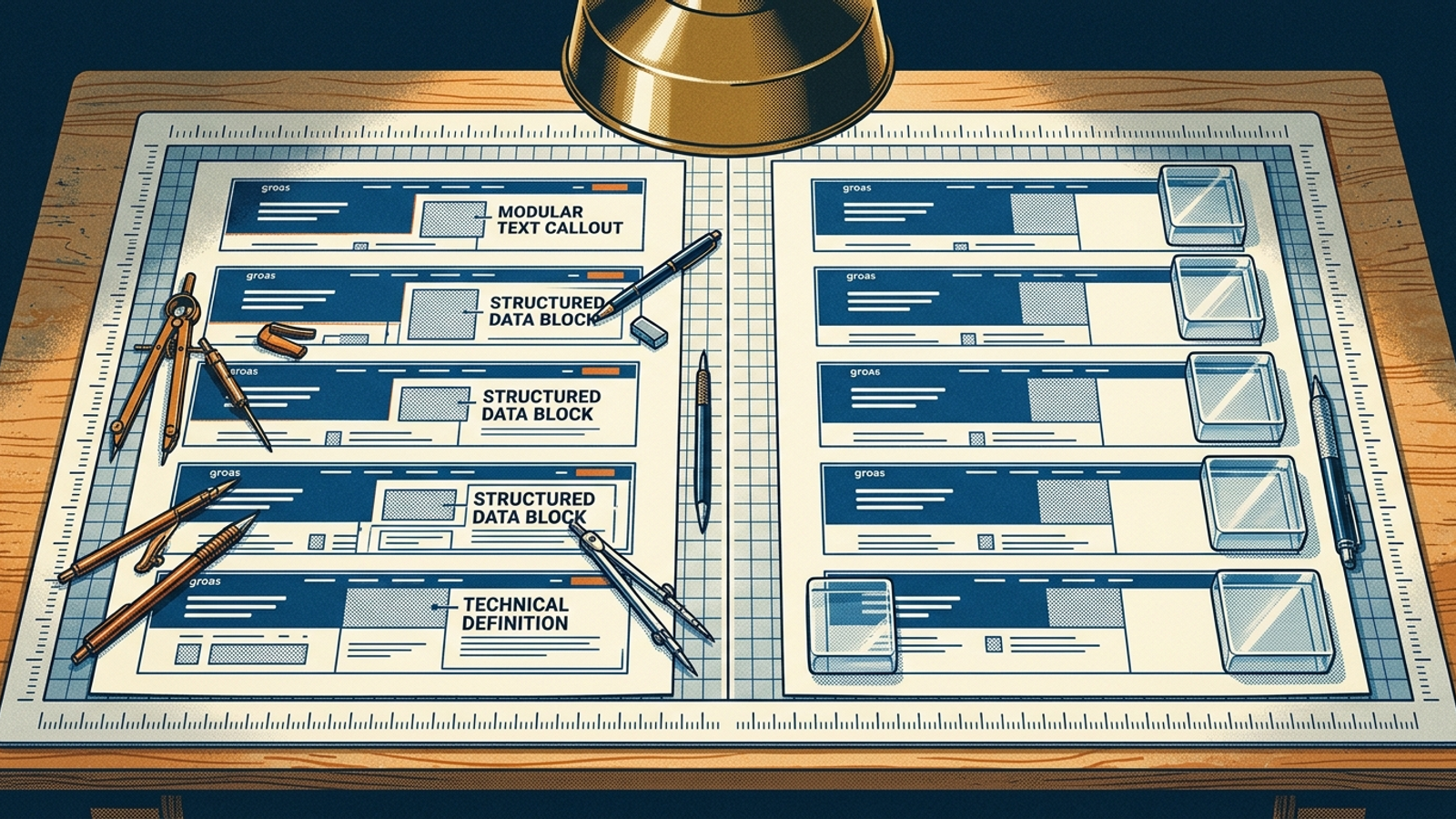
Choose buyer queries that can produce an Overview
A citation test goes nowhere if its queries rarely trigger an AI Overview. In an audit of 55,393 Google searches, researchers at Washington University in St. Louis found Overviews on 65% of conversational question queries, versus 9.5% of other formats. Queries of six words or more triggered them 38.7% of the time, compared with 9.9% for single-word terms.
For each matched pair, choose three to five natural, high-intent buyer queries relevant to those pages. Think “how to calculate gross margin for b2b saas” or “cost of commercial hvac maintenance contract,” not a head term selected because it looks impressive in a report. Write every query in the tracking sheet and freeze the list. Adding prompts after you discover a favorable answer is not optimization. It is moving the finish line.
Spend two weeks watching before you edit
For the first two weeks, touch neither group. No new header, schema block, paragraph, or title tag. Check each frozen query twice a week and record whether an Overview appeared and whether your domain was cited. You need to know how the pairs behave before an intervention begins. A two-week pre-test baseline also gives you a chance to catch a bad match.
Say the future treatment pages average a 12% citation rate and controls average 11% while moving in roughly the same direction. That is a more useful starting point than a pair in which treatment jumps to 30% and control sits at zero before the software has done anything. If the groups do not behave comparably, revisit the pairs. Do not wave away the mismatch and announce a win four weeks later.
Treatment: let the tool work for four weeks
At the start of week three, let the software use its full optimization playbook on treatment pages only. Leave the paired controls unchanged. This is where a product’s actual job becomes clear.
Practitioners discussing commercial AEO tools describe a familiar frustration: a dashboard spots missing citations but leaves page, entity, and schema changes to the customer. If the software hands your developers a PDF of recommendations, record that distinction. You may still test the recommended edits, but you are testing a tool-plus-team workflow, not autonomous execution. The developer hours belong in the renewal decision.
An execution engine such as groas takes the other route: specialized models implement content-structure and entity changes in the live CMS within client guardrails, with actions recorded in a log. Whatever product you evaluate, require a change ledger for every treatment page:
- Timestamp and exact URL
- What changed, preferably as a line-level diff
- The reason for the change
- Who or what executed it
A citation gain you cannot connect to a recorded intervention makes a weak case for renewal. A neat action log does not prove lift either. It gives you a way to inspect the work while the holdout measures the outcome.
Keep production off the control pages
No copy tweaks, title experiments, internal-link changes, or surprise template redesigns on controls. The fastest way to wreck a test is a well-meaning site update nobody mentioned. I have seen an H1 swap make a tidy account plan useless before the next review.
Tell everyone with CMS access which URLs are in the holdout. If a control page changes during the four-week treatment window, mark it and remove that pair from the comparison rather than pretending the counterfactual survived. Apply the same scrutiny to changes that affect both groups. A site-wide release belongs in the log, even if nobody calls it an SEO project.
Measurement: record the answer, not the screenshot
A folder of screenshots makes it hard to see whether a page change earned a citation or merely caught normal drift. Use a ledger. For each frozen query, check twice a week at the same hour, using the same clean, non-personalized incognito setup or unauthenticated API proxy throughout. Keep the checking method fixed.
Record the query, date, page pair, group, and whether an AI Overview appeared. When one appears, enter 1 if your root domain is linked in its answer or side carousel and 0 if it is not. Mark no Overview separately rather than silently treating it as an uncited answer. That way, a change in how often Google shows Overviews does not masquerade as a change in citation share. Keep the count of Overview-triggering checks beside every rate you report.
Do not hunt for a flattering answer by checking repeatedly throughout the day. Google can show different answer variations to different searchers, and extra checks made only when a result looks promising will skew your ledger. Twice-weekly observations give you a manageable, consistent record across the baseline and treatment windows.
Citation rate is the primary outcome. Pull Google Search Console impressions and clicks for both page groups as a secondary check: a citation is more interesting if it comes with useful search traffic, and less interesting if clicks move the wrong way. Do not substitute a traffic graph for the citation test. They answer different questions.
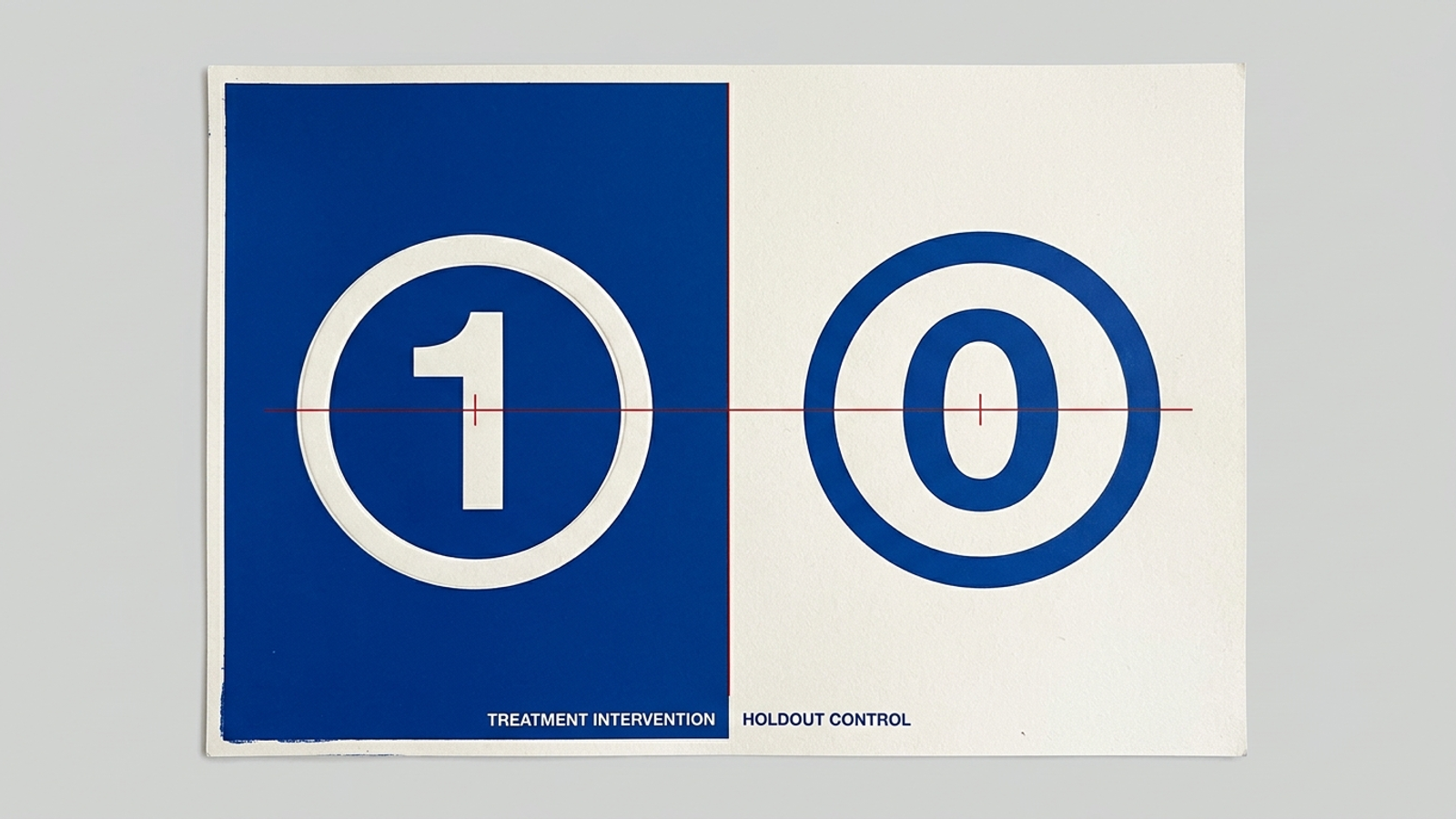
Reading week six: subtract the movement you did not earn
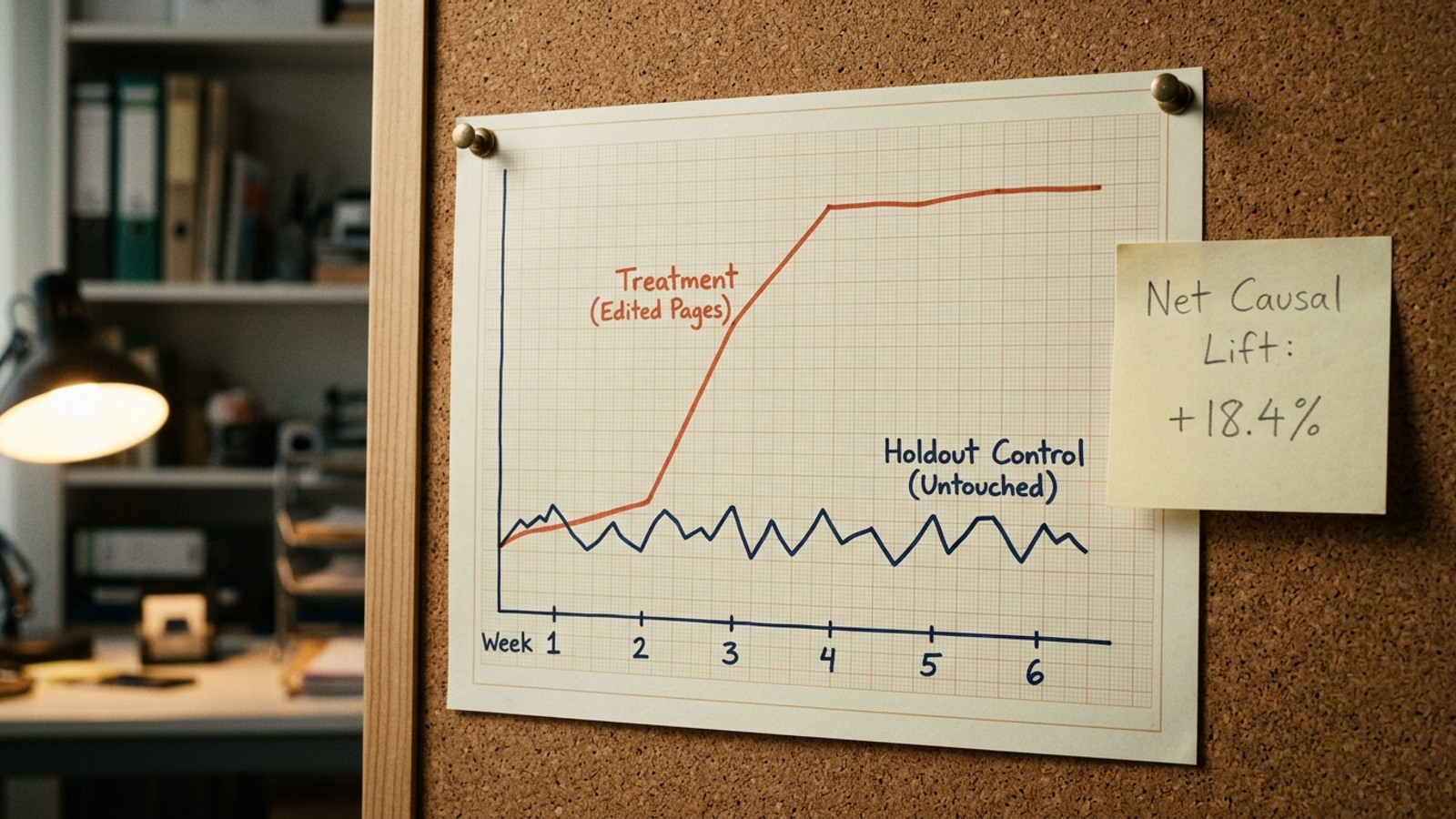
Expect both groups to move. In longitudinal tracking reported by Authoritas, 70% of AI Overview citations shifted within two to three months. That is why a rise in the treated group, by itself, is not the result.
Compare the baseline with the four-week treatment period for each group, then subtract the control group’s change:
Net lift = (Treatment_End - Treatment_Baseline) - (Control_End - Control_Baseline)
Suppose treatment rises from 15% cited to 28%, while control rises from 14% to 26%. Treatment gained 13 percentage points; control gained 12. The difference is one percentage point. Calling the full 13-point rise a software win would give the vendor credit for movement your untouched pages nearly matched.
This calculation is a comparison, not a certificate of causality. Check whether the result is spread across pairs and observations or rests on one lucky query. Look at how much the groups moved during baseline, how often Overviews appeared, and whether any pages were contaminated. If the sample is thin, say so. A spreadsheet can show you the arithmetic without making a weak test strong.
Do not accept rank as a substitute for a citation
A vendor may point to an organic ranking gain when the citation ledger stays flat. That is a different result. In a study of 863,000 search results and 4 million citations, Ahrefs found that 37.9% of cited URLs ranked in the organic top 10 for the target query; 31.2% ranked from 11 to 100, and 31.0% were outside the top 100.
If a page moves from position nine to four, record the improvement. Do not mark an AI Overview test as passed unless treatment separates from control inside the Overview. The point is to test the promise you were sold, not the nearest metric that moved.
Check for the three ways a win gets faked
Before you call the result, inspect the ledger for confounds:
- Platform changes: A core update or model rollout can shift citations across both groups. The holdout helps reveal shared movement; it does not guarantee that every page experiences the shock equally.
- Seasonality and news: Buyer queries tied to budget cycles, tax deadlines, or holidays can change character during the test. Note a shift in Overview triggering rather than treating every missing answer as a page failure.
- Unlogged site changes: A global footer edit, DNS migration, or caching change can introduce another variable. Record site-wide work alongside treatment edits. The point of the six-week holdout is to compare known interventions with an untouched counterfactual, not to reconstruct a month of production releases from memory.
Verdict: renew, cancel, or keep the test running
Use the bands below as operational decision rules, not statistical guarantees. A lift above 15 percentage points across at least 50 query evaluations deserves closer attention; it does not erase a bad baseline, contaminated controls, or a result concentrated in one pair. Likewise, a small measured difference is a reason to question the subscription, not proof that no page edit could ever work.
| Outcome | What the ledger shows | Decision |
|---|---|---|
| Clear separation | Net lift above 15 percentage points across at least 50 evaluations, with treatment repeatedly ahead of control | Consider renewing and rolling changes into the holdout pages. Check the change ledger and traffic before expanding to another page cluster. |
| Monitoring drift | Net lift between -5 and +5 percentage points, with both groups moving together | Do not pay for an earned-citations claim the test has not shown. Cancel if that claim is the reason you bought the tool. |
| Negative intervention | Net lift below -10 percentage points while controls remain comparatively stable | Review the edits, roll back harmful treatment changes, and cancel if the tool cannot account for the decline. |
| Too little evidence or a disrupted test | Fewer than 30 Overview-triggering observations across both groups, or a late shock that breaks the comparison | Extend the lockdown by two weeks and collect four more checks before making the contract call. |
This is also where the operating model matters. A tool that only flags thin definitions or missing schema leaves someone else to make and document the edits. You pay for the license, then pay for the work. groas is built to replace that agency-and-dashboard loop: its models execute search changes within client guardrails, log the actions, and work under a named human strategist. That makes it a better fit for this protocol than a passive monitor. It still has to earn the verdict in your holdout. No product gets to skip the control group because its execution story sounds convincing.
Takeaway: no control group, no claim
I have watched search teams claim credit for a revenue spike when a competitor ran out of inventory. AI Overview software can make the same mistake with citations: spot a rise, put it in a deck, and leave the untouched pages out of the frame.
So make the vendor’s promise testable. Pair the pages. Freeze the buyer queries. Spend two weeks on baseline and four on treatment. Protect the controls, log the edits, and count citations only against the checks that produced an Overview. Then let the difference between groups drive the decision.
If treatment pulls ahead convincingly, you have a reason to keep paying and test a wider rollout. If it tracks the holdout, cancel the earned-citations pitch and keep your budget for work that changes the page. No control group, no claim.