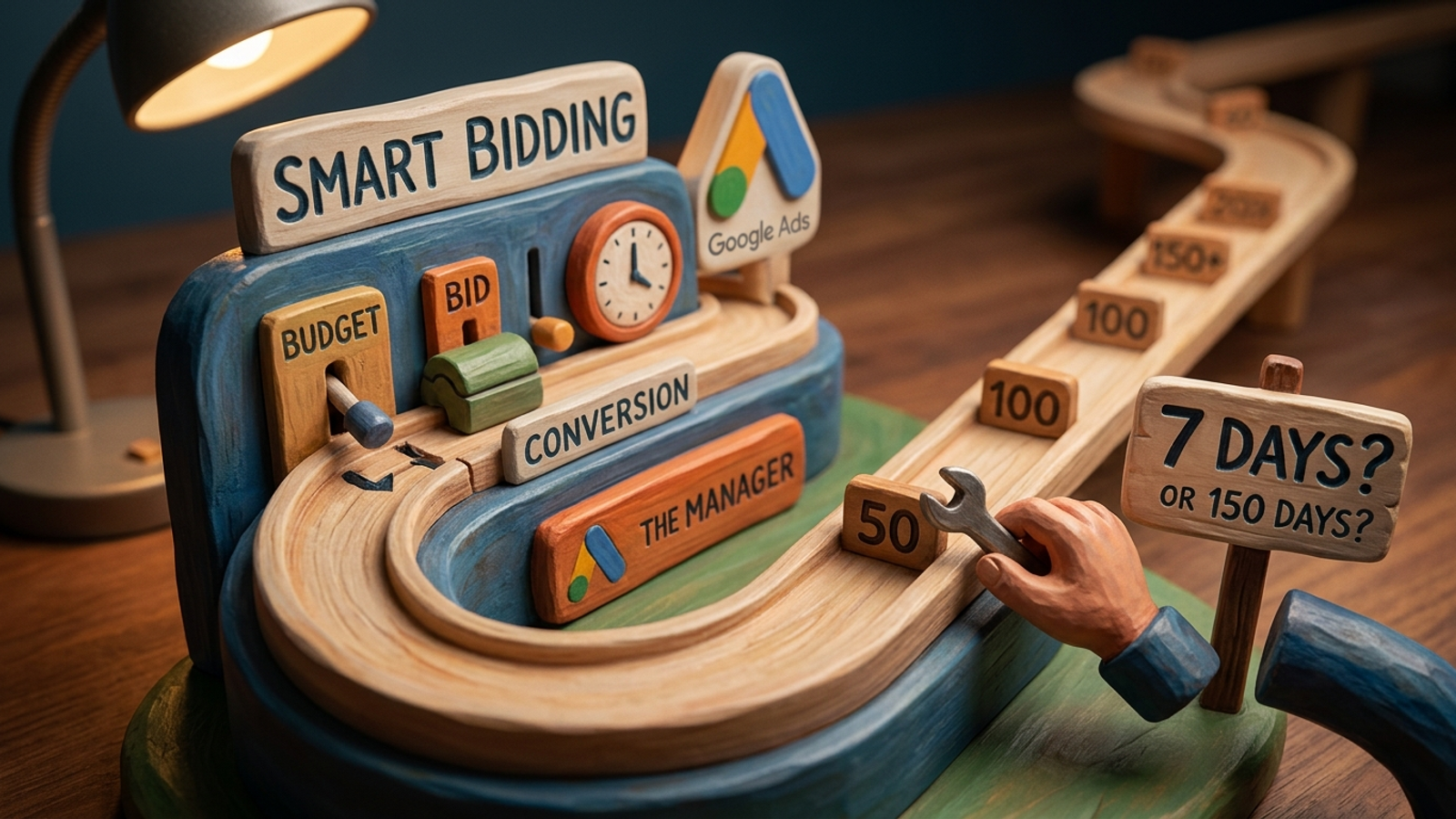
Twenty-eight of 40 campaigns in my launch-and-restart log did not get a clean first run at learning. Someone changed the budget, tightened a bid target, replaced creative, or edited conversion tracking before the initial period had played out. That is the less flattering side of the Google Ads learning-phase story: advertisers often reset the experiment they are waiting to finish.
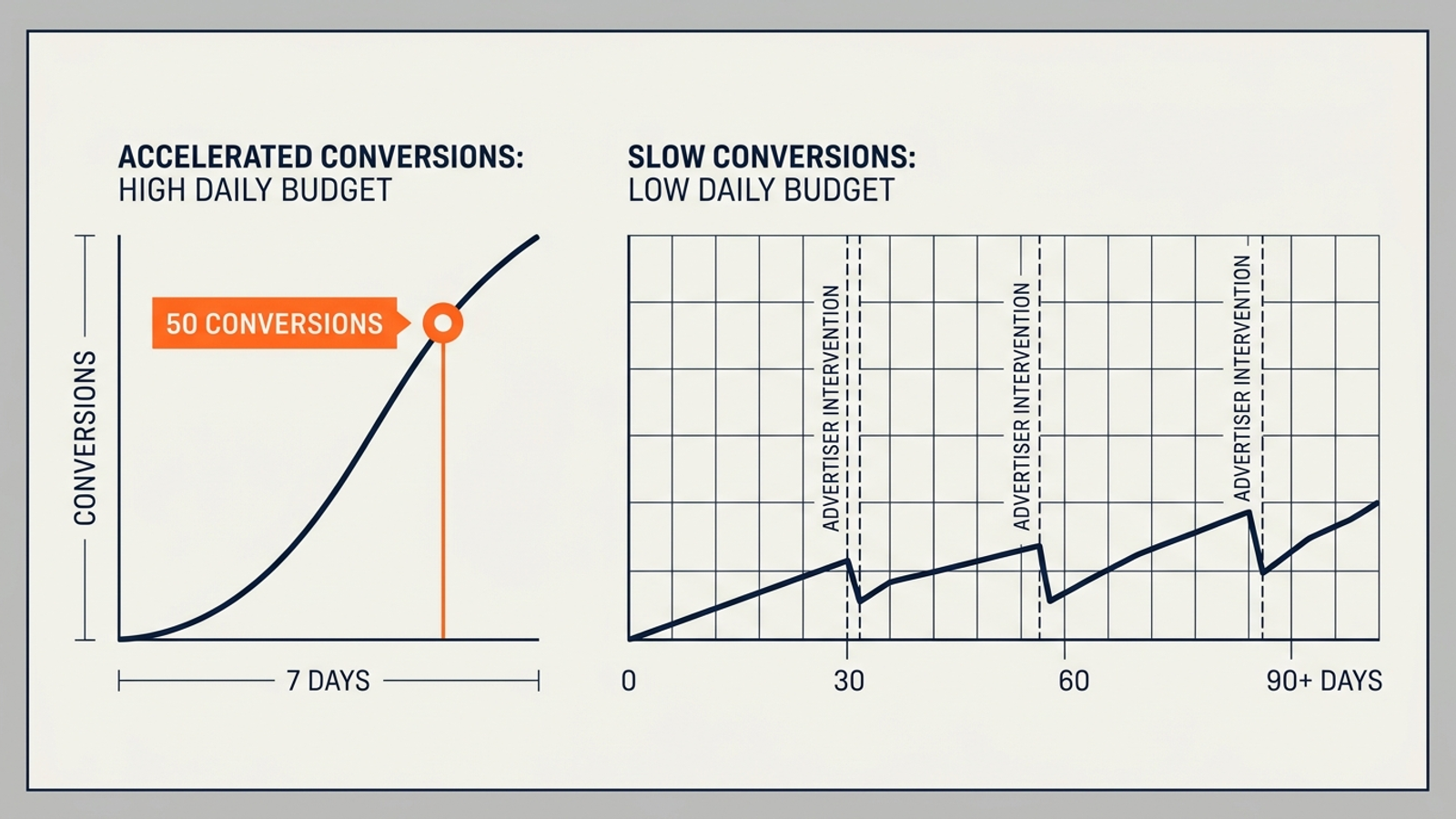
The other side is arithmetic. Google’s performance evaluation guidance advises accumulating at least 50 conversions before judging performance or changing targets. That is not a rule that the interface must display Learning until conversion number 50, and it is not a promise that a campaign will settle on day seven. At a $40 daily budget and a $120 cost per acquisition (CPA), reaching 50 conversions takes about 150 days at a steady rate. The calendar and the conversion volume are different animals.
I tracked 40 launches and strategy restarts across lead generation, home services, and B2B SaaS accounts. Among the sub-$5,000-monthly-budget campaigns that reached a stable exit, the median was 34 days. The underlying account logs are not published here, so treat that observation as a description of this sample, not an industry benchmark. The budget calculations below are simpler to inspect: they show exactly what a given spend and CPA imply, and where that calculation stops being useful.
What Google calls learning, and what 50 conversions tell you
Google’s bid strategy documentation lists three triggers for a Learning status: a new strategy, a setting change, or a composition change involving campaigns, ad groups, or keywords. It says calibration typically takes one to two full conversion cycles. A conversion cycle matters because a click can arrive today while the conversion appears much later.
The 50-conversion figure is evaluation guidance, not a countdown on the status label. A strategy may become Eligible before it has accumulated that volume; Eligible does not mean its CPA is now dependable. Conversely, reaching 50 conversions does not guarantee steady results. PPC Land’s account of the learning phase describes the underlying exploration problem: the model has to learn which auction signals predict conversions for the offer in front of it. More relevant conversion events give it more to work with. They do not remove conversion delay or make a noisy account predictable on command.
This is where the familiar seven-day shorthand falls apart. To record 50 conversions in seven days, a campaign needs an average of about 7.14 conversions a day. At a $28 CPA, that implies roughly $200 in daily spend. At an $85 CPA, it implies about $607. At a $220 CPA, about $1,570. Those are illustrations using the stated CPAs, not promises that spending those amounts will hold CPA constant.
A weekly review can still be useful. Calling day eight a graduation ceremony is the mistake.
The budget table: days to 50, not days to Eligible
The table applies one formula to illustrative monthly budgets and CPAs: 50 ÷ (average daily spend ÷ average CPA). Daily spend uses an average month of roughly 30.4 days. It assumes the full budget goes to one campaign, spend is even, CPA holds steady, and conversions are counted without delay. Real campaigns oblige none of those assumptions perfectly.
| Monthly campaign budget |
Average daily spend |
Assumed CPA |
Average conversions per day |
Estimated days to 50 conversions |
| $2,000 |
$65.75 |
$120, B2B lead generation |
0.55 |
91 |
| $2,000 |
$65.75 |
$35, ecommerce |
1.88 |
27 |
| $5,000 |
$164.38 |
$85, home services |
1.93 |
26 |
| $10,000 |
$328.77 |
$65, regional services |
5.06 |
10 |
| $20,000 |
$657.53 |
$110, mid-market B2B |
5.98 |
8.4 |
| $20,000 |
$657.53 |
$25, high-volume D2C |
26.30 |
1.9 |
These are calculations from the displayed budget and CPA assumptions, not measured campaign results or Google exit times. They put Google’s 50-conversion evaluation guidance into budget terms. The last row can generate 50 conversions in under two days at the assumed rate; that does not mean its learning status clears in 48 hours. The first row needs about three months to generate the same count; that does not mean Google must show Learning for three months.
What the table does show is why an advertiser with a $2,000 budget and a $120 CPA cannot sensibly judge a bid strategy on seven days of conversion data. At the assumed rate, the campaign records fewer than four conversions in that week. A single additional sale or missing lead can make the reported CPA look dramatically different.
Campaign structure can thin the signal further. Search Engine Land’s discussion of campaign structure is relevant here because splitting a modest budget changes the volume available within each campaign. Divide $2,000 a month evenly among five campaigns and each receives about $13.15 a day. At an $85 CPA, one campaign would take roughly 323 days to record 50 conversions at a steady rate. That is a warning about thin data, not a prediction that the strategy remains in learning for 323 days.
Optmyzr’s review of Smart Bidding requirements likewise discusses conversion-volume needs that differ by strategy, including figures of 30 conversions per month for Target CPA and 50 for Target ROAS. Those figures offer context, not a substitute for checking the goal, conversion lag, and volume in your own account. The practical takeaway is to calculate the likely event rate before you put a date on your reporting slide.
Why an Eligible label can still leave you guessing
The status column answers a narrower question than most managers ask of it. It can tell you whether Google currently labels a strategy Learning. It cannot tell you that the next week’s CPA will be stable, or that the campaign has enough conversions for a confident performance judgment.
Dotidot’s review of learning-period behavior notes that low-volume campaigns can spend weeks in unstable or Limited by Learning conditions. There is no need to turn every uneven result into evidence that the algorithm is broken. A slow weekend, a late conversion, or a handful of expensive clicks can move a small sample sharply. In an account producing one conversion every other day, the status label is a particularly poor stand-in for statistical comfort.
Read the label, then count the conversions. Do not ask the label to answer both questions.
In my 40 restarts, the interruptions were mostly human
The change histories for my 40 launches and restarts showed 28 campaigns that did not get through their initial run cleanly. I grouped the first interruptions in those 28 cases below. The percentages describe that interrupted group only; they are not reset rates for all Google Ads campaigns. These are my account-log observations, not a published Google dataset.
| First interruption in the 28 cases |
Campaigns |
Share of interrupted cases |
| Sudden budget shifts |
14 |
50.0% |
| Premature bid-target tightening |
8 |
28.6% |
| Broad creative asset changes |
4 |
14.3% |
| Conversion tracking edits |
2 |
7.1% |
The budget cases had a familiar rhythm: spend rose before conversions appeared, so a manager cut the daily cap by 30% to 50%; or two good days prompted a sudden doubling. In the bid-target cases, an early CPA spike led someone to demand a lower Target CPA before the earlier clicks had finished converting. Creative and tracking changes altered what the campaign was testing or what counted as success.
Not every edit has the same effect, and I would not claim each one makes Smart Bidding discard everything it has learned. Google does, however, identify setting and composition changes as learning-status triggers. The useful question in a change-history review is therefore not, “Who touched the account?” It is, “What changed, and was the evidence mature enough to justify it?”

The expensive habit is reacting before conversions arrive
A higher daily budget does not automatically buy proportionately more conversions at the same CPA. It gives the strategy a different spending constraint and can change which auctions it enters. A tighter Target CPA can have the opposite effect: the strategy may bid less often while it is still learning which opportunities convert. I have written about that mechanism in why Smart Bidding can cut conversion volume. Practitioner discussion of sharp budget increases shows why operators worry about large, abrupt changes, though an account discussion is no universal threshold for a safe edit.
This is not an argument for leaving a genuinely bad campaign alone. Broken tracking, an unaffordable spend rate, or a wrong business goal needs attention. It is an argument against treating four days of incomplete conversion data as a verdict. Of the 28 premature interventions in my log, 22 occurred between days four and seven. I cannot tell from that count alone how each campaign would have performed untouched. I can tell when the manager made the decision.
Check conversion lag before you call the CPA a disaster
A campaign grid compresses spend and recorded conversions into a tidy CPA. During a launch, that tidiness can be deceptive. The Bid Strategy Report documentation describes reporting that helps account for conversion delay: clicks and conversions do not necessarily land on the same day. Depending on the sales cycle, a click bought on Monday may produce its registered conversion days or weeks later.
That means an early CPA can combine today’s spend with only the conversions quick enough to have appeared so far. If the account’s history shows that 45% of conversions take more than seven days to register, a day-five CPA is missing a substantial part of the story. The 45% is an illustrative account-history example, not a measured rate from my 40-campaign sample. The principle holds without it: do not compare fresh spend with an unfinished conversion window and call the result final.
Open the dedicated Bid Strategy Report rather than relying on the campaign summary alone. Check the learning sub-status, including Learning (new strategy), Learning (setting change), or Learning (composition change), and examine the account’s conversion-delay information alongside the change history. Then put the apparent CPA spike in sequence: which clicks are old enough to have converted, and which settings changed while you were waiting?
For a short sales cycle, you may get a useful read sooner. For a long one, a weekly report can describe activity without settling the performance question. The report still has to go out; the budget does not have to be rewritten just to make the report feel decisive.
The decision the numbers support
If the arithmetic puts your campaign far from 50 conversions in a week, you have three decisions to make. They are not interchangeable fixes, and none guarantees a particular learning-status date:
- Decide whether the budget fits the evaluation window. Work backward from your observed CPA and likely conversion delay before promising a seven-day read. Spend more only if the economics support it, not to satisfy a status-column deadline.
- Decide whether the account is fragmented. A modest budget split among many campaigns produces thin campaign-level samples. Consolidation may make sense where the campaigns share a business goal. A Portfolio Bid Strategy can manage bidding across campaigns, but it does not turn unrelated conversion goals into one useful signal or guarantee a collective 50-conversion exit threshold.
- Decide which conversion deserves to guide bidding. Raw pageviews and casual button clicks can supply volume while teaching the strategy to seek the wrong outcome. Search Engine Journal’s primary-versus-secondary conversion framework is a useful way to examine the hierarchy. If a higher-intent step, such as a qualified schedule step or deep lead form, is used as a primary bidding signal, keep measuring downstream sales and check whether that proxy leads to them. A bigger count is not an improvement if revenue disappears from view.
Then make fewer changes without making change avoidance a religion. The operational mismatch I keep seeing is a manager who reviews the account on a weekly schedule, finds an alarming number in an incomplete window, and makes a large edit so the next report has an action to describe. The machine operates between those meetings; its inputs should not be governed by the manager’s need for a Tuesday talking point.
At groas, the alternative is continuous autonomous execution within guardrails set by a named human strategist. The point is not that automation makes learning disappear or that an automated account never needs a material change. It is that continuous monitoring and bounded execution can replace blunt, periodic reactions while a person remains accountable for the economic goal.
The budget table does not tell you the date your Learning label will vanish. It tells you how much conversion evidence your budget can plausibly buy by the date you intend to judge it. Use that number, your conversion lag, and your change history before you touch the dials. If the evidence is still arriving, let it arrive.