

 LinkedIn

Most businesses vet a Meta agency on case studies and vibes. Then they cancel and discover the agency controls the ad account, pixel history or audiences they paid to build. I have seen that restart cost more than the management fees that came before it. Keep this list open on the sales call and get every answer in writing before you sign. Start with fees: the way an agency gets paid shapes every incentive after it. If an answer sounds vague, ask for the exact sentence in the contract. The items in bold are the ones buyers skip most, often because the pitch makes them sound like details to sort out later. They are not.
Money: establish the incentive before the pitch (checks 1–4)
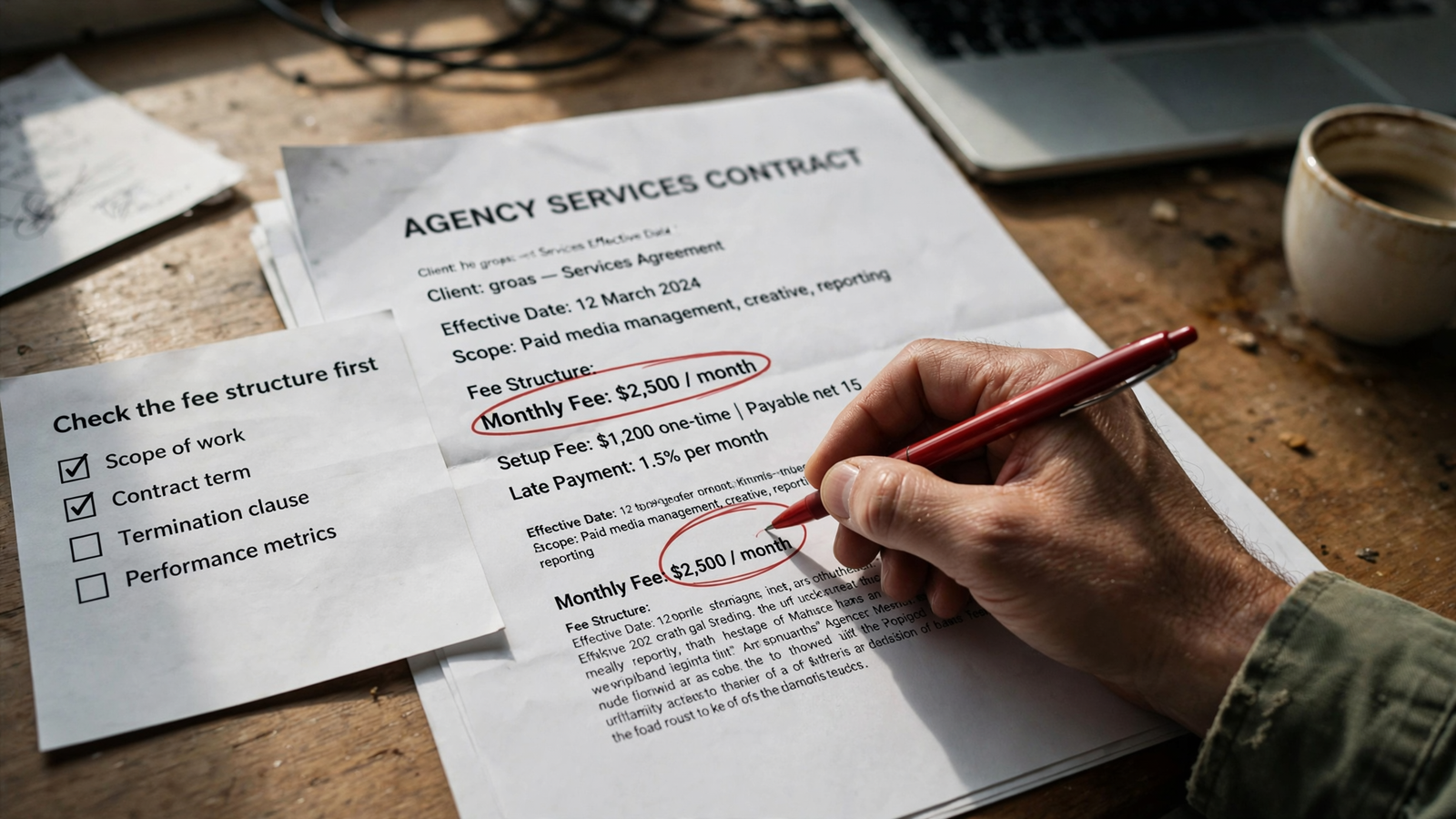
- Flat fee or percentage of spend, including the fee at your next spend level. Ask for the formula, minimum and any spend band that triggers an increase. Published small-business management rates run $500–$3,500 per month, and percentage pricing typically runs 10–20% of spend plus a minimum. At $20k in monthly spend, 12% is $2,400; at $100k, it is $12,000. That does not mean the work grows fivefold. Get both figures on paper. Bad answer: “It scales with you.”
- Confirm who pays Meta directly. Your card, billed by Meta inside your ad account, gives you a clean line between media spend and management fees. If the agency invoices you for media, ask whether it adds a markup and where that markup appears. Have them name every other party that bills you for the account. “We handle billing for simplicity” is not a number. Write down who charges your card and for what.
- Get a price for setup, creative and every add-on. Published setup fees run $500–$2,500; video may cost $500–$2,500 per ad, while static creative may be included. Ask separately about landing pages and tools. Put a price or a zero beside each deliverable, including revisions. “Creative included” tells you little until you know what they make, how often they make it and what happens when you need more.
- Put fee increases and fee-adjusted reporting in the contract. Who can raise the fee, what triggers the change, and how much notice do you get? Also ask whether reported ROAS accounts for fees. With $1,500 in ad spend, a $750 management fee and a 50% margin, break-even ROAS moves from 2.0x to 3.0x. In-platform ROAS alone misses that cost. Bad answer: “We review fees as spend grows.” Ask what that review can change.
Ownership: make sure the assets survive cancellation (checks 5–8)
- Create the ad account in your Business Manager, not the agency’s. The agency should work through partner access to your business portfolio with defined permissions. Ask who will have admin access, who can remove the partner, and what remains available to you on cancellation. An agency-owned account may be convenient during the pitch; it is less convenient when you need another operator. Bad answer: “We run everyone through our account for efficiency.”
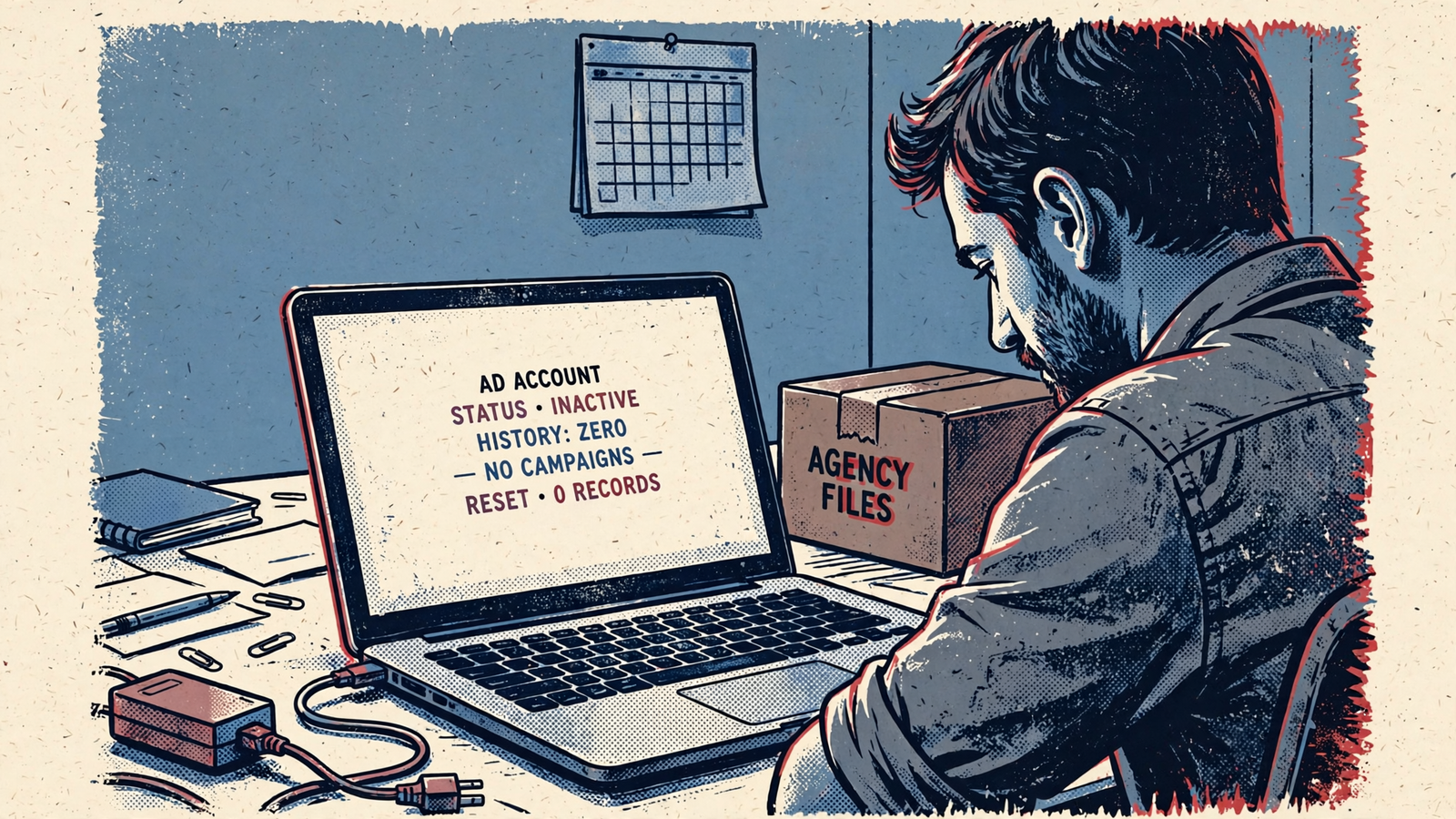
- Own the Pixel, Conversions API dataset and domain setup. Ask them to show which business portfolio owns the ad account, Page and pixel or dataset. The dataset should live in yours, the domain should be verified by you, and agency access should be removable on exit. Get the portfolio and dataset IDs in writing. Bad answer: “Our pixel is already warmed up, so we’ll use that.” You need a setup you can keep.
- Receive creative source files and raw footage, not just live ads. Specify project files, UGC raw cuts and other working files alongside exported MP4s, with delivery to your drive each month. Name who can use the files after cancellation. This is commonly skipped because an ad preview looks like the finished asset. It is not the file your next editor needs to make a new version. Bad answer: “The source stays with our editors.”
- Keep custom and lookalike audiences in your account. Ask where website, customer-list and engager audiences will be built, who controls the underlying seed lists, and what the agency will document for handover. Do not accept “proprietary method” as an explanation for losing access to audiences built with your account and spend. Get the audience inventory and handover obligation into the agreement, rather than waiting for a final report to tell you what existed.
The work: pin down what happens after launch (checks 9–13)
- Set a monthly creative count and name who makes it. Ask how many new concepts and variants you receive, who shoots, edits and writes them, and what delays production. One mid-size retainer benchmark is 8–16 new creatives a month, including variants, with at least four structured tests. Treat that as a question to ask, not a promise hidden inside “creative included.” I used to tell clients a new audience would fix tired ads. I was wrong. Fresh creative needs an owner and a schedule.
- Define a creative test before calling anything a winner. Ask how many hooks they will try per concept, how much spend each variant needs before a decision, and what rule kills a loser. At $5k a month, three concepts with three hooks each can exhaust a testing budget unless someone sets the allocation first. “We test constantly and scale winners” skips the useful part: what gets tested, against what, and when the agency decides. Have them show that decision rule.
- Require a conversion-tracking audit before launch. Ask for Pixel and Conversions API checks covering deduplication, domain verification and validated Test Events. Browser-only tracking can miss events because of blockers and iOS limits. Have the agency show you the dataset location and the test results before it starts spending against those events. If the dataset does not live in your portfolio, settle ownership first. Bad answer: “Tracking looks fine; we’ll fix it after launch.”
- Name the strategist and the time they will spend on your account. Ask who sets direction, who reviews performance, who can approve a change, and who covers an absence. Put strategy and review hours in the statement of work; one mid-market benchmark is 4–8 hours a week. A team can do the execution, but “you get our whole team” does not tell you who is accountable when CPA rises or a test stalls. Get a name.
- Write down what the agency cannot change without approval. Set the budget cap that requires a sign-off and identify who approves changes to landing pages, offers and promo codes. Say how approval is recorded and who can give it. This is not a request to slow every bid change; it is a boundary around business decisions. Put the guardrails in writing before a Friday budget increase becomes a Monday explanation. Bad answer: “We need full freedom to move fast.”
Reporting: ask for decisions, not a polished PDF (checks 14–16)
- Require a dated change log, not just dashboard access. It should record budget shifts, audience edits, creative launches and paused ads, with the reason for each change and the result once there is one. Ads Manager shows activity; it does not necessarily tell you why the agency acted. Ask for a sample entry and decide who maintains the log. Without it, a performance drop turns into competing memories of what changed. Bad answer: “It’s all in Ads Manager.”
- Agree on the success metric before the first report. CPL can hide lead quality; platform ROAS can hide management cost. For lead generation, ask for cost per qualified lead or booked call tied to your CRM. For ecommerce, ask for ROAS after fees alongside the platform figure. A store reporting 3.0x on $20k of media spend has a lower return once it includes a $2,400 management fee. Have the agency show the calculation, not just the dashboard label. Bad answer: “We optimize to CPL and platform ROAS.”
- Ask for a redacted weekly report before signing. It should show spend against target, CPM trend, cost per result, purchase ROAS or lead-to-revenue, CAPI health, deduplication checks, anomalies with an owner and action, and the top three creatives by spend. The monthly view should add tests, winners and the next 30-day test pipeline. Ask who writes it and which decision it prompted. A report that names no losers or next tests is a retention document.
Exit: agree on the handover while you still have leverage (checks 17–18)
- Put cancellation terms in days, not sales-call shorthand. Ask for the minimum term, notice period, cancellation method, treatment of prepaid months and any fee change tied to spend. Six- or 12-month minimums and add-ons still appear on reviewed rate cards. By contrast, groas lists Meta Ads at a $1,499 flat monthly fee, month to month, with no setup fee and cancellation anytime; the fee does not rise with ad spend, and your accounts, pages and data stay yours. That is a stronger incentive structure than paying more simply because you spent more.
- List every handover deliverable and its due date. Include continued access to the ad account and dataset, an audience inventory, creative source files, the change log and tracking documentation. Specify who removes partner access and who confirms the transfer is complete. Keep the Meta ad account handover checklist beside this one if you need the longer version. Bad answer: “We’ll send a final report and wrap up.” A PDF is not an ad account.
The three answers that end the call
- Show me how you calculate ROAS after fees on an account like mine. I want to see the fee in the calculation, not in a footnote.
- Show me how you validate Pixel and Conversions API before spend. I use the Meta tracking pre-flight as the bar; “we’ll check it later” fails.
- Show me the contract sentence saying I own the ad account, dataset and creative files. No sentence, no signature.
If you have ten minutes before a second call, email those questions with a request for the exact fee at your current spend, monthly creative count, weekly report sample and handover list. For a closer look at the ownership questions, read how to hire a Meta ads manager without losing your account or data. The agency that replies with numbers, IDs and contract language is worth considering for a trial. If you want the flat-fee alternative, groas lists Meta Ads at $1,499 per month, live in under 24 hours, with cancellation anytime. A case study alone answers none of the questions above.
The item most often skipped, and what it costs
Check 6: the Pixel and Conversions API dataset must live in your portfolio. It sounds technical, so buyers nod past it and spend the call debating creative. But it determines whether the tracking setup and audiences built around your spend remain yours when the agency leaves. If the dataset sits in the agency’s portfolio, a final PDF does not bring that history with you. The next operator has to rebuild the setup instead of working from what you already paid to establish. I have seen that rebuild eat two months of budget before CPA settles. Get the portfolio ID, dataset ID and ownership sentence into the contract before spend starts. Otherwise, you can end up paying to build the same foundation twice.