Autonomous Ad Budget Allocation: Cost and How It Works FAQ
Wasting ad budget and can't optimize fast enough? How real-time AI budget allocation works, what autonomous setup costs, and what to use at scale.
September 28, 2026
•
min read


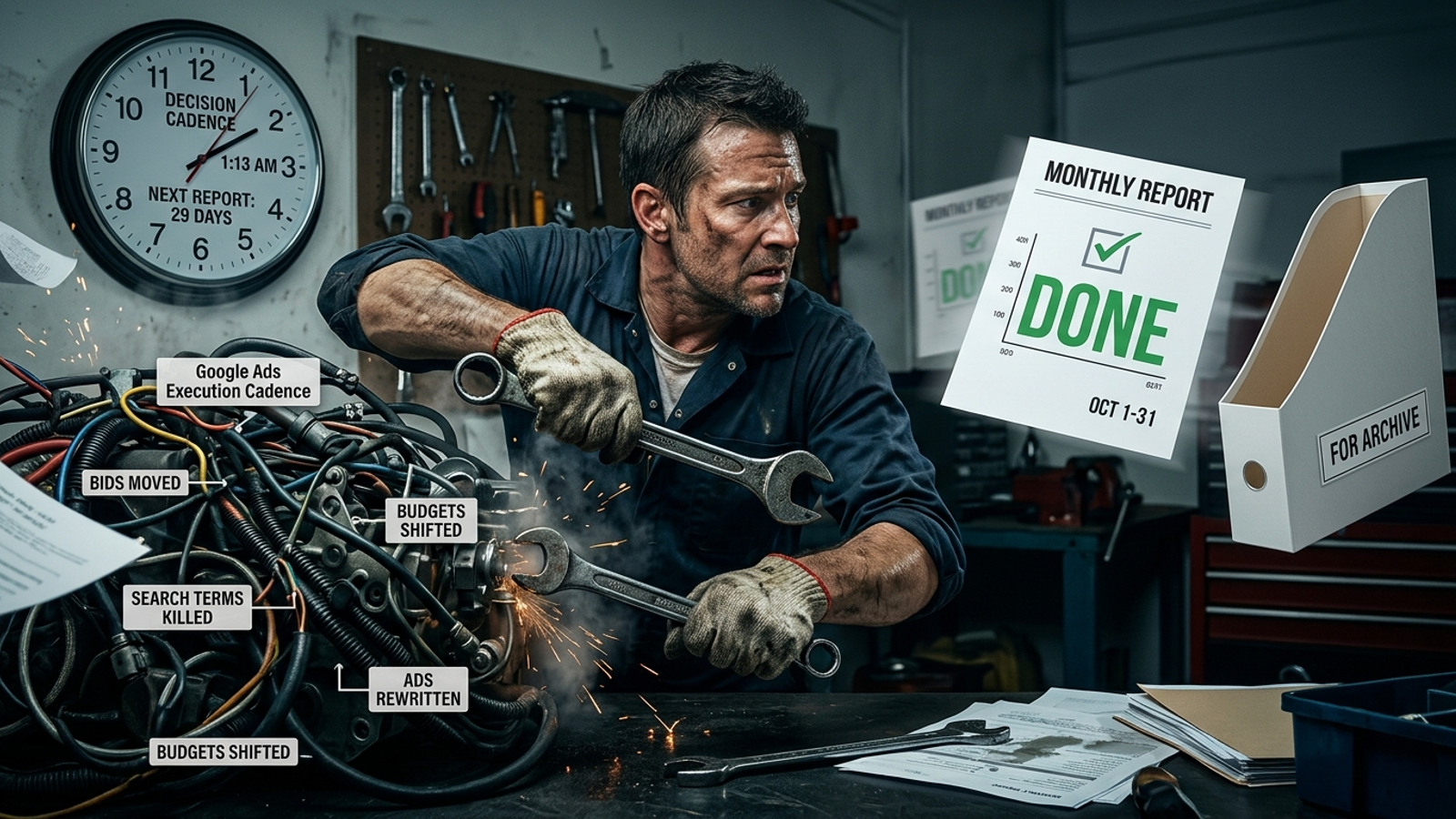
A monthly report is not proof that your Google Ads are handled. It is proof that someone can describe what happened after your money was spent.
The most hands-off setup might send you an ugly report: bids moved, search terms killed, budgets shifted, ads rewritten. No charts to admire. Just work done. I managed accounts by hand for years, mining search terms at 1am while a client burned spend on clicks that would never convert. A PDF at the end of the month never fixed that. What matters is what changed between reports.
One analysis of 251,236 Performance Grader reports found $1,127.54 in average monthly waste and 29% of accounts with zero conversions over 90 days. When a busy owner asks me for a tool that runs everything without an agency and only bothers them once a month, I understand the appeal. But the monthly report is the wrong thing to shop for. Ask what the system decided while you were not looking. If the answer is a summary, you still have the job.
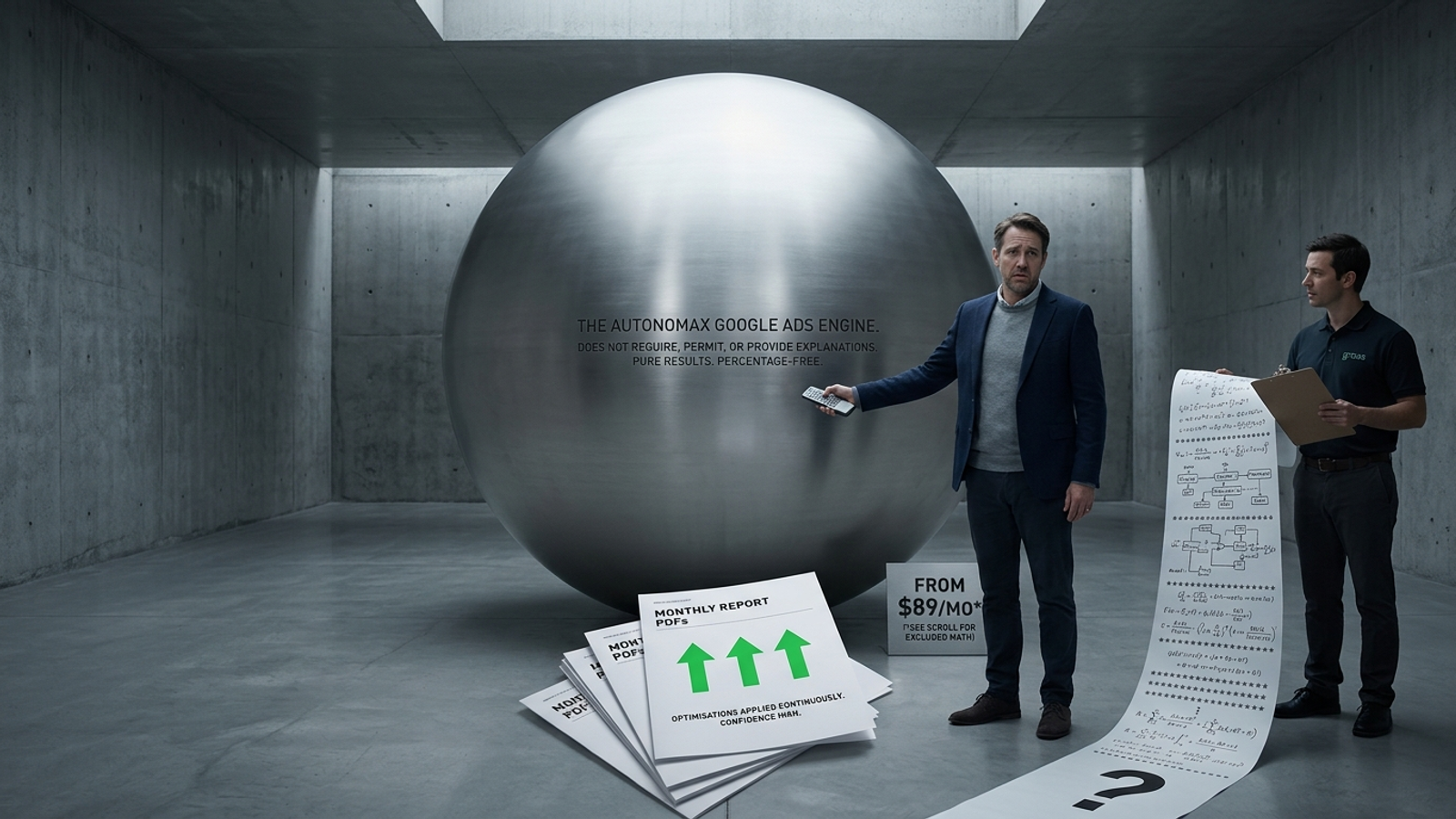
When owners say hands-off, they usually describe a specific picture: no agency retainer, no logins to check, a clean dashboard if they get curious, and a monthly report that says spend, clicks, calls, done. That is how busy owners described the wish in a discussion summarized by Atomic Design.
I get it. I used to send those reports myself. They made it easy for a client to see the month at a glance, and they made it easy for me to show I had been paying attention. Neither benefit answered the harder question: who decides anything in the 30 days between PDFs?
The practitioner answer in that same discussion was blunt. Look for evidence of active work: search-term pruning, bid and creative changes, new tests. Automated bidding running untouched with a report attached does not settle the matter. If no one prunes, moves budget, and tests copy while you are busy, you are not hands-off. You are just uninformed.
A category breakdown of Google Ads tools draws a useful distinction between tools that recommend changes and tools that execute automation you configure. The exact feature list varies by product. The labor question does not. With recommendations, you review and apply the work. With rules, you decide what the rules should do, keep them current, and deal with a bad call. Either way, someone still owns the operating decisions. Check whether that someone is you.
This is where a dashboard earns its keep as a sales demo and loses me as a hands-off solution. It can surface a search term that wastes spend. It can make the waste impossible to miss. But if you have to approve the negative keyword, decide which campaign loses budget, and write the replacement ad, the software has given you a tidier inbox. It has not taken the account off your desk.
I used to tell clients those tools would save them ten hours a month. I was wrong. They saved about two hours and moved the other eight into reviewing suggestions. That may be worthwhile if reviewing suggestions is your job. It is a bad bargain if you bought the tool because you do not have time to do that job.
Reporting keeps getting easier, too. New Dashboards can generate a visual report from a prompt and produce a summary of the trend. One Mediology guide puts the division of labor plainly: the dashboard does first-pass analysis so the strategist can focus on decisions. Fine, if you have a strategist making them. If the strategist is you, a prettier explanation of why CPA rose is still an explanation delivered after CPA rose.
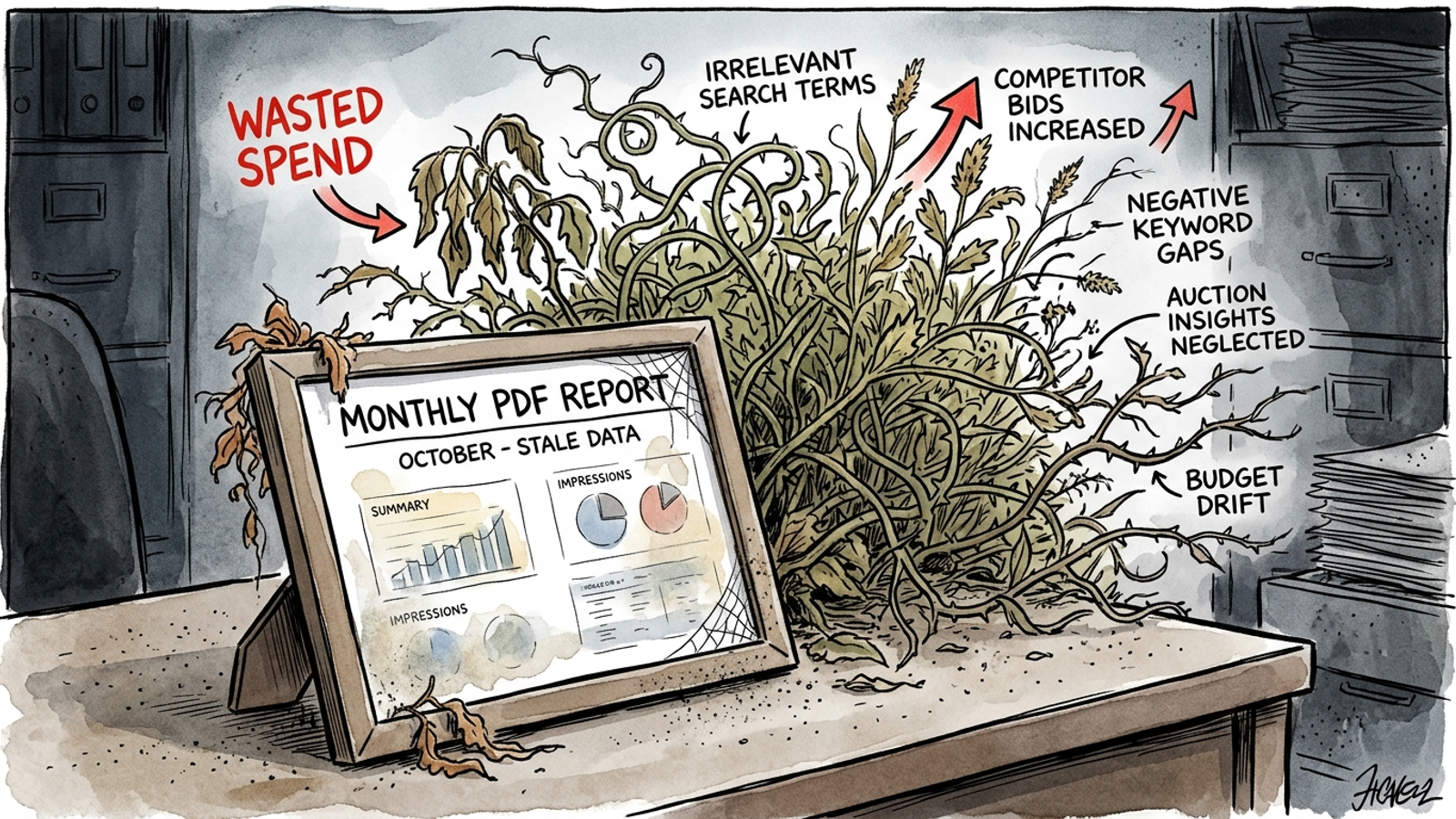
Google Ads does not run on a monthly cycle. Auctions clear every second. Competitors change bids on Tuesday. A bad search term eats $40 on Wednesday. Smart Bidding learns from what happened by Friday. If your management cycle is a monthly PDF, the account has been spending while you wait for someone to describe it.
That is the timing mismatch behind report-first management. The system gathers outcomes continuously, but the human response arrives on a calendar invite. A monthly review can tell you where the spend went. It cannot go back and stop Wednesday’s query from taking another bite on Thursday. Review cadence is what someone promises. Execution cadence is what the account records.
Start with a 30-second test: open Change History. It shows edits made in the account. It will not tell you whether every edit was smart, and it will not capture work done outside Google Ads, such as changing a landing page. But an empty history is a hard thing to reconcile with a claim of constant account optimization. One Claire Jarrett audit found $800 a month paid for zero changes in 90 days. I once inherited an account whose prior manager said he optimized weekly. History showed three bid changes in two months.
Do not mistake a crowded log for a good strategy, either. Moving bids back and forth to create activity is not management. The point is to connect actions to the problems they were meant to solve: an irrelevant query excluded, budget moved from a tired campaign, a weak ad replaced. A report can tell that story after the fact. The work has to happen first.
Say you spend $20k a month. Hands-off does not mean a PDF arrives on the 1st. It means the preceding 30 days contain decisions you did not have to queue up yourself: 200 negative keywords added, $3k moved from a tired search campaign into a winner, two ads that stopped converting paused, three replacements launched, and a landing page headline fixed because it mismatched the query. Those are illustrative actions, not a quota every account should hit. The question is whether the system can identify the need and act.
A Mediology breakdown describes a familiar analyst rhythm: search terms and pacing weekly, conversion and budget review monthly. I know that rhythm. I also know how quickly a weekly task becomes a next-week task when the same person has to pull the data, make the call, get approval, and do the edit. The issue is not whether a human can manage an account well. Good ones can. The issue is what happens when the person paying for hands-off management still has to push every decision through.
One advertiser described firing a $2,000-a-month agency after finding it looked at his account about seven hours a month. He said he beat its performance by month three by adding negatives weekly instead of monthly and saved $24,000 a year in fees, as he told it on Medium. The lesson is not that every owner should take over their own account. It is that the work had been waiting for somebody to do it. Weekly pruning stopped irrelevant queries from continuing to spend; CPA fell after the cadence changed.
That is the bar I would apply to a replacement for the agency model. groas describes execution across ad copy, budgets, and landing pages, rather than a pile of suggestions for the owner to process. Judge that pitch by its actions, not its polish. Ask what changed, when it changed, and why. Then look at the account and the pages. Count the decisions made without you, not the charts sent to you.
Do not start with the sample report. Ask a vendor to walk you through what it did in a real account last week. A tool that runs an account should be able to show actions, their timing, and the reason for them. For a broader setup bar, this runbook for Google Ads that manage themselves lays out what genuine autopilot has to cover.
My filter has three parts:
If the answer to all three is you, stop calling the setup hands-off. A weekly log should let you inspect the actions without making you the person who has to initiate them. Ask about landing pages separately, since Google Ads Change History will not prove that a page was updated. A demo that begins and ends with scheduled PDFs is telling you which part of the job the product expects to own.
This will not matter equally to every advertiser. If you spend $1,500 a month on five exact-match keywords for one service in one town, you do not need autonomous execution. You need a quarterly check and a clean report. Same if you are an in-house marketer whose actual job is to look busy in meetings. A gorgeous PDF is career armor, and I am not going to talk you out of armor.
But if you have real spend, search-term sprawl, and competitors changing bids while you sleep, a monthly summary is not management. It is a participation trophy. For the middle ground of recommendation-only tools, this comparison of Adzooma alternatives helps show where the work still lands. My objection is not that recommendations are useless. It is that a recommendation requiring you to act is not an autonomous action, no matter how neatly it appears on a dashboard.

An audit is where this distinction usually becomes painful. Someone pays for a 40-page teardown, gets 73 recommendations, and then nobody has permission to touch the account. Diagnosis without the right to act changes nothing; this piece on why audits fail without execution authority makes that case. I have written those audits. Clients nodded, paid, and implemented four items out of 73. The other 69 sat in a PDF next to last month’s performance PDF. No one owned the changes. The waste stayed put, better documented.
So my answer to the owner shopping for the best AI to run Google Ads without an agency is not “find the smartest summary.” Find a system with authority over the work: copy, bidding, budget, negatives, and landing pages, acting between your check-ins. Scaling without hiring follows the same logic. You do not scale by getting faster at reviewing suggestions. You scale by removing yourself from the suggestion loop. The system that decides and acts is hands-off. Everything else is homework with a logo on it.

A monthly report can be a confession: nothing in this account acted in time, so here is a summary of what you should have done sooner. I kept one from my agency days. Twelve pages, clean charts, CPA up 22% month over month with a paragraph explaining seasonality. What it did not contain was a single negative keyword added that month. That was the whole story. The client paid for documentation of drift.
Keep optimizing for the prettiest PDF and you will get exactly what you paid for: perfect visibility into waste that already happened. Auctions will keep clearing while you wait for the 1st. Competitors will test copy you never answered. Search terms will keep taxing you $40 at a time. Judge the setup another way. Ask what it changed last Tuesday while you were quoting jobs, closing deals, running the shop. If the answer is bids, budgets, negatives, ads, and pages, you have the hands-off setup you asked for. If the answer is a report, you have a report.
Before you buy anything, open Change History for the last 30 days and count meaningful account changes: negatives added, budgets moved, ads launched. Check landing-page changes separately. That is your baseline. Ask any vendor who wants your money to show how its weekly actions will beat it. If it offers a sample PDF instead, you have your answer. The account will keep spending while you read.