

 LinkedIn

At $5,000 a month in Meta spend, the tool route lists at $178 a month with tracking. Add four fresh creative hooks and four hours of your own work each week, and it costs roughly $1,828 to $3,528 a month, depending on what your time is worth. A flat-fee done-for-you service like groas lists at $1,499 a month, plus the time you spend giving direction. For a service business without a marketer, your hours can decide which route is cheaper.
We looked at who makes the ads in Madgicx vs Advantage+ vs Done-for-You Meta Ads: Who Makes the Next Ten Ads?. This is the second look: what does each option cost once the owner has to do the work the software leaves behind? A subscription can help lower cost per lead only if someone supplies creative, checks the recommendations, and acts on them.
I used to tell clients software paid for itself if it saved two hours a month. I was wrong to stop the calculation there. The subscription replaces some account work; it does not automatically replace the person making decisions, getting ads live, and checking whether the leads are worth calling. Price that work before you call the tool cheap.
The listed monthly costs: what the pricing pages show
Madgicx Pro Complete changes price with ad spend: $45 a month under $1,000 of spend, $99 from $1,000 to $2,500, $119 from $2,500 to $5,000, $129 from $5,000 to $10,000, $229 from $10,000 to $20,000, and $329 from $20,000 to $30,000. Tracking Pro adds $49 a month per ad account. Above $30,000 in spend, the price appears only in-app after signup. That is not helpful when you are trying to budget for growth.
| Listed cost | Monthly price | Source | Billing type | What the price leaves out |
|---|---|---|---|---|
| Madgicx at $5,000 in spend | $129 base + $49 Tracking Pro = $178 | Madgicx pricing breakdown | Recurring | Creative, your hours, tracking setup labor |
| Madgicx at $15,000 in spend | $229 base + $49 Tracking Pro = $278; optional AI ad generation adds $29 | Madgicx pricing breakdown | Recurring | Designer cost, approvals, rule checks |
| Percentage or flat-fee agency | 10–20% of spend or $1,500–$10,000 flat; one published example is $975 or 15%, whichever is greater | Agency fee survey | Recurring; setup fees at many shops | Creative and lead-quality reporting may cost extra |
| groas Meta Ads service | $1,499 flat, with no cut of spend or setup fee | groas pricing | Recurring | Your direction and approvals |
| Your Meta ad spend | $5,000 on either route in this example | Your ad account | Recurring | Keep it in your total budget, but out of this fee comparison |
Ad spend is not a saving you get by choosing one management model over another. At the same $5,000 budget, the comparison is what you pay around that spend to produce and manage ads that bring in qualified leads. The tool looks inexpensive because its listed price covers only part of that work.
Do not compare a software invoice with an all-in service fee. Compare the work each one leaves on your desk.
The recurring costs the tool invoice misses
A dashboard does not run the account. You do. DIY guides put the ongoing load at 5–10 hours a week, plus 15–20 hours for setup. In practice, that time goes into clearing the audit queue, checking whether a rule paused a good ad after one bad day, briefing creative, uploading variants, and reading the results. Skip a week and the account can keep spending on old creative while the subscription keeps billing.
Creative is the other recurring line. Marketplace pricing averages about $198 per UGC video; simple talking-head clips run $150–$300, premium cuts $300–$500, and studio commercials $8,000–$10,000. Four simple fresh hooks bought piecemeal cost roughly $600–$1,200 a month. At the $198 average, call it about $800. The tool may help you identify a loser faster. Someone still has to make and launch its replacement.
Then there is the cost that never arrives as an invoice: a recommendation waiting for approval, or a new angle waiting for the owner to find an hour to upload it. I would rather pay for an ad that gets tested than for a suggestion that sits in a queue. If you are the approval bottleneck, put your hours in the recurring-cost column.
The one-off setup bill: tracking is not free labor
Software pricing does not necessarily include the work of connecting and checking your tracking. Pixel plus Conversions API setup is listed at $50–$250 one time for freelancers, while enhanced tracking packages list at $350–$1,500. Those are setup choices, not charges to add together automatically. What you need depends on the tracking work already done and the setup you choose.
There may also be a recurring infrastructure cost if you use a separate server-side delivery setup: Conversions API Gateway hosting runs $10–$400 a month by volume, plus setup. Do not quietly add that range to the Madgicx example as though every buyer pays for both. Do ask what your proposed setup includes. Separate one-time implementation from monthly software and hosting before you compare a quote with a retainer.
The practical test is whether lead-quality feedback makes it back into the decisions you pay the account to make. A tracking subscription on its own cannot tell you that a cheap form fill came from someone outside your service area. Someone has to check the lead and use what they learn.
The service bill: fewer owner hours, but check the scope
Done-for-you does not mean you disappear. You still hand over access, agree on goals, and approve direction. groas describes one access handoff and a direction call: you share the ad account, GA4, and site access, then agree goals before the account goes live within 24 hours. That is less account work for the owner, not zero involvement.
Check ownership before you hand anything over. If an agency creates the ad account, pixel, and Page inside its own Business Portfolio, it owns them and the history does not transfer. The safer arrangement is plain: you own the Business Portfolio, Page, pixel, and ad account, then grant partner access you can revoke and check under Business Settings > Ad Accounts > Ownership. groas says your accounts, pages, and data stay yours. It lists no setup fee and month-to-month terms. If a provider will not put ownership and exit terms in writing, walk away.
The other trap is paying for the wrong result. Agency red flags include account ownership by the provider, long lock-ins with heavy exit fees, and reports built around reach and likes instead of leads and cost per qualified lead. Treat guaranteed ROAS or sales within fixed days with the same suspicion.
A $975 monthly retainer that reports 40 leads at $25 each looks tidy until sales finds 35 were renters, students, or outside your service area. Agree on what counts as a qualified lead before you sign. Otherwise, a falling number on a slide can hide a rising cost per actual customer.
Four owner hours a week change the comparison
Say you run a home services shop spending $5,000 a month on Meta, with no marketer on staff. Give the tool route a lean four hours of your time each week: one hour clearing recommendations, one checking rules and results, and two getting creative briefed and live. That is below the 5–10 hours a week in the DIY guides, so treat it as an optimistic working case, not a promise.
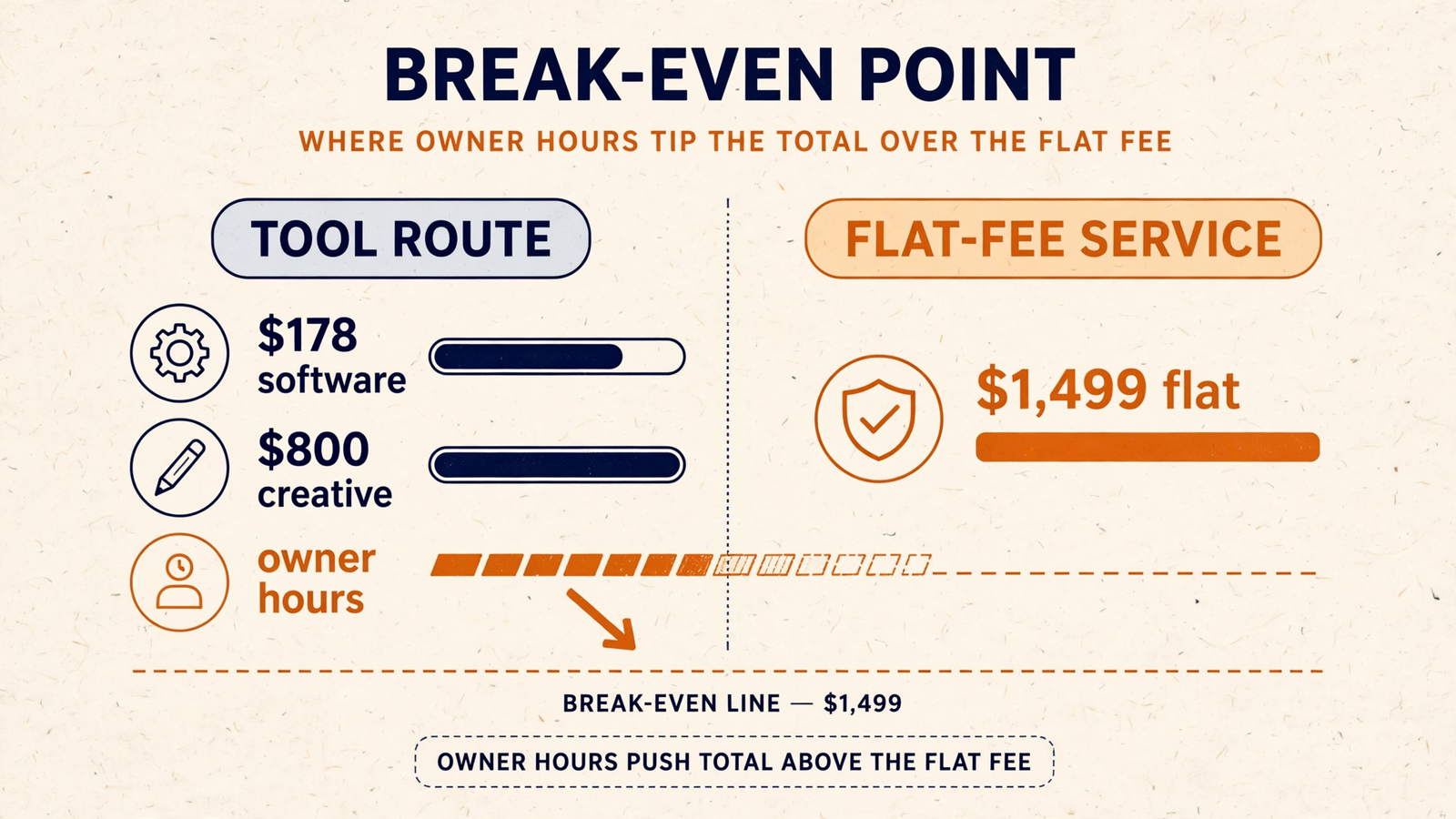
Buy four hooks at roughly the $198 marketplace average and creative costs about $800 a month. Add $178 for software with Tracking Pro. Four hours a week is roughly 17 hours a month. Your time makes the rest of the bill:
| Value of your hour | Approximate monthly owner-time cost | Software + creative + owner time |
|---|---|---|
| $50 | $850 | $1,828 |
| $100 | $1,700 | $2,678 |
| $150 | $2,550 | $3,528 |
The groas service costs $1,499 a month, plus your direction time. If that takes one hour a month, the comparison is about $1,549, $1,599, or $1,649 at those same hourly values. In this example, the service costs less at all three rates. It does not follow that it will produce a lower cost per qualified lead in every account; that depends on what gets shipped and what the leads turn out to be. It does mean the software fee alone is the wrong comparison.
There is also the 11 p.m. factor. An hour spent checking ads after a day of estimates, jobs, and callbacks is still an hour you cannot spend elsewhere. What the deck calls flexibility, I call a second shift as a media buyer. If you like that work and can make the time, keep the tool. If your calendar has no room for it, do not choose the option that makes you the media buyer.
Your break-even worksheet
Write down two totals. Tool cost = software + creative + your hours. Service cost = flat fee + your direction hours. Use the same ad spend for both, and keep one-off tracking setup separate. Then check cost per qualified lead to see whether either route earns its keep.
- Owner hours: How many hours can you give the account each week without dropping jobs? Include the short phone checks you tend to forget.
- Value of an hour: At $150,000 in owner income across 1,500 working hours, use $100 an hour. Use a different rate if your own numbers say so.
- Creative: Price the hooks you will need. Three or four simple UGC clips at $150–$300 each are a real production expense, even if the software subscription looks small.
- Software: At $5,000 in spend, the example is $178 with Tracking Pro. At $15,000, it is $278. Check the tier your spend actually falls into.
- Service: Compare with $1,499 a month for groas Meta Ads, plus the time you expect to spend on direction and approvals.
- Setup: Put any one-time tracking work on its own line. Do not disguise it as a monthly charge or pretend it does not exist.
For a quick monthly estimate, multiply weekly hours by about 4.3, then by your hourly value. At four hours a week and $100 an hour, rounding the month to 17 hours puts the tool example near $2,678. If your real workload is closer to the DIY guides’ 5–10 hours a week, rerun the calculation. An honest worksheet beats a flattering one.
If the math says hire, demand a complete price
Do not respond to an expensive tool route by buying the lowest retainer. Buy a scope you can check. groas lists Meta Ads at $1,499 a month, with audiences, budgets, and ads worked around the clock, new ads tested and winners scaled, no cut of spend, and no setup fee. It says your accounts, pages, and data stay yours, with month-to-month terms and a 7-day money-back guarantee. That is a clearer offer than a low fee that leaves creative and account work back with you.
Before signing any provider, get these answers in writing:
- Fee model: Is the price flat or a percentage? What spend does it cover, and what triggers a higher tier? A percentage shop gets paid more when you spend more. Read that incentive twice.
- Creative cadence: How many new hooks will ship, who makes them, who approves them, and what happens if you stall? “As needed” is not a schedule.
- Lead reporting: Will you see cost per qualified lead and close rate rather than reach and likes? How will sales feedback get passed back through the pixel and Conversions API?
- Ownership and exit: Do you own the Business Portfolio, ad account, Page, and pixel? Can you revoke access? What happens when you leave?
- Trial billing: What charges, when, and how do you cancel? Trustpilot reviewers report charges of $300–$849 after a 7-day Madgicx trial, with refunds refused a day late. Get the terms in an email before entering a card.
Keep the tool if you have the hours, can keep creative moving, and the full calculation beats the service fee. Hire when doing the work yourself costs more or leaves ads waiting in a queue. Then judge the decision by qualified leads, not by which invoice looked smaller.
The cheapest mistake is overpaying for a subscription. The most expensive one is treating your evenings as free while stale ads keep spending your budget.