

 LinkedIn

At $50,000 a month in client spend, a 10% white-label fulfillment fee costs you $5,000. A $500 flat fee costs you $500. That $4,500 difference comes out of your resale margin on the client you worked hardest to grow. One published margin model lays out that comparison line by line.
I used to shop for fulfillment partners by checking whether the monthly fee fit inside my retainer. I was wrong. The fee on day one matters less than how that fee behaves when spend grows. A percentage-of-spend partner gets more expensive every time the client raises the budget. A flat per-account partner does not. If you sell growth, that distinction belongs in your pricing model before you sign a client.
The assumptions behind the margin table
This is illustrative arithmetic, not a partner quote or an observed agency result. Keep the fee formulas and swap in your own retainers, minimums and hours before making a decision.
Published pricing guides describe management fees of 10% to 20% of monthly spend. Another guide puts white-label wholesale at 10% to 15%, often with a $300 to $500 floor, or $500 to $2,000 flat per account. Those ranges explain why I’m comparing the two fee shapes. They do not establish what a particular partner will charge you.
For the table, I use $299 flat per account against an illustrative 12% of client spend with a $300 floor. The percentage formula is a modelling choice, not a published offer; a separate published pricing example shows how a percentage fee and minimum can appear together. The client fees are illustrative retainers, from $1,000 at $2,000 in spend to $5,000 at $50,000. A worked margin example gives another point of comparison for agency retainers. Neither source tells you what your clients will accept.
The table shows the retainer left after fulfillment only. It does not include your reporting time, client calls, other delivery work or any minimum account commitment. Those come next.
What you keep at five client-spend levels
Hold each client retainer at the amount shown and change only the fulfillment formula. The figures below are calculated from the illustrative inputs above; they are not sourced performance data.
| Monthly client spend | You charge client | After $299 flat fulfillment | After 12% fulfillment, $300 floor |
|---|---|---|---|
| $2,000 | $1,000 | $701 (70%) | $700 (70%) |
| $5,000 | $1,500 | $1,201 (80%) | $900 (60%) |
| $10,000 | $1,800 | $1,501 (83%) | $600 (33%) |
| $25,000 | $3,000 | $2,701 (90%) | $0 (0%) |
| $50,000 | $5,000 | $4,701 (94%) | -$1,000 (-20%) |
At $2,000, the options are nearly identical. At $10,000, percentage-based fulfillment costs $1,200 against $299 flat. At $25,000, it consumes the entire modelled retainer. At $50,000, you pay more for fulfillment than you collect from the client. The flat-fee column improves because the model raises the client retainer while holding fulfillment at $299. That is the mechanism, not a promise that every account will earn a 94% margin.
A separate worked comparison uses $500 flat versus 10% of spend. In that example, the fees match at $5,000 in spend, and $500 represents 2.5% at $20,000. The rates differ from my table, but the pressure on a resale margin is the same: the percentage invoice rises with budget even if your retainer does not rise enough to cover it.
The $300 floor changes where the fees separate
Divide $299 by 12% and you get a spend level just under $2,500. Without a minimum, that would be the point where the two formulas match. With the $300 floor, they never quite match: percentage-based fulfillment starts $1 higher than the $299 flat fee, then rises above the floor once spend passes $2,500. The gap widens from there.
That does not mean spend is a perfect measure of work. Flat fees make costs predictable but do not automatically account for more complex accounts; percentage fees fluctuate with client budgets. This white-label comparison describes the tradeoff, and this fee-structure breakdown puts it beside other ways to charge. For a reseller, the immediate question is narrower: when the budget changes, whose invoice moves first?
The client doubles spend. Who gets the upside?
Take the $5,000-spend row. You charge $1,500. Flat fulfillment leaves $1,201; 12% fulfillment leaves $900. Then spend doubles to $10,000 and you raise the retainer to $1,800. Under the flat model, fulfillment still costs $299 and you keep $1,501. Under the percentage model, fulfillment rises to $1,200 and you keep $600.
Your retainer rose. Your amount left after fulfillment fell by a third. More budget may bring more search terms, budget decisions and reporting, but this model does not assume your workload doubles with spend. The partner’s fee doubles anyway. That is the part I missed when I looked only at the starting monthly price.
A five-account minimum can erase the cheap starting fee
A per-account price tells you what one filled seat costs. A minimum tells you what you owe for the empty ones. A pricing guide describes monthly wholesale minimums of $1,000 to $3,000; one published price list also changes its plan pricing at five accounts. Those are market examples, not evidence that every flat-fee partner imposes a five-account minimum.
Here is the commitment to test if a proposed agreement does require five accounts at $299 each:
| Three-client agency scenario | Monthly amount |
|---|---|
| Three $1,000 client retainers | $3,000 revenue |
| Fulfillment for three active accounts only | $897 |
| Fulfillment under a five-account minimum | $1,495 |
| Left after the five-account commitment | $1,505 |
Those amounts come from the hypothetical commitment and retainers, not a vendor quote. You are paying for two empty seats. The $1,505 left is roughly a 50% gross hold before your own hours or other costs. A worked white-label margin example discusses a 30% to 50% gross band, but landing in that band on paper does not make the agreement comfortable to carry.
Fill the two empty slots with two more $1,000-retainer clients and the same illustrative commitment supports $5,000 in revenue. That is why the five-account math changes so sharply when the seats fill. If you have three clients today, though, price the commitment for three clients today. Do not build your margin on the two you hope to sign.
Add the hours and work missing from the partner invoice
The invoice is not the whole delivery cost. Agency-side reporting, escalation calls and build checks still take time. Landing pages, tracking fixes and feed work can sit outside the agreed scope; this white-label comparison flags that risk. I would put those lines beside the fulfillment fee, not bury them under “account management.”
For a modest time allowance, model one hour per monthly report and one hour per quarter for tracking fixes. At $60 an hour, that averages $80 a month in owner time: $60 for the report plus $20 a month for the quarterly hour. That is one hour and twenty minutes a month on average, not two hours a month. It still excludes the unexpected call.
| Illustrative account | Left after fulfillment | After $80 owner time |
|---|---|---|
| $1,000 retainer, $299 flat fulfillment | $701 | $621 |
| $1,800 retainer, 12% fulfillment on $10,000 spend | $600 | $520 |
Both final figures are deductions from the earlier table, not benchmark margins. Change the hours and rate to match your work. A partner that handles more of the delivery may justify a higher invoice; a cheaper partner that hands you every exception may not.
Read the inclusions list before making that call. One wholesale menu lists landing pages, heatmaps, split tests, call tracking and click-fraud protection as included against a $595 setup and $495-a-month Smart Niche line. That is an example of a stated package, not a reason to assume another partner bundles the same work. Check the usual Google Ads pricing red flags, then get build scope, reporting ownership and escalation calls in writing. Your resale cost is the invoice plus the work that remains yours.

Why a small legal budget can still consume your week
Spend does not tell you how many leads an account will produce, or how much explanation each result will require. In a benchmark covering more than 16,000 campaigns from April 2024 to March 2025, average search CPC was $5.26; attorneys averaged $8.58, while dentists and home improvement each averaged $7.85. A 2026 benchmark reported across 13,474 US search campaigns gives overall CPC as $5.42 and cost per lead as $66.69. It reports attorneys at $9.87 CPC and $131.63 CPL, home services at $8.33 and $90.92, and dentists at $8.00 and $72.97.
Those are different benchmark sets, not a trend line. Dividing the latter CPL figures into an illustrative $2,000 budget gives roughly 15 legal leads versus 27 dental leads. That division is a planning illustration, not a forecast for either client.
The point for a reseller is practical. With a small batch of leads, a missed call, an intake problem or a thin landing page can dominate the monthly conversation. You may spend your hours checking tracking and explaining why a lawyer’s $2,000 budget produced fewer leads than a dentist’s. Percentage-based fulfillment does not remove that work: 12% of $2,000 sits below the modelled $300 floor, so you still pay the floor. Price the account for the attention it needs, not just the budget it carries.
Put the spend trigger in your retainer before growth arrives
I would stop selling one retainer that absorbs every fulfillment swing. My starting shape is a $1,000 to $1,500 retainer below $5,000 in spend, $1,800 to $2,500 up to $10,000, and a renegotiation trigger at $15,000 that steps the retainer up $500 for each additional $10,000 in spend. These are proposed prices to test against your own scope, not market rates the tables prove. A white-label pricing discussion describes a 1.5x to 3x wholesale-to-retail markup; your hours and client terms still determine what you keep.
Put the trigger in the proposal while you are agreeing on scope, not after the budget has doubled. One workable sentence is: Fulfillment is billed per account on a flat fee, and the retainer steps up when monthly spend stays above the next agreed tier for two straight months. It explains a price change without pretending that more spend always means more leads. It also gives both sides a defined point to revisit the work.
For the fulfillment side, I prefer a flat invoice because a client budget increase does not automatically increase the partner fee. groas lists a flat fee regardless of spend, no setup fee and month-to-month terms. That is the fee shape I want to compare against any percentage proposal; it does not excuse me from checking scope, my own hours or a proposed commitment.
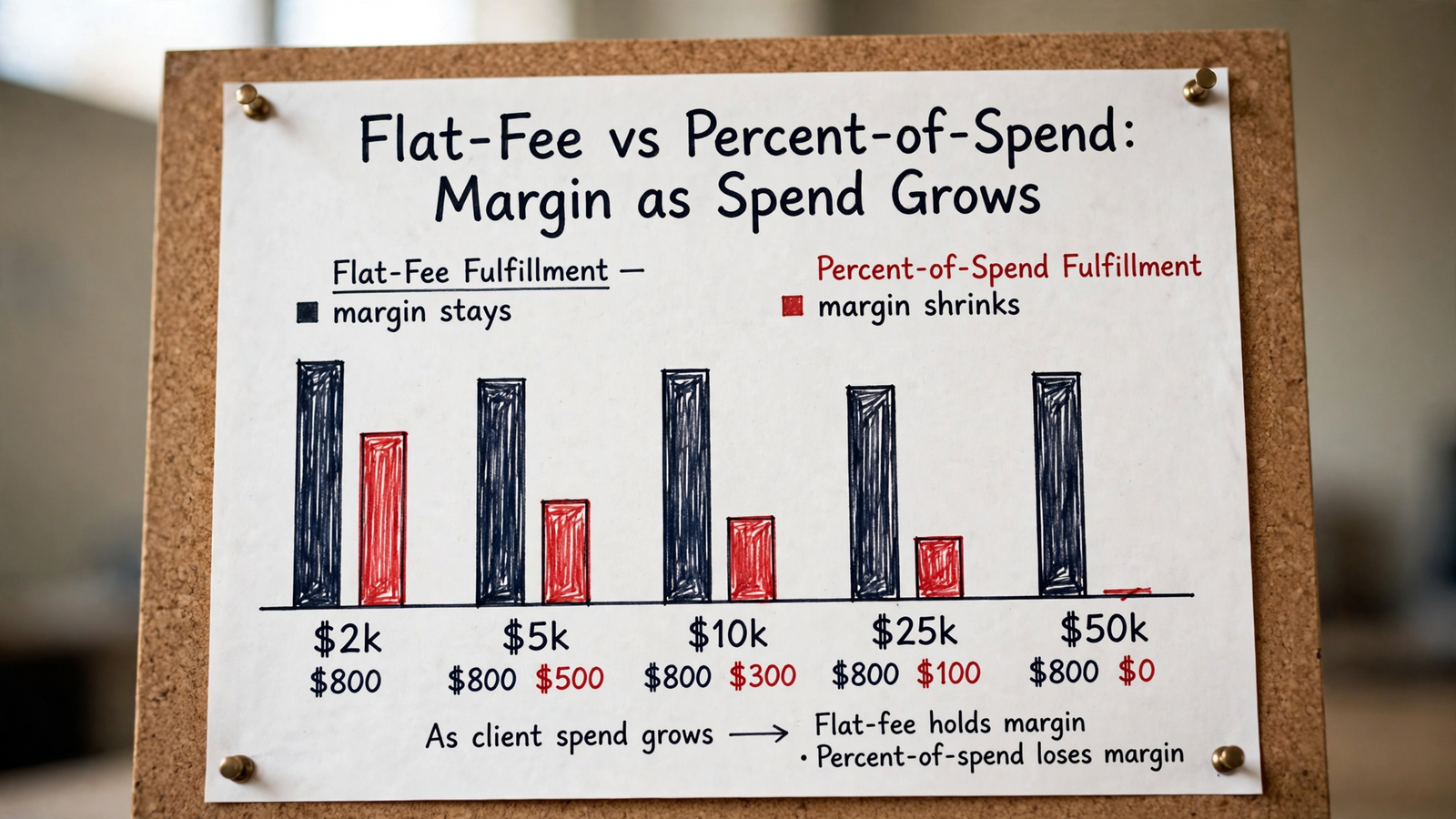
I keep a second version of the table with owner time priced in. At $10,000 in client spend, the model leaves $1,501 after $299 flat fulfillment. Subtract three hours of reporting and calls at $60 and it leaves $1,321, about 73% of the $1,800 retainer. The same retainer under 12% fulfillment leaves $600 before those hours and $420 after them. Those are modelled amounts, but the decision they support is real enough: compare the fee at the spend your clients can grow into, include the minimum, then subtract your time. If the $25,000 row leaves you nothing, do not sign on the strength of the $2,000 row.