

 LinkedIn
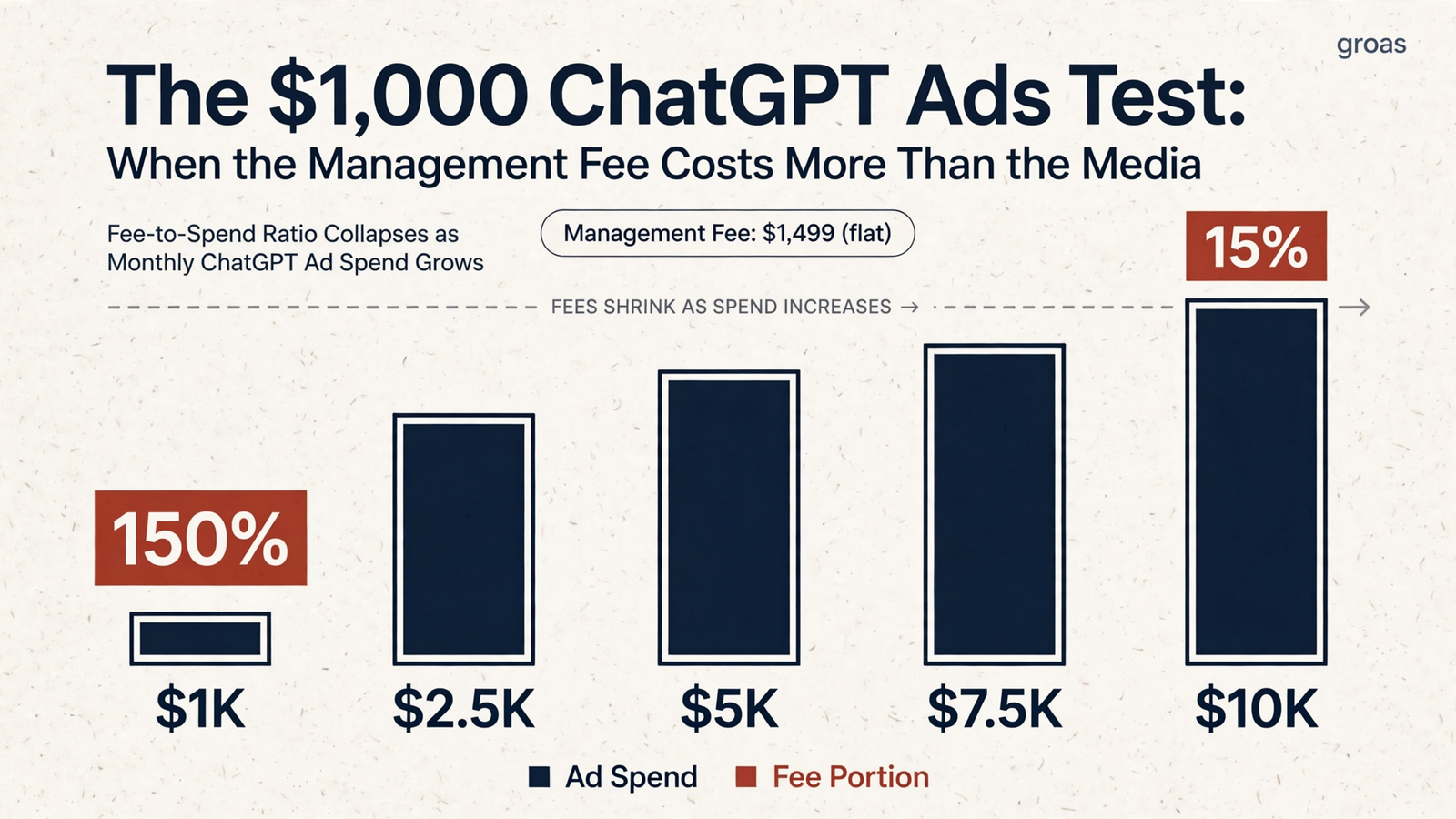
At $1,000 a month in ChatGPT ad spend, our Search Ads fee of $1,499 a month is about 150% of the media budget. That is not a subtle overhead. You would spend $2,499 in total on a test that may produce too few conversions to judge.
Here is the mechanism. ChatGPT ads have no public rate card, but a published guide reports a $25 daily campaign floor in the US and recommended starting bids of $3 to $5 per click. At an illustrative $4 per click, $1,000 buys about 250 clicks. If 2% convert, that is five conversions. Five tells you that someone bought or enquired. It does not tell you whether the channel works.
The fee-to-spend ratio at five budget levels
The fee in this table comes from groas’s pricing page. The percentage-fee columns are comparisons, not quoted offers: I calculated them at 15% and 20% of media spend. The final column divides the flat fee by media plus management, which is the portion of your total test investment going to management.
| Monthly ChatGPT spend | $1,499 flat fee as % of spend | 15% of spend fee | 20% of spend fee | Flat fee as share of total cost |
|---|---|---|---|---|
| $1,000 | 149.9% | $150 | $200 | 60.0% |
| $2,500 | 60.0% | $375 | $500 | 37.5% |
| $5,000 | 30.0% | $750 | $1,000 | 23.1% |
| $7,500 | 20.0% | $1,125 | $1,500 | 16.7% |
| $10,000 | 15.0% | $1,500 | $2,000 | 13.0% |
The first row is the one I would put in front of any small advertiser before discussing management quality. At $1,000 in media, the fee takes 60% of the total outlay. That does not prove the campaign cannot pay back; it means the campaign has a much higher hurdle to clear while producing a small sample.
A practitioner’s example makes the same cost problem visible from another angle: $3,000 in ad spend plus a $2,500 flat fee puts about 45% of the total investment into management. Percentage fees look kinder at the bottom. A 15% fee on $1,000 is $150, not $1,499. But that fee grows automatically with spend, whether or not the work grows with it. Flat fees punish undersized tests; percentage fees tax scale. Neither pricing model creates conversions that the media budget cannot buy.
How many conversions make the result readable?
Ten conversions can move around a lot. If you record 10 demo requests at a fixed spend, then record 12 at the same spend next month, the reported CPA falls by about 17%. You might have improved the campaign. You might also have watched a small sample wobble.
Published Google Ads experiment guidance discusses 50 to 100 goal completions for a more reliable comparison. Guidance for Target CPA and Target ROAS bidding gives a 15-conversion minimum in the preceding 30 days, with 30 or more recommended for Target CPA stability. Those are Google Ads yardsticks, not proof that a ChatGPT campaign becomes statistically significant on conversion number 50. They do show how little a five-conversion month gives you to work with.
For this planning exercise, I use 30 to 50 conversions as the point where a small test starts to speak. That is a directional reading threshold, not a guarantee of significance or profitability. An agency-side budget rule similarly plans roughly 10 times expected cost per lead each month for three months to get near 30 conversions. Its original context is Google Ads. The useful part here is the arithmetic: expected CPA determines how much you must spend to collect a sample. The platform’s minimum daily budget does not.
What five media budgets could buy in 30 days
The click estimate below uses an illustrative $4 CPC, inside the $3 to $5 starting-bid range. Each conversion column is monthly spend divided by an assumed CPA. The $80, $150 and $400 CPAs are scenarios, not ChatGPT benchmarks or forecasts. In particular, $80 CPA at $4 CPC assumes 5% of clicks convert; the opening’s five-conversion example assumes 2%, or $200 CPA. I am keeping those cases separate because changing the conversion rate changes the decision.
| Monthly spend | Clicks at $4 CPC | Conversions at $80 CPA | Conversions at $150 CPA | Conversions at $400 CPA |
|---|---|---|---|---|
| $1,000 | 250 | 12.5 | 6.7 | 2.5 |
| $2,500 | 625 | 31.3 | 16.7 | 6.3 |
| $5,000 | 1,250 | 62.5 | 33.3 | 12.5 |
| $7,500 | 1,875 | 93.8 | 50.0 | 18.8 |
| $10,000 | 2,500 | 125.0 | 66.7 | 25.0 |
Fractional conversions are expected values, not events you can count in an account. At $1,000, even the favourable $80 CPA scenario yields only about 12 or 13 conversions. At $400 CPA, you are planning around two or three. Neither reaches my 30-conversion threshold.
The minimum viable run is smaller still. Two weeks at the $25 daily floor costs about $350 and could buy roughly 70 to 115 clicks at $3 to $5 CPC. At a 1% to 2% click-to-conversion rate, that points to roughly one or two conversions. The same guide describes about 1,000 clicks, or $3,000 to $5,000, as a route to 10 conversions at 1%. I would call 10 the start of the conversation, not the answer.
This table also shows why a single budget threshold cannot fit every business. At $5,000, the $80 CPA scenario has a substantial sample; the $400 CPA scenario still has only about 12 or 13 conversions. Budget without expected CPA is not a test plan.
Where paying for management starts to make sense
At $2,500 a month, the scenarios split. If you can acquire a transaction at $80, the budget yields about 31 conversions. A careful DIY test may give you a directional read, provided $80 is an acceptable CPA for your business. If your lead costs $150, the same budget yields about 17. At $400 per demo, it yields about six. I would not pay anyone, us included, to manage those last two samples as though they could settle the channel question.
At $5,000, the $150 lead scenario reaches about 33 conversions, while the $80 scenario reaches about 63. That is where a managed test has enough observations to make its work easier to judge. The groas flat fee is then 23.1% of the combined $6,499 media-and-management cost. It is still real overhead. It is no longer larger than the media budget.
A $400 demo is a different decision. At that CPA, you would need $12,000 in media to plan for 30 conversions. Calling $5,000 a universal hiring threshold would hide the most important line in the table.
Before signing, read the flat-versus-percentage comparison. A 15% fee is cheaper than $1,499 at $5,000 in media. Its weakness is the incentive as spend rises: the manager earns more when you spend more, not necessarily when you earn more. My practical threshold is narrower: consider managed testing when the budget can plausibly buy 30 conversions and the fee fits the total test cost. Otherwise, run it yourself or wait.
Measure one buying question, not the whole funnel
A small ChatGPT test should answer one question: do these prompts produce buyers or qualified leads at a CPA you can tolerate? Not three questions. Not a full-funnel readout assembled from a handful of clicks.
That makes the first week plumbing, not a performance verdict. Before launch, set up the OpenAI Pixel and Conversions API with a shared event ID, and keep the attribution parameter intact. The same implementation guidance says spend reporting can lag 7 to 8 hours and conversions 24 to 48 hours. Compare week four with your organic baseline for buyer prompts, while grading paid performance against the CPA you set before launch. Anyone declaring victory or failure after 72 hours is partly grading the reporting delay.
Fix tracking, then the page, then the bids
Order matters because each layer can corrupt the next. If tracking double-counts or misses conversions, bid decisions use the wrong target. If the landing page answers a different question from the prompt that brought the visitor in, changing the bid does not repair the page.
Start with a clean primary conversion. Then match one landing page to one high-intent prompt cluster. Only then judge bids and consider more budget. For context on the management line item, see what agencies charge across budget levels and models. No scale until conversions deduplicate; no second prompt cluster until the first page has had a fair read.
Who should wait, and who should start
Wait if your monthly budget is under $2,500 and your expected CPA is above $100: the arithmetic gives you fewer than 25 expected conversions. Wait if form fills and phone calls double-count, or if you have no post-click baseline. Wait if your landing page was written for a Google Search query and you cannot make it answer the chat prompt you intend to target. A report saying we need more data does not improve because you paid someone to produce it.
- Under $2,500 for leads or demos: run one campaign yourself at the $25 daily floor, or sit out until you can fund a more readable sample. Six expected conversions do not justify a management fee.
- Tracking unproven: fix Pixel and Conversions API deduplication, plus your GA4 import, before spending to test performance. Broken counting can make a bad answer look precise.
- At $5,000 or more, with a matched page and a plausible $150 CPA or lower: a managed test has a reasonable shot at a directional read. Cap the first four weeks and grade CPA, not click volume. If your expected CPA is $400, the same $5,000 is not enough.
What to change on Monday
- Set the budget from expected conversions. Pick an honest CPA and multiply it by 30. A $150 CPA calls for $4,500 in media; a $400 demo calls for $12,000. Those are planning calculations, not promised results. The $25 daily floor tells you the minimum you can spend, not the cost of learning.
- Run one campaign for four weeks. Use one prompt cluster, one matched landing page and one primary conversion event. Review week four against the organic baseline, allowing for the spend and conversion reporting lags.
- Fix counting before raising spend. Use Pixel and Conversions API with a shared event ID and intact attribution parameter. Check that the primary conversion deduplicates before treating CPA as a decision metric.
- Gate the next move. In week two, check delivery and tracking stability. In week four, check whether CPA is within tolerance and whether you have at least 30 conversions. If either fails, do not declare a winner and scale it.
- Price management against the whole test. At $5,000 in media, the groas $1,499 flat fee is 23.1% of the $6,499 total. Below a readable budget for your CPA, do it yourself. Above it, decide whether paying for management improves the test enough to earn that overhead.
The decision is narrower than most agency pages admit. At $1,000 a month, a $1,499 fee is about 150% of media spend, while a $4 click and 2% conversion rate produce only five expected conversions. At $2,500, an $80 CPA could yield a directional DIY read; a $150 lead or $400 demo probably will not. At $5,000, the $150 lead scenario starts to become readable, but the $400 demo still needs more budget.
So I would not hire anyone simply because the platform lets me launch. I would fund the sample my CPA requires, fix tracking first, and hire only when management has a result it can meaningfully work with. Below that point, waiting is not a failure to move fast. It is declining to pay a fee for noise.