

 LinkedIn

A homeowner has water spreading across the kitchen floor. She asks ChatGPT where the shutoff valve might be, whether the leak can wait until morning, and what an emergency plumber might cost. That conversation, not a keyword, is the starting point for an ad.
I spent years building Google Ads keyword structures by hand, so I understand the first question advertisers ask about ChatGPT ads: where does the keyword list go? It does not go anywhere. A Google search ad responds to a typed query. A ChatGPT ad uses the conversation to infer what the person needs, then competes for a labeled card below the answer.
That difference changes the work. Match types and search-term mining matter less. The clarity of the offer and the page the click lands on matter more. I will build the mechanism one layer at a time, using the homeowner and an emergency plumber throughout. By the end, we can use it to decide who should test this channel and who should keep the budget.
Start with the familiar contract: a Google keyword
Say the homeowner types emergency plumber near me into Google. My old job started there. I picked the keyword, set a bid, wrote the ad, and sent the click to a page promising 24/7 service with a phone number above the fold. If the keyword matched the query, Google considered the ad for an auction. If it showed and the homeowner clicked, we paid for the click.
That auction has more going on than a bid. Google checks eligibility, then ranks eligible ads using Ad Rank, which it calculates twice per auction. Its inputs include the bid, ad and landing-page quality, minimum thresholds, auction competitiveness, search context such as location and device, and the expected effect of assets. Higher quality can earn the same position at a lower click price. Two plumbers bidding $12 need not pay the same CPC.
Still, the keyword gives the advertiser a clear contract. It says which intent I meant to reach, which queries might trigger the ad, and which search terms I will inspect later. I lived in that report. The system was manageable because the homeowner expressed her need in a few typed words. In ChatGPT, she may never type those words together.
Replace the query with the whole conversation
Our homeowner writes three messages about the leak, one about the valve and one about cost. ChatGPT can use that broader context to generate queries and embeddings that nominate candidate ads. There is no advertiser-supplied keyword list to match against. Instead, an advertiser supplies one- or two-sentence, plain-language hints describing the buyer moment at ad-group level. For the plumber: homeowner with a burst pipe needs help tonight. The hints guide semantic matching; they do not guarantee an impression.
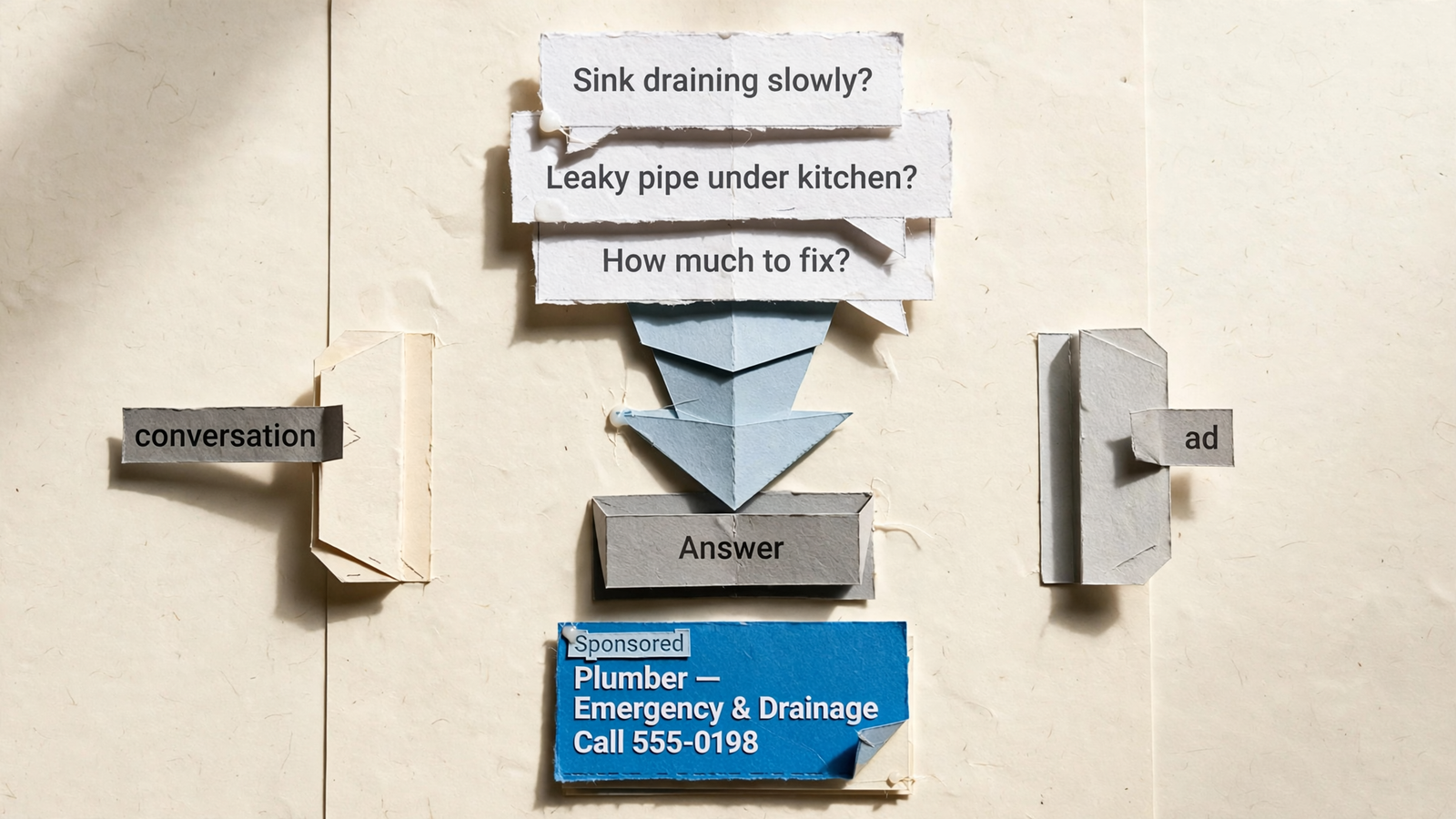
This is where the skill I sold for years stops being the steering wheel. On Google, match types, negatives and search-term reports helped me shape traffic. Here I cannot defend an exact match or mine the homeowner’s messages afterward. I used to tell clients that tight keyword structure wins. I was wrong for this channel. The useful question is whether the buyer moment is unmistakable in the hint and on the landing page.
A page about emergency pipe repair with a 60-minute response and upfront pricing gives the system and the homeowner something specific to work with. A page about full-service plumbing solutions gives them less. That is not a reason to stuff the page with variations of “burst pipe.” It is a reason to say plainly what the plumber will do and what happens when someone calls.
The answer comes first; the ad must earn a second decision
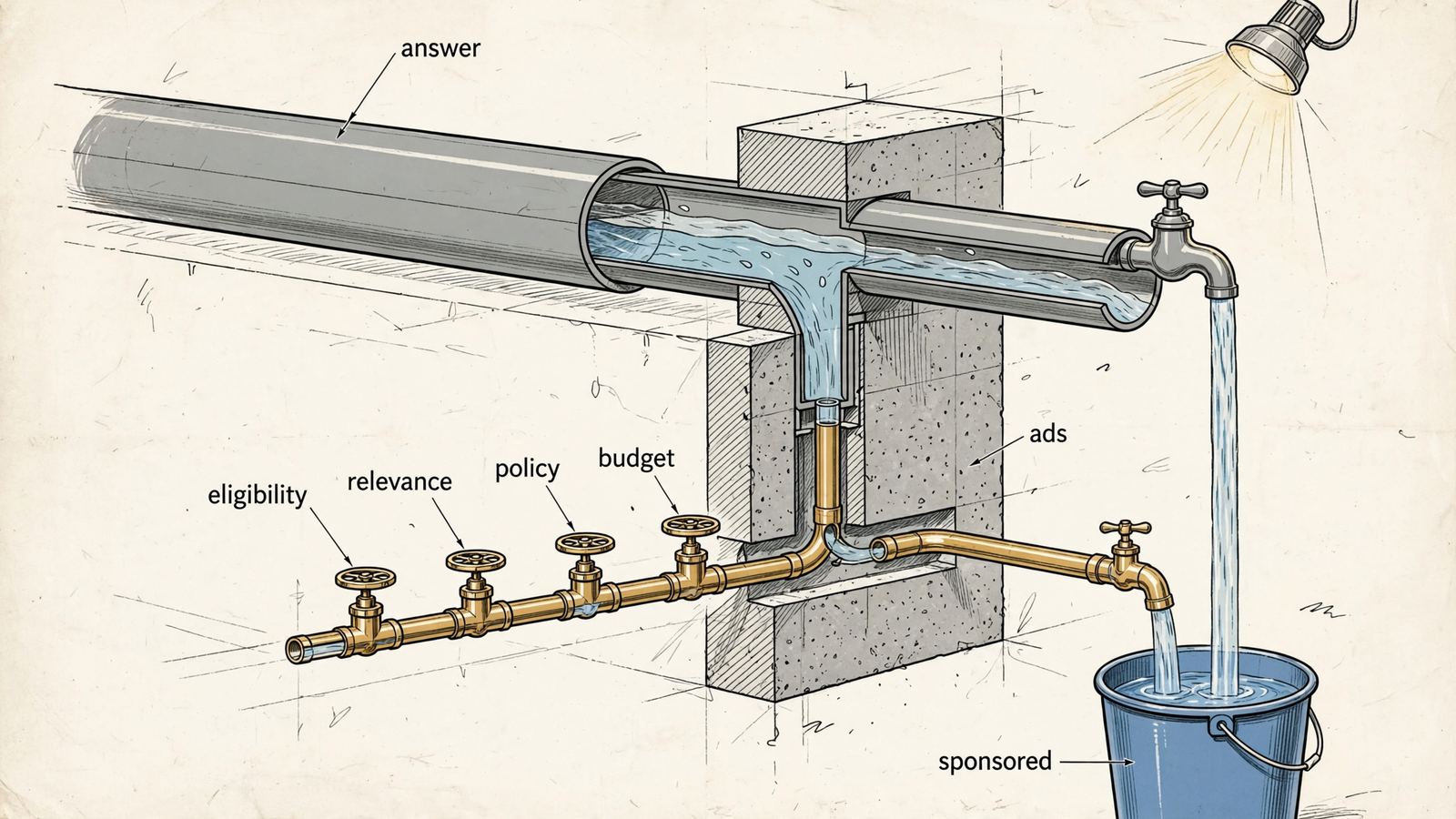
The plumber’s ad does not become part of ChatGPT’s instructions for finding the shutoff valve. It appears as a labeled sponsored card below the response, visually separated from it. The card can carry the advertiser’s name, logo or favicon, headline, short description, image and landing page. OpenAI says ads do not change the answer and that ad selection runs separately from the response.
That placement matters. On Google, the ad and an organic result both meet the person at the typed query. In ChatGPT, the homeowner has already received an answer before she sees the card. The ad has to earn a second decision: does this particular plumber solve tonight’s problem?
“24/7 burst pipe repair. 60-minute response. Tap to call” gives her a reason to act. “Trusted plumbing solutions for every home” asks her to do more interpretation while standing in a wet kitchen. Write the card like a van door, not a brand manifesto: name the job, the response and the next step.
Follow one ad from context to click
There are four connected parts to this mechanism. Each one depends on the one before it, and the landing page matters at both ends.
1. Context nominates possible advertisers
Delivery can consider the conversation’s intent alongside the advertiser’s hint, landing-page title and copy, coarse location and platform, custom audiences, and past chats if the user has left personalization on. The advertiser does not receive the chats, only aggregate reporting.
For the plumber, the useful signals are the leak, the urgency, the location and the page that says emergency pipe repair is available tonight. The system can connect those signals without the homeowner typing emergency plumber near me. But a vague page gives matching less to hold onto. If the hint promises a tonight response and the page lists six general services, the advertiser has made its own case harder to recognize.
2. Eligible candidates enter an auction
The system uses an approximate-neighbor index to nominate candidates, then checks eligibility, relevance, policy and budget before the auction. This is where the Google comparison helps: in both systems, an ad must be eligible before its bid can matter. The comparison breaks at the input. Google starts from a typed search and keyword matching; this system starts from conversational context and semantic matching.
The filtered auction is described as relevance-weighted and second-price. A more relevant ad can beat a higher bid, and the winner pays enough to beat the next competitor. Listed objectives include CPM for views, CPC for clicks and oCPC billed per click but aimed at a post-click conversion. Early guidance puts a maximum CPC around $3 to $5 and the US minimum at $25 per day, paced as a seven-day average. Those are test parameters, not a reason to assume cheap jobs will follow cheap clicks.
Eligibility also limits the audience. Ads do not appear to under-18s or paid Plus, Pro and Business users, and they are excluded near health, mental-health and political topics. For our plumber, the practical point is simpler: a bid cannot rescue an ineligible ad or make a generic offer relevant to a specific emergency.
3. A small card makes a specific promise
The unit has little room: advertiser name, logo, short title, one line of copy, an image and one landing page URL. Our plumber’s title can say “Burst pipe repair in 60 minutes”; the copy can promise an upfront price before work starts; the image can show a van or a technician at work. The exact wording matters less than its consistency with the page.
Short and literal wins this moment. The homeowner is not browsing a catalogue of plumbing brands. She is deciding whom to call. Every word that merely says the company is “committed to excellence” uses space that could tell her whether someone can come tonight.
4. The page must keep the promise
The landing-page title and copy help inform matching, and the click lands on that same page. If the hint says burst pipe tonight but the page opens with “Welcome to our plumbing family” and hides a contact form three scrolls down, the advertiser loses twice: the page is a weaker targeting signal before the click and a weaker closer afterward.
I learned the value of a specific page on Google, where a better match between ad and page could cut CPA by a quarter. Here that discipline matters even more because there is no keyword structure to lean on. Give one buyer moment a page that repeats the promise and makes the next action obvious. For a kitchen-floor emergency, that means the burst-pipe page and the call button, not the general services homepage.
Use the mechanism to predict who should test
Once targeting starts with a conversation and the ad sits below an answer, the better candidates become easier to spot. They have a distinct job to do, a page that clearly offers to do it, and a conversion they can count. Burst pipe repair tonight fits. So might a travel page for a four-day Lisbon itinerary under $1,200. “Plumbing solutions” and a travel homepage make the person work harder to find the relevant offer.
Early tests cluster around researched purchases such as travel, ecommerce and home services, where a call, form or purchase can be tracked. That makes a focused test more sensible than moving an entire search budget. Pick a buyer moment, pair the hint with its page, and decide in advance which action counts.
The businesses I would tell to wait have a different problem. Their value is hard to state, one page tries to serve six buyer types, or they cannot distinguish a good lead from a five-second visit. Inventory is narrow too: ads appear in Free and Go tier chats, not across every ChatGPT account. Early reports include cheap clicks with short visits and low-quality leads in some accounts. One reported early test saw around 0.5% CTR as CPMs fell from roughly $25 to $10. Without a counted conversion, it is easy to buy curiosity and call it demand.
Measure the job, not just the click
The available measurement combines a browser Pixel and server-side Conversions API, with reporting for impressions, clicks, spend, CTR, average CPC or CPM, and conversions. Clicks can carry UTMs to the landing page. The stated default attribution window is seven-day click and one-day view. OpenAI also lists attribution connections including AppsFlyer, Triple Whale, Adjust, Northbeam and Singular, along with data bridges and lift-testing options.
For the plumber, those tools have one purpose: connect an ad click to a call, form or booked job. Set up Pixel and API before spending, and check that the source survives the trip to the conversion. Otherwise an oCPC test learns from an incomplete account of what happened after the click.
There is a limit that no dashboard fixes. The advertiser cannot read the conversation that triggered an ad. I can see aggregate results and whether the burst-pipe hint brought booked work; I cannot open the chat and mine the precise phrase that did it. Judge the test on counted jobs and revenue inside the chosen window, not CTR alone. If the test continues, keep a holdout or geo test in mind for the second month. A click is evidence of interest. A job is evidence that the offer, page and follow-up worked together.
What the weekly work looks like without keywords
Removing keyword builds does not remove account management. It changes the jobs. At the start, I would keep four checks in a tight loop:
- Rewrite the buyer-moment hint when aggregate results suggest it is drawing the wrong traffic. Keep it to the problem the customer is trying to solve.
- Fix the page behind that hint. It is both a matching signal and the place that has to turn interest into a call, form or purchase.
- Verify the conversion feed. Check Pixel, Conversions API, UTMs and call tracking before treating a cost-per-click number as a verdict.
- Adjust bids, budgets and hints from outcomes. Cut combinations that produce five-second visits without counted work.
That can mean daily attention early on, not a set-and-forget launch. Most agencies will not tell you this because the work looks too small for the big deck and too repetitive to make a good percentage-of-spend pitch. I did the manual version for years. The small edits moved CPA; the decks did not. Anyone offering to run ChatGPT ads without owning the landing page and conversion feed is offering half the job.
groas runs Search Ads across Google, Bing and ChatGPT for one flat fee, with bids and budgets worked around the clock and a landing page for every ad group. That is the coverage I want here. A shop still billing 2015 hours for keyword lists is solving a different problem.
Before spending a dollar, make three decisions
- Choose one buyer moment and its page. “Burst pipe tonight” goes to a burst-pipe page with the response promise and a call button, not a general services page.
- Decide what counts. Set up Pixel and Conversions API, preserve UTMs, track calls and forms to source, and use a seven-day click window you trust.
- Set a small budget and a kill rule. At $25 per day to start, the test is buying information about matching and page conversion. Stop funding a hint-and-page pair that cannot produce a tracked call, form or purchase.
Now apply the model to a different business. A garage door company in Phoenix considers a test next month. The conversation may never say garage door repair. It may be four messages about a door stuck half open at 9 p.m. with a car trapped inside. A hint describing that night-time problem, a page promising 60-minute night service in Phoenix and a price before the company rolls, and a tap-to-call button give the system a clear candidate and the homeowner a clear next step. Count booked jobs from those calls, not visits.
Send the same hint to a homepage with six services and a quote form, and the test tells you much less. The bid did not change. The conversation did not change. The offer and the page did. That is where I would put the work before I put more money into the auction.