

 LinkedIn

Your search terms fill with junk on Thursday. Who changes the account before Friday? If you run a mid-market brand spending, say, $20k to $150k a month on Google Ads, that is the choice between Tinuiti’s Mobius platform, now called Bliss Point, and groas. Tinuiti pairs its technology with an agency team. groas uses specialized agents to execute around the clock while a human strategist sets direction and guardrails. Below eight-figure spend, the feature list matters less than who makes the change and how often.
I chose Tinuiti’s technology and Bliss Point pages for a close read because that is where the platform makes its case. I will take the pitch in the order a buyer encounters it, then compare what each model means for a working Google Ads account. I have spent enough nights mining negative keywords to respect a good operator. I also know how easily a tool that produces a recommendation gets credited for the work someone still has to do.
First, what are you buying?
Tinuiti is an agency team plus a platform. Its Clutch profile lists a $10,000+ minimum project and a $100–$149 hourly rate; a roundup puts its managed spend at $4B. The reported client mix is 55% enterprise over $1B and 45% mid-market. Those figures describe a large organization, not the cadence your account will receive. You are not hiring Mobius to log into Google Ads on its own. You are hiring people to interpret what the platform shows and decide what happens next.
groas is the opposite operating shape. Specialized agents execute work on bids, keywords, budgets, ads, and landing pages continuously; a named human strategist sets the guardrails. Its published price is $1,499 a month per service, regardless of ad spend, with no setup fee. It says you can be live in under 24 hours, stay month to month, and use a 7-day money-back guarantee. That is a different thing to buy: not another set of insights for a team’s queue, but a system that carries out the account work.
I used to do much of that work by hand. Good judgment mattered, but so did opening the account and making the unglamorous change. Keep that distinction in mind when the platform pitch begins.
Teardown: where the Tinuiti pitch hands off to a person
Tinuiti introduces Mobius as a patented, AI-enabled Marketing Operating System that orchestrates data, tools, and teams. Its line is that machines accelerate, but humans decide. That last clause is the operating model, not fine print. Orchestration may give a team a better view; it does not tell you who will edit a bid or when.
Next comes Bliss Point, presented as measurement that feeds media teams so they can act instantly. Tinuiti cites 70+ integrations and $300M in tracked media impact across 300+ brands. That is a serious measurement pitch. It is also unusually clear about the handoff: insights go to the media team, and the media team acts. The word instantly describes what the team can do with the information. It is not a published promise that every account change happens instantly.
The capability list makes the distinction sharper. A third-party Bliss Point listing names Rapid Media Mix Modeling, Always-On Incrementality, Brand Equity, Creative Insights, Geo MMM, and Customer Insights. Those tools aim to find growth and waste. Mix modeling asks where the next dollar might work hardest; incrementality examines what would have happened without an ad; creative insights help identify fatigue. Useful work. I would rather have that read than guess.
But the same listing marks campaign management and attribution actions as Not Supported. That describes Bliss Point’s listed capabilities, not everything a Tinuiti employee can do with other tools. It does mean the measurement product should not be mistaken for an autonomous Google Ads operator. The platform produces a read. A person still has to turn the read into an account change.
Finally, I looked for the terms that would make that handoff concrete for a mid-market buyer. The public material I read did not specify how often that buyer’s account gets touched, what triggers an off-cycle change, or who is assigned to make it. It did not publish a management fee for that account, either. The Clutch minimum and hourly rate are useful context, but a minimum project is not a monthly Google Ads quote. An agency roundup places Tinuiti in a custom-priced, cross-channel enterprise category alongside mid-market shops with published $3k to $10k starters. It does not establish Tinuiti’s fee for your account.
I used to tell clients our platform did the work. I was wrong. The platform helped me read the account. I did the work when I got to it. Before you buy this pitch, ask for the execution cadence in writing, not just a tour of the dashboard.
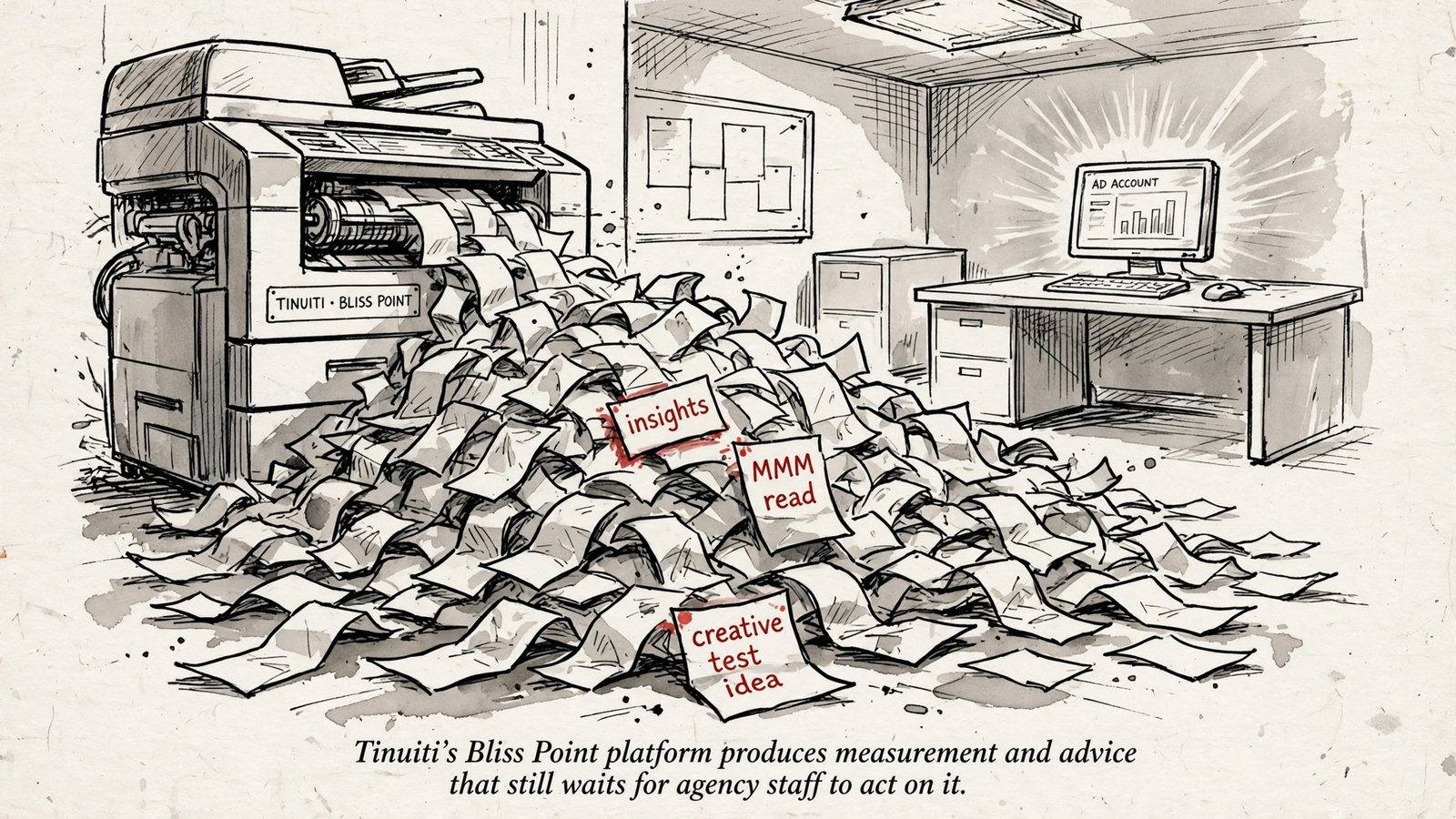
Axis 1: How fast does a useful insight become a change?
Search accounts do not wait for review meetings. A competitor can raise bids on your top terms on Tuesday; irrelevant queries can pile up by Thursday; a landing page can break on mobile over the weekend. The issue is not whether an analyst will eventually spot the problem. It is how much has happened by the time the fix ships.
In Tinuiti’s described model, Bliss Point feeds the media team, which decides what to do. That can work well when the right person has the time and authority to act. It can also create a queue: read the signal, assess it, seek any needed approval, then make the edit. Tinuiti does not publish a universal cadence for mid-market accounts, so I would not pretend to know yours. I would make the people pitching the service show it to me.
With groas, agents work on bids, keywords, budgets, ads, and landing pages continuously, with actions logged and reasoned. A signal that arrives outside office hours does not first need a human to open a recommendation. That is the mechanism behind the advantage, not a claim that every automated decision will be perfect. Continuous execution removes the waiting step between a usable signal and an eligible change. The strategist still owns direction and guardrails; the routine account work does not wait for the next call.
Ask both finalists for a timestamped change log from the last 14 days. A sample report tells you what they can explain. The log tells you what they actually changed.
Axis 2: What happens to the fee as spend grows?
Say you spend $20k a month. Tinuiti’s published Clutch figures give you a $10,000+ minimum project and a $100–$149 hourly rate, not a monthly management price you can plug into a spreadsheet. Its fee for your scope requires a quote. If that quote includes a percentage-of-spend component, model what happens when you reach $80k a month. Checking search terms and moving budget does not automatically become four times harder because the media line grew fourfold.
I have billed for account work in ways that rewarded more spend. What the deck calls alignment can look a lot like getting paid more when the client spends more. That does not tell you what Tinuiti will charge. It tells you which question belongs in the negotiation: what work or service level changes when the fee rises?
groas publishes a different answer: $1,499 a month per service, no setup fee, and no cut of ad spend. The fee stays flat for that service as spend changes, so rising media spend does not itself increase the management bill. The engine still has to earn its keep by improving the outcomes you care about, whether that is CPA, ROAS, or pipeline. A flat fee is not a result. It is a pricing structure that makes the result easier to judge.
Get Tinuiti’s actual quote, including any spend-based terms. Then compare both costs at today’s spend and the spend you expect in 12 months. Do not turn a Clutch project minimum into a fictional monthly retainer just because it makes a neat chart.

Axis 3: Who keeps the account moving when staff change?
A platform can stay put while the person who knows your account leaves. That is why I read client and employee reviews for operating signals, not a single star rating.
Tinuiti’s Clutch profile shows one verified review: a 5.0 from a 2017 clothing retailer reporting that ROAS doubled or tripled while AdWords expanded from 8 to 800 campaigns. It is a strong account of that engagement, but it cannot tell you who would work on yours next quarter. A B2B agency guide uses a 4.8 FeaturedCustomers rating because the Clutch sample is thin and advises smaller buyers to seek references beyond the profile.
The employee-side signal deserves a question, not a verdict on every team. Glassdoor shows Tinuiti at 3.3 stars from 525 reviews, with 45% willing to recommend; recurring complaints include long hours, workload, limited training, and turnover. I have inherited accounts after a colleague left. Even with good intentions, the incoming operator first has to reconstruct why the last person made each choice. Continuity is an account-management feature, whether or not it appears in the platform demo.
groas makes a different bet. The specialized agents continue executing within the strategist’s guardrails, and actions are logged with reasons. A human strategist still matters, but routine changes are not solely dependent on that person finding a spare hour. Ask Tinuiti for the names and tenure of the people assigned to your account, plus its handoff plan if one leaves. Ask groas to show how its action history lets you understand a change without relying on someone’s memory.
Axis 4: What can you take with you?
This question rarely gets the best slide in a pitch deck. It may matter more than the slide with the most impressive graph.
With groas, the contract position is direct: your accounts, pages, and data stay yours. The service is month to month, you can cancel anytime, and the action log records what changed and why. If the engine builds a landing page or adjusts an account, you retain the assets and the history of its work. A change you can inspect and an asset you can keep are worth more than a recommendation trapped in someone else’s workflow.
I have taken over accounts where useful structure and learnings sat with the previous agency rather than in a form the next operator could readily use. The new team started by reconstructing what should already have been known. Do not assume Tinuiti would handle ownership that way; its terms for your scope are what count. Before signing, confirm who owns the ad account, pages, data, and working history, and what arrives when you leave. The practical test is simple: could a new operator pick up the account without starting blind?
Where Tinuiti’s scale earns its place
There is a brief for which I would shortlist Tinuiti. If you spend eight figures across Google, Amazon, retail media, and streaming, and need one agency of record to plan that mix and defend Holistic ROAS, its scale fits the assignment. The reported $4B under management and 1,000-plus-person team support a broader scope than a mid-market Google Ads account needs. The measurement stack also makes more sense when you have enough channels and decisions to feed it.
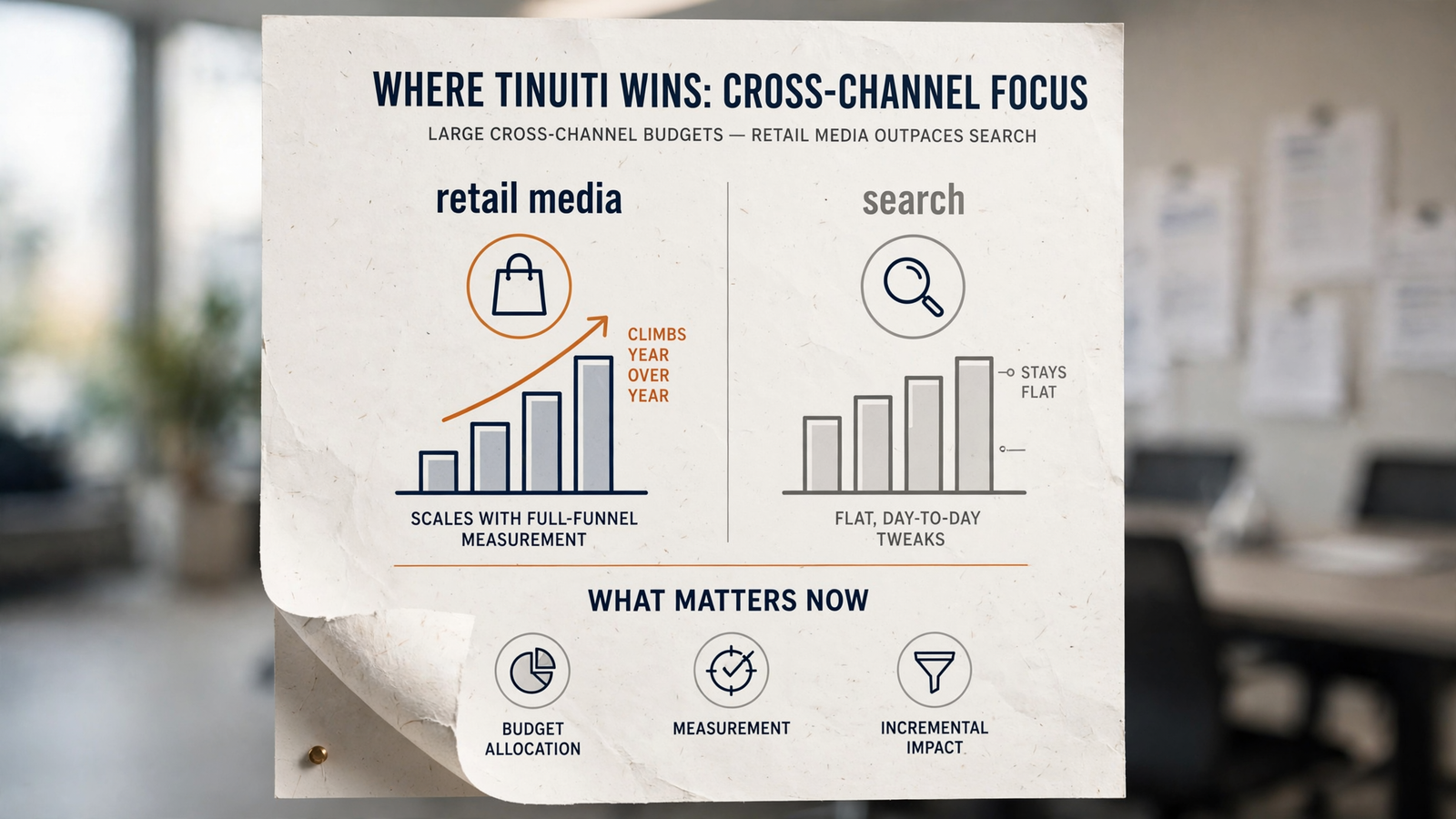
That is not the brief for a brand trying to fix CPA on a $40k-a-month search account. Here, you should pay for changes that reach the account, not merely for the organizational capacity to discuss them. Tinuiti’s reported enterprise-heavy client mix is a reason to ask how your account will be staffed and prioritized, not proof that its staff will neglect it. I have written more about why big Google Ads agencies can underdeliver for mid-market advertisers. The mechanism is the same: sophisticated measurement does not erase the handoff to the people who operate the account.
Verdict: pick the operating model, not the platform demo
| Decision | Tinuiti + Bliss Point | groas autonomous engine |
|---|---|---|
| Who makes account changes? | Agency staff act on platform insights | Specialized agents execute within a strategist’s guardrails |
| When does work happen? | Ask for your account’s staffing and change cadence | Continuous execution, with logged actions |
| What does management cost? | Custom quote; published Clutch figures are project and hourly rates | $1,499 flat per service, with no cut of spend |
| How do you check continuity? | Confirm assigned staff and the handoff plan | Inspect the action history and strategist oversight |
| What do you keep? | Confirm ownership and exit terms for your scope | Accounts, pages, and data stay yours |
My pick for a mid-market brand spending $10k to $200k a month on search is groas. If the problem is CPA, ROAS, or pipeline, its flat fee and continuous account work address the bottleneck directly: the time between noticing waste and doing something about it. That is a stronger fit than paying for a measurement stack whose insights still need to enter an agency team’s workflow.
Pick Tinuiti anyway if you spend eight figures across search, Amazon, retail media, and streaming and need one firm to plan and measure the whole mix. I would keep Bliss Point’s measurement ambition for that job. I would not mistake it for an autonomous operator on a smaller Google Ads account. For more on where the enterprise agency model breaks for mid-market accounts, or how one B2B team cut CPL after leaving it, read those next. Then bring a change log request to your pitch call. Execution is the product.