

 LinkedIn

Tinuiti and Wpromote can both put strategy, creative and data in one room. If you are a director or VP at a 500-plus-person consumer, retail or tech brand choosing between them for enterprise Google Ads, the harder question is what happens after that room empties. Who works the search account, how does the fee grow with spend, and does reporting reach revenue your CFO accepts? On those questions, the gap between the two agencies is smaller than the gap between either one and a lean strategist paired with autonomous execution.
I managed accounts the slow way for years, by hand, so I read these pitches differently than most comparison posts do. Tinuiti positions itself as the largest independent full-funnel agency, with $4B in media under management. Wpromote pitches itself as a 600-person challenger that acts like an in-house team across search, social, SEO and creative, anchored to first-party data. Both can make a credible case for complex work. I would pick Tinuiti when Amazon and retail media sit at the center of the budget, and Wpromote when Google and Meta performance sit there. If the actual brief is to work your search account every day without taxing your spend, I would pick neither. Here is how I would make the call.
Axis 1: Who works the Google Ads account after the pitch?
At enterprise scale, Google Ads is not one job. It is Shopping feed health, brand and non-brand splits across markets, Performance Max exclusions, and weekly negative-keyword mining so junk queries stop eating budget. Both shops offer the breadth to put those jobs in a plan. The useful question is who does them on an ordinary Tuesday, after the senior people who presented the plan have moved to the next pitch.
Comparison coverage lists Tinuiti at $100–149 an hour on Clutch with $10,000-plus monthly minimums, and Wpromote at $150–199 an hour with custom enterprise retainers. Those figures do not tell you who will touch your account. They do tell you to ask how the proposed team turns senior direction into weekly work: who owns the feed, who mines queries, who changes budgets, and who checks the result.
I used to tell clients that a review-and-ticket cadence was normal and fine. I was wrong about the second part. It may be normal, but demand does not wait for the next review. An account can have sound architecture on day one and still lose money between meetings when queries, budgets or assets need attention. That is not a criticism of the people doing the work. Human teams covering large accounts have limited hours.
Ask for the names, responsibilities and working cadence of the people who will run your search account, not just the people who will present its strategy. If daily execution is the requirement, make the finalist show how it happens.
Axis 2: Does measurement change the next search decision?
Both agencies have a serious answer to the limits of platform ROAS. Tinuiti centers measurement on Bliss Point, pairing Rapid MMM with Always-On Incrementality through holdouts, geo-splits and exposed-versus-control tests. Wpromote centers it on Polaris and the Polaris Growth Planner, combining high-velocity MMM, incrementality testing and scenario planning to allocate the next dollar across channels. For a director trying to reconcile DTC, retail and digital reporting, those are relevant capabilities.
The mechanism matters more than the model’s name. MMM can help tell you where budget should go. It does not, by itself, fix the query that burned $18,000 last week, a Shopping feed disapproval or a consent setup feeding Smart Bidding incomplete data. I have seen clean incrementality reads sit above messy search builds for quarters because measurement and search teams worked on different calendars. One team learned something; the other kept running the account as before.
There are two handoffs to inspect. First, who translates a test result into a decision about search? Second, who makes the keyword, bid or budget change and checks whether it did what the test suggested? A cross-channel plan is valuable only when it survives both handoffs. Otherwise, the model produces a better explanation of yesterday while the account keeps spending today.
Ask each finalist who owns the loop from test result to account change, and how many days that loop takes. A shorter, clearly owned loop is more useful to your search budget than a prettier measurement slide.
Axis 3: What can client feedback actually tell you?
Star ratings will not settle an enterprise search decision. Tinuiti sits at 5.0 on Clutch from a single review, and Wpromote at 4.7 from three. Those are thin public samples for a decision involving a complex, high-spend account. I would not treat a fraction of a star as a verdict on who can manage yours.
The more useful pattern is what happens after month six. Tinuiti’s retail and marketplace depth is a reason to put it on a retailer’s shortlist; the question is how much senior attention a smaller line of business gets once the account is running. Wpromote’s embedded-team approach is appealing when performance work crosses search and social; the question is who owns the search build when scope also includes SEO and creative. Neither question is answered by an agency logo or an overall rating.
References can get you closer, provided you ask about work rather than satisfaction. Request two clients in your vertical at roughly your spend level. Then ask who touched their search queries last week, how a feed problem reached the right person, and what happened when a test called for a budget change. These are ordinary operating questions. If the answers turn vague, that is useful information before you sign.
Ignore the stars as a tie-breaker. Find out how the account is run when nobody is preparing for a review call.
Axis 4: What happens to the fee when spend doubles?
Neither firm publishes a rate card, so procurement has to get specific. Enterprise scopes can account for media volume through a percentage of spend or a retainer that changes as spend changes. Industry reporting puts a common percentage-of-spend band at 10–20 percent, with a broader observed range of 12–30 percent. That is context for a negotiation, not a quote from either agency.
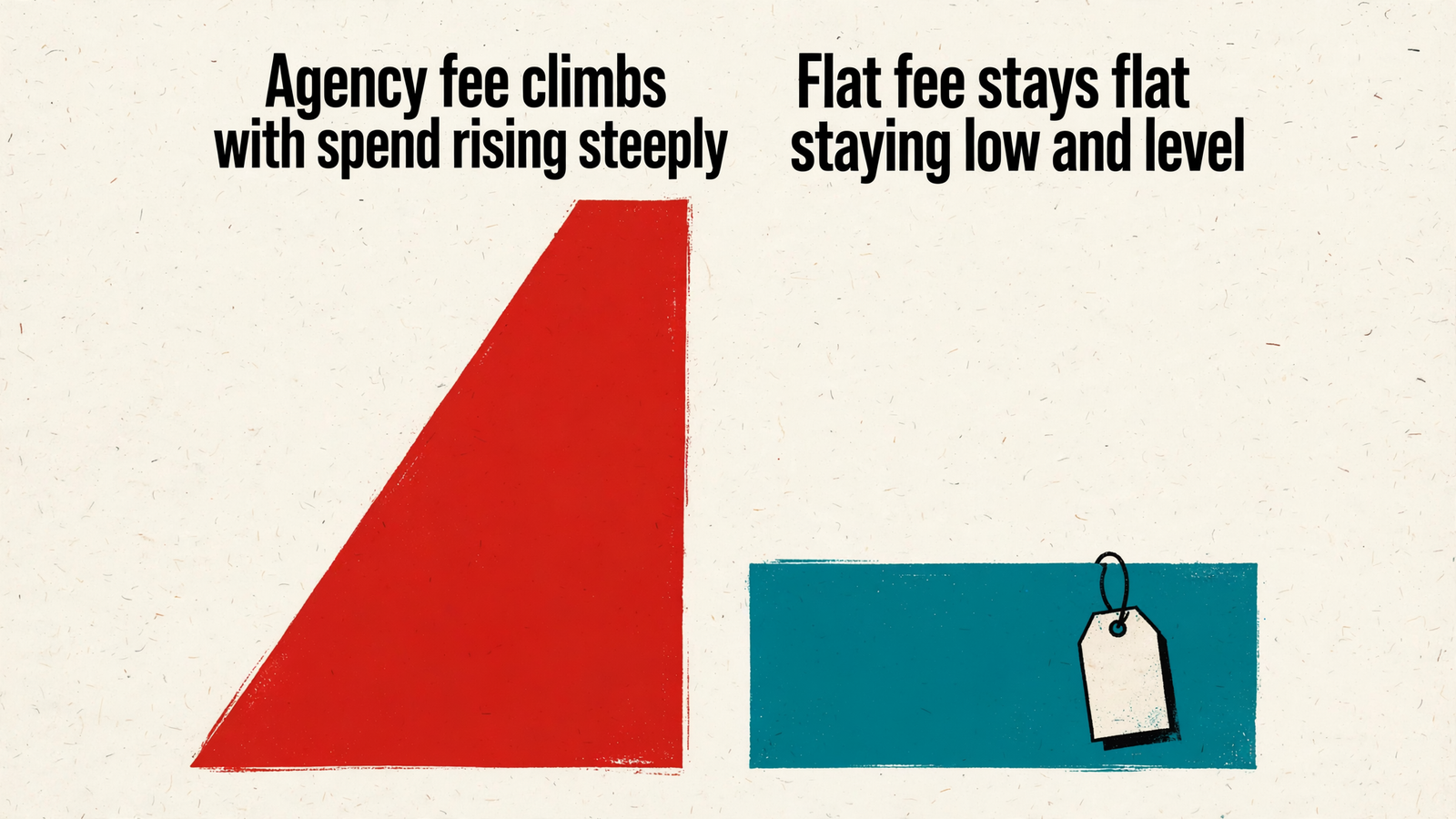
The arithmetic is still worth doing. Say you run $400,000 a month in media. At 15 percent, management fees are $60,000 a month, or $720,000 a year, whether efficiency improves or not. If your contract ties the fee to spend, increasing budget can increase the fee without increasing the work by the same proportion. That is the part I want in writing before a holiday ramp, not explained afterward as additional strategic oversight.
Smart Bidding now sets bids, while people still have valuable work to do on structure, feeds, queries, creative testing and tracking. I do not object to paying for that work. I object to assuming it costs proportionally more just because the media budget rose. A larger account may need more attention; the contract should say what additional attention you buy.
Run a simple fee-at-double-spend test with both finalists:
- Get the fee at your current media spend.
- Get the fee at twice that spend.
- Get the added hours, responsibilities and deliverables attached to the increase in writing.
If the price rises faster than the work you receive, you have found the part of the model that benefits the agency more than your account.
Axis 5: Does reporting end at ROAS or closed revenue?
Both firms can make a case for business-outcome reporting. Their proposed plumbing includes CRM tie-ins, first-party data loops, and retail and DTC information connected to ad exposure. The test is not whether a slide says pipeline. It is whether someone reconciles Google-reported conversions with closed revenue each month, then changes the search account when the numbers disagree.
Most enterprise dashboards I have audited did not close that loop. Platform ROAS climbed while finance showed flat margin, and the disagreement sat under the label tracking discrepancy for two quarters. That is an operating problem, not a chart-design problem. Platform credit and causal revenue are different numbers. Reconciling them takes CRM access, permission to use first-party data, and someone willing to say a brand team’s favorite keyword loses money on a blended basis.
A measurement system is only as useful as the budget decisions people let it make. Ask what happens when incrementality testing conflicts with the platform dashboard. Who brings the finding to the search team? Who has authority to cut spend? When does finance see the result? If those answers sit in three separate departments, the reporting may be sophisticated without being decisive.
Ask each finalist for one report in which incrementality findings led to a search budget cut despite attractive platform ROAS. The firm that can walk you through that decision reports to the business. The one that can only show a rising dashboard still has work to do.

Where Tinuiti and Wpromote each have an edge
| Axis | Tinuiti | Wpromote | What to test |
|---|---|---|---|
| Paid search work | Full-funnel approach across Google, Amazon and retail media | Google and Meta performance with an embedded-team approach | Who executes search changes, and how often? |
| Measurement | Bliss Point MMM with incrementality tests | Polaris MMM with scenario planning | Who turns a test into an account change? |
| Client proof | Enterprise experience; thin public reviews | Enterprise experience; thin public reviews | Can references describe the weekly work? |
| Fees | Scope may change with media volume | Custom enterprise retainer | What happens to fee and hours at twice the spend? |
| Business reporting | Revenue-focused measurement capabilities | Revenue-focused measurement capabilities | Has an incrementality finding changed search spend? |
Comparisons generally give Tinuiti the edge in Amazon, retail media and marketplaces, while Wpromote leans into Google and Meta performance. That split makes sense to me. A retailer or consumer brand whose quarter turns on Amazon, Walmart and retail media has a strong reason to choose Tinuiti. A brand centered on Google plus Meta that wants a team working inside its operating rhythm has a strong reason to choose Wpromote.
But do not mistake that distinction for an answer to every search problem. Either agency can bring strategy, creative and data together. Neither agency’s positioning alone tells you how often someone will work your queries, what happens to the fee as budget grows, or whether a revenue finding will change a bid. Choose between them on channel fit; make both prove the execution and fee model.
The third option: Keep the strategist, change the execution model
Here is the option I would put beside both proposals when search execution is the main job. Keep senior strategic direction, but stop buying human hours for every mechanical account change. groas runs search ads for a flat $1,499 a month per service, regardless of media spend. Autonomous execution works on bids, keywords, budgets and ads around the clock, while a dedicated strategist with more than 10 years of experience sets goals and guardrails with you. A weekly action log shows changes and their reasoning instead of leaving you to infer activity from a monthly slide deck.
That structure changes the fee calculation. In the $400,000-a-month example, doubling media spend to $800,000 does not double groas’s $1,499 monthly fee for the same service. The system is not billing additional hours because the budget grew. For the fuller model comparison, see self-serve vs agency vs autonomous execution.
This is not a substitute for every enterprise agency brief. If you need Amazon DSP, streaming TV and retail media planned alongside search in one room, keep Tinuiti or Wpromote on the shortlist. groas does not pretend to be a full-funnel creative agency. But if your bottleneck is weekly search execution, a fee that scales with spend, or reporting that never reaches closed revenue, the leaner arrangement addresses the work at the center of the brief. The case for that distinction is developed further in why agencies and in-house teams both hit a ceiling.
Keep a human accountable for direction. Do not make the account wait for human availability to execute it.
Verdict: Pick the team that matches the work
If Amazon and retail media carry your quarter, I would hire Tinuiti and negotiate search responsibilities and hours before signing. If Google plus Meta carry your quarter and an embedded performance team is the brief, I would hire Wpromote and make the same demands. Both are credible choices for the enterprise buyer who needs channels, creative and measurement managed together.
If the job is search efficiency, I would pick groas over either one. Daily account work, a named strategist and a flat fee attack the execution and cost questions directly. I would still ask how reporting connects to closed revenue, because no operating model gets a pass on that question.
Run the fee-at-double-spend test. Ask who changed a query last week. Ask for the budget cut that followed an incrementality finding. Tinuiti and Wpromote differ at the edges of an enterprise brief. The bigger choice is whether your search account needs another agency operating model at all.