Autonomous Ad Budget Allocation: Cost and How It Works FAQ
Wasting ad budget and can't optimize fast enough? How real-time AI budget allocation works, what autonomous setup costs, and what to use at scale.
September 28, 2026
•
min read



If you are the business owner staring at a 32% grader score beside a $4,000 agency retainer invoice, you are right to be angry. You are not yet right to fire your agency over the PDF.
You have paid that invoice every thirty days for half a year. Your customer acquisition cost in month six sits within three dollars of where it started in month one. Now a competitor or a cold-pitch consultant has sent you an automated report covered in red warning badges, missing-negative-keyword alerts, and a verdict that your account is a disaster. Friday afternoon suddenly looks like a good time to terminate the contract.
I managed Google Ads accounts directly for nearly a decade, spreadsheet by spreadsheet and bid by bid. I know why six months of fees with no visible improvement makes you want an answer today. But grader scores correlate poorly with commercial outcomes. The report may give you questions to ask. It does not tell you whether your agency has earned its fee.
The six flat months are the problem. The grader is a distraction. Before you fire anyone or sign anything else, find out whether your agency has been defending your margins, working against a real bottleneck, or simply collecting a retainer.
Your first instinct may be that the media buyer stopped working after onboarding. Sometimes that is exactly what happened. But an operator can also be running hard just to keep your numbers in place. According to LocaliQ’s 2026 Google Ads benchmarks across 13,474 search campaigns, average Search cost per click rose to $5.42, from $5.26 in 2025 and $4.66 in 2024. If auction costs in your market climbed 20% while your cost per acquisition held at $95, flat CPA would represent defensive work with real value.

Of course, defensive work needs an explanation, especially at $4,000 a month. If your agency has kept you on a flat line, it should be able to tell you which constraint it is fighting:
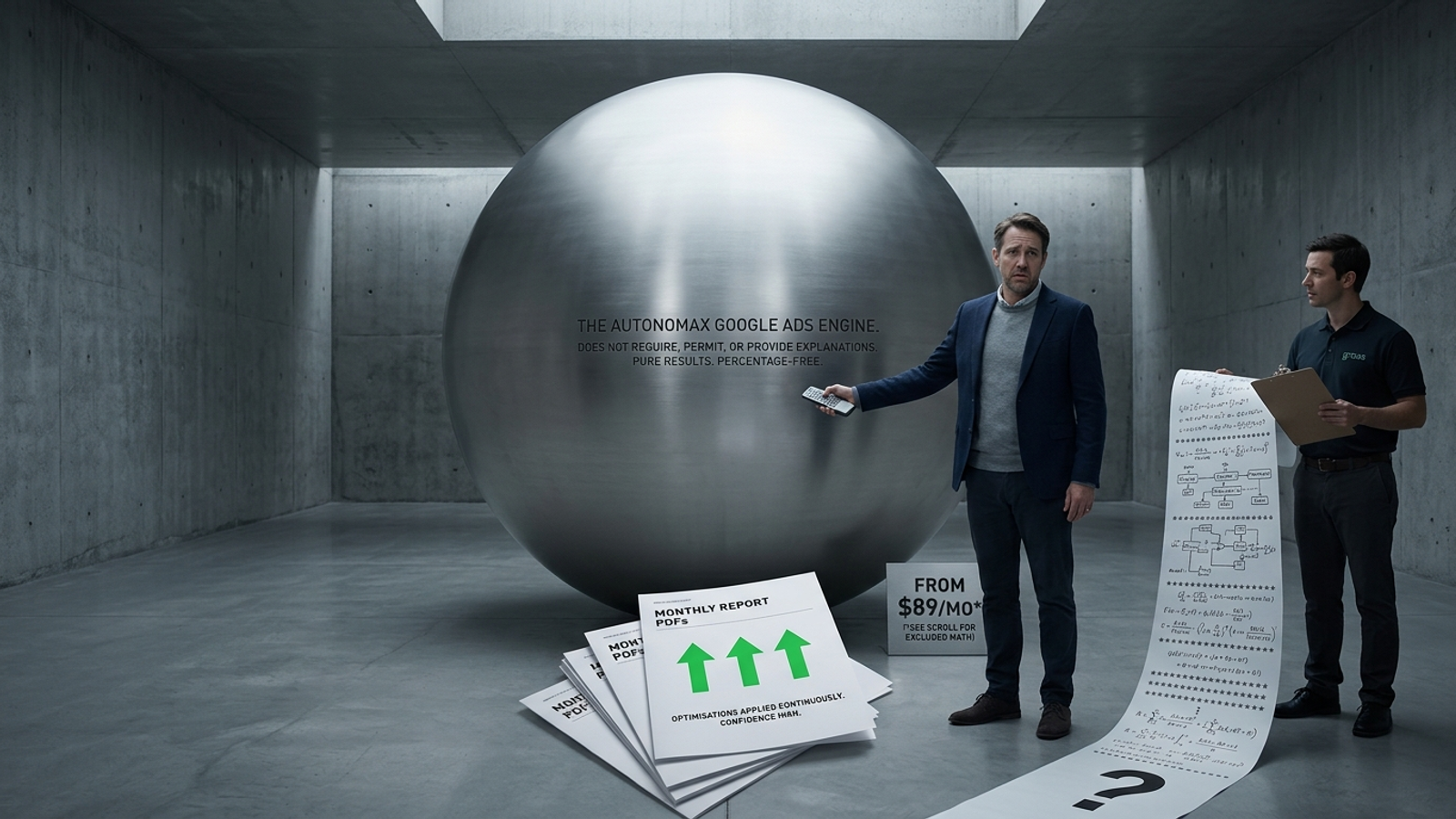
A skilled operator brings you that diagnosis before month six. You should hear which high-intent searches are exhausted, what needs to change on the landing page, or why the CRM must feed better signals back into bidding. You should also hear what the agency has tried. A struggling agency sends a PDF on the first of the month with green arrows beside “impressions” and hopes you do not ask what happened downstream.
The grader on your desk is not an independent referee. Automated graders from tool vendors and cold-pitching consultants are often lead-generation tools built to produce alarming scores. They can flag account settings. They cannot read your bank deposits, calculate your customer lifetime value, or tell you which leads your sales team closed.
Some grade accounts against rigid hygiene rules: a preferred number of keywords per ad group, a particular match-type mix, or a static negative-keyword checklist. A warning might expose waste worth investigating. It might also mark a deliberate choice as a failure because the tool cannot see why you made it.
Competing agencies use grader reports for a reason: a page of red badges creates urgency before anyone has studied your business. A low Quality Score distribution does not, by itself, prove that your agency is wasting money. Nor does a pristine grader score prove that the clicks turn into customers. The grader measures account syntax; you need to understand revenue.
So close the PDF for a moment and open the native Google Ads Change History. Look past automated updates for signs of deliberate work: search-term decisions, structural experiments, and changes your agency can connect to an outcome. If you find only a few automated negative-keyword syncs, one headline tweak, and a budget adjustment just before the invoice, you have a better question than “Why is my score 32%?” You can ask what management you actually bought. In practitioner discussions of failing accounts, a quiet change log is a more useful warning sign than a flat CPA line alone.
Change History is not the whole case, either. Someone may have spent time diagnosing a landing-page problem they could not fix inside Google Ads. But if that is the answer, you deserve to hear the diagnosis and the proposed fix. Silence is not a strategy.
Before you draft the cancellation notice, put four questions to your account team. You are not looking for a performance of confidence. You are looking for someone who can explain the mechanics of your account and the limits of what their work can change.
What specific conversion action is the bidding strategy optimizing toward today?
“Conversions” is not enough. If that means form fills, ask what happens to those forms in your CRM. In high-consideration B2B, SaaS, or high-ticket services, platform conversions can obscure what reaches the sales team. Smart Bidding can efficiently find cheap submissions while your reps wait for viable conversations. You need to know whether the campaign is learning from the outcome you care about.
What would you change tomorrow if you had complete creative and structural autonomy?
An operator who knows your funnel should be able to name concrete constraints: an offer with unclear pricing, a landing-page hero that misses customer objections, or a keyword group that needs isolation. You do not need to agree to every proposed change. You do need an answer more specific than “We could test some headlines next week.”
What does our $4,000 monthly fee buy in hours and operational output?
Ask who works on the account, how often, and what they have done over the last ninety days. Retainer and percentage-of-spend models can fail growth-stage advertisers when the fee stays high but the account gets little focused attention. You are paying for decisions and execution, not the comforting existence of an account manager.

What breaks if we freeze the account and make zero manual changes for fourteen days?
Listen to the reasoning, not just the answer. Smart Bidding may handle bids while query volume remains stable; an agency can still be doing valuable work on tracking, search terms, creative, or the post-click funnel. But it should be able to tell you what it is watching, what would trigger an intervention, and why that work matters. Basic tools such as Optmyzr and Adalysis can surface diagnostic alerts. An agency charging thousands should offer more than human middleware between an alert and your account.
Do not let the meeting drift into a tour of dashboards. Get the answers in plain English. If the team knows your unit economics and can show what it has changed or learned, the conversation can turn to the next constraint. If it cannot, you have a reason to reconsider the retainer that has nothing to do with a grader’s color scheme.
There is a point where switching away from the agency makes commercial sense: your campaigns have conversion history, your unit economics are clear, and the work your account needs keeps waiting for a human to notice and act. A media buyer has office hours, other clients, and a queue. Search terms and budget opportunities do not wait for the next account review.
An autonomous growth engine like groas uses specialized models for bidding, search-query pruning, and budget reallocation around the clock, while a named strategist sets business guardrails and owns the strategic conversation. If that sounds like the work your retainer is supposed to cover, read what the first 30 days of a switch to autonomous PPC look like. The case for switching is not that software has better instincts than every human buyer. It is that continuous execution does not have to wait for a calendar slot.
Autonomous execution will not fix a business that cannot give it reliable signals. If your product-market fit is unproven, your pricing changes every month, or you do not have at least thirty conversions a month flowing through the funnel, do not expect a machine to find its way through the noise. Bad tracking data and erratic sales feedback can make faster execution a faster way to waste money.
You may also need an agency for work that is not account execution. If you need someone in weekly board meetings, someone to explain branding decisions to your executive team, or a team to coordinate custom lifestyle video shoots, pay for that consultative work knowingly. Do not buy it by accident under the label of bid management.
That is the dividing line. Advisory dashboards show you graphs and suggest changes, then leave implementation to you. Autonomous execution takes on repetitive mechanical work inside the guardrails you set. A human-led agency can be worth its fee when it supplies judgment and services you actually need. But if your tracking works, your product sells, and the agency’s main contribution is periodic manual account maintenance, $4,000 a month is a fee you should challenge.
Do not call your account manager in a rage on Friday afternoon. Do not forward the grader and demand a defense of every red badge. That meeting will become a debate about the tool instead of your business. Give yourself one week to check the evidence that matters:
If the answers show that your agency understands your unit economics, knows the bottleneck, and has actively worked to reduce waste, keep it and throw the grader PDF in the trash. If the answers are vague, the Change History is a digital graveyard, and the only plan is another $4,000 check while everyone “waits for the algorithm to learn,” send the termination notice.
Fire an operating model that has stopped serving your ledger. Do not fire a working one over someone else’s sales pitch.
— Alexander