

 LinkedIn

Twelve clients want AEO inside their retainers. Your agency can buy a visibility tracker and hire freelancers, resell a white-label dashboard, or use a white-label engine that publishes the fixes under your brand. I have run the first two versions of that job. Past about five domains, I would pick the execution engine: hours per domain per month matter more than the feature list, and those hours eat the retainer as the roster grows.
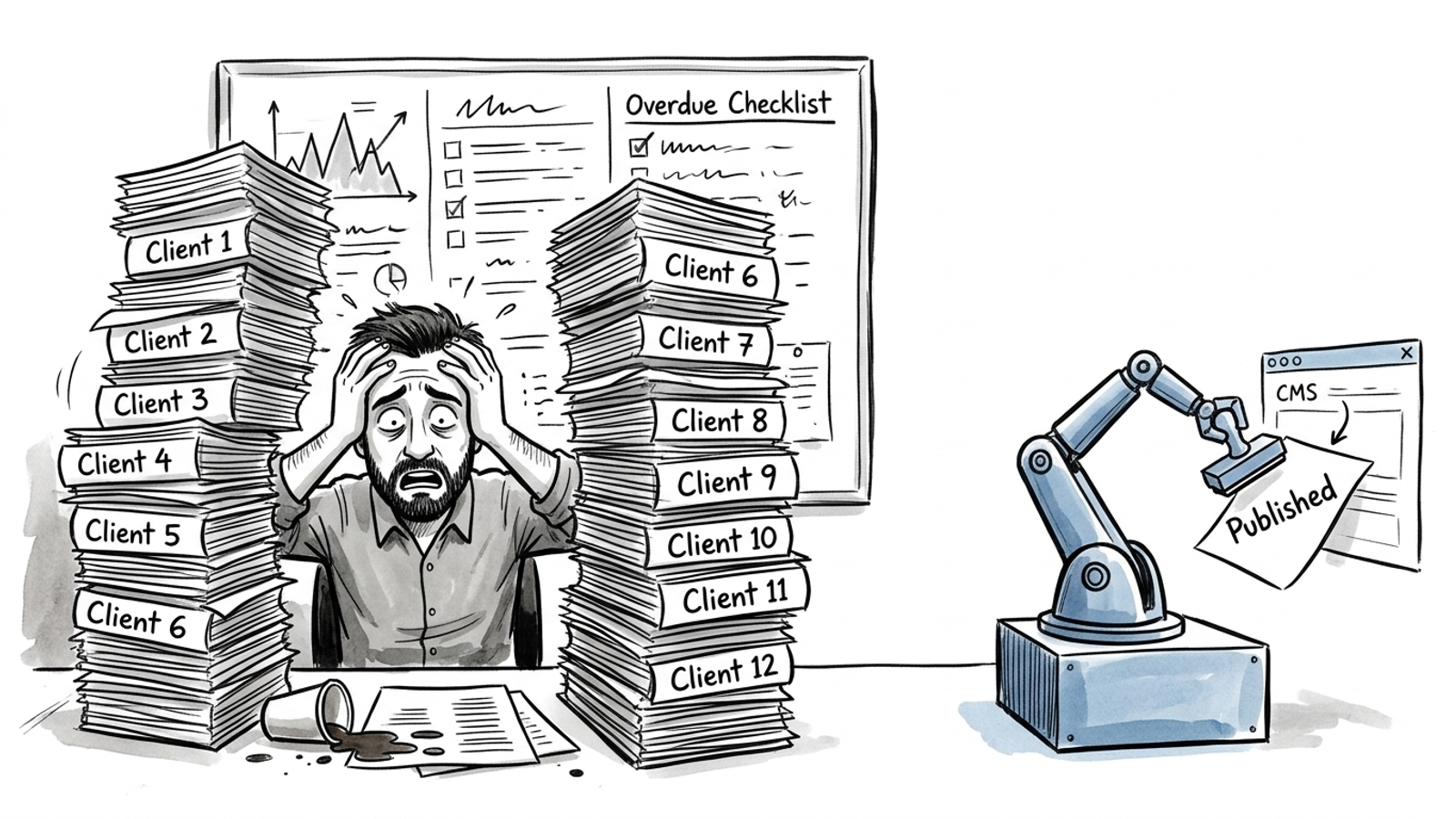
Say each client pays $1,500 a month for AEO. That is $18,000 in monthly revenue across 12 domains. A tracker subscription may look cheap until someone has to brief writers, edit drafts, publish pages, fix schema, build citations and explain the report. The retainer stays flat. The work multiplies by 12.
The contenders: three ways to sell one service
Across 12 domains, you need four jobs done: prompt tracking, answer content, CMS publishing with technical fixes, and reporting the client can understand.
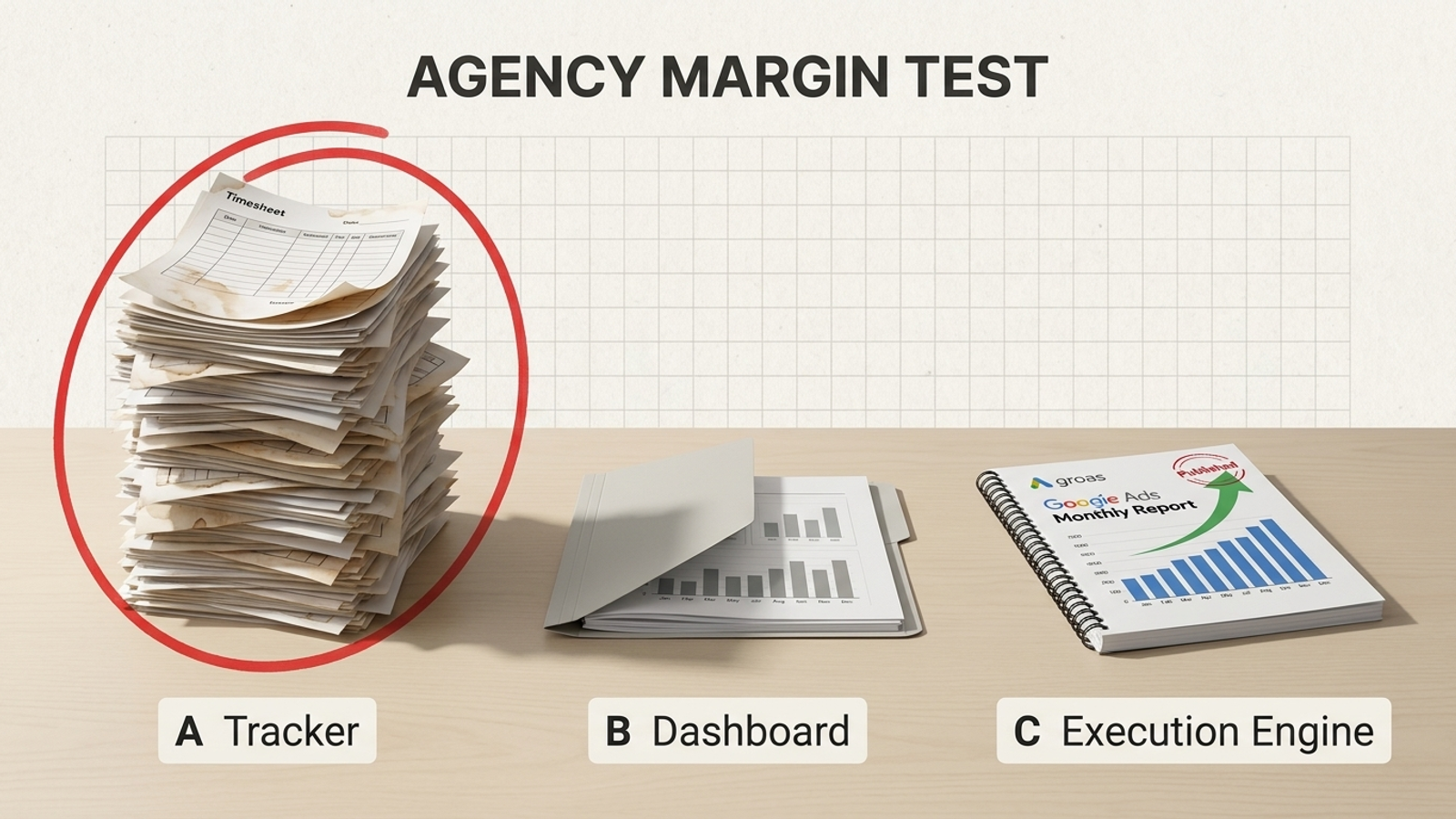
- Model A, tracker plus freelancers: Buy the tracking, commission the writing and have your team ship the work.
- Model B, dashboard resale: Buy white-label visibility reporting and put your logo on it. Your team still owns the work behind the chart.
- Model C, white-label execution engine: Connect each client, then have the engine track, write, publish and report under your brand.
Model A looks flexible because each purchase seems manageable on its own. A Semrush AI Visibility Toolkit at $99 per domain per month sounds reasonable until you multiply it by 12. A HubSpot AEO standalone tracker at $50 per month sounds cheaper until its 25 prompts have to cover the questions you want to track. Freelance writers at 10 to 30 cents per word, or $375 to $675 per solid article, sound like a variable cost you control. At four articles per client, though, you need 48 articles every month. I used to like that flexibility. I was wrong about how well it scales.
Model B is cheaper to display. White-label reporting costs about $20 per client per month on an annual plan, or roughly $240 for 12 clients, while Rank Tracker and AI Tracker credits are sold separately. No content or fixes ship with the dashboard. At that per-client rate, 20 clients mean $400 a month and 50 mean $1,000 before the work behind those reports. Price the plan at twice your current roster before you sign.
Model C changes who does the shipping. With groas for agencies, you connect each client once and turn on paid ads or organic per client. Execution covers bids, content, technical fixes and citations; actions and their reasoning appear in branded weekly reports. Paid ads is a separate service at $299 a month per client account. SEO and AI search are priced per client account ($299 a month each), so the cost grows as you add AEO clients. groas does not appear in front of the client. In A and B, your team still ships the work. In C, your team reviews what shipped.
Axis 1: Who gets a fix onto the site?
AEO fulfillment means more than finding a prompt where the client does not appear. The work can include entity optimisation, schema engineering, llms.txt, Reddit and forum citation work, and prompt-level testing. A tracker tells you where to look. It does not log into a CMS and change the page.
With Model A, your account manager becomes the publisher. They chase CMS access, check the freelancer draft, fix headings and internal links, add schema, and repeat for the other 11 clients. A dashboard resale gives that manager a prettier way to show the gap. It does not close it. What the sales deck calls visibility management, I call a chart next to an untouched page.
With groas, content, technical fixes and citations go live without your team handling each CMS change. The work is tracked weekly across Google and AI answers, with actions and reasoning attached. I used to tell clients reporting was delivery. I was wrong. A client can open a live page or citation; they cannot open a promise to get to it next week.
Takeaway: if your team publishes every change, you did not buy fulfillment. You bought homework.
Axis 2: How many hours does each domain take?
My Model A estimate is 7 hours per domain per month when nothing breaks. Here is where they go:
- 1 hour briefing and reviewing prompts.
- 2 hours editing freelancer drafts to fit the client.
- 1.5 hours publishing and fixing formatting, schema and internal links.
- 1 hour chasing logins and approvals.
- 1.5 hours building the report and answering questions about it.
Multiply that by 12 domains: 84 hours a month before rewrites. At seven hours, one client sounds manageable. At 84, you have a staffing decision, not a software decision.
Model B cuts the reporting portion from 1.5 hours to about 30 minutes per domain because the PDF arrives mostly finished. The other work remains. That leaves roughly 6 hours per domain, or 72 hours across the roster, if you intend to deliver AEO rather than a report about it.
For Model C, I would budget under 1 hour per domain: 15 minutes checking the branded weekly report and 30 minutes on the client call. Across 12 domains, that is about 9 hours on those tasks. I learned the bottleneck running Model A for home services clients. The writing was not what jammed the calendar. The publishing queue and CMS permissions were.
Takeaway: count publishing and reporting hours before you compare subscriptions. Those hours are easy to leave out of a demo.
Axis 3: Which meter grows with the roster?
Say each client needs 20 prompts tracked daily across services, locations and comparisons. Twelve domains mean 240 prompts. Otterly.AI Lite covers 15 prompts at $29 a month, Standard covers 100 at $189, and Premium covers 400 at $489; Gemini, AI Mode and Claude are paid add-ons from $9 a month. A Lite account cannot cover that roster. Standard cannot cover 240 prompts either. Premium clears the prompt count, but your team still has to act on what it finds.
The per-domain route has a different meter. Semrush at $99 per domain puts 12 domains at $1,188 a month before any white-label reporting cost. Each new domain increases the tracking bill while leaving the publishing job untouched.
Traditional wholesale fulfillment can cost more: packages run $300 to $5,000-plus per client per month, with many standard packages at $500 to $1,500. If you charge $2,000 and a fulfillment house takes $800 to $1,200, you still have onboarding, edits and client questions to cover. Buying labor from someone else does not make those responsibilities disappear.
Model C is not a claim that every service is one unlimited flat fee. groas charges $299 a month per client account, per service, for paid ads and for SEO and AI search. The distinction matters for this AEO comparison: compare that domain price with both the tracker bill and the hours required to turn findings into published work. A fee that buys execution is not the same purchase as a fee that buys measurement.
Takeaway: model the price at twice your current roster, and ask what your team still has to do after paying it.
The 12-domain cost breakdown: listed bills versus labor
The listed monthly floor for Model A is about $10,788; using the draft’s $375-to-$675 solid-article range instead puts it at $19,188 to $33,588. Those totals cover tracking and 48 articles, not staff time. Model B starts at about $240 a month for dashboards, with tracking credits and fulfillment extra. Model C is $299 a month per client account, per service, or $3,588 a month for SEO and AI search across 12 domains, and there is no other dollar figure here to add to it. I will not invent one to make the comparison look tidy.
| Recurring line item at 12 domains | A: Tracker + freelancers | B: Dashboard resale | C: Execution engine |
|---|---|---|---|
| Tracking or reporting | $1,188 for 12 domains at $99 each | About $240 for 12 dashboards; tracking credits extra | Weekly tracking and branded reporting; SEO/AI search at $299 a month per client account |
| Content | 48 articles: $9,600 at the cited $200 lower-end article price, or $18,000–$32,400 at the cited $375–$675 solid-article range | No content shipped; writing remains your cost | Content included in execution |
| Internal work, not priced here | About 84 hours editing, publishing, fixing and reporting | About 72 hours if your team still produces the AEO work | About 9 hours for report checks and client calls at the estimate above |
Those are recurring costs, not a complete profit calculation. Model A’s $10,788 floor leaves $7,212 of the illustrative $18,000 monthly revenue before paying for 84 hours of staff work or any rewrites. At $375 an article, the listed tracker and writing bills alone exceed that revenue. Model B’s $240 invoice looks much better only if you pretend 72 hours of work cost nothing. Model C’s $3,588 leaves $14,412 of the $18,000 before about 9 hours of report checks and client calls.
The one-off bill vendors leave off the invoice
Onboarding is separate from the monthly run rate. In Model A, allow 2 to 4 hours per domain chasing logins and CMS access. Model B inherits that work if you also promise to publish fixes; a dashboard alone does not need CMS access, but it does not deliver fixes either. With Model C, the setup is one connection per client, rather than your team returning to the CMS for each change.
Then comes the less visible monthly tax: approvals, rewrites, and the call explaining why visibility moved on prompts the client has never searched. I have eaten that cost. It does not show up on a tracker invoice. It shows up when prospecting stops because everyone is busy pasting.
What is left of a $1,500 retainer?
At the low-end $200 article assumption, Model A spends $800 on four articles and $99 on tracking per domain. That leaves $601 of the $1,500 retainer before seven hours of staff work. At the cited $375 solid-article price, four articles cost the entire retainer before tracking. Model B leaves $1,480 after the roughly $20 dashboard charge, but that is before the six hours per domain needed to produce anything beyond a chart.
Model C replaces much of that production work with a $299 per-domain charge for SEO and AI search, which leaves $1,201 of the $1,500 retainer before about an hour of report checks and client calls. I can also tell you which line to watch: whether publishing stays on your team’s calendar after the bill is paid.

The cheapest mistake is treating a low tracker or dashboard price as the cost of AEO. The most expensive one is staffing 84 hours a month of publishing and reporting as if it were free.
Axis 4: What can the client see at renewal?
At month three, the client does not ask how many prompts your plan permits. They ask what changed on their site and whether they show up in the answers that matter to them.
Model A can hand over articles and tracker results, provided the articles made it through the publishing queue. Model B can hand over a branded chart, but the chart does not prove that anyone changed a page. I have sat in those renewals. A client can nod at a report and still cut the AEO line because there is nothing on their domain to inspect.
Model C can show branded weekly reports with actions and reasons alongside live pages, technical fixes and citations. That is a much easier conversation than explaining why the work is waiting in Google Docs. Renewal proof should be something the client can click, not a score you have to defend.

| Roster size | My pick and why | Who should pick a losing model anyway |
|---|---|---|
| 1–4 domains | Tracker plus a good writer, if you want hands-on control. At four domains, the 7-hour estimate is 28 hours a month. | Pick dashboard resale only if the client bought visibility reporting rather than AEO fulfillment. |
| 5–15 domains | Execution engine. Keeping production hours low per domain matters more as the roster grows. | Keep the tracker stack if hands-on AEO is your craft differentiator and you charge over $3,000 per client to cover the work. |
Verdict: at 12 domains, stop buying homework
For the agency in this comparison, twelve $1,500 retainers, I would buy the execution engine. Model A needs a writer budget and roughly 84 internal hours. Model B replaces a $1,188 tracker bill with an approximately $240 dashboard bill but still leaves roughly 72 hours of fulfillment with your team. Model C moves publishing, technical fixes, citations and branded reporting off that queue. At $299 a month per domain for SEO and AI search, that is $3,588 across the roster, against 72 to 84 internal hours in the other two models.
That is why I put the line at about five domains. Below it, you can afford to be the publisher. Above it, that job starts eating the retainer. Skip this comparison if you sell only one-off audits, clients forbid third-party CMS access, or you charge under $800 and cannot fund fulfillment. For an agency running 5 to 15 domains, sign up at $299 a month per client account with a 7-day money-back guarantee and compare what actually ships. The chart never saved my renewals. Shipped pages did.