

 LinkedIn

A SaaS founder I worked with bought 400 trial starts in 30 days at $18 each. Sales logged 29 second logins. For founders and growth leads choosing between trial starts, activated trials, and paid conversions in Meta, that gap is the contest: the easiest event to buy is not necessarily the one worth buying.
My winner for most SaaS accounts is the activated trial, even though it fires less often. Trial starts give Meta enough volume to learn, then teach it to find people who sign up and disappear. First payments tell the truth, but often arrive too late and too rarely to steer delivery. The right Meta manager is willing to make that trade with you rather than celebrate a cheap signup.
Meet the three events before you pay for any of them
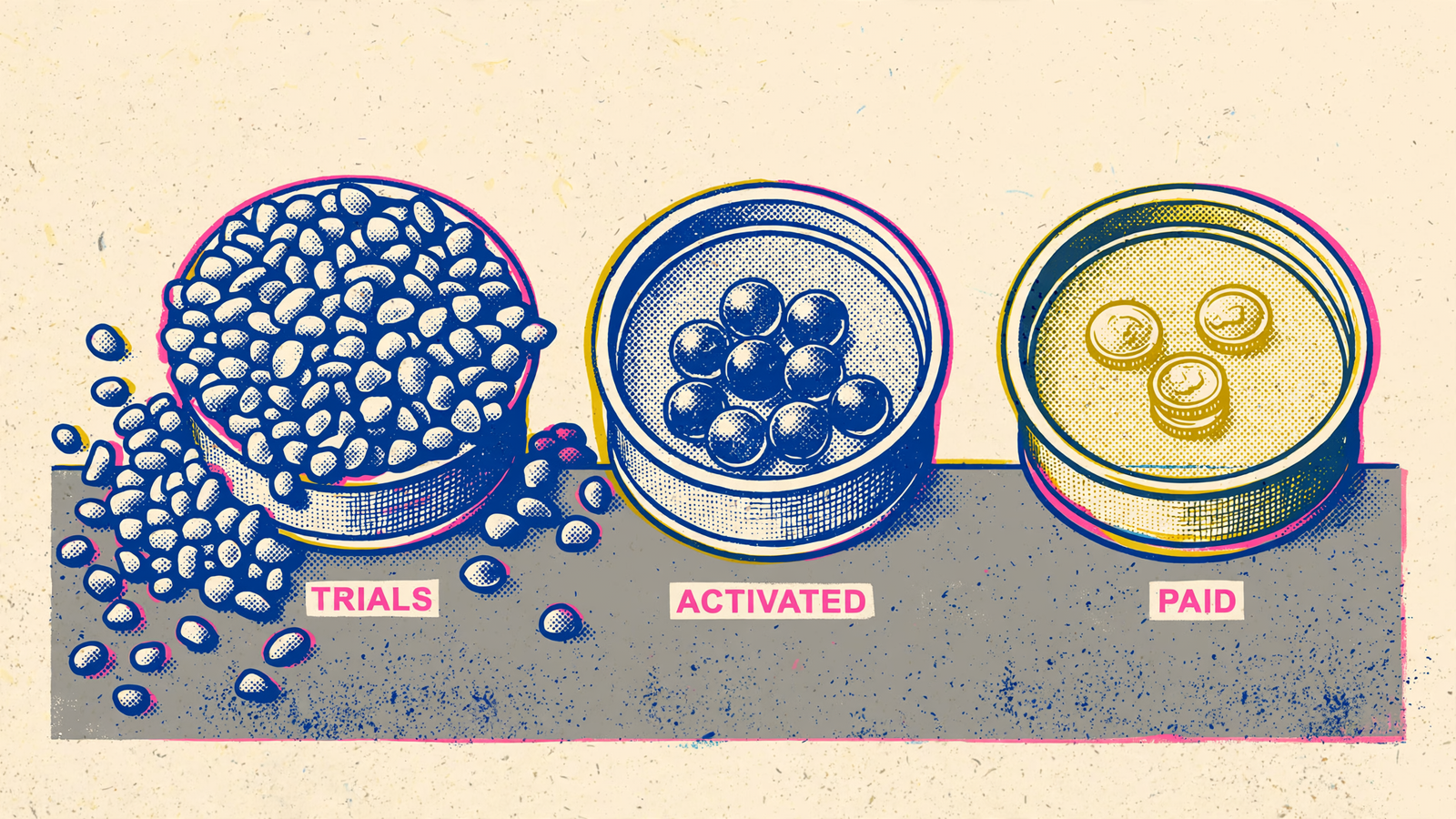
Most SaaS teams talk about “a trial” as if it were one thing. Meta sees distinct events, each of which gives delivery a different example of the person to find next:
- Trial start fires when someone submits the signup form. It arrives quickly and often, but says little about what happens after signup.
- Activated trial fires when that person does the product action you use as a sign of intent: connecting an integration, importing data, inviting a teammate, or publishing a first project. You define that action in product analytics and send the event back to Meta.
- First paid conversion fires when the first charge goes through, after a 7-, 14-, or 30-day trial. It is the clearest outcome and usually the slowest signal.
A subscription ads breakdown makes the underlying distinction: trial start is a weak predictor of payment, activation is stronger, and payment can arrive too late to guide the ads that brought the person in. Name the activation action in one sentence before you change optimisation events. If nobody can agree on it, the campaign cannot compensate for the missing definition.
Axis 1: Volume gets an ad set learning, not a customer paying
Meta needs about 50 optimisation events per ad set per week to exit learning. Treat that as a planning line, not a promise that event number 50 flips a switch. It explains why trial start wins so many account setups by default.
Say you spend $5,000 a month at $15 per trial start. That buys roughly 330 starts a month, or about 80 a week on a four-week planning month. Put them in one ad set and you have enough volume to work with. Split them across two and each gets roughly 40. The same account can look healthy or thin depending on how you divide it.
Now suppose 30% of those trials activate. Across the account, that is about 25 activation events a week. Split those again and neither ad set gets close to the line. Optimise for first payment on a 14-day trial at the 8% median free-to-paid rate cited in these SaaS benchmarks, and you are down to roughly six or seven payments a week. That is not a useful diet for a payment-optimised ad set.
I used to tell clients to push through and optimise for payment anyway. I was wrong. With that little feedback, delivery can lurch, edits muddy the test, and it becomes hard to tell whether the event choice helped. Volume is the price of admission, not the goal. Work out weekly events per ad set before you pick a winner.
Axis 2: The event decides which people Meta tries to find
Meta looks for more people like the ones who fire your optimisation event. Point it at trial starts and it gets very good at finding form-fillers: curious clicks, serial triallists, people who sign up for everything and open nothing. A B2B pixel guide warns that dashboards can show a reasonable CPL while 80% of leads never pass the first call, because raw and qualified leads look alike to delivery unless you distinguish them.
That is the cheap-trial trap I have written about before. You reward the system for bringing in tourists, then ask the sales report why the tourists did not buy tickets.
Activation changes the example. The event fires only after someone does real work inside the product, so Meta gets feedback on people willing and able to take that step. First payment is a clearer example still, but clarity does little for delivery if the example arrives a handful of times a week.
Signal quality improves downstream while volume shrinks. For many accounts, activation is the furthest downstream event that can still arrive often enough to use. That is the trade your manager should show in numbers, not hide behind a low cost per signup.
Axis 3: Trial length can make payment too late to steer ads
Trial start can fire minutes after a click. Activation may arrive a day or three later, once onboarding does its job. First payment waits for the trial to end and the charge to go through. For a 14-day trial, the first bill is already about two weeks behind the click. A signup can inform near-term delivery; a payment may arrive after the campaign has moved on.
Meta’s longest standard click-attribution window is 7 days. That makes a first charge after a 14- or 30-day trial a poor primary optimisation signal for the ad that won the signup. Do not confuse that click window with event delivery: Meta’s Conversions API can accept an event sent up to seven days after the event happens, while attribution still depends on the click window. Sending a day-14 charge promptly does not turn it into a day-seven charge.
A 7-day trial puts payment closer to the edge of that window. It does not solve a thin weekly payment count. Check both clocks: time from click to charge and payments per ad set per week. On a 14- or 30-day trial, I would use first payment to judge outcomes, not as the event tasked with steering delivery.
Axis 4: Better signals require more tracking work
Trial start is the easiest event to track. Fire the Pixel on signup confirmation and map it to a standard event such as CompleteRegistration. For a straightforward setup, that can be an afternoon’s job.
Activation takes product and analytics work. Someone has to define the action, catch it reliably, and send it server-side through the Conversions API so the signal does not depend entirely on the browser. In a Meta April 2026 test of 5,926 advertisers, CAPI plus Pixel averaged 17.8% lower cost per result. That is a reason to take the plumbing seriously, not a promise that installing CAPI produces the same result in your account.
The easy installation is not always the useful one. A one-click CAPI setup may mirror web Pixel events, while filtering, product actions, CRM data, and offline events can call for partner or custom work, hosting, and developer time. First payment can demand the most plumbing of all: a billing or CRM event has to make it back to Meta, even when a long trial makes that event a poor fit for click-based optimisation.
Pay for tracking that improves the decision. For most SaaS accounts, the activation event is the work worth doing first; build payment reporting to see whether that decision earns revenue.

Axis 5: The cheapest event can buy the costliest customer
Trial starts tend to look cheapest in an ads report. Activated trials often cost two to four times as much per event. Payments look expensive enough to make someone ask whether the dashboard is broken. None of those prices, alone, tells you what a payer costs.
Consider the $20,000 example in this subscription analysis: 4,000 no-card trials at $5 each, with 8% becoming paid, yield a $62.50 cost per payer. Another 1,200 card trials at $16.67 each, with 35% becoming paid, yield a $47.62 cost per payer. The $5 event looks better until you follow the people who fired it. These are different trial cohorts, not proof that changing Meta’s optimisation event alone creates that outcome. The arithmetic shows why cost per trial cannot settle the argument.
I have watched teams scale the cheap event for months because the weekly report rewarded them for it. Put cost per activated trial and cost per payer beside cost per trial. If the first number falls while the other two climb, do not call the campaign efficient.

The head-to-head scorecard
| Decision axis | Trial start | Activated trial | First paid conversion |
|---|---|---|---|
| Weekly volume | Highest; easiest to feed one ad set | Lower; consolidation matters | Often too thin to optimise toward |
| Person represented | Someone who filled out a form | Someone who used the product | Someone who paid |
| Time to feedback | Minutes | Often 1–3 days | After the trial and charge |
| Tracking work | Signup Pixel event | Defined product event and server-side delivery | Billing or CRM pipeline |
| Apparent cost | Cheapest, but easy to misread | Higher per event, closer to useful intent | Highest per event; valuable for reporting |
Activation wins the middle of this scorecard. The exceptions are about budget and timing, not a secret setting in Ads Manager.
The winner by monthly spend
Under $5,000 a month: start with trial starts, but fence them in. At the $5,000 example above, a 30% activation rate produces only about 25 activation events a week across the account. Cutting spend makes that harder. Use one campaign and one or two ad sets at most, then keep an activation check in your own reporting. Set a kill rule tied to cost per activated trial, not a prettier cost per trial. The 50-conversion math at modest budgets is a constraint; it is not permission to scale tourists.
$5,000 to $20,000 a month: choose activation when the event math supports it. This is my winner for most SaaS accounts. At the low end of this band, the example account still has only about 25 activations a week, so do not pretend the spend threshold alone solves volume. Consolidate rather than spreading the signal across ad sets, calculate your actual activation rate, and check whether the resulting weekly count can support the setup. Send the product event server-side and give delivery time to recalibrate. Cost per optimisation event will probably rise. Judge the change on activated cost and, once a billing cycle finishes, cost per payer.
Above $20,000 a month: optimise for activation and keep payment as the accountant. Higher spend makes a clean comparison easier, but it does not shorten your trial. Feed first payment back as a secondary event with value and use it to judge whether activation is pointing at revenue. I would consider payment as primary only where a 7-day trial with a card upfront produces enough payments; the 25–35% conversion range in these benchmarks is not a substitute for counting your own weekly events. On a 14- or 30-day trial, even $50,000 a month cannot fix the calendar. If you have the history to do it, assign activations a value based on their payer rate and send that through CAPI rather than treating every activation as equally valuable.
Ask a prospective Meta manager to make the trade in public
Most agencies will not volunteer that a low cost per trial makes a lovely slide while saying very little about paying customers. A manager who defaults to trial starts without asking about activation may be choosing the easiest number to report. A manager worth hiring will challenge your event definition, show you the weekly volume, and agree to be judged beyond the signup.
I run accounts through groas now for that reason: a flat $1,499 a month for Meta Ads, one owner on the outcome, and execution that keeps running while the trial clock runs. There is no percentage-of-spend fee bump to justify with a growing pile of cheap trials. Before you hire anyone, ask:
- Which event will you optimise toward first, and how many times will it fire per ad set per week at my budget?
- How will you define activation, send it back to Meta server-side, and tell whether the signal is arriving reliably?
- Which two numbers will you report alongside cost per trial, and what cost-per-activated-trial threshold makes you stop or change course?
- Given my trial length, will first payment arrive soon enough to help delivery, or should we use it to judge the result instead?
If a prospective hire will not make that trade with you, keep looking. Trial starts are the fallback when activation volume is too thin. First payment is the primary event only when timing and volume both make it workable. For the SaaS account between those extremes, I pick activation—and the manager willing to own its cost per payer.