

 LinkedIn

A $50-a-day Meta account can produce plenty of impressions and still give the delivery system almost nothing to learn from. Split that budget across five ad sets, and the problem gets worse: each ad set needs its own conversions, but none gets enough money to find many.
That is the fact everything else here follows from. On a modest budget, the scarce resource is optimization events, not reach. Meta’s delivery system looks for roughly 50 optimization events in seven days per ad set to exit learning. It does not pool those events across your carefully labeled audiences. At the costs in our $50-a-day example, five ad sets mean five separate learning problems the budget cannot support.
The auction needs a prediction, not just a bid
Every impression goes through an auction, and the highest bidder does not automatically win. Meta weighs advertiser bid, estimated action rate, and ad quality and user value. The estimated action rate is its prediction that a particular person will take the action you chose to optimize for after seeing your ad. Quality also matters: an ad people engage with is not treated the same as one they hide.
I used to describe those inputs to clients as three dials. That made them sound more independent than they are. A bid matters, but it cannot do its job without a credible prediction of who will act. In the simplified version, a $50 bidder with a weak predicted action rate can lose to a $20 bidder whose ad Meta expects to convert. Paying more for the chance to show an ad is not the same thing as giving the system a better idea of whom to show it to.
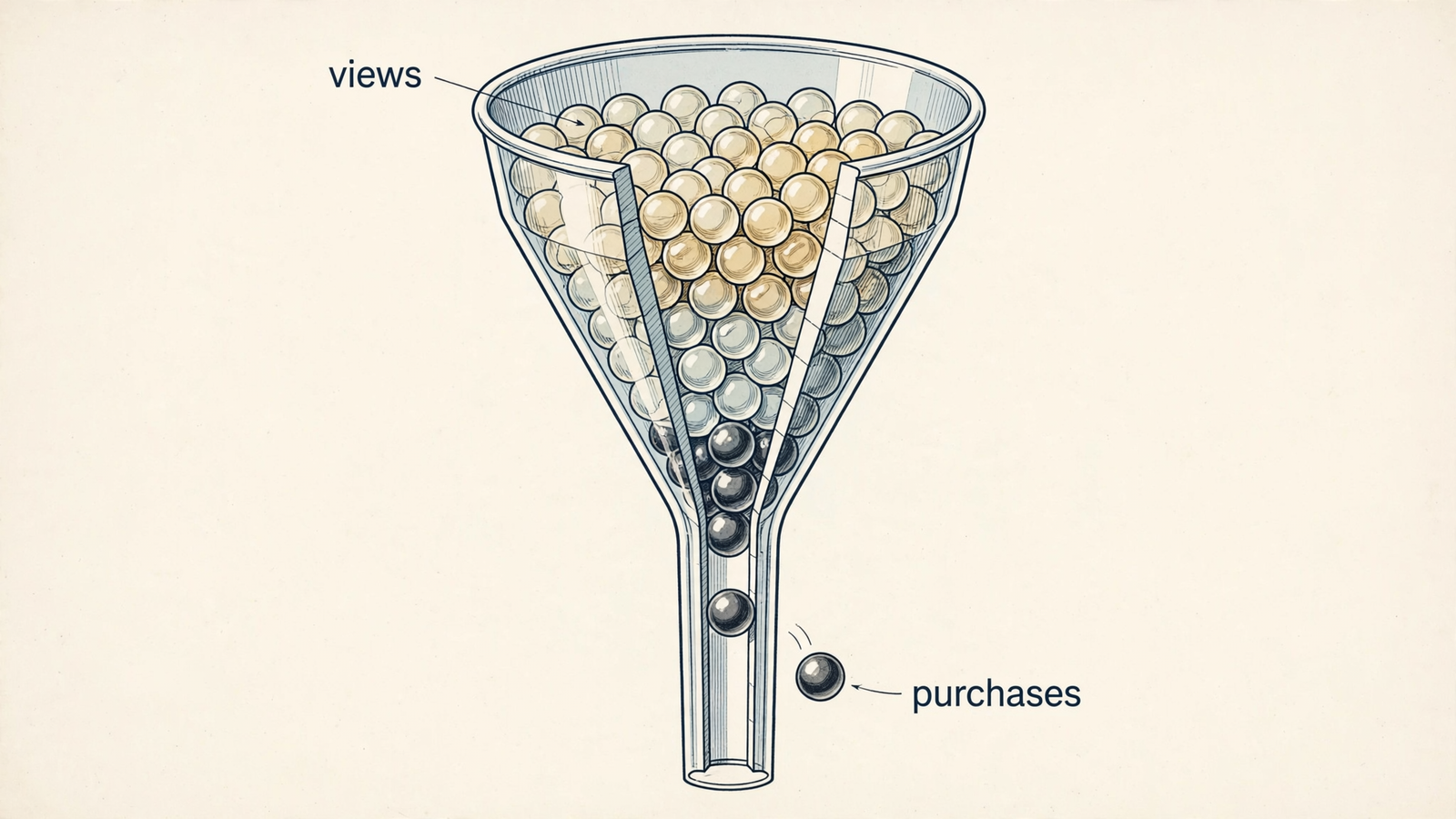
That is why the event matters. If you ask Meta to find buyers, it needs examples of buyers. If you ask it to find leads, it needs examples of leads. Your budget buys delivery; completed events give that delivery direction. When events arrive too slowly, the system has fewer examples to work from, however broad your potential audience looks on a proposal slide.
Fifty events means fifty in a week
A new ad set starts with uncertainty about which people inside its audience will take your chosen action. Meta explores, observes the responses, and adjusts delivery. That exploration is the learning phase. The usual benchmark for exiting it is about 50 optimization events in seven days, counted for that ad set.
The seven-day window is the part small-budget plans tend to skip. If an ad set produces nine purchases this week and nine next week, it has not worked its way toward a lifetime total of 50 and finished the job. It is still producing roughly nine purchases per week. Waiting five or six weeks does not turn that into 50 events in seven days. I have watched small accounts spend for a month while the reports got busier and delivery still felt unsettled. More elapsed time was not the missing input.
There is a cost to that uncertainty. In Meta’s peak-season analysis, ad sets below roughly 50 weekly conversions ran about 28% more expensive per purchase than those above the threshold. That comparison is a warning, not a promise that crossing 50 will instantly cut your CPA by 28%. The useful mechanism is simpler: fewer conversion examples give the system less information for its next delivery decision. Learning is a weekly volume problem, not a patience contest.
Do the $50-a-day division before building an account
Say the ad budget is about $1,500 a month, or $50 a day for this example. That gives you $350 in a seven-day week. If a purchase costs $38.99, the cited ecommerce median, your weekly budget buys about nine purchases. At a $30 cost per lead, it buys about 11 or 12 leads. Neither figure approaches 50 events in one ad set.
Now split the same $350 across five ad sets. Each gets $70 a week, or $10 a day. At a $30 cost per event, that is a little over two events per ad set per week. The split has not created five tests with enough signal to learn. It has taken one thin stream of events and divided it into five thinner ones.
The budget ceiling calculation is worth writing down:
Weekly budget ÷ (cost per result × 50) = ad sets the budget can support at 50 weekly events each.
With $350 a week and a $30 cost per result, that is $350 ÷ $1,500, or about 0.23 ad sets. You cannot run a fraction of an ad set. The number tells you that even one ad set is unlikely to hit the 50-event benchmark at that cost, and five are farther from it. Use your own cost per chosen optimization event in the formula. A purchase CPA and a lead cost answer different questions.
That division is the account audit I want before anyone presents an audience map. If the math cannot support one fully learning ad set, a prettier map will not support five.
Three levers when the budget will not move
If the calculation comes back below one, you have three practical moves: reduce the number of places the signal goes, choose an event that occurs more often, or improve the ad that earns the event. I consider them in that order because consolidation is free. The other two introduce tradeoffs a proposal can hide behind phrases like testing framework.
1. Consolidate so events stop competing for budget
One ad set at $50 a day gives all its resulting events to one learning process. Five at $10 a day make each ad set learn from only its share. Consolidation does not magically turn nine weekly purchases into 50. It removes an avoidable reason for each ad set to see even fewer.
I learned this by unbuilding my own clever segmentation. Every separate audience looked defensible in isolation; together, they left too little budget in each place to observe much. Under $5,000 a month, a lean structure described in the small-account setup guidance is two campaigns at most: roughly 70% toward prospecting, with restrained retargeting rather than a stack of small audiences. At $50 a day, even that split deserves a check against actual event volume. A retargeting ad set does not get a free pass on the arithmetic because its name sounds sensible.
A shorthand is to plan around a daily budget of five times your target CPA per ad set. It is only a shorthand. The stricter calculation for 50 weekly events is CPA × 50 ÷ 7. At a $40 CPA, those figures are $200 and about $286 a day respectively. At $50 a day, you expect about 1.25 purchases a day at that CPA, or fewer than nine in a week. You could accumulate 50 purchases over about 40 days at that pace, but you would not have met the 50-per-week benchmark.

2. Choose a cheaper event, but name what it teaches
When purchases are rare, an event higher in the funnel may occur often enough to give Meta more examples. The illustrative event ranges show the attraction: Purchase at 3 to 15 a week often remains Learning Limited; Add to Cart at 15 to 80 can be borderline; View Content at 100 or more usually supplies more than enough event volume.
The mechanism is straightforward. If your budget buys more of the event you chose, the system receives more examples of that event and can adjust delivery sooner. The catch is equally straightforward: more signal is not necessarily better signal. A model optimizing for content viewers learns to find content viewers. It has not thereby learned to find buyers.
The usual progression is to start with a more frequent event when purchase volume is too low, then move back toward Purchase when there is enough volume to support it. That change can restart learning. It also has to earn its place in the business numbers: if Add to Cart traffic never buys, you paid to get better at finding window shoppers. Do not call a calmer learning indicator a win while qualified leads or purchases get worse.
3. Make the creative do more of the filtering
With a broad or Advantage+ audience, creative helps determine who engages and what delivery can learn from that engagement. Suppose you sell roofing services in Austin. An ad that names Austin homeowners with old roofs gives the right people a reason to pay attention and the wrong people less reason to do so. Their subsequent actions supply clearer feedback than an ad written for everyone.
That does not mean a line of copy can perfectly screen an audience. It means the ad itself can carry some of the specificity marketers otherwise try to force into separate audience builds. Under $1,500 a month, the one broad Advantage+ prospecting ad set approach leaves room to test distinct creative angles without dividing a thin budget among five micro-audiences showing the same video.
On a small budget, test a new angle before you build a new audience. The former can change who responds while keeping events together. The latter starts another place where scarce events must accumulate.
Try the model on a different cost per result
Take a home services company spending the same $50 a day. A qualified lead costs $25. The weekly division is $350 ÷ $25, or 14 qualified leads. One ad set is still short of 50 weekly events; several ad sets would each see fewer. I would keep the structure consolidated, optimize toward the lead, and judge the result by the cost of qualified leads downstream. A steady-looking delivery graph would not make an unqualified lead valuable.
Now change the business, not the budget. A $29 impulse product has a $12 cost per purchase. The same $350 buys about 29 purchases a week. That is still below 50, but it gives one ad set substantially more purchase examples than the home services account gets qualified leads. One ad set and strong creative have a better shot at useful feedback than five ad sets sharing those 29 purchases. I would not assume the account has exited learning or claim the under-50 cost difference disappears. I would say the gap between its current event volume and the benchmark is smaller.
I think of the learning phase like training a new closer: nine calls a week reveal fewer patterns than 50. The analogy breaks where it matters. A person can carry experience into next week; a significant ad-set edit or an optimization-event change can send Meta back into learning. That is why I treat edits on a small account as costly decisions, not something to make whenever a Tuesday report looks odd. The question remains the same across both businesses: how many relevant events can this budget produce for each ad set in seven days?

Ask this before hiring someone for a small Meta account
Picture a proposal for a $1,500-a-month ad budget: four prospecting audiences, a lookalike stack, and separate retargeting, each on $8 or $10 a day. It may sound thorough. At a $30 cost per event, $10 a day buys a little over two events a week for that ad set. Meta’s guidance warns that too many overlapping ad sets can undermine data collection. Here the arithmetic has already shown the more basic problem: each ad set gets too little signal.
I ask two questions before the creative presentation or reporting tour:
- How many optimization events per ad set per week does this plan expect at our cost per event?
- What will you consolidate first if that figure stays below 50?
The answers matter more than the logo slide. Someone who understands small-budget delivery can show where the events will come from, explain why an ad set exists, and say what they will stop running when the data stays thin. They should also know why creative quality and conversion signals matter: a higher bid does not fix a weak prediction about who will convert.
Good management at $50 a day looks restrained. Start with one broad prospecting ad set, add retargeting only if the budget and signal justify it, test new ideas as ads rather than reflexively creating new ad sets, and avoid unnecessary edits once delivery starts. Report purchases or qualified leads and cost per result. Reach curves and click-through rates can describe activity; they cannot substitute for the event the business needs.
The management fee deserves the same division test. A percentage of spend takes a cut of the ad budget and can reward complexity instead of restraint. groas offers Meta Ads management for a flat $1,499 a month, with no cut of ad spend. I prefer the flat-fee incentive to paying a provider more as spend rises, but on a $1,500 monthly ad budget the management fee is nearly as large as the media budget. That is a real cost, not something a cleaner account structure erases. Know what you are paying to manage, then ask whether the plan respects the size of the account.
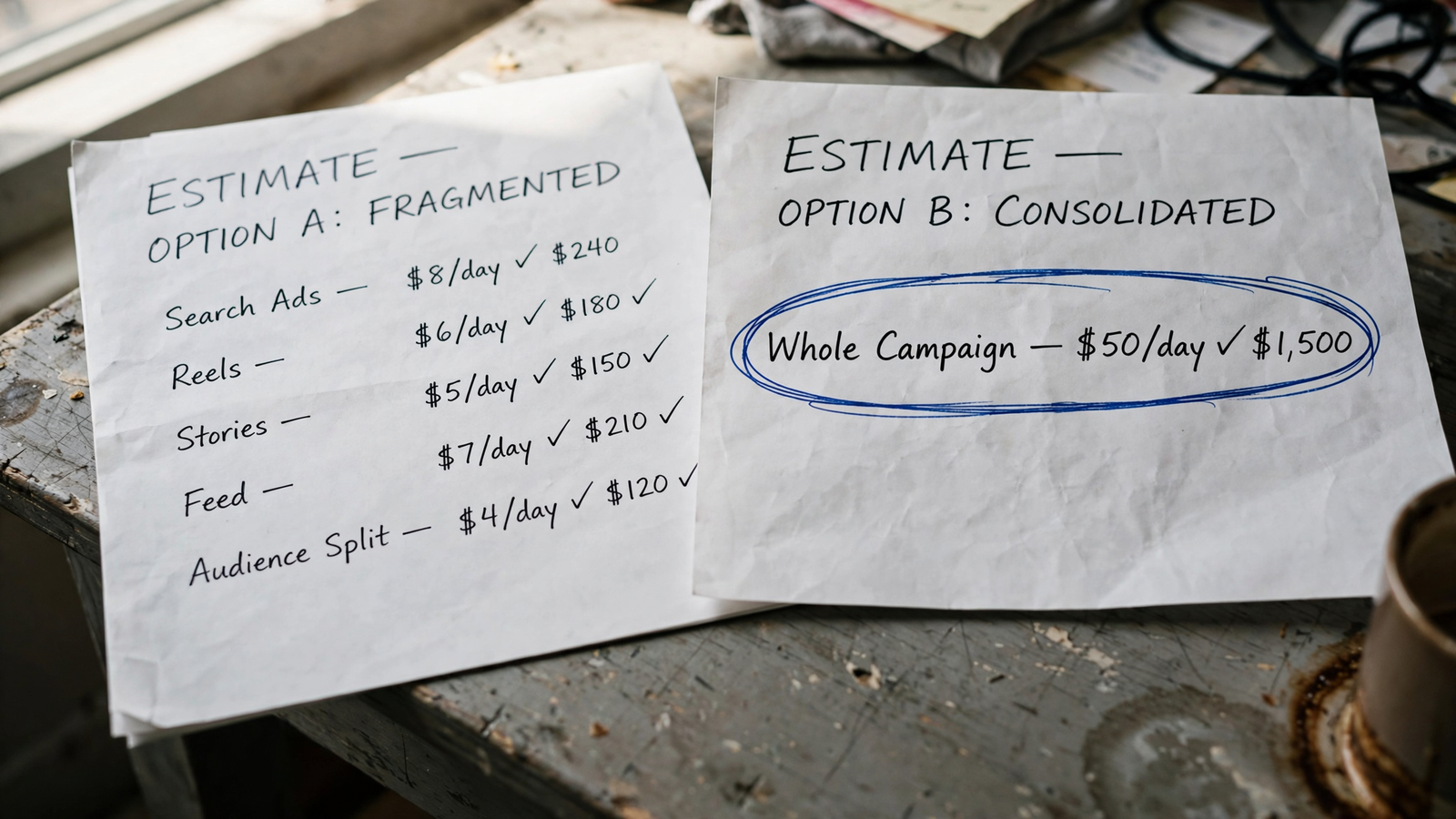
Before approving any $50-a-day plan, take its expected cost per result and do the division. Weekly budget ÷ cost per result gives you expected events. Divide those events among the proposed ad sets and compare each share with 50 in seven days. If the answer is five ad sets buying roughly two events apiece, you know what the busy report will conceal. I would rather run one ad set, give it distinct creative, and watch the result that pays the bills. On a modest budget, the best person to hire is often the one willing to run less.