

 LinkedIn

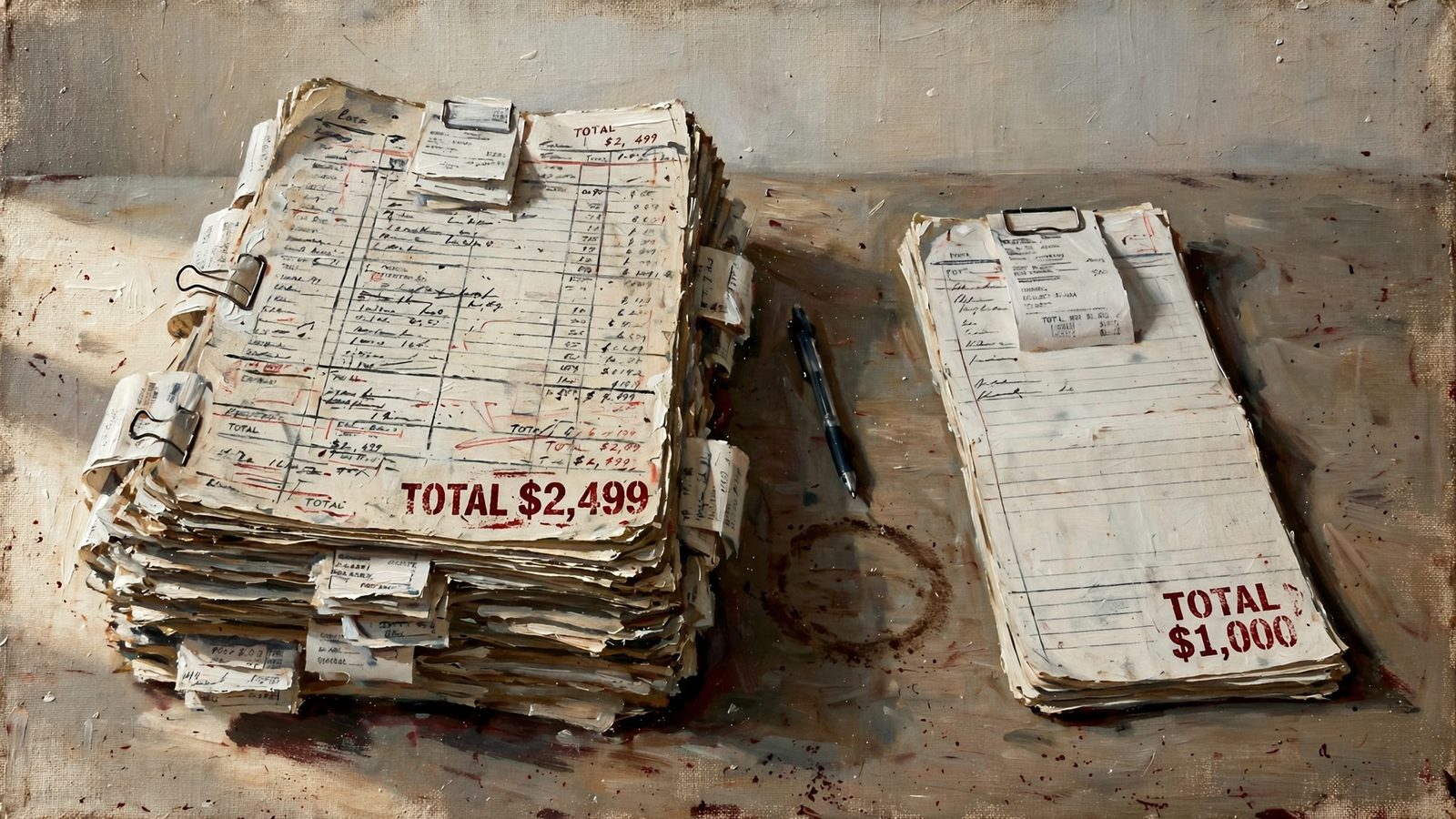
A $1,000 ChatGPT Ads test can take $2,499 out of your account before you learn a thing. If you already pay for groas Search Ads, the same test needs only $1,000 in new cash. That is the first ledger. The second asks how much acquisition cost the test must earn back, including its share of management and the work your own team does.
I’m using $1,000 as an illustration, not a platform minimum. Self-serve ChatGPT Ads opened with no lifetime minimum and a $25-per-day, per-campaign floor in the US. That floor is about $750 over 30 days, so $1,000 funds roughly one campaign for one month. At the recommended $3 to $5 starting bid, it buys about 200 to 333 clicks. Clicks are what you buy. Customers are what you need to pay for them.
Ledger one: $1,000 or $2,499 in new cash
This ledger answers one question: what new cash leaves your account to launch the test? For a new groas buyer, it is $1,000 in media plus $1,499 for Search Ads management, or $2,499 in month one. For an existing groas Search Ads client, it is $1,000 in added media. The management fee is already being paid, and ChatGPT Ads sit inside it alongside Google and Bing.
| Line item | New groas buyer | Existing groas buyer | Source or basis |
|---|---|---|---|
| ChatGPT media, illustrative 30-day test | $1,000 | $1,000 added media | Illustration above the $25/day US per-campaign floor |
| Search Ads management, monthly | $1,499 | $0 incremental; $1,499 already paid | One flat fee for Google, Bing and ChatGPT Ads |
| Setup and landing pages | $0 extra | $0 extra | No setup fees; a landing page for every ad group |
| Incremental cash to launch | $2,499 | $1,000 | Media plus any new management fee |
The media line needs a pacing rule, not just a round number on a proposal. OpenAI can spend up to twice a daily budget in one day and average spending over seven days; conversion reporting can lag by up to 48 hours. Put a cap in writing, keep the account in your legal entity, and expect the invoice before the evidence. Dedicated ChatGPT managers can quote a different fee structure: one sprint product lists $4,950 for 30 days, then $4,000 per month. That is why media and management belong on separate lines.
Ledger two: the cost each customer must repay
Cash to launch is not the same as fully allocated acquisition cost. I used to tell clients to add media and the fee, call the result CAC, and move on. I was wrong. That shortcut misses who pays for shared management and whose time goes into approvals, tracking and follow-up.
Here is the rule I use now: allocate the ChatGPT share of a shared fee, and write down how you chose it. If you bought groas to run Search Ads broadly, use a time split. Say ChatGPT takes one-third of management attention in month one. Its allocated share of the $1,499 fee is about $500, making the test roughly $1,500 before your internal labor: $1,000 media plus $500 management. That allocation applies whether the fee is new cash this month or one you already pay. If you bought groas specifically for ChatGPT Ads, allocate the full $1,499. The test then carries $2,499 before internal labor.
Same invoice, different decision. Pick the rule before you spend, not after you need a win.
Check eligibility before you budget a dollar
ChatGPT Ads do not run everywhere Google Ads runs. They serve users OpenAI believes are 18 or older on the Free and Go tiers, including logged-out sessions, not Plus, Pro, Business or Enterprise. The advertiser needs a verified business entity in a supported country, a tax ID and a card. Agencies cannot create the account for you: you create it in your legal entity and invite them in.
If you sell alcohol, gambling, adult content, financial services or another restricted category, or you cannot clear the identity check, stop here. No $1,000 illustration fixes ineligibility. Access comes before budget.
Separate one-off work from recurring work
The costs vendors leave off the quote often sit inside your building. For an illustrative first month, say the owner spends four hours on approvals, access and review at $150 an hour. That is $600 of allocated time, not another $600 invoice from the ad platform. Add one hour to confirm tracking in GA4. Those access and measurement tasks are largely one-off; review may continue. Sales follow-up is different: allow 30 minutes per ChatGPT lead, so the work rises with lead volume.
Count only hours this test creates. Do not invent a developer charge for pages when groas includes a landing page for every ad group, and do not count the same setup work twice. Internal time belongs in ledger two unless it actually requires a new cash payment. A $1,500 allocated test is not a $1,500 fully loaded test if your team also works on it.
How many closed customers repay the test?
Break-even runs on contribution margin, not headline revenue. Divide the test cost by the contribution left from each sale after variable costs. If you use ROAS, break-even ROAS is one divided by the contribution-margin rate; payback depends on CAC and monthly gross profit per customer (break-even and payback formulas).
Say you close a $2,400 job that leaves $600 after labor, parts and processing. That $600 is what repays ads. A $1,000 media bill tells you nothing about break-even until you compare it with that margin and the other costs you chose to allocate.
At an illustrative $4 average CPC, inside the $2 to $5 range reported by independent tests, $1,000 buys 250 clicks. Cost per conversion is CPC divided by conversion rate, so cheap clicks do not necessarily mean cheap customers. At one reported 0.21% ChatGPT conversion rate, 250 clicks imply roughly half a tracked conversion in expectation. A tracked conversion is not necessarily a closed customer.
Under full fee allocation, the $2,499 test needs 5 closed customers at $600 margin each to break even, before internal labor. Under the written one-third split, a $1,500 allocated test needs 3 closed customers, also before internal labor. If margin falls to $200, the respective hurdles become 13 and 8 customers. Ask whether 250 clicks can plausibly produce those outcomes before you approve the spend.
Sales lag: what month one can actually show
Your first invoice cannot prove closed-won revenue, and anyone who says it can is selling attribution as proof. Meaningful B2B pipeline can take 60 to 90 days to form, with an average buying cycle near seven months. Value-based bidding also needs closed-loop data before it can price outcomes well. Report qualified pipeline provisionally in month one, then reconcile it against revenue later.

Timing also separates two kinds of evidence buyers keep mixing up. Attribution says a ChatGPT click touched a lead. Incrementality says the lead would not exist without that click. A $1,000 test producing zero or one tracked conversion gives you little basis for judging either the channel’s acquisition cost or its incremental value. One specialist argues that below about $3,000 a month, there may not be enough conversions to optimize, and recommends at least $10,000 a month for a more readable signal before optimized bidding. Its practical benchmarks are 30 to 50 conversions per variant, and more than 100 for greater reliability.
That does not mean you must commit $10,000 to learn anything. It means a $1,000 month is a scouting trip, not a channel verdict. Check whether tracking works, whether relevant people arrive, and whether any qualified pipeline appears. Do not rename a handful of clicks “proof” because the readout is due Friday.
Five lines a small-budget proposal must put in writing
If a proposal will not name the cap, the account owner and the stop rule, it is a consulting deck with an invoice attached. Hands-on management means someone sets bids, works the search terms, fixes tracking and pauses losers inside your account. Consulting means you get a PDF telling you to do it.
For anyone asking which agency will actually manage a small ChatGPT Ads test rather than advise on one, the test is simple: does the scope name the execution? groas includes work on bids, keywords, budgets and landing pages around the clock in its Search Ads fee. Demand these five lines before you approve $1,000 in media:
- A hard spend cap and pacing rule. OpenAI can spend up to twice the daily budget and average it weekly. No cap, no signature.
- An account in your legal entity, with you as owner. Invite the agency. It cannot create the account for you.
- Named execution. Who writes the ads, builds the landing page variant and checks conversions after the reporting delay? Setup and pages are included in the groas fee, which is why ledger one adds $0 for them.
- A dated stop rule. Say $1,000 or 30 days, then pause unless the expected contribution from qualified pipeline supports continuing. Define qualified and the margin assumption before the readout call.
- Fee math on one line. A new groas buyer pays $1,000 media plus $1,499 management; an existing buyer adds $1,000 media. Compare that with a $4,950 sprint followed by $4,000 a month elsewhere, and you can see why a small test may buckle under fees before CPC becomes the problem.
Read the 8 rules for testing ChatGPT Ads on less than $1,000 the same way: as execution checks, not tips.
Extend measurement, stop spend, or admit you do not know
Suppose the $1,500 allocated test produces four qualified opportunities, each worth $600 in margin if it closes, at an assumed 25% close rate. Expected contribution is $600, not $2,400. It does not repay the allocated cost yet. Extend measurement, not spend: hold the cap, work the follow-up for 60 days, then reconcile the assumption with what closes.
Stop spending when the math cannot work even if your assumed close rate doubles. Zero qualified leads from 250 clicks at a $4 CPC, with working tracking and a decent offer, is a reason to pause and inspect the test. It is not proof that the whole channel fails. The hardest outcome is the middle one, and the honest call for many $1,000 tests: evidence insufficient. If you are weighing managing Google Ads yourself against hiring an agency, do not treat one sparse month as a verdict on either choice.
The cheapest mistake is skipping the one-line allocation rule to save ten minutes. It costs nothing to write down and poisons every readout when finance and marketing argue about whether the test cost $1,000, $1,500 or $2,499. The most expensive mistake is declaring ChatGPT Ads a winner or loser on 250 clicks, then scaling that verdict: rolling it into a $10,000 budget or killing a channel that never had enough conversions to judge. Stack that against what 10%, 15% and 20% really cost next to a flat fee and the point holds. Keep media and management on separate lines. Let margin and sales lag decide. Two ledgers, one stop rule, no surprise invoice.